Where to Buy Retatrutide Research Peptide: A 2026 Laboratory Procurement Guide
In the high-stakes environment of 2026 metabolic research, the difference between a scientific breakthrough and a failed study often rests on the integrity of a single lyophilized vial. Precision is the only acceptable standard. You likely recognize that the effort to buy retatrutide research peptide is often hindered by batch-to-batch inconsistency and opaque testing protocols that cloud the validity of your data. These logistical currents can pull a project off course before the first assay is even conducted.
This procurement guide equips your laboratory with the technical expertise to identify, verify, and secure high-purity retatrutide for your 2026 experimental models. We promise to move beyond marketing claims, providing the tools to interpret mass-spectrometry data and HPLC reports with clinical accuracy. By establishing a verification-first methodology, you can anchor your research in ≥99% pure compounds and domestic fulfillment speeds that respect your project timelines. We will examine the specific analytical markers of quality and the logistical frameworks required for reliable laboratory procurement.
Key Takeaways
- Understand the biochemical profile of retatrutide as a 39-amino acid triple agonist targeting GLP-1, GIP, and glucagon receptors.
- Identify the analytical markers required to buy retatrutide research peptide with confidence, prioritizing batches with ≥99% HPLC purity and mass-spec verification.
- Mitigate logistical risks by sourcing from domestic suppliers to eliminate the delays and uncertainties associated with international customs.
- Master laboratory handling techniques, including precise reconstitution protocols and storage requirements to preserve peptide stability.
- Utilize batch-specific COAs and transparent documentation to ensure total data integrity for 2026 experimental models.
The Chemical Profile of Retatrutide (LY3437943) in Metabolic Research
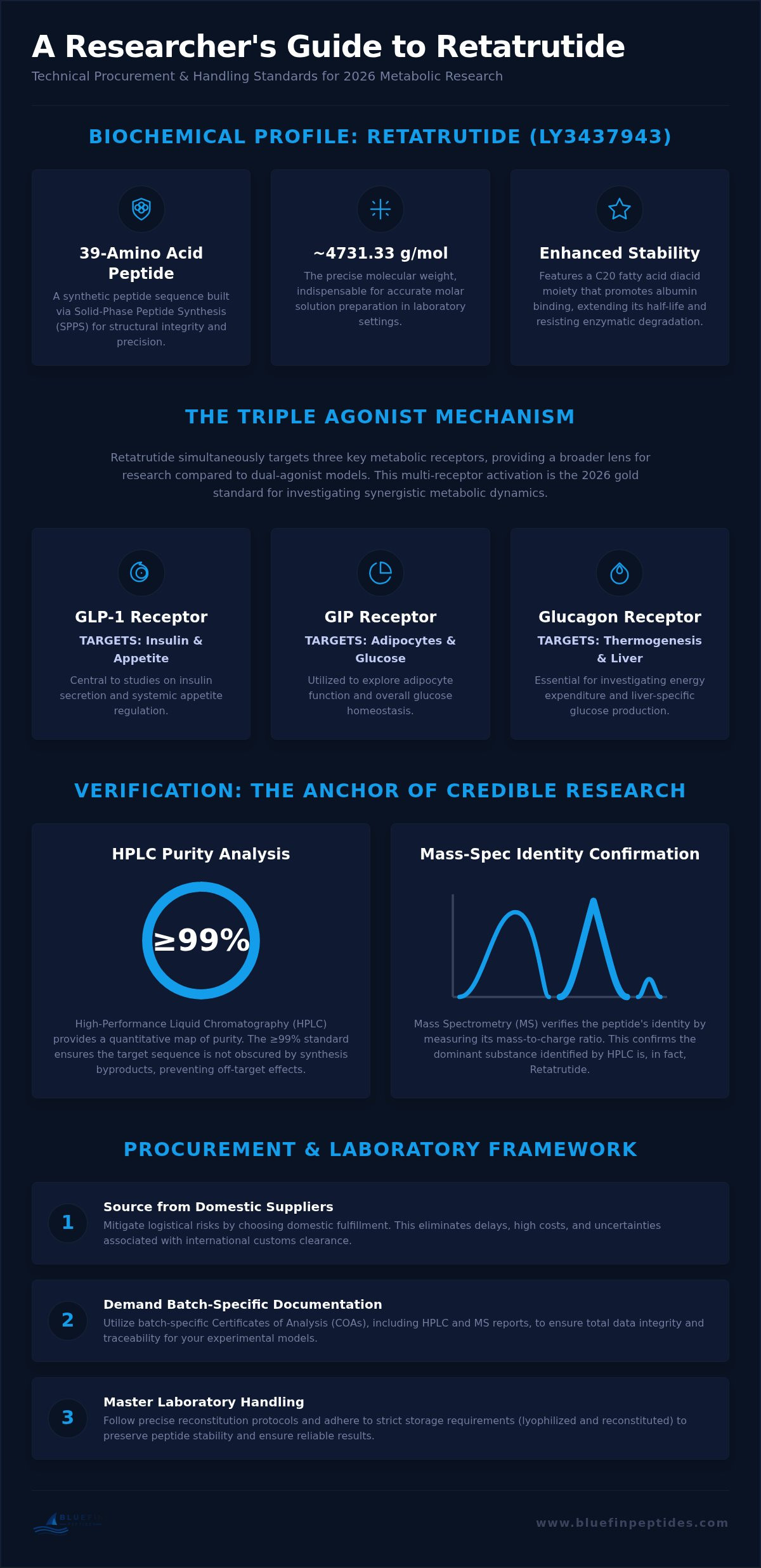
Retatrutide is a synthetic 39-amino acid peptide. It functions as a potent unimolecular agonist. Its structure is derived through solid-phase peptide synthesis (SPPS), a methodology that anchors the peptide sequence with absolute precision. This synthesis process is vital. It guarantees that the structural integrity of the 39-amino acid chain remains uncompromised during laboratory handling. Researchers who intend to buy retatrutide research peptide must evaluate the chemical fidelity of their source to ensure that the synthetic sequence matches the intended experimental design. The purity of the sequence directly dictates the reliability of downstream endocrine signaling data.
Triple Agonist Mechanism and Signaling
The primary innovation of retatrutide lies in its triple agonism. It targets the glucagon-like peptide-1 (GLP-1), glucose-dependent insulinotropic polypeptide (GIP), and glucagon (GCGR) receptors simultaneously. This differs significantly from dual-agonist models like tirzepatide, which lack the glucagon receptor component. The inclusion of GCGR allows researchers to investigate more complex metabolic currents, specifically those involving hepatic lipid metabolism and increased energy expenditure. The triple-agonist class serves as the 2026 gold standard for investigating the synergistic dynamics of multi-receptor activation in metabolic research models. This mechanism provides a broader lens through which to examine receptor binding kinetics and the subsequent intracellular signaling cascades.
- GLP-1 Receptors: Central to studies on insulin secretion and appetite regulation.
- GIP Receptors: Utilized to explore adipocyte function and glucose homeostasis.
- Glucagon Receptors: Essential for investigating thermogenesis and liver-specific glucose production.
Structural Stability and Molecular Weight
Retatrutide possesses a molecular weight of approximately 4731.33 g/mol. This figure is indispensable for laboratory calculations, allowing for the precise preparation of molar solutions. The molecule features a C20 fatty acid diacid moiety, which is conjugated to the peptide backbone. This specific chemical modification enhances the peptide's stability by promoting reversible binding to albumin. Such binding creates a shield against proteolytic enzymes, effectively extending the half-life of the compound within cell assays. When you buy retatrutide research peptide, understanding this moiety is crucial for predicting the compound's behavior in long-term experimental models. The diacid moiety ensures that the peptide maintains its functional state, resisting the metabolic degradation that often plagues less stable research compounds. This structural resilience is the anchor for consistent, high-fidelity research outcomes.
Technical Standards for Verifying Retatrutide Purity and Identity
Verification is the anchor of credible metabolic research. When you buy retatrutide research peptide, the analytical documentation must match the physical vial with absolute fidelity. In 2026, the baseline for sensitive assays has shifted. Sub-99% purity levels introduce unacceptable variables into triple-agonist studies. High-Performance Liquid Chromatography (HPLC) serves as the primary diagnostic tool to map these impurities. It provides a quantitative representation of the peptide's chemical landscape, ensuring that the target sequence isn't obscured by synthesis byproducts.
Auditing HPLC Purity Reports
An HPLC report is a map of molecular composition. The primary peak represents the target 39-amino acid sequence. Minor peaks represent synthesis byproducts like truncated sequences or deprotected variants. A 99% pure designation means that these secondary peaks account for less than 1% of the total area under the curve. Understanding the integration of these peaks is vital for adhering to research peptide quality standards. Without batch-specific integration data, a purity claim is merely an unverified assertion. Precise integration ensures that your laboratory is working with a compound that won't trigger off-target effects during receptor binding studies.
Mass-Spec Confirmation Protocols
Purity alone doesn't confirm identity. While HPLC measures the concentration of the dominant substance, Mass Spectrometry (MS) verifies that the substance is actually retatrutide. By measuring the mass-to-charge ratio, MS confirms that the synthesized peptide aligns with the theoretical molecular weight of 4731.33 g/mol. Identity verification is as critical as purity percentage because even a 99% pure compound is useless if it's the wrong sequence. Every vial in your laboratory must be accompanied by lot-matched MS documentation to ensure data integrity. This documentation acts as the final verification of structural accuracy.
Navigating these technical requirements ensures your study's results aren't compromised by chemical drift. For researchers who require HPLC-verified retatrutide, auditing the COA is the final step in secure procurement. This disciplined approach to data verification protects the investment of your research timeline.
Vetting Research Peptide Suppliers in 2026: A Procurement Framework
Procurement in 2026 requires a shift from vendor selection to partner vetting. It's a calculation of risk and reliability. To buy retatrutide research peptide without compromising your data, you must evaluate the supplier's logistical infrastructure and ethical boundaries. A fragmented supply chain is a liability. Precision in synthesis means nothing if the delivery vessel founders in international customs. Trust is replaced by verification. Security is found in data, not claims.
Domestic Logistics and Shipping Integrity
US-based inventory is the essential anchor for modern research timelines. International shipping introduces a level of volatility that laboratory schedules can't absorb. Customs seizures and regulatory delays disrupt the momentum of longitudinal studies. Beyond simple delays, extended transit times expose lyophilized peptides to uncontrolled thermal environments. While lyophilization provides structural stability, extreme temperature spikes during multi-week transits can initiate sub-visible degradation. Maintaining a domestic supply chain ensures that the peptide reaches the laboratory within 48 to 72 hours, preserving the structural fidelity established during synthesis. This logistical speed is as critical for retatrutide as it is for other metabolic models, such as tirzepatide research peptide, where consistent purity is the baseline for all comparative assays.
Compliance and Ethical Documentation
Professionalism is a primary indicator of quality. In the research peptide sector, certain red flags are immediate disqualifiers. Suppliers that provide dosage instructions, offer medical consultations, or market products for human consumption operate outside the bounds of laboratory science. These practices signal a lack of adherence to strict "Research Use Only" protocols. A disciplined supplier prioritizes technical transparency over marketing fluff. Verification requires access to specific documentation that proves the batch's chemical nature remains uncompromised.
- Safety Data Sheets (SDS): Essential for laboratory safety protocols and regulatory compliance.
- Technical Specifications: Detailed chemical parameters that go beyond simple purity percentages.
- Batch-Level COAs: Direct evidence of the specific lot's analytical testing and mass-spec confirmation.
Academic-style professionalism in communication reflects a supplier's commitment to scientific standards. When you buy retatrutide research peptide, the presence of a transparent testing pipeline is the only way to ensure the compound's integrity. High-performance research demands a supplier that functions as a disciplined logistics specialist, focusing on the "how" of their processes to guarantee the "what" of your results.
Laboratory Handling: Reconstitution and Long-Term Stability
Laboratory handling is the final determinant of experimental success. When you buy retatrutide research peptide, the compound arrives as a lyophilized powder, a state engineered for maximum stability during transit and storage. However, this stability isn't absolute. Precision in storage and reconstitution is required to ensure the 39-amino acid sequence remains biologically active. Improper handling leads to peptide degradation, introducing silent variables that can invalidate months of metabolic data. These protocols serve as the anchor for experimental reproducibility.
Optimal Storage Temperatures and Conditions
Lyophilized peptides are highly sensitive to thermal fluctuations and environmental contaminants. If you intend to buy retatrutide research peptide for multi-phase studies, storage at -20°C is the laboratory standard for long-term preservation. Short-term storage for immediate use may be conducted at 2-8°C, provided the vials remain vacuum-sealed. Protection from UV light is mandatory, as radiation can catalyze the cleavage of peptide bonds. Lyophilized retatrutide under vacuum seal typically maintains its structural integrity for 24 months when stored at -20°C. Moisture ingress is the primary catalyst for hydrolysis; therefore, vials should reach room temperature before opening to prevent condensation from forming on the powder.
Reconstitution Best Practices for Analytical Accuracy
Reconstitution is a delicate phase where the peptide transitions from a stable solid to a more volatile liquid state. Bacteriostatic water or sterile saline are the preferred diluents for most metabolic assays. Calculating the concentration in mg/mL is the first step toward ensuring precise experimental dosing. When adding the diluent, the liquid should be aimed at the side of the vial rather than directly onto the lyophilized cake. This technique prevents the formation of air bubbles and ensures a more uniform solution.
- Gentle Swirling: Rotate the vial slowly until the powder is fully dissolved.
- Avoid Agitation: Never shake the vial; vigorous movement causes peptide shearing and denaturation.
- Aliquoting: To prevent the degradation caused by repeated freeze-thaw cycles, divide the reconstituted solution into single-use aliquots.
The stability of a reconstituted solution is significantly lower than its lyophilized counterpart. Once in solution, retatrutide should be utilized within 7 to 10 days if stored at 2-8°C. Adhering to these retatrutide research peptide standards ensures that your assays reflect the true potency of the compound. For laboratories ready to secure their supply, you can source verified retatrutide vials that meet these strict handling requirements.
Procuring Retatrutide from Bluefin Peptides: Precision and Reliability
Bluefin Peptides functions as a high-performance laboratory partner. We recognize that 2026 metabolic research demands more than a simple transaction. It requires a commitment to analytical transparency. When you decide to buy retatrutide research peptide, you aren't just purchasing a compound; you're securing the integrity of your experimental data. Our methodology is built on a "show, don't tell" philosophy. We don't ask for blind trust. We provide the tools for verification. Every vial is an anchor for your research project, backed by rigorous testing and disciplined logistics.
The Bluefin Quality Assurance Pipeline
Quality isn't a static claim. It's a continuous process. We utilize High-Performance Liquid Chromatography (HPLC) and Mass Spectrometry (MS) for every single batch in our inventory. This dual-verification protocol ensures that the peptide's purity meets or exceeds the ≥99% gold standard. We provide batch-specific Certificates of Analysis (COAs) that are accessible for laboratory peer review. This level of transparency is essential for maintaining the high-fidelity standards required in modern biochemistry. While our focus on metabolic research is primary, this same analytical rigor extends across our entire catalog, including complex formulations like the GHK-Cu BPC-157 TB-500 blend. By providing detailed analytical specifications, we allow researchers to audit the chemical nature of our offerings before the first assay begins.
Expedited Fulfillment for National Research
Logistical speed is a core service advantage. In the competitive landscape of 2026 research, downtime is a critical failure point. Bluefin Peptides maintains a fully stocked US-based inventory to eliminate the volatility of international supply chains. We don't rely on overseas transits that expose sensitive compounds to environmental stressors. Our fulfillment process is a quick-strike operation. We ensure that your laboratory receives its materials within a precise 48 to 72-hour window. Every shipment is handled with clinical-grade packaging designed to maintain chemical stability and prevent UV exposure. This domestic anchor allows you to maintain research momentum without the threat of customs interference or shipping-related degradation.
Precision in procurement leads to precision in results. Secure a reliable source of high-purity compounds to protect your research investment. Procure HPLC-Verified Retatrutide for Your Laboratory and ground your 2026 experimental models in verified data.
Anchoring Your 2026 Metabolic Research
Securing the validity of 2026 metabolic data requires a departure from traditional procurement. It demands a verification-first methodology. You now possess the framework to audit HPLC reports and navigate the complexities of triple-agonist stability. By prioritizing domestic logistics and batch-level transparency, you eliminate the variables that often sink promising research before the first assay begins. These standards are the only way to ensure that your findings remain reproducible and scientifically sound throughout the project's lifecycle.
When you buy retatrutide research peptide, the analytical documentation must serve as the primary foundation for your laboratory's work. Bluefin Peptides provides the security of ≥99% HPLC-verified purity and mass-spec confirmation on every batch. Our US-based inventory acts as a logistical anchor, ensuring fast US shipping and unwavering chemical stability for your experimental models. Access your batch-specific COAs and advance your project with absolute confidence in your materials. We're committed to supporting your scientific breakthroughs with disciplined precision and academic-level transparency. We look forward to seeing your research reach its full potential.
Procure ≥99% Purity Retatrutide for Laboratory Research
Frequently Asked Questions
Is retatrutide research peptide legal to buy in the USA in 2026?
Retatrutide research peptide is legal for procurement in the United States for laboratory use. It's classified as a research chemical, meaning it's intended strictly for in vitro or animal studies within controlled environments. This status allows you to buy retatrutide research peptide for academic inquiry without violating controlled substance regulations. Compliance requires that the compound is never diverted for human or veterinary applications. This legal framework anchors the compound’s availability for professional use.
What is the molecular weight and chemical formula of retatrutide?
The molecular weight of retatrutide is approximately 4731.33 g/mol with a chemical formula of C221H342N52O68. These specifications are indispensable for calculating precise molar concentrations in laboratory assays. Every researcher should verify these data points against the mass-spectrometry results provided in the batch-specific COA. Structural accuracy is the primary anchor for consistent receptor binding studies and endocrine signaling research. This data ensures the vessel of your research remains on course.
How should lyophilized retatrutide be stored for long-term research?
Long-term storage of lyophilized retatrutide requires a temperature of -20°C or lower. Vials must remain vacuum-sealed and protected from UV light to prevent peptide bond cleavage. For short-term use over the course of a few weeks, refrigeration at 2-8°C is acceptable. Always allow the vial to reach room temperature before opening to prevent moisture condensation on the lyophilized cake. This disciplined approach preserves the physical state and chemical nature of the offering.
Can retatrutide be used for human or veterinary applications?
No, retatrutide is strictly for laboratory and research purposes only. It's not for human or veterinary use. Any diversion from these protocols violates the intended application of the compound and can lead to unreliable data or legal complications. The compound is intended for use by qualified professionals in controlled settings to examine metabolic pathways and receptor dynamics. We maintain a stoic adherence to these strict research-only boundaries to ensure laboratory safety.
What is the difference between 98% and 99% purity in research peptides?
The 1% difference between 98% and 99% purity represents a significant volume of unknown byproducts. These impurities often consist of truncated sequences or deprotected variants that can interfere with sensitive assays. When you buy retatrutide research peptide, a 99% purity level ensures that experimental noise is minimized. This higher standard is the 2026 baseline for academic-grade metabolic modeling. It provides the deep-sea precision required for identifying subtle signaling changes.
Does retatrutide require a cold chain during shipping?
Lyophilized retatrutide is chemically stable at ambient temperatures for short durations, typically during the 48 to 72-hour transit window from a US-based inventory. While a strictly refrigerated cold chain isn't mandatory for domestic shipping, extreme heat must be avoided. Once the compound arrives at the laboratory, it should be immediately transferred to a freezer for long-term preservation. This logistical speed ensures the compound’s structural integrity isn't compromised during fulfillment or transit.
How do I interpret the HPLC report for my retatrutide batch?
Interpreting an HPLC report involves auditing the primary peak and the integration of minor peaks. The main peak represents the target 39-amino acid sequence. Secondary peaks indicate the presence of synthesis byproducts. A report confirms ≥99% purity if the area under the primary peak accounts for 99% of the total integrated area. This data provides a quantitative map of the peptide’s chemical nature. It allows for efficient navigation of batch-level details and verification.
What reconstitution solution is best for retatrutide research?
Bacteriostatic water or sterile saline are the standard reconstitution solutions for retatrutide research. The choice depends on the specific requirements of your assay and the sensitivity of the experimental model. Bacteriostatic water contains 0.9% benzyl alcohol, which inhibits bacterial growth, making it suitable for multi-use vials. Sterile saline is often preferred for studies where the presence of alcohol might interfere with cell signaling pathways. Precise reconstitution is the final step in secure laboratory procurement.
For laboratory research use only. Not for human or veterinary use. This content is educational and does not constitute medical, dosing, or usage guidance.
Browse the BLUEFIN catalog