Analytical Quality Standards for Research Peptides: A Laboratory Guide
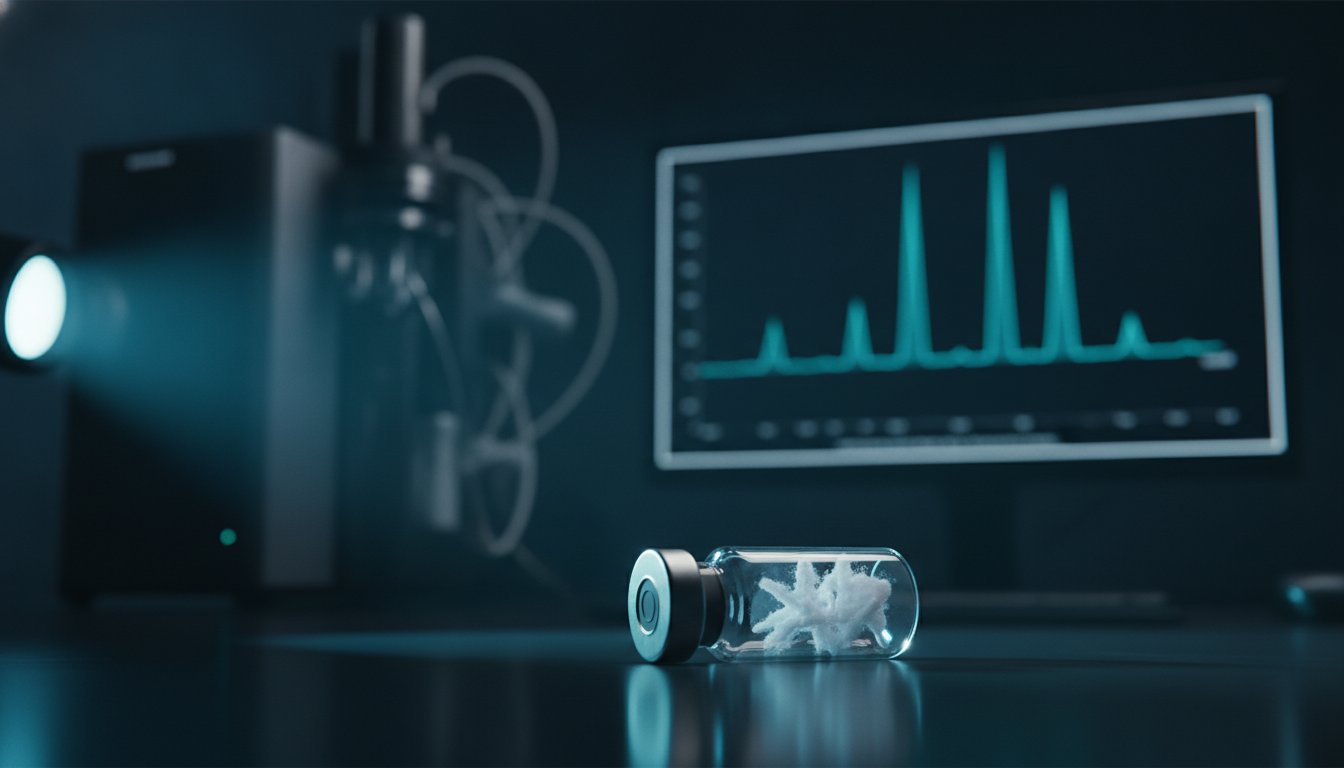
A single impurity exceeding 0.1% is no longer a marginal error. Under the June 2026 EMA guidelines, it's a definitive regulatory failure. Precision. Verification. Transparency. For the modern researcher, the depth of analytical verification determines the stability of the entire project. You understand that inconsistent batch quality isn't just a nuance; it's a source of skewed data that compromises months of laboratory effort. Maintaining high research peptide quality standards requires more than trust. It demands a disciplined adherence to the latest chemistry, manufacturing, and controls frameworks.
This guide serves as a technical manual to master the benchmarks of purity and identity verification required for 2026 protocols. You'll learn to interpret complex chromatograms and demand the transparency of batch-specific HPLC and Mass-Spec documentation. We provide a precise overview of the new reporting thresholds and the logistical pathways for rapid procurement of verified compounds. This is the baseline for reliable research results in a shifting regulatory landscape. The current analytical sea has moved toward absolute data; we provide the coordinates to stay on course.
Key Takeaways
- Define the analytical benchmarks required for 2026 laboratory protocols and the critical distinction between industrial and research-grade purity.
- Identify the core components of research peptide quality standards, including the non-negotiable ≥99% HPLC purity threshold.
- Master the interpretation of Mass Spectrometry data to confirm molecular identity and amino acid sequence integrity beyond simple molecular weight.
- Distinguish between "typical" documentation and batch-specific Certificates of Analysis (COAs) to ensure data-driven procurement for every experiment.
- Streamline laboratory workflows by utilizing US-stocked inventory that balances deep-sea precision with rapid logistical fulfillment.
The Framework of Research Peptide Quality Standards
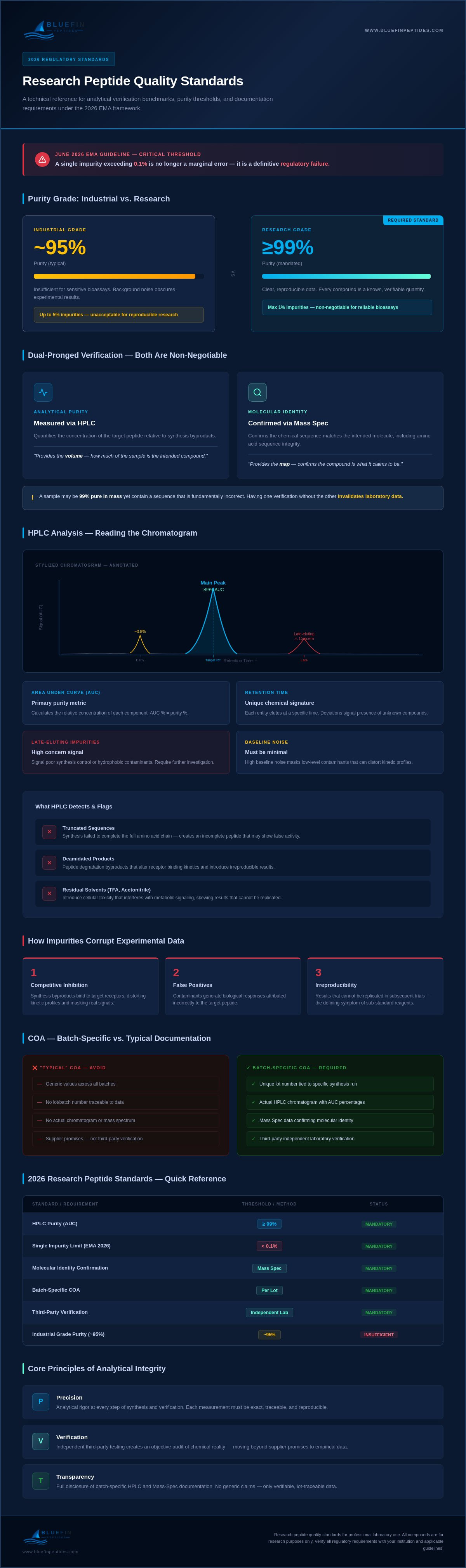
Precision. Verification. Transparency. The 2026 environment marks a definitive transition from voluntary compliance to standardized analytical verification. High-performance laboratories no longer accept generic quality claims. They operate within a framework of rigorous benchmarks where a single impurity exceeding 0.1% constitutes a failure. These research peptide quality standards ensure that every compound is a known quantity, providing the stable foundation required for rigorous inquiry. Industrial grade purity, often hovering around 95%, is insufficient for sensitive bioassays. Research grade mandates a higher threshold, typically ≥99%. This distinction is not arbitrary. It is the difference between clear data and background noise.
Analytical integrity is the anchor of research reproducibility. Without it, the data currents become unpredictable. Third-party verification creates a chain of trust that moves beyond supplier promises. It provides an objective audit of the chemical reality. In an era of increased regulatory scrutiny, including the June 2026 EMA guidelines, the ability to provide verifiable data is a non-negotiable requirement for professional procurement.
Defining Analytical Purity vs. Molecular Identity
Purity measures the concentration of the target peptide relative to synthesis byproducts. Identity confirms that the chemical sequence matches the intended molecule. One provides the volume; the other provides the map. During solid-phase peptide synthesis, errors can occur, such as amino acid deletions or truncated chains. A sample might be 99% pure in terms of mass yet contain a sequence that is fundamentally incorrect. Having one without the other invalidates laboratory data. Verification must be dual-pronged to ensure the compound performs as expected in vivo or in vitro.
The Impact of Impurities on Experimental Models
Impurities are not inert. Synthesis byproducts can act as competitive inhibitors, binding to target receptors and distorting kinetic profiles. These contaminants create false positives or mask legitimate biological responses. Residual solvents, such as TFA or acetonitrile, introduce cellular toxicity that interferes with metabolic signaling. This toxicity often leads to skewed results that cannot be replicated in subsequent trials. The reproducibility crisis in modern science is often the direct result of researchers building complex models upon the shifting sands of sub-standard reagents. By adhering to strict research peptide quality standards, laboratories eliminate these variables, ensuring that observed effects are attributed solely to the target peptide.
HPLC Analysis: The Gold Standard for Purity Verification
High-Performance Liquid Chromatography (HPLC) is the definitive methodology for quantifying the purity of a synthetic peptide. It functions by separating the target molecule from related impurities based on chemical affinity. In the context of research peptide quality standards, HPLC provides the quantitative evidence required to confirm that a sample meets the specified purity grade. This process identifies truncated sequences where the synthesis failed to complete the chain, as well as deamidated products where the peptide has begun to degrade. These contaminants, if left unquantified, introduce significant noise into experimental datasets.
The relationship between retention time and peak area integration is fundamental. Each chemical entity elutes from the column at a specific time, creating a unique signature. By calculating the area under these peaks, analysts determine the relative concentration of each component within the batch. To ensure your laboratory protocols are based on the most rigorous data, it's essential to utilize peptide reference standards that have been validated through these precise chromatographic methods. This level of verification is the only way to move beyond the uncertainty of industrial-grade reagents.
Interpreting the HPLC Chromatogram
A chromatogram is a visual map of chemical purity. The main peak represents the target peptide, while smaller peaks indicate impurities. Baseline noise must be minimal to ensure that low-level contaminants aren't masked. The Area Under the Curve (AUC) is the primary metric; it tells the researcher exactly what percentage of the total sample is the intended compound. Late-eluting impurities are particularly concerning. They often signal poor synthesis control or the presence of hydrophobic contaminants that can interfere with cellular uptake in experimental models.
Why 99% Purity is Non-Negotiable
In sensitive assays, the statistical significance of a 1% impurity cannot be ignored. While a 95% "standard" purity might suffice for basic screening, it introduces five times more unknown variables than a 99% pure compound. These contaminants can trigger off-target effects or induce inflammatory responses in vivo. Bluefin Peptides maintains a ≥99% benchmark because high-purity lyophilized powders offer superior long-term stability. Lower purity batches often contain residual salts or solvents that accelerate degradation during storage. For researchers who prioritize data integrity, selecting HPLC-verified research peptides is the first step in eliminating avoidable experimental variance.
Mass Spectrometry: Confirming Molecular Identity
HPLC determines the quantity of the target molecule, but Mass Spectrometry (MS) validates its chemical architecture. It serves as the analytical fingerprint. Without MS confirmation, a researcher is effectively adrift, relying on mass-balance assumptions rather than structural proof. High-volume synthesis environments carry the inherent risk of batch cross-contamination or sequence errors that HPLC may fail to resolve if the impurity shares a similar retention time. By measuring the precise mass of the ionized peptide, MS ensures that the compound in the vial is exactly what the protocol requires. This is a fundamental pillar of modern research peptide quality standards. A disciplined laboratory partner treats MS as a non-negotiable prerequisite for every batch, providing the definitive proof of molecular identity required for high-stakes research where even a single incorrect amino acid can fundamentally alter receptor binding affinity.
Confirming Molecular Weight and Sequence
Every peptide possesses a calculated theoretical mass derived from its specific amino acid sequence. The MS report must present an observed mass that aligns with this value within a strict tolerance. Discrepancies often arise from salt adducts, such as sodium (+23 Da) or potassium (+39 Da) ions, which attach to the peptide during the ionization process. Water loss peaks are also frequent features in the spectra of lyophilized powders. To clarify the data, the mass-to-charge (m/z) ratio represents the mass of an ionized molecule divided by its charge state, a value that allows the spectrometer to pinpoint the exact molecular weight of the substance with high resolution. Accurate interpretation of these reports prevents the misidentification of a batch based on common ionization artifacts.
Detecting Synthesis Byproducts and Contaminants
Peptide synthesis is a methodical assembly of building blocks. Deletion sequences occur when an amino acid fails to couple during a specific cycle, resulting in a peptide chain that is shorter than intended. While these might elute near the main peak in HPLC, MS identifies the missing mass immediately. In complex research blends, the risk of "scrambled" sequences—where amino acids are coupled in the wrong order—can invalidate an entire study. This verification is vital for confirming the identity of complex GLP-1 analogues, such as the Retatrutide Research Peptide. Mass Spec ensures that the specific triple-agonist structure is chemically intact and free from the structural anomalies that compromise experimental integrity. By isolating these structural failures, researchers maintain a clean trajectory from hypothesis to conclusion.

Navigating Batch-Specific Certificates of Analysis (COAs)
Verification is the only currency of trust in laboratory procurement. A Certificate of Analysis (COA) is not a marketing brochure; it's a forensic record of a specific chemical batch. Many vendors provide "typical" reports, which represent a best-case scenario from a historical production run rather than the actual material in the vial. For 2026 protocols, this is an unacceptable liability. True research peptide quality standards demand batch-specific documentation that links the physical vial to its analytical profile through a unique lot number. This connection ensures that the data generated in your lab is anchored to the specific chemical reality of the reagent.
A high-fidelity COA must detail four core metrics: HPLC purity, Mass Spectrometry confirmation, physical appearance, and solubility. Physical appearance ensures the lyophilized cake is uniform and free from moisture, while solubility data confirms the compound's behavior in sterile diluents. The "Date of Analysis" is equally critical. In a market where degradation is a constant risk, a report generated more than 12 months ago is functionally obsolete. It fails to account for the stability of the peptide over time. For researchers operating under the June 2026 EMA guidelines, the date of testing is a non-negotiable data point for compliance.
Documentation Red Flags in the Peptide Market
Generic reports are the primary indicator of a compromised supply chain. If a COA lacks a specific batch or lot number, it cannot be traced to a manufacturing event. Outdated data is another significant risk; researchers should reject any documentation that precedes the current calendar year. Visual inconsistencies, such as low-resolution chromatograms or mismatched fonts in the peak table, often signal "photoshopped" results. These forgeries are designed to mask synthesis failures or the presence of unlisted impurities that exceed the 0.1% reporting threshold. A blurred baseline on an HPLC graph is often a deliberate attempt to hide related substances that compromise research peptide quality standards.
The Anatomy of a High-Fidelity Research Report
Transparency is a security feature. A professional report clearly identifies the testing laboratory and the specific equipment used, such as Agilent or Waters HPLC systems. Raw data availability allows for an independent audit of the peak integration, ensuring that the Area Under the Curve (AUC) hasn't been artificially inflated by ignoring baseline noise. Every batch must also confirm the lyophilized state, as proper vacuum-sealing is the only anchor for long-term chemical stability. To ensure your data remains untainted by reagent variance, you should only procure from sources that provide batch-specific COAs for every research peptide in their inventory. This level of detail provides the navigational baseline required for high-performance laboratory environments.
Bluefin Peptides: The Intersection of Precision and Logistics
Analytical excellence is a static metric until it meets the demands of a functioning laboratory. High-performance research requires a merger of chemical verification and logistical reliability. While previous sections established the technical necessity of research peptide quality standards, the practical application of these standards depends on the integrity of the supply chain. Bluefin Peptides operates at this intersection. We apply deep-sea precision to the procurement and fulfillment of research chemicals, ensuring that the theoretical purity calculated in the lab remains the physical reality upon delivery. For the professional researcher, a ≥99% HPLC-verified purity is not a goal; it is the baseline coordinate for every compound in our catalog.
The transition from synthesis to the laboratory bench involves variables that often compromise sensitive molecules. International transit introduces thermal fluctuations and handling delays that threaten the stability of even the most robust lyophilized powders. By maintaining US-stocked inventory, we eliminate the uncertainty of trans-oceanic shipping. This disciplined approach to logistics ensures that cold-chain integrity is prioritized and that the "Date of Analysis" on your COA remains a relevant indicator of current chemical state. We serve as a high-performance laboratory partner, focusing on the "how" of our processes to secure the "what" of your experimental results.
The Bluefin Testing Protocol
Our commitment to quality is rooted in a "Show, Don’t Tell" philosophy. Every batch of research peptides, including complex sequences like Retatrutide and Tirzepatide, undergoes a dual-pronged verification process. Rigorous HPLC analysis quantifies purity, while Mass Spectrometry confirms structural identity. We do not ask for blind trust. Instead, we provide transparent access to batch-specific documentation for qualified researchers. This protocol ensures that every vial is anchored to a verifiable dataset. By providing the actual chromatograms and mass spectra, we allow laboratories to perform their own due diligence before a single microliter is pipetted. This adherence to research peptide quality standards is what separates a disciplined logistics specialist from a standard retail vendor.
Urgent Precision in Fulfillment
Speed is a critical component of laboratory efficiency, yet it must never come at the expense of accuracy. Bluefin Peptides utilizes domestic stocking in the United States to facilitate rapid fulfillment. This direct-to-lab model minimizes the time a peptide spends in transit, significantly reducing the risk of degradation. Maintaining the stability of lyophilized powders requires a controlled environment; our US-based logistics infrastructure is designed to provide this security. We understand that research timelines are often high-stakes and time-sensitive. By providing rapid procurement of verified compounds, we allow your team to maintain momentum without sacrificing the analytical integrity of your reagents. This is urgent precision in action.
Securing the Analytical Baseline for Future Discovery
The evolution of laboratory protocols in 2026 mandates a shift from general quality claims to granular, verifiable data. Reliability is no longer an optional feature; it's the anchor of every valid experimental model. Mastering research peptide quality standards requires a disciplined focus on the dual coordinates of HPLC purity and Mass-Spec identity. Without this structural proof, a laboratory operates in a state of analytical uncertainty that compromises the integrity of its findings. Every batch must be a known quantity.
Bluefin Peptides functions as a high-performance partner for researchers who demand absolute transparency. Precision. Verification. Momentum. We provide the tools to eliminate reagent variance through ≥99% HPLC verified purity and batch-specific confirmation for every lot. Our US-stocked inventory ensures that rapid fulfillment never comes at the cost of chemical stability or cold-chain integrity. Procure HPLC-Verified Research Peptides from Bluefin Peptides to secure the foundations of your next project. The path to reproducible data is defined by the quality of your reagents. We provide the map to stay on course.
Frequently Asked Questions
What is the minimum purity standard for research peptides?
The accepted benchmark for rigorous laboratory inquiry is ≥99% HPLC-verified purity. While industrial grades often settle for 95%, high-performance research requires the elimination of unknown variables that can skew kinetic data. This threshold ensures that observed biological responses are attributed solely to the target molecule. Adhering to these research peptide quality standards prevents the noise created by synthesis byproducts or residual solvents from compromising your results.
How do I interpret an HPLC chromatogram for a research peptide?
Analyze the Area Under the Curve (AUC) of the primary peak relative to the baseline noise and secondary spikes. The main peak represents the target compound, while any additional spikes indicate impurities or truncated sequences. A clean baseline and a sharp, symmetrical peak with a calculated AUC of ≥99% confirm chemical purity. You must ensure the integration includes all detectable peaks to get an accurate representation of the batch quality.
Why is Mass Spectrometry necessary if I already have an HPLC report?
Mass Spectrometry validates the structural identity of the molecule, whereas HPLC only measures quantity and purity. It's possible for an impurity to elute at the same time as the target peptide, which creates a false purity reading on a chromatogram. Mass Spectrometry acts as a chemical fingerprint. It confirms the precise molecular weight and amino acid sequence integrity, providing the definitive proof required to prevent batch misidentification.
What is a batch-specific Certificate of Analysis (COA)?
A batch-specific COA is an analytical record generated for a single, unique production lot rather than a "typical" representative sample. It contains the specific HPLC and Mass-Spec data for the physical material in your possession. This documentation provides the forensic evidence required for data-driven verification. It ensures that every reagent used in your laboratory is a known quantity, anchored to a verifiable manufacturing event and testing date.
How should lyophilized research peptides be stored to maintain quality?
Store lyophilized powders in a temperature-controlled environment at -20°C for long-term stability or 4°C for immediate short-term use. Protection from light and moisture is mandatory to prevent chemical degradation. Once you reconstitute the peptide in a sterile diluent, use it immediately or aliquot and freeze the solution. This practice avoids the damaging structural effects of repeated freeze-thaw cycles, which can fragment the peptide chain.
Can I use research peptides for human or veterinary applications?
No. These compounds are strictly for laboratory research use only and are not for human or veterinary consumption. They do not qualify as human-grade pharmaceuticals, medical consultations, or retail supplements. Research peptides are chemical reagents intended for in vitro or in vivo laboratory experimentation. Any application outside of a controlled, professional research environment is prohibited and fundamentally violates the intended use of the chemical offerings.
What are the most common impurities found in synthetic peptides?
The most frequent contaminants include truncated sequences, deletion peptides, and residual solvents such as trifluoroacetic acid. During synthesis, amino acids may fail to couple correctly, resulting in shorter chains that interfere with receptor binding affinity. Maintaining high research peptide quality standards requires identifying these byproducts through high-resolution chromatography. This ensures that related substances do not exceed the 0.1% reporting threshold established by modern analytical frameworks.
How does Bluefin Peptides ensure the quality of its research blends?
Every constituent peptide in a blend undergoes independent HPLC and Mass-Spec verification before and after the formulation process. We provide batch-specific documentation that confirms the identity and purity of complex research blends. Our US-based logistics infrastructure maintains the stability of these lyophilized powders during transit. This disciplined fulfillment process balances analytical precision with rapid delivery, serving as a reliable anchor for high-performance laboratories.
For laboratory research use only. Not for human or veterinary use. This content is educational and does not constitute medical, dosing, or usage guidance.
Browse the BLUEFIN catalog