Retatrutide Research Peptide: Analytical Specifications and Laboratory Standards

In the high-stakes environment of metabolic research, a single percentage point of impurity isn't just a deviation. It's a compromised variable that can derail months of longitudinal data. You recognize that sourcing a reliable retatrutide research peptide often feels like navigating unmapped waters, where overseas vendors frequently offer opaque documentation and questionable cold-chain stability. This lack of transparency undermines the precise nature of triple-agonist investigation and introduces unnecessary risk to the laboratory environment.
This technical reference provides the analytical anchor your laboratory requires. It delivers a comprehensive breakdown of the chemical properties, purity benchmarks, and triple-agonist mechanisms necessary for rigorous evaluation. We'll examine the critical importance of HPLC-verified ≥99% purity, the necessity of mass-spectrometry to confirm the 4731.6 Da molecular weight, and the domestic logistics protocols that ensure chemical integrity remains fluid and intact from synthesis to the bench. By prioritizing lot-matched documentation and verifiable standards, you can secure a supply chain that matches the speed and precision of your own research objectives.
Key Takeaways
- Analyze the unimolecular triple-agonist mechanism and its simultaneous interaction with GLP-1, GIP, and GCG receptors.
- Identify precise analytical specifications, including the C221H342N46O68 molecular formula, to verify chemical identity in laboratory settings.
- Evaluate the necessity of ≥99% HPLC purity for the retatrutide research peptide to maintain experimental integrity and minimize off-target biological responses.
- Master standardized reconstitution protocols and titration calculations to preserve the stability of lyophilized compounds throughout the research lifecycle.
- Establish a secure procurement anchor by prioritizing domestic sources that provide mass-spec confirmation and batch-specific documentation.
The Triple-Agonist Mechanism: Retatrutide in Molecular Research
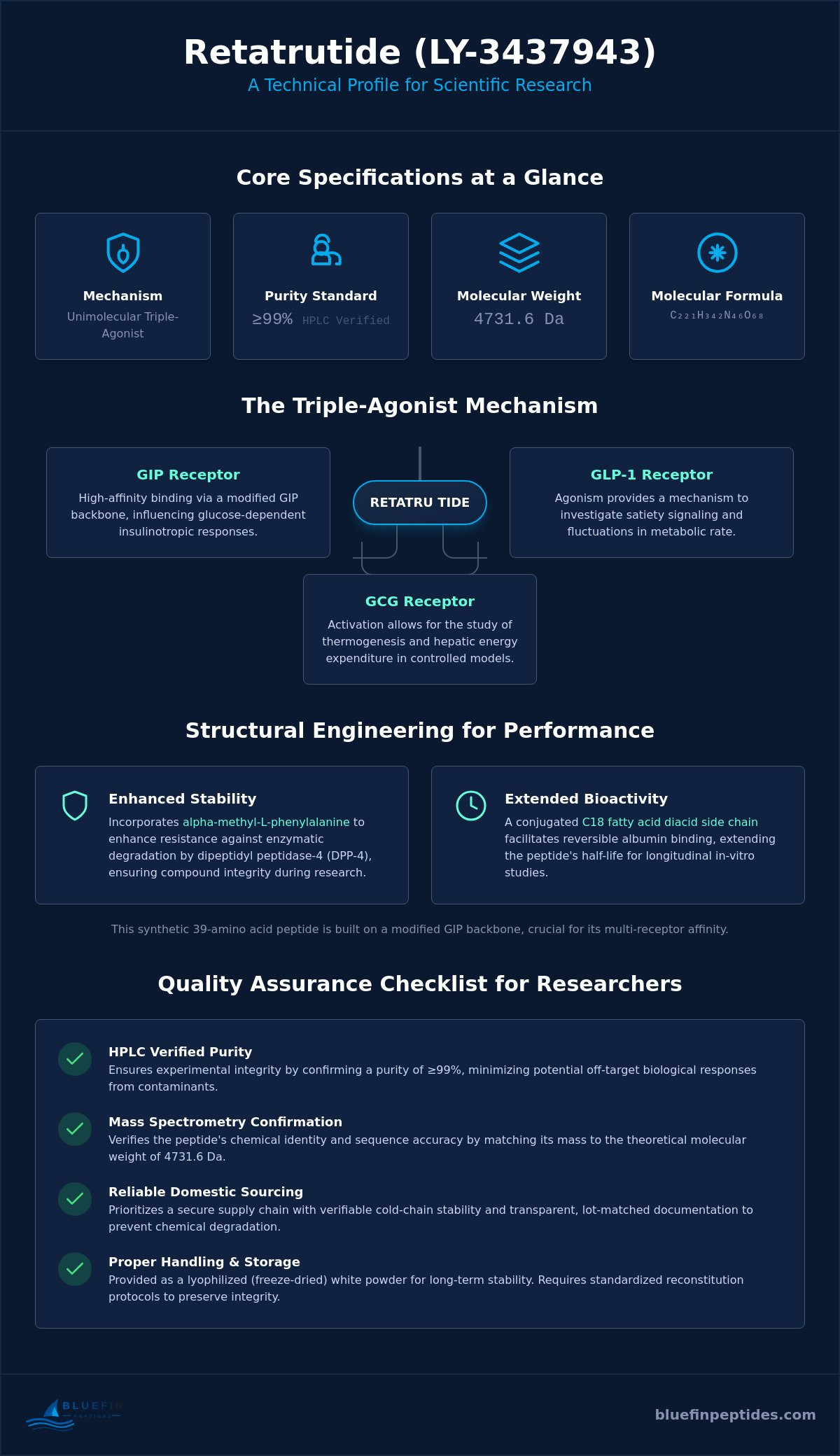
Retatrutide represents a sophisticated shift in the architecture of metabolic investigation. It is a synthetic peptide engineered specifically as a unimolecular triple agonist. This design allows for the simultaneous targeting of the glucagon-like peptide-1 (GLP-1), glucose-dependent insulinotropic polypeptide (GIP), and glucagon (GCG) receptors. By integrating these three distinct signaling pathways into a single molecular structure, the retatrutide research peptide provides a unique platform for studying synergistic endocrine effects. Researchers utilize this compound to explore the complex interplay of receptor activation without the pharmacokinetic variability inherent in co-administering multiple separate agents.
The development of Retatrutide (LY-3437943) stems from a modified GIP backbone. This structural foundation is critical. It enables the molecule to maintain high-affinity binding across three divergent receptor systems while ensuring the stability required for rigorous laboratory analysis. It is currently employed in research models to map intricate endocrine signaling pathways and observe metabolic homeostasis in controlled environments.
Receptor Binding Dynamics
The potency of this peptide at the GIP receptor is a primary focus of its analytical profile. Because the backbone is derived from the GIP sequence, it demonstrates binding affinities that often match or exceed endogenous ligands in specific research models. Parallel to this, GLP-1 receptor agonism provides a mechanism for investigating satiety signaling and experimental metabolic rate fluctuations. The third pillar, glucagon receptor activation, allows for the study of thermogenesis and hepatic energy expenditure. This triple-receptor engagement facilitates a deeper navigation of integrated metabolic flux than was possible with previous dual-agonist or mono-agonist compounds.
Structural Modifications and Bioactivity
Stability is the anchor of reliable research results. To prevent rapid enzymatic degradation, the sequence incorporates alpha-methyl-L-phenylalanine at specific positions. This substitution enhances the peptide's resistance to dipeptidyl peptidase-4 (DPP-4) cleavage. Furthermore, the inclusion of a C18 fatty acid diacid side chain, conjugated via a linker, facilitates reversible albumin binding in vitro. This modification is essential for extending the peptide's bioactivity and ensuring a consistent presence during longitudinal studies. Retatrutide is a synthetic 39-amino acid peptide that functions as a unimolecular triple agonist at the GIP, GLP-1, and GCG receptors to investigate integrated metabolic signaling pathways.
Precision. Stability. Verification. These are the requirements for any high-performance laboratory partner. By understanding the structural nuances of this triple agonist, researchers can better interpret the data generated during complex endocrine simulations.
Analytical Specifications: Chemical Profile of Retatrutide
Chemical composition is the baseline for experimental validity. The retatrutide research peptide follows a rigorous molecular formula of C221H342N46O68. Its theoretical molecular weight is calculated at approximately 4731.6 Da. This weight is the primary anchor for mass spectrometry verification. Structurally, it consists of a 39-amino acid backbone. This backbone is further stabilized by specific side-chain acylation, which is essential for the peptide's triple-agonist functionality. It's not a simple chain; the acylation adds a layer of chemical complexity that requires precise synthesis. The C18 fatty acid diacid side chain is a defining feature of the chemical profile, providing the structural basis for extended half-life in research environments. In its physical state, the compound is provided as a lyophilized white powder. This lyophilization ensures long-term stability and protects the peptide from hydrolytic degradation during transit and storage.
Chemical Identification Standards
Verification begins with the synthesis method. High-purity retatrutide is typically produced via solid-phase peptide synthesis (SPPS). This method allows for exact control over the sequence assembly, ensuring each amino acid is added in the correct order. To confirm identity, researchers rely on Mass Spectrometry (MS). The resulting spectrum must show primary target peaks that align with the theoretical mass of 4731.6 Da. Significant deviations indicate potential sequence errors or synthesis byproducts. Solubility also serves as a secondary identification marker. The peptide demonstrates high compatibility with aqueous buffers like sterile bacteriostatic water. However, specific high-concentration assays might require organic solvents or pH adjustments to maintain the peptide in a fluid, dissolved state.
Batch Consistency and Lot-Matching
Reliability in longitudinal studies requires unwavering batch-to-batch reproducibility. Inconsistent purity levels can introduce noise into metabolic data, obscuring the actual effects of the triple-agonist mechanism. Bluefin Peptides addresses this by providing lot-specific analytical documentation for every vial. This ensures that the specific chemical signature of your current batch matches the standards of previous iterations. Standard deviation thresholds for mass-spec variance are kept below 0.1% in high-purity samples to maintain this consistency. It's about providing a clear view of the underlying data without the fog of batch variance. To ensure your laboratory operates with this level of data security, you can procure HPLC-verified retatrutide that includes comprehensive, batch-level reporting. This commitment to transparency allows for more precise titration and more reliable outcomes in complex metabolic models.
Purity Verification: HPLC and Mass Spectrometry Standards
Precision in the laboratory is non-negotiable. For the retatrutide research peptide, purity isn't just a label; it's the foundation of experimental reliability. High-Performance Liquid Chromatography (HPLC) serves as the primary instrument for this verification. It separates the peptide from residual synthesis byproducts, ensuring that the biological responses observed in your models are attributed solely to the target molecule. Maintaining a ≥99% purity threshold is essential. Lower purity levels introduce unknown variables, such as truncated sequences or residual solvents, which can trigger off-target effects and skew metabolic data. Every experiment relies on the integrity of its starting material.
Bluefin Peptides provides batch-specific Certificates of Analysis (COAs) to help you navigate quality currents with confidence. These documents aren't mere formalities. They're analytical maps that confirm the chemical landscape of your specific shipment. By prioritizing these standards, you eliminate the noise of contamination and focus entirely on the triple-agonist signaling pathways you're investigating.
Interpreting the HPLC Chromatogram
Evaluating an HPLC report requires a focused analysis of the chromatogram's topography. The primary peak represents the target peptide. Its purity is determined by calculating the Area Under the Curve (AUC) relative to any secondary signals. A high-quality report will show a singular, sharp peak with minimal "shoulders" or baseline noise. When you review these reports, you're looking for three specific markers: the retention time of the main peak, the total area percentage, and the absence of peaks representing truncated sequences. To verify the purity percentage, locate the integration table; the 'Area %' column for the highest peak must reach or exceed 99.00% to meet laboratory standards.
Mass-Spec Confirmation for Triple Agonists
Identity is as vital as purity. While HPLC confirms the concentration of the substance, Mass Spectrometry (MS) verifies its specific chemical nature. For a triple agonist like retatrutide, MS is used to confirm the presence of the essential fatty acid side chain through a specific mass shift. The theoretical molecular weight of 4731.6 Da must be matched by the experimental mass-to-charge (m/z) ratio. Without this confirmation, it's impossible to distinguish the retatrutide research peptide from similar analogues that might share an HPLC retention time but lack the correct bioactivity. Bluefin maintains an anchor of transparency by providing third-party verification for every batch. This rigorous cross-referencing ensures that the structural integrity of the peptide is verified before it ever reaches your bench.

Laboratory Handling: Reconstitution and Stability Protocols
Precision in the laboratory doesn't end with chemical verification. Maintaining the structural integrity of the retatrutide research peptide during the transition from lyophilized solid to aqueous solution is a critical variable in experimental success. The secondary and tertiary structures of complex triple agonists are susceptible to mechanical shearing. If the 39-amino acid chain is compromised during handling, the resulting data will be skewed. Researchers must treat the reconstitution phase with the same analytical rigor applied to the initial HPLC verification.
To reconstitute, first allow the vial to equilibrate to room temperature. This prevents moisture condensation within the vial upon opening. Use a sterile syringe to introduce the solvent slowly, aiming the stream against the glass wall rather than directly onto the lyophilized cake. This "side-wall" method minimizes immediate foam formation. Once the solvent is introduced, do not shake the vial. Vigorous agitation can denature the peptide. Instead, utilize a gentle, circular swirling motion. Allow the vial to sit undisturbed for five to ten minutes to ensure complete dissolution. The resulting solution should be clear and free of visible particulates.
Optimal Reconstitution Solvents
The choice of solvent dictates the longevity of the research material. Bacteriostatic water, containing 0.9% benzyl alcohol, is the preferred medium for multi-use laboratory vials. The alcohol acts as a preservative, inhibiting microbial growth that could otherwise degrade the peptide over time. Sterile saline is a viable alternative for single-use assays but lacks these protective properties. For a 10mg vial, 1ml of solvent creates a 10mg/ml concentration, simplifying titration math. A 20mg vial typically requires 2ml of solvent to maintain this standard ratio. Maintaining a neutral pH is essential; deviations can trigger premature peptide cleavage or aggregation.
Stability and Degradation Risk Factors
Storage conditions act as the anchor for long-term bioactivity. Lyophilized powder is highly stable and can be maintained at -20°C for up to 24 months without significant loss of purity. However, once reconstituted, the stability window narrows significantly. The aqueous solution should be stored at 2-8°C and used within 14 to 21 days for optimal results. Light exposure is a known catalyst for degradation. UV rays can compromise the C18 fatty acid side chain, effectively neutralizing the triple-agonist mechanism. Avoid repeated freeze-thaw cycles. Each cycle creates microscopic ice crystals that can physically shear the peptide bonds, reducing the effective concentration of the active compound.
To ensure your laboratory maintains these rigorous standards, you can source HPLC-verified retatrutide research peptide directly from our domestic inventory. This ensures that the material arriving at your bench has been handled with cold-chain precision from the moment of synthesis.
Procurement and Quality Assurance at Bluefin Peptides
Bluefin Peptides functions as the analytical anchor for laboratories requiring high-purity compounds for metabolic investigation. We maintain rigid adherence to "Research Use Only" (RUO) standards. This discipline ensures that every vial of retatrutide research peptide meets the stringent requirements of professional researchers. Our US-based inventory eliminates the variables of international transit. It minimizes environmental exposure. It guarantees that the chemical integrity of the peptide remains stable from our facility to your bench. We operate with a high degree of confidence that borders on the academic, prioritizing transparency and verification over marketing fluff. Our persona is that of a high-performance laboratory partner, focusing on the verifiable data that researchers require.
Logistical Efficiency and Security
Logistics in research demand urgent precision. Our domestic shipping protocols are designed to protect the fragile state of lyophilized peptides. We utilize specialized packaging standards to shield vials from thermal fluctuations and physical impact. By maintaining a domestic supply chain, we bypass the turbulence of customs delays and uncontrolled transit environments. Speed is not a marketing goal; it's a technical requirement to preserve the molecular stability of the retatrutide research peptide. Every shipment follows a disciplined path, ensuring fluid movement through the logistics chain. We ensure that cold-chain stability is maintained through optimized transit times. This rapid fulfillment process allows your laboratory to maintain momentum without compromising chemical fidelity.
Commitment to Scientific Transparency
Trust is built on data, not claims. Bluefin provides direct access to batch-specific documentation through our secure portal. Every shipment is linked to its unique HPLC and mass-spec results. This level of transparency allows researchers to verify the 4731.6 Da molecular identity and ≥99% purity before beginning an assay. Mass-spec confirmation serves as the final verification of structural integrity. It ensures the C18 fatty acid side chain is correctly positioned for triple-agonist activity. For a deeper understanding of our protocols, review our Analytical Quality Standards for Research Peptides. We operate as a high-performance laboratory partner rather than a simple retail vendor. We provide the tools for verification. We ensure the "how" of our process protects the "what" of your results. Our "show, don't tell" philosophy regarding quality is rooted in biochemical reality. We provide the lot-matched COAs that serve as the definitive record of batch purity. This commitment to documentation provides the security and trust required for high-stakes metabolic research.
Advancing Metabolic Discovery with Analytical Precision
The evolution of metabolic research depends on the absolute fidelity of the molecular tools employed. Navigating the complexities of triple-agonist signaling requires more than surface-level purity; it demands rigorous verification of the 4731.6 Da molecular identity and a commitment to standardized reconstitution protocols that protect structural integrity. By prioritizing these analytical benchmarks, you eliminate the variables that often compromise longitudinal data. Precision and verification are the markers of a disciplined laboratory environment.
Securing a supply chain that provides batch-specific documentation ensures that your focus remains on the data rather than the quality of the starting material. Integrating a high-performance retatrutide research peptide into your study allows for a clearer observation of synergistic receptor dynamics without the noise of chemical impurities. Bluefin Peptides serves as your anchor in this high-stakes field, providing the transparency and logistical speed necessary to maintain your research timeline.
Procure HPLC-Verified Retatrutide for Your Laboratory Research
We guarantee ≥99% purity and provide lot-matched HPLC/MS documentation with every shipment from our domestic inventory. Secure the foundation of your next breakthrough with unwavering chemical precision.
Frequently Asked Questions
What is the purity level of Retatrutide available for research?
The accepted standard for high-performance laboratory investigation is ≥99% purity as verified by High-Performance Liquid Chromatography. This threshold is critical to ensure that experimental variables remain controlled and free from the interference of synthesis byproducts. Every batch of retatrutide research peptide from Bluefin Peptides undergoes rigorous testing to meet this benchmark, providing a stable foundation for metabolic signaling studies and precise data collection.
How should Retatrutide vials be stored for long-term stability?
Lyophilized vials should be maintained in a deep-freeze environment at -20°C to preserve chemical integrity for up to 24 months. Once the peptide is reconstituted, the stability window narrows significantly, requiring storage at 2-8°C in a light-protected environment. Researchers should avoid repeated freeze-thaw cycles and mechanical stress to prevent the shearing of the complex 39-amino acid chain and the loss of triple-agonist potency.
Is Retatrutide intended for human or veterinary use?
No. This compound is strictly designated for Research Use Only (RUO). It is intended exclusively for laboratory professionals conducting in vitro assays or animal model investigations. It is not a human-grade pharmaceutical, and it is not intended for medical, clinical, or veterinary applications. Adherence to these legal and professional boundaries is mandatory for all procurement to ensure the safety and integrity of the scientific community.
What solvents are recommended for reconstituting Retatrutide research peptides?
Bacteriostatic water is the primary recommendation for multi-use laboratory vials due to the inclusion of 0.9% benzyl alcohol, which inhibits microbial growth. Sterile saline is an acceptable alternative for single-use protocols but lacks these long-term preservative qualities. Maintaining a neutral pH during reconstitution is vital to prevent the premature degradation of the triple-agonist structure and ensure the peptide remains in a fluid, bioactive state.
How can I verify the HPLC results for my specific batch of Retatrutide?
Verification is achieved through lot-matched Certificates of Analysis (COAs) accessible via the Bluefin portal. Researchers can cross-reference the batch number on the physical vial with the digital report to analyze the primary peak and the area under the curve. This transparency ensures that the material on your bench aligns perfectly with the analytical standards required for high-stakes research, providing a clear map of the chemical landscape.
What is the difference between Retatrutide and Tirzepatide in research models?
Retatrutide functions as a unimolecular triple agonist, targeting the GLP-1, GIP, and glucagon receptors simultaneously. In contrast, Tirzepatide is a dual agonist targeting only GLP-1 and GIP. The inclusion of glucagon receptor agonism in the retatrutide research peptide allows scientists to investigate thermogenesis and hepatic energy expenditure. This provides a more complex model for studying integrated metabolic flux than dual-agonist alternatives.
How long does domestic shipping take for Retatrutide vials?
Our US-based inventory is optimized for rapid fulfillment to minimize environmental exposure and maintain cold-chain stability. Most orders are processed and delivered within a narrow window of two to five business days, ensuring that your laboratory timeline remains uninterrupted. This domestic logistics anchor provides a level of security and speed that international vendors cannot replicate, maintaining the "urgent precision" required for professional research.
Why is mass-spec confirmation necessary for triple-agonist peptides?
Mass spectrometry is the only definitive method to confirm the molecular identity and structural integrity of the peptide. While HPLC measures purity, mass-spec verifies the exact molecular weight of 4731.6 Da and confirms the presence of the essential C18 fatty acid side chain. This verification is the only way to distinguish the target compound from similar analogues or truncated sequences that might share an HPLC retention time.
For laboratory research use only. Not for human or veterinary use. This content is educational and does not constitute medical, dosing, or usage guidance.
Browse the BLUEFIN catalog