GHK-Cu BPC-157 TB-500 Research Blend: Analytical Profile and Laboratory Applications
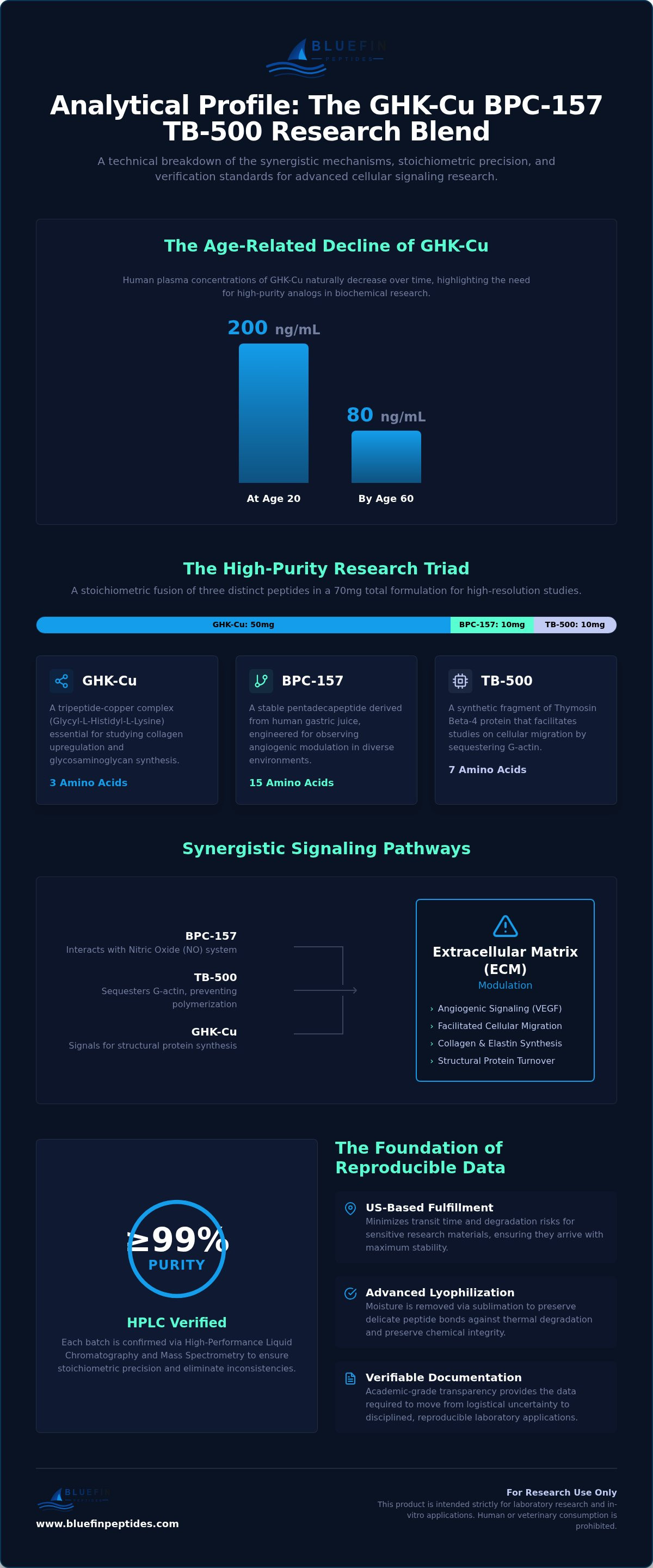
Human plasma concentrations of the GHK-Cu tripeptide decline from 200 ng/mL at age 20 to approximately 80 ng/mL by age 60. This biological variance underscores the necessity for high-purity analogs in modern biochemistry settings. Utilizing a GHK-Cu BPC-157 TB-500 research blend allows for the observation of complex cellular signaling pathways, yet many investigators remain hindered by inconsistent batch purity and a lack of verifiable documentation. Such logistical friction often compromises the integrity of sensitive research timelines. Quality. Purity. Verification.
This technical profile offers a rigorous analysis of the synergistic molecular mechanisms and stoichiometric precision inherent in this high-purity triad. We provide an exhaustive breakdown of HPLC-verified chemical data, clear reconstitution protocols for the 50:10:10 mg formulation, and the verification standards essential for reliable domestic sourcing. The following sections provide the depth of data required to move from logistical uncertainty to disciplined, reproducible laboratory applications. Expect a methodical examination of the analytical profile and the protocols required to ensure precise outcomes.
Key Takeaways
- Define the molecular architecture and lyophilization requirements necessary to preserve the chemical integrity of the GHK-Cu BPC-157 TB-500 research blend.
- Examine the synergistic modulation of VEGF pathways and collagen synthesis within the extracellular matrix through precise peptide interactions.
- Learn to interpret mass spectrometry data and HPLC verification standards to confirm ≥99% purity across complex multi-peptide profiles.
- Master stoichiometric calculations for reconstitution to ensure consistent molar concentrations and stability during laboratory applications.
- Discover how US-based fulfillment and academic-grade transparency minimize degradation risks for sensitive research materials.
Molecular Architecture of the GHK-Cu, BPC-157, and TB-500 Research Blend
Precision in molecular assembly defines the utility of a GHK-Cu BPC-157 TB-500 research blend. This triad represents a stoichiometric fusion of three distinct peptide sequences, each characterized by unique molecular weights and chemical affinities. The formulation typically utilizes a 50:10:10 mg ratio, creating a 70mg total vial weight designed for high-resolution cellular signaling studies. Every component is selected for its specific role in extracellular matrix (ECM) modulation and angiogenic research. Stability is maintained through advanced lyophilization, a process that removes moisture via sublimation to preserve the delicate peptide bonds against thermal degradation. This blend is intended strictly for laboratory research and in-vitro applications. Human or veterinary consumption is prohibited.
Chemical Profiles of the Component Peptides
The structural integrity of the blend relies on the individual purity of its constituents. BPC-157 is a pentadecapeptide composed of 15 amino acids. Derived from human gastric juice proteins, its sequence (Gly-Glu-Pro-Pro-Pro-Gly-Lys-Pro-Ala-Asp-Asp-Ala-Gly-Leu-Val) is engineered for high stability in diverse environments. In contrast, TB-500 represents the synthetic 7-amino acid fragment (Ac-Ser-Asp-Lys-Pro-Asp-Met-Ala) of the larger Thymosin Beta-4 protein. Its lower molecular weight allows for different kinetic properties within experimental models. The final component, GHK-Cu, is a naturally occurring tripeptide (glycyl-L-histidyl-L-lysine) with a profound affinity for copper (II) ions. This tripeptide-copper complex is essential for studying collagen upregulation and glycosaminoglycan synthesis.
The Synergy of the Research Triad
Stoichiometric precision is the anchor of reproducible data. When these three compounds are combined, they function as a multi-modal signaling tool for investigating complex cellular repair pathways. The interaction between the angiogenic modulation of BPC-157 and the actin-sequestering properties of TB-500 provides a dual-layered approach to studying tissue dynamics. GHK-Cu completes the triad by providing the signal for structural protein synthesis. Verification is paramount. Investigators must rely on HPLC-verified sequences to ensure that the GHK-Cu BPC-157 TB-500 research blend maintains its intended molecular ratios. Without mass-spectrometry confirmation, the subtle interplay between these sequences can be lost to batch-level inconsistencies. Data-driven research requires this level of analytical depth. We prioritize the "how" of molecular stabilization to ensure the "what" of your experimental results. This blend serves as a sophisticated tool for studying the intricate mechanics of cellular signaling and structural protein modulation in controlled environments.
Synergistic Signaling Pathways in Extracellular Matrix (ECM) Research
The remodeling of the extracellular matrix is a delicate equilibrium between synthesis and degradation. A GHK-Cu BPC-157 TB-500 research blend serves as a high-performance vector for studying these dynamics in vitro. By modulating the balance between matrix metalloproteinases (MMPs) and their endogenous inhibitors (TIMPs), this triad allows for the granular observation of structural protein turnover. It's an essential tool for mapping the chemical topography of cellular environments. Investigators use these compounds to anchor their research in measurable data, focusing on the fluid movement of signaling molecules across semi-permeable membranes. This synergy is not merely additive; it represents a multi-modal approach to understanding how diverse peptide structures influence the architectural integrity of the ECM.
Angiogenic Signaling and Vascular Research
Angiogenesis research often focuses on the Vascular Endothelial Growth Factor (VEGF) pathway to understand how new vessels emerge from pre-existing vasculature. BPC-157 interacts directly with the nitric oxide (NO) signaling system, providing a unique model for observing the promotion of collateral vessel development in ischemic environments. When combined with TB-500, the signaling currents become more complex. TB-500 sequesters G-actin, preventing its polymerization into F-actin and thereby facilitating the cellular migration necessary for endothelial cell differentiation. This interaction provides researchers with a disciplined framework for studying how endothelial cells organize into functional tubules. The blend allows for the simultaneous observation of nitric oxide-mediated vasodilation and actin-driven motility, offering a comprehensive view of vascular proliferation mechanisms.
Collagen Synthesis and Tissue Engineering Models
GHK-Cu is a primary modulator of dermal fibroblast activity. Established gene expression data on GHK-Cu indicates its capacity to upregulate the synthesis of collagen, elastin, and various glycosaminoglycans like hyaluronan. This biochemical signal is critical in tissue engineering, particularly when analyzing the mechanical properties of repaired tissue in tendon-to-bone healing models. The inclusion of BPC-157 and TB-500 in the study of these models helps researchers examine the differentiation of myofibroblasts. Proper differentiation ensures that the ECM architecture remains organized rather than progressing toward fibrotic accumulation. This triad provides the stoichiometric precision required to study the upregulation of structural proteins without compromising the fidelity of the cellular model.
Accurate data depends on the stability of the molecular signals. For investigators requiring stoichiometric synchronization and academic-grade transparency, utilizing a verified GHK-Cu BPC-157 TB-500 research blend ensures that every batch meets the necessary analytical thresholds. This commitment to verification allows for deeper insights into the mechanics of cellular repair. Results are only as reliable as the purity of the inputs.
Analytical Standards and Stoichiometric Precision in Peptide Blending
Verifying a multi-peptide formulation requires more than standard analytical protocols. It demands a rigorous examination of individual molecular signatures within a single matrix. A GHK-Cu BPC-157 TB-500 research blend presents a unique challenge for quality control. Each component must independently meet a ≥99% purity threshold before and after the blending process. Stoichiometric precision is the only way to ensure that experimental data remains reproducible. Without batch-specific COAs, investigators risk introducing variables that can invalidate months of laboratory work. Navigating the sea of low-quality suppliers requires a disciplined eye for analytical red flags, such as missing mass-spec data or generic purity claims that lack batch-level specificity.
HPLC Analysis for Multi-Peptide Formulations
Interpreting a chromatogram for a multi-peptide blend is a methodical task. Unlike single-peptide vials, a GHK-Cu BPC-157 TB-500 research blend produces three distinct peaks that must be resolved with high clarity. Overlapping peaks indicate poor separation or the presence of impurities that can compromise cellular signaling studies. For a deeper understanding of these metrics, consult our Analytical Quality Standards for Research Peptides: A Laboratory Guide. Verification of the final blend is critical. Relying solely on raw material data ignores potential degradation during the lyophilization or mixing phases. Purity must be confirmed for the finished product to guarantee stoichiometric accuracy and the integrity of the research triad.
Mass-Spec Verification and Sequence Confirmation
Mass spectrometry provides the final layer of security. By utilizing Electrospray Ionization (ESI), we confirm the primary structure of each sequence in the triad. ESI is particularly effective for large, non-volatile molecules like peptides because it produces multiple-charged ions without causing significant fragmentation. This process identifies the unique molecular weight signatures of BPC-157, GHK-Cu, and the multi-functional regenerative peptide fragment known as TB-500. Mass spectrometry provides the definitive molecular fingerprint that ensures the security and integrity of every research batch. This methodology ensures the absence of truncated sequences or residual solvents that could interfere with delicate cellular signaling models. High-resolution data is the only acceptable standard for modern laboratory applications.
Accuracy is the baseline. A commitment to academic-grade transparency means providing the tools for verification rather than asking for blind trust. Every vial must be a testament to disciplined logistics and chemical precision.

Laboratory Protocols: Reconstitution and Stability of Multi-Peptide Formulations
Handling a GHK-Cu BPC-157 TB-500 research blend requires a level of care equivalent to its analytical complexity. Lyophilized peptides are essentially "frozen" in a stable state, yet their molecular integrity is highly vulnerable once introduced to a liquid medium. Precision in the lab isn't just about the numbers; it's about the physical preservation of peptide bonds. GHK-Cu is particularly sensitive due to its tripeptide-copper (II) complex. Thermal fluctuations or improper pH levels can destabilize this bond, leading to the dissociation of copper ions and a subsequent loss of signaling fidelity. Avoid vigorous agitation. Never vortex. UV exposure must be minimized to prevent photodegradation of the sequences. Disciplined handling is the only way to ensure the "how" of your protocol doesn't compromise the "what" of your results.
Reconstitution Calculation and Solvent Selection
Solvent selection is the first step in ensuring a reproducible experiment. Bacteriostatic water, containing 0.9% benzyl alcohol, is the standard for inhibiting microbial growth in multi-use vials. However, certain in vitro models may require sterile saline to maintain specific osmotic pressures. Achieving precise molarity across three different peptides with varying molecular weights requires a methodical approach. For a 70mg total vial containing 50mg of GHK-Cu, 10mg of BPC-157, and 10mg of TB-500, the volume of the diluent determines the concentration of each constituent. Use our Peptide Blend Reconstitution Calculation: A Laboratory Protocol for 2026 to ensure your concentrations align with your experimental design. Introduce the solvent slowly, allowing it to move down the side of the glass to minimize foaming.
Long-term Storage and Chemical Stability
Stability is a function of temperature and time. Lyophilized powders should be stored at -20°C for long-term preservation, which can maintain chemical signatures for several years. Once reconstituted, the "clock" for degradation accelerates. Refrigeration at 2°C to 8°C is mandatory. Investigators should monitor vials for signs of peptide aggregation or precipitation, which appear as cloudiness or visible particulates. These physical changes indicate that the peptides have fallen out of solution or have denatured. For detailed guidelines on maintaining these standards, refer to Does Reconstitution Solution Need to Be Refrigerated? Laboratory Storage Standards. Consistent monitoring ensures that the signaling molecules remain active for the duration of the study.
Reliable research requires reliable materials. Secure your laboratory supply from a source that prioritizes domestic logistics and HPLC-verified purity. Purchase high-purity research blends to ensure your protocols yield consistent, verifiable data. Every batch is a commitment to academic-grade transparency.
Procuring High-Purity Research Blends: The Bluefin Advantage
Reliability is the anchor of scientific discovery. A GHK-Cu BPC-157 TB-500 research blend must be as precise as the hypothesis it tests. Bluefin Peptides operates with a high degree of academic confidence, prioritizing verification over marketing claims. Our role is that of a high-performance laboratory partner. We understand the high-stakes nature of modern biochemistry. Every vial we provide is a testament to disciplined logistics and chemical precision. It's about providing the tools for verification. Trust is earned through data, not promises. Purity is a documented fact.
Fulfillment Excellence and Laboratory Reliability
Logistical speed is a requirement, not a luxury. Time-sensitive research projects require a supply chain that moves with deep-sea precision. We maintain a US-stocked inventory to ensure rapid fulfillment and minimize the risk of transit-related degradation. Sensitive peptide sequences are vulnerable to thermal fluctuations during long-haul international shipping. By utilizing domestic, climate-controlled packaging, we preserve the molecular integrity of every batch. This commitment to speed ensures that your research timelines remain intact. We act as a disciplined logistics specialist for the scientific community. Efficiency meets security. Navigating the currents of global logistics shouldn't compromise your data.
Verifying Your Research Supply Chain
The integrity of peer-reviewed data depends on the purity of the inputs. A ≥99% purity threshold is the baseline for academic-grade research. We provide batch-level COAs for every order, allowing investigators to verify the stoichiometry of the GHK-Cu BPC-157 TB-500 research blend before the first experiment begins. Accessing HPLC and Mass-Spec reports is a standard part of our transparency protocol. We don't ask for blind trust. We provide the raw analytical data. This allows you to focus on the cellular signaling outcomes rather than questioning the chemical nature of your materials. Security. Purity. Verification.
Invest in the analytical depth required for reproducible results. For investigators who demand stoichiometric synchronization and domestic logistical speed, the choice is clear. Procure HPLC-Verified GHK-Cu / BPC-157 / TB-500 Research Blends to ensure your laboratory outcomes are backed by verifiable chemical data. Your research deserves the highest analytical standard.
Advancing Analytical Accuracy in Peptide Research
The integration of GHK-Cu, BPC-157, and TB-500 into a single stoichiometric formulation represents a sophisticated vector for modern biochemistry. Investigators can now observe complex extracellular matrix dynamics and angiogenic signaling pathways with a level of resolution previously hindered by isolated peptide models. Success in the laboratory depends on the unwavering chemical stability of the GHK-Cu BPC-157 TB-500 research blend, requiring disciplined reconstitution protocols and rigorous analytical verification. Every data point is a reflection of the inputs used.
Bluefin Peptides serves as a high-performance partner, providing the raw data and logistical speed necessary to maintain sensitive research timelines. We eliminate the friction of inconsistent purity through batch-level transparency and domestic fulfillment. Our commitment to the "show, don't tell" philosophy ensures that every vial is a verifiable instrument of discovery. Purity. Precision. Reliability. We treat the reader as a peer in a professional field, prioritizing verifiable results over marketing fluff.
Secure Your HPLC-Verified Research Blends at Bluefin Peptides and ensure your data is anchored in ≥99% purity, mass-spec confirmation, and rapid US-stocked fulfillment. We look forward to supporting the integrity of your next experimental phase with academic-grade excellence.
Frequently Asked Questions
What is the specific ratio of GHK-Cu, BPC-157, and TB-500 in the research blend?
The standard formulation for the GHK-Cu BPC-157 TB-500 research blend is a 50:10:10 mg ratio, resulting in a 70mg total vial weight. This stoichiometric precision ensures that investigators can accurately model synergistic cellular signaling in controlled environments. Each component is independently verified before the lyophilization process to maintain the integrity of the molecular triad.
Is the GHK-Cu BPC-157 TB-500 research blend stable at room temperature during shipping?
Lyophilized peptide powders remain chemically stable at room temperature for short durations during transit. However, Bluefin Peptides utilizes US-based inventory and rapid fulfillment to minimize environmental exposure. This logistical speed prevents the thermal degradation of delicate peptide bonds, ensuring the analytical profile remains intact upon arrival at the laboratory. Once received, vials should be moved to long-term cold storage immediately.
How do I calculate the concentration of each peptide after reconstitution?
Concentration is calculated by dividing the specific mass of each peptide by the volume of the diluent added. For a 2mL reconstitution of the 70mg blend, the resulting concentrations are 25 mg/mL for GHK-Cu, 5 mg/mL for BPC-157, and 5 mg/mL for TB-500. Precision in solvent measurement is mandatory to maintain experimental reproducibility and ensure the accuracy of cellular signaling data.
Can I use this blend for human clinical trials or personal use?
These compounds are strictly intended for laboratory research and in-vitro applications and are not approved for human or veterinary consumption. Regulatory classifications for BPC-157 and TB-500 restrict their use to supervised research settings. Any use outside of a disciplined laboratory environment violates established safety protocols and legal boundaries. We provide these tools exclusively for the advancement of scientific data.
What analytical methods are used to verify the purity of Bluefin research blends?
We utilize High-Performance Liquid Chromatography (HPLC) and Mass Spectrometry (Mass-Spec) to confirm purity and identity. HPLC verifies that each component meets a ≥99% purity threshold, while Electrospray Ionization (ESI) Mass-Spec provides the molecular fingerprint for sequence confirmation. These reports are available for every batch to ensure academic-grade transparency and the security of your research supply chain.
Does the presence of GHK-Cu affect the stability of BPC-157 or TB-500?
The presence of GHK-Cu introduces a copper (II) ion complex that requires careful pH management to avoid destabilizing the other peptides in a liquid state. While the lyophilized state prevents interaction, reconstituted vials must be handled with care. Improper solvent selection or thermal stress can lead to the dissociation of copper, which may alter the molecular kinetics of the BPC-157 or TB-500 components during sensitive experiments.
What is the shelf life of the lyophilized blend when stored at -20°C?
Lyophilized blends stored at -20°C maintain their chemical signatures for approximately 24 to 36 months. Proper storage in a moisture-free environment is essential to prevent hydrolysis and preserve the peptide bonds. Once the vial is reconstituted, the shelf life decreases significantly, requiring refrigeration at 2°C to 8°C for use within a limited experimental window to avoid degradation.
How does Bluefin Peptides ensure stoichiometric accuracy in its multi-peptide vials?
Stoichiometric accuracy is ensured through batch-level verification and precise mass-spec confirmation of the final blend. We don't rely on raw material data alone; we test the finished 70mg vial to confirm that the 50:10:10 mg ratio is maintained after the lyophilization process. This disciplined approach provides the tools for investigators to verify their research supply chain with high-resolution analytical data.
For laboratory research use only. Not for human or veterinary use. This content is educational and does not constitute medical, dosing, or usage guidance.
Browse the BLUEFIN catalog