Research Peptides with Certificate of Analysis: The Gold Standard for Analytical Integrity

A purity percentage on a product label is merely a marketing claim, yet a rigorous data trail is the only objective evidence that your research model won't be compromised by synthesis artifacts. You likely recognize that in high-stakes laboratory environments, even a 1% deviation in chemical integrity can invalidate months of data and prevent the successful replication of your studies. Sourcing research peptides with certificate of analysis (COA) documentation is no longer a luxury; it's a foundational requirement for analytical security. This guide provides the technical framework to master peptide verification, ensuring your work is anchored in 99% HPLC-verified precision.
We'll examine the critical components of a valid report, from mass-spec identity confirmation to the necessity of batch-specific traceability. With the FDA releasing revised guidances for peptide products as recently as July 28, 2026, the demand for transparency in impurity thresholds has reached a new peak. You'll learn to distinguish between forged reports and authentic third-party data, protecting your research from the volatility of inconsistent batches. This analysis equips you to audit your supply chain with clinical precision, ensuring every vial meets the gold standard of laboratory integrity.
Key Takeaways
- Identify the technical requirements for valid purity reports, including HPLC chromatographic baselines and Mass Spectrometry identity confirmation.
- Navigate the verification gap by prioritizing independent third-party laboratory data over manufacturer-provided in-house claims.
- Implement a rigorous auditing checklist to ensure your research peptides with certificate of analysis precisely match the physical batch numbers in your inventory.
- Secure your laboratory research against batch-to-batch inconsistency and forged data through full traceability from synthesis to vial.
- Master the nuances of analytical integrity to ensure 99% HPLC-verified precision in every research model.
The Critical Role of Certificates of Analysis in Peptide Research
Analytical integrity is the bedrock of reproducible science. A Certificate of Analysis (COA) serves as a formal laboratory record that authenticates the chemical identity and purity of a specific substance. It's not a generic assurance. It's a technical audit. In high-stakes laboratory environments, the absence of a COA introduces unacceptable risks to the integrity of the research model. Every synthesis artifact or residual solvent represents a confounding variable that can skew results, invalidate datasets, and prevent the successful replication of peer-reviewed studies. Sourcing research peptides with certificate of analysis documentation ensures that your laboratory work is anchored in verifiable data rather than vendor promises.
Precision requires a batch-specific focus. Generic or "representative" reports often circulate in the industry, yet these documents only reflect a historical baseline rather than the current lot. Synthesis is a fluid process. Batch-to-batch inconsistency is a reality of chemical manufacturing. Only a batch-specific COA provides the necessary traceability from the initial synthesis to the final vial on your laboratory bench. At Bluefin Peptides, we prioritize this "show, don't tell" philosophy. We maintain a 99% purity baseline because high-fidelity research demands it. Anything less than 99% HPLC-verified purity introduces synthesis side-products that can interact unpredictably with research models, compromising the depth and accuracy of your findings.
Identity Verification vs. Purity Assessment
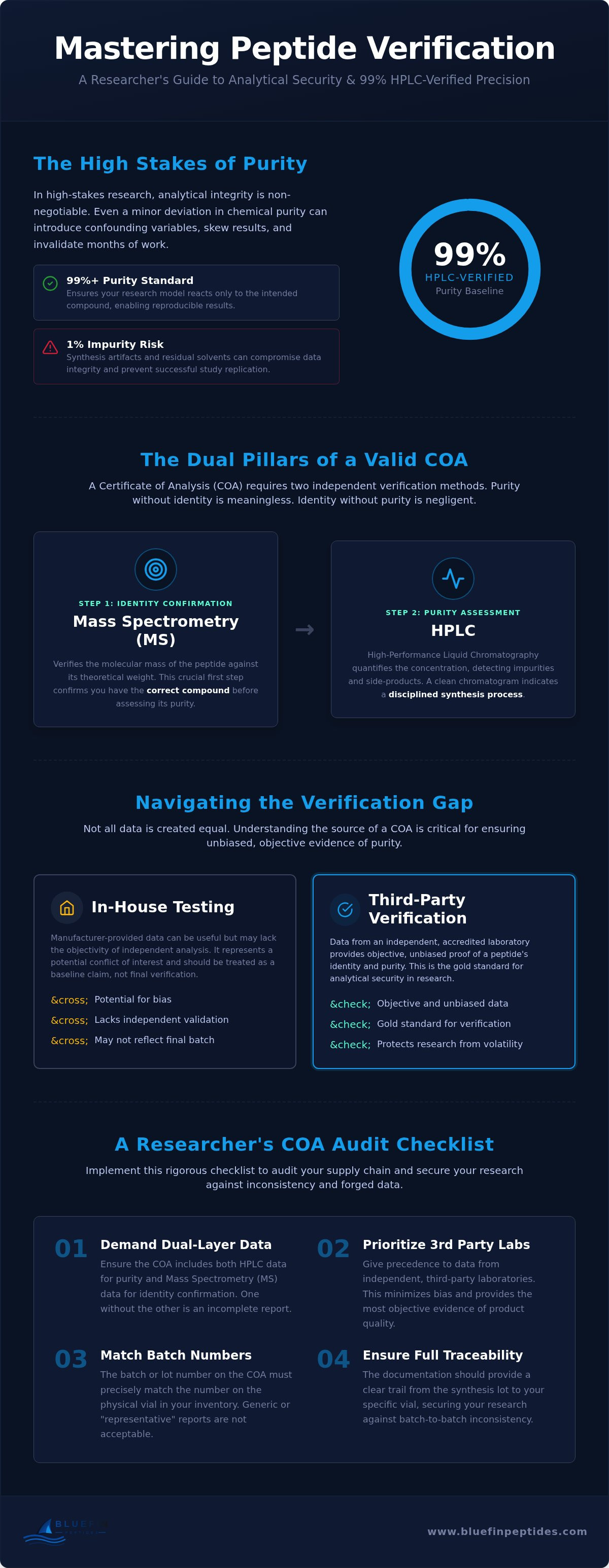
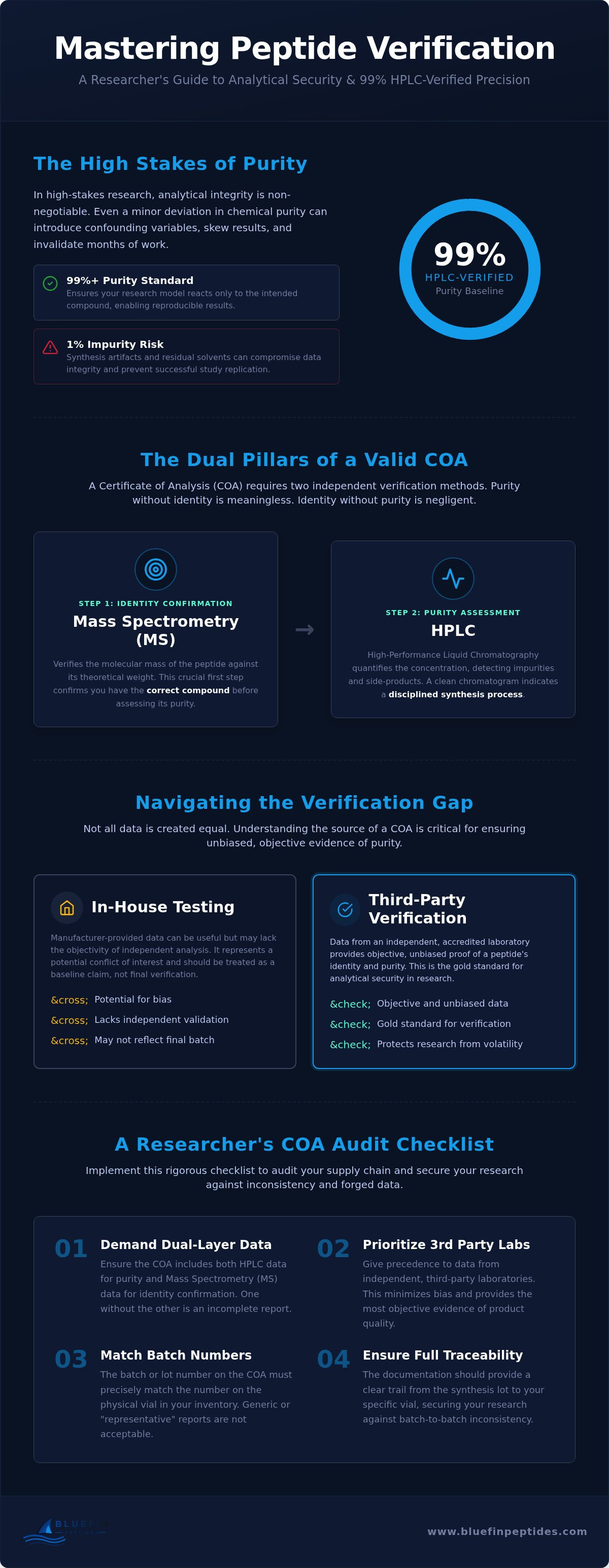
Identity confirmation must always precede purity assessment. High-Performance Liquid Chromatography (HPLC) measures the concentration of a substance, but it cannot definitively confirm what that substance is. Mass Spectrometry (MS) is the necessary anchor. It verifies the molecular mass against the theoretical weight of the peptide sequence. Without MS data, a report showing 99% purity could describe the wrong chemical compound entirely. Bluefin utilizes dual-layer verification for every batch of Tirzepatide Research Peptide and our specialized blends. We confirm the sequence first. We measure the purity second. This rigorous protocol eliminates the risk of misidentified compounds entering your laboratory workflow.
The Legal and Ethical Framework of Research Chemicals
Strict adherence to "Laboratory Use Only" designations is a non-negotiable standard for professional suppliers. Documentation plays a vital role in institutional compliance and safety protocols. COAs provide the raw data required for internal audits and safety assessments, ensuring that all research chemicals are handled within a disciplined framework. Ethical suppliers never offer human dosage or administration guidance. Our focus remains on the "how" of our processes and the "what" of our results. By providing research peptides with certificate of analysis, we empower researchers to maintain full traceability and institutional transparency. This commitment to documentation reflects our role as a disciplined logistics specialist and a dedicated partner in high-performance research.
Decoding HPLC and Mass Spectrometry: The Dual Pillars of Purity
Verification is a two-stage process. Purity without identity is scientifically meaningless. Identity without purity is commercially negligent. To ensure research peptides with certificate of analysis meet the rigorous demands of modern biochemistry, one must understand the interplay between High-Performance Liquid Chromatography (HPLC) and Mass Spectrometry (MS). HPLC serves as the primary tool for quantifying chemical concentration. It maps the chromatographic baseline, allowing researchers to detect impurities, synthesis side-products, and residual solvents like Trifluoroacetic acid (TFA). A clean baseline indicates a disciplined synthesis process. It ensures that your research model reacts only to the intended compound.
The reliability of these laboratory reports is anchored in established standards. According to FDA cGMP regulations, a report of analysis can be accepted from a supplier once their reliability has been validated through consistent testing. For a researcher, this means the COA must provide the raw data required for independent auditing. The report should include a clear chromatogram where the primary peak is distinct from the noise. Assessing the Area Under the Curve (AUC) allows for a precise calculation of the peptide's concentration relative to any detected contaminants. This level of transparency is what defines a professional partner in the research space.
Interpreting HPLC Chromatogram Peaks
A chromatogram is a visual representation of chemical separation over time. The target peptide should appear as a sharp, dominant peak. Secondary peaks signify impurities or degradation products. HPLC purity is the ratio of the target peak area to the total area of all peaks. A clean, singular peak with minimal "shoulders" or baseline drift is the hallmark of superior peptide synthesis. If you require absolute certainty in your reagents, you can explore our catalog of verified compounds to see these standards in practice.
Mass Spectrometry and Molecular Mass Confirmation
Mass Spectrometry provides the final layer of security. It confirms that the substance in the vial matches the theoretical molecular weight of the peptide sequence. By comparing the observed m/z ratio to the calculated weight of compounds like Retatrutide Research Peptide, researchers can identify truncated sequences or amino acid deletions. These errors are common in high-volume manufacturing but are caught through rigorous mass spec peptide verification. This dual-pillar approach ensures that every research vial is chemically identical to the sequence intended for the study, eliminating the risk of unverified analogs compromising your data.
Third-Party vs. In-House Testing: Navigating the Verification Gap
Trust is not a scientific variable. In-house testing creates a closed loop where the manufacturer audits their own synthesis. This inherent conflict of interest compromises the objectivity of the laboratory data. To secure research peptides with certificate of analysis that reflect reality, researchers must demand third-party verification. Independent laboratories function as the anchor of trust in the supply chain. They provide a cold, objective assessment of chemical integrity without the pressure of commercial production quotas. When a supplier relies solely on internal reports, they ask for blind trust. Professional research demands proof.
Verification requires due diligence. Researchers should verify the credentials of the testing facility listed on every report. A legitimate COA features a clear laboratory header, contact information, and a verifiable reputation within the analytical community. Bluefin Peptides operates with a "show, don't tell" protocol. We utilize independent batch audits to ensure absolute transparency. This process removes the manufacturer from the quality control equation, providing a disciplined data trail that researchers can audit with confidence. It's a commitment to the "how" of our logistics to ensure the "what" of your results.
The Problem with "Representative" COAs
Precision is batch-specific. Researchers should reject any COA that doesn't match the specific batch number on the physical vial. Suppliers often use data from a "master batch" to represent subsequent syntheses, but this practice ignores the fluid nature of chemical manufacturing. Synthesis artifacts and impurities can fluctuate between lots. Full traceability from the synthesis lab to the final research environment is the only way to avoid confounding variables. If the batch numbers don't align, the data is irrelevant.
Comparing Supplier Standards in 2026
Documentation transparency is the primary metric for quality. You can compare research peptide suppliers by evaluating the analytical depth of their COA libraries. A professional supplier provides downloadable, batch-level documentation rather than vague purity claims. Rapid fulfillment is essential for momentum, but it must never compromise the testing timeline. In 2026, the standard for research peptides with certificate of analysis includes mass-spec confirmation and HPLC purity for every individual lot. This rigorous screening ensures that your laboratory research is anchored in 99% verified precision, protecting your models from the risks of synthesis deletions or truncated sequences.
How to Audit a Peptide COA: A Researcher’s Checklist
Analytical oversight requires more than a cursory glance at a PDF. It demands a systematic audit. When evaluating research peptides with certificate of analysis documentation, the first checkpoint is the laboratory header. You must verify that the testing facility is a legitimate third-party entity with a verifiable reputation. An anonymous report is a liability. Next, match the batch number. The identification code on the COA must correspond exactly to the physical vial in your lab. Any discrepancy here renders the entire document irrelevant to your current study. Precision is batch-specific. It's the only way to ensure your research is anchored in reality.
Purity analysis requires technical depth. Look for a specific percentage of ≥99% based on the Area Under the Curve (AUC). Vague estimates are insufficient for high-stakes modeling. Examine the date of analysis to ensure the report is current. A legacy document from 2024 cannot validate a synthesis conducted in 2026. Finally, scrutinize the chromatogram. A clean, flat baseline is non-negotiable. Hidden "shoulders" on the primary peak often mask synthesis artifacts or degradation products that can skew your results. If you require reagents that meet these rigorous auditing standards, view our batch-specific inventory to secure your laboratory supply.
Red Flags in Analytical Documentation
Digital manipulation is a persistent threat in the unverified supply chain. Look for "Photoshop" artifacts, inconsistent fonts, or misaligned text blocks that suggest a forged report. A critical failure in identity verification is the absence of Mass Spec data. Without it, you have no confirmation that the compound is actually what the label claims. Be wary of vague purity claims like "99%+" that lack supporting HPLC data. These are often used to obscure the presence of residual solvents or truncated sequences. A professional COA provides the raw data necessary for you to reach your own analytical conclusions.
Maintaining Research Peptide Quality Standards
Verification doesn't end with the audit. You must integrate COA data into your laboratory’s internal quality control (QC) logs to ensure full traceability from synthesis to vial. Lyophilization plays a vital role in preserving the purity verified on the report. This freeze-drying process stabilizes the peptide, but its integrity depends on your storage protocols. To ensure the peptide matches its COA upon reconstitution, maintain strict temperature controls. Heat and light are the primary drivers of degradation. By following these disciplined procedures, you ensure that the analytical precision promised in the documentation is maintained throughout the duration of your research.
Bluefin Peptides: Precision Logistics and Batch-Specific Transparency
Bluefin Peptides operates as a disciplined logistics specialist. We prioritize transparency over marketing-driven claims. Every product in our catalog, from Tirzepatide to complex multi-peptide formulations, is backed by downloadable, batch-level documentation. This "Show, Don't Tell" philosophy ensures that researchers have immediate access to the raw data required for institutional audits. We exclusively serve the scientific community. Our US-based stocking allows for rapid fulfillment without sacrificing the analytical scrutiny that professional-grade research demands. Providing research peptides with certificate of analysis is our baseline standard; it's the foundational requirement for any high-performance laboratory partner.
Reliability is built through consistency. While competitors may focus on consumer-facing marketing or retail-style discounts, we maintain a clinical focus on the chemical nature of our offerings. Our fluid logistics system ensures that inventory moves quickly from synthesis to the research bench, yet every lot remains anchored in a rigorous data trail. This approach treats the researcher as a peer in a scientific field, providing the tools for verification rather than asking for blind trust. By maintaining a high-level technical register and avoiding marketing fluff, we ensure that your laboratory research is anchored in 99% HPLC-verified precision.
The Bluefin Verification Protocol
Every batch undergoes HPLC and MS confirmation before being cleared for inventory. Our verification process functions as a dual-stage analytical audit that mandates both identity confirmation and purity quantification before inventory release. We do not rely on manufacturer-provided data. We conduct independent audits to eliminate the verification gap. This protocol ensures that every vial delivers ≥99% verified purity. We prioritize transparency over marketing-driven claims because we understand the high-stakes nature of laboratory environments. If the data doesn't meet our standards, the batch doesn't enter our inventory.
Advanced Research Blends and Specifications
Multi-peptide formulations present unique analytical challenges. Managing the complexity of COAs for a GHK-Cu BPC-157 TB-500 research blend requires identifying distinct peaks for each constituent compound. Each component must meet its individual purity and identity benchmarks. This rigorous approach extends to GH secretagogues, such as the Ipamorelin CJC-1295 research blend USA. We verify every sequence. We confirm every concentration. Sourcing research peptides with certificate of analysis from a specialist ensures that these advanced blends are anchored in 99% HPLC-verified precision, providing the analytical integrity required for successful study replication.
Securing the Future of Analytical Reproducibility
Analytical integrity is a moving target that requires constant vigilance. You now possess the technical framework to audit documentation with clinical precision. By prioritizing dual-layer verification and rejecting generic reports, you eliminate the synthesis artifacts that jeopardize laboratory data. Reproducibility is the ultimate metric of science. Anchoring your work in research peptides with certificate of analysis standards ensures that every data point is defensible and every study is replicable.
Bluefin Peptides remains committed to a disciplined "show, don't tell" philosophy regarding chemical quality. We provide the raw data required for deep-sea precision in your research models. Every vial in our inventory is backed by ≥99% HPLC purity verification and mass spec identity confirmation. This batch-level transparency isn't a marketing choice; it's a fundamental commitment to the scientific method. Our US-based stocking and rapid fulfillment ensure your momentum is never stalled by logistical delays. We look forward to supporting your next breakthrough with the disciplined logistics and technical accuracy your research deserves.
Procure HPLC-Verified Research Peptides with Batch-Specific COAs
Frequently Asked Questions
What is the difference between purity and identity on a peptide COA?
Identity confirms the chemical structure of the compound through Mass Spectrometry, while purity measures the concentration of that compound relative to contaminants via HPLC. Identity must be established first to ensure the purity reading actually describes the intended peptide sequence. A high purity rating is scientifically irrelevant if the Mass Spectrometry data reveals an incorrect molecular weight or truncated sequence.
How can I verify if a third-party laboratory report is legitimate?
Legitimate reports feature a clear laboratory header with a physical address and contact information that you can independently verify. You should cross-reference the batch number on the report with the lab’s own verification portal or contact the facility directly to confirm the data trail. Forged documents often display inconsistent fonts, misaligned logos, or "Photoshop" artifacts that suggest the original data has been manipulated.
Why do some COAs show 98% purity while others claim 99.9%?
These variations reflect the stringency of the purification process and the precision of the initial synthesis. While 98% is a common baseline in bulk manufacturing, high-fidelity research requires a 99% or higher threshold to minimize synthesis artifacts. Higher purity levels reduce the presence of confounding variables, ensuring that your research models respond only to the target compound rather than residual solvents or side-products.
Does the COA cover the stability of the peptide during shipping?
A COA reflects the analytical state of the peptide at the specific moment of laboratory testing. While lyophilization provides significant stability for the research peptides with certificate of analysis, environmental factors during transit can impact chemical integrity. Professional suppliers mitigate these risks through temperature-controlled logistics and rapid fulfillment to ensure the peptide remains as close to its verified state as possible upon arrival.
Should I request a new COA for every order even if the batch number is the same?
A new report is unnecessary if the batch number remains identical, as the analytical data is tied to that specific synthesis lot. You should, however, ensure you possess the most current version of the documentation for your internal quality control logs. If a supplier changes lots, you must secure a new COA to maintain full traceability and avoid introducing batch-to-batch inconsistency into your research environment.
What are the most common impurities found in research peptides?
Impurities typically consist of truncated sequences, amino acid deletions, and residual solvents like Trifluoroacetic acid (TFA) used during the synthesis process. These artifacts are unavoidable byproducts of solid-phase peptide synthesis that must be removed through rigorous purification. A professional COA identifies these impurities on the HPLC chromatogram, allowing researchers to assess the potential impact of residual contaminants on their specific study models.
How do I interpret the Mass Spec graph on my Bluefin Peptides report?
Identify the primary peak on the m/z axis and compare the observed value to the theoretical molecular weight of the peptide. If the observed mass aligns with the calculated weight within a standard margin of error, the chemical identity is confirmed. Our "show, don't tell" philosophy provides these raw data points so you can verify that every vial contains the exact sequence required for your laboratory applications.
Can I use an in-house COA for institutional research submissions?
Institutional review boards and peer-reviewed journals generally require third-party verification to eliminate the conflict of interest inherent in manufacturer-provided data. Providing research peptides with certificate of analysis from an independent laboratory ensures your work meets the transparency standards required for professional publication. Independent audits function as the anchor of trust, providing the objective evidence necessary for regulatory compliance and study replication.
For laboratory research use only. Not for human or veterinary use. This content is educational and does not constitute medical, dosing, or usage guidance.
Browse the BLUEFIN catalog