How to Compare Research Peptide Suppliers: 2026 Guide

A research supplier is only as reliable as their most recent batch-specific Certificate of Analysis. In a global peptide market valued at $164 billion as of 2026, the margin for analytical error has reached an absolute zero. You require more than a retail vendor; you need a disciplined logistics specialist that prioritizes deep-sea precision over marketing fluff. To effectively compare research peptide suppliers, one must look past the digital interface and into the raw data of HPLC and Mass Spectrometry verification.
We recognize that inconsistent batch purity and opaque testing methodologies are not merely inconveniences; they are direct threats to the reproducibility of your data. This guide establishes a technical framework for researchers to evaluate peptide purity, verification protocols, and domestic fulfillment speed when selecting a laboratory partner. We'll analyze the critical role of batch-specific documentation and the logistical necessity of a streamlined, domestic supply chain. By the end of this analysis, you'll have the tools to ensure your research results remain reproducible and your supply chain remains fluid.
Key Takeaways
- Establish an analytical baseline of ≥99% HPLC purity and Mass Spectrometry verification to ensure molecular identity and research reproducibility.
- Utilize a rigorous technical framework to compare research peptide suppliers, prioritizing batch-specific COAs over static or outdated documentation.
- Mitigate supply chain instability by evaluating domestic US-based fulfillment protocols that eliminate the risks of international customs delays.
- Implement a comprehensive 2026 vetting checklist to secure a disciplined laboratory partner focused on transparent verification and logistical precision.
The Criticality of Vendor Selection in Peptide Research
Scientific progress relies on the stability of the chemical substrate. In the context of 2026 laboratory standards, the ability to compare research peptide suppliers hinges on a singular metric: verifiable consistency. A vendor is not a retail endpoint; they're a technical partner. If the chemical foundation is fractured, the entire experimental architecture collapses. Industrial grade compounds often contain truncated sequences or residual solvents that introduce uncontrolled variables into a controlled environment. High performance research requires a higher standard. Precision is the baseline. Verification is the requirement.
Data Integrity and Reproducibility
Batch-to-batch variance is the silent killer of longitudinal studies. If a supplier provides 99% purity in January and 95% in June, that delta is not merely a statistical outlier. It's a variable that can skew gene expression data, metabolic signaling, or protein-protein interactions. Reproducibility is the gold standard of the scientific method. It's impossible to achieve when the starting material is in flux. The specific method of Peptide synthesis employed by a laboratory determines the specific impurity profile of the final product. Solid Phase Peptide Synthesis (SPPS) must be executed with deep-sea precision to minimize side reactions. Average purity is a meaningless metric. You need the specific data for the specific vial in your hand. The hidden costs of low-purity compounds are staggering. Losing six months of data due to an unverified batch is a catastrophic failure of logistics and oversight.
Legal and Ethical Procurement Standards
The 2026 regulatory environment demands absolute transparency. The "Research Use Only" (RUO) designation is a legal boundary, not a suggestion. As of July 2026, the FDA has intensified its focus on the peptide market, specifically targeting entities that fail to provide adequate documentation or those making unsubstantiated therapeutic claims. The July 2026 FDA advisory committee meeting on peptide reclassification underscores the shifting landscape, making it vital to partner with suppliers who maintain rigid legal boundaries. Sourcing from opaque or international vendors without domestic verification protocols introduces unacceptable risks. These risks include customs seizures, batch inconsistency, and legal liability. A disciplined researcher verifies the supplier's identity and their adherence to strict laboratory standards. Security. Trust. Verification. These are the markers of a professional partnership. Opaque methodologies have no place in a high-stakes laboratory environment. When you compare research peptide suppliers, look for a domestic supply chain that ensures fluid movement from the lab to your bench without the friction of international interference.
Core Technical Metrics for Evaluating Peptide Purity
Analytical verification is the bedrock of experimental security. To effectively compare research peptide suppliers, a researcher must move beyond the marketing summary and interrogate the raw data. A purity level of ≥99% is not a suggestion. It's the laboratory gold standard. Anything less introduces unknown chemical noise into your system. Many vendors rely on manufacturer-provided data, which represents a clear conflict of interest. Independent, third-party verification provides the necessary layer of security to ensure the compound matches the label. Professionalism requires transparency. Verification requires data.
Interpreting HPLC Chromatograms
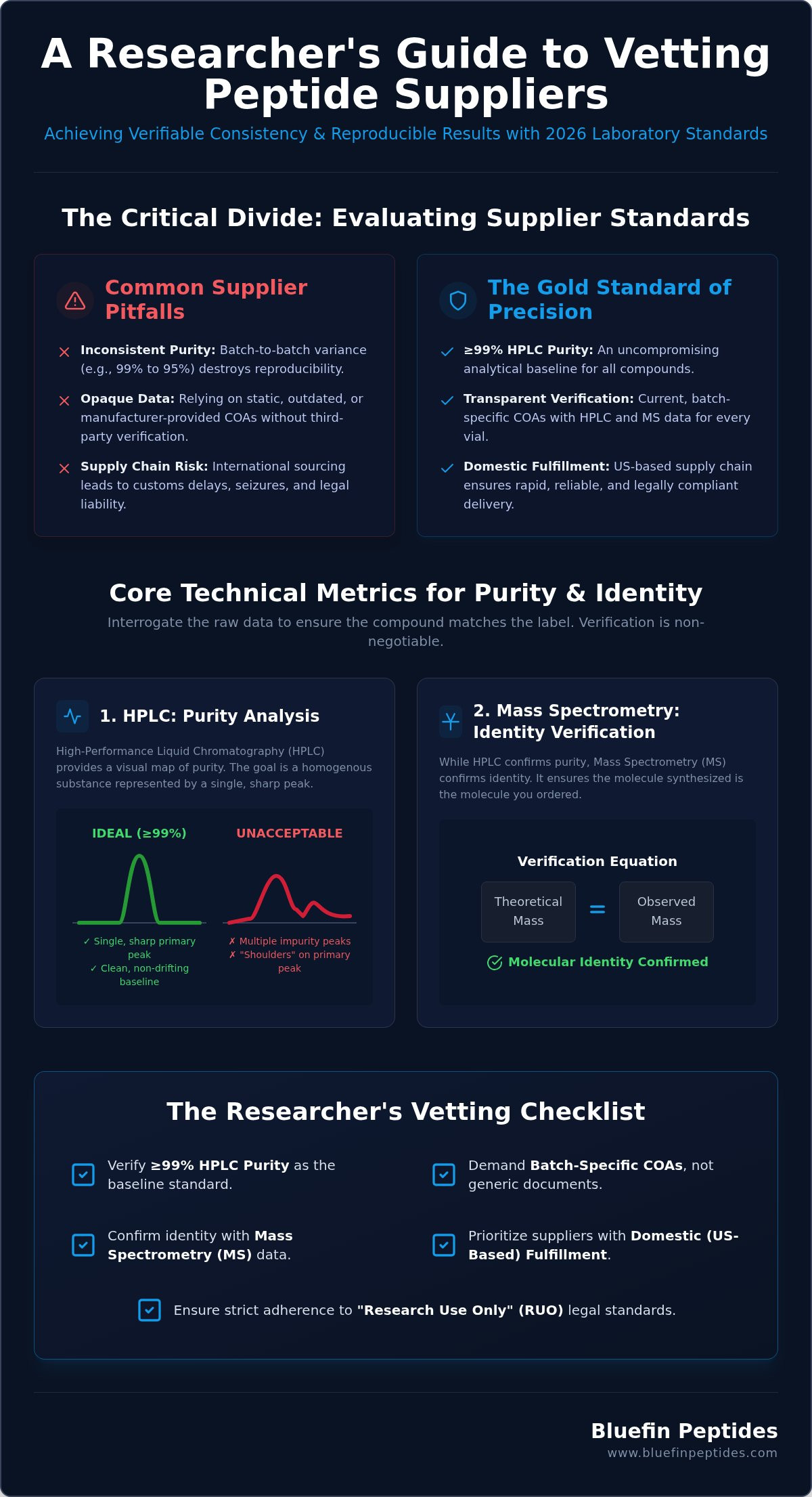
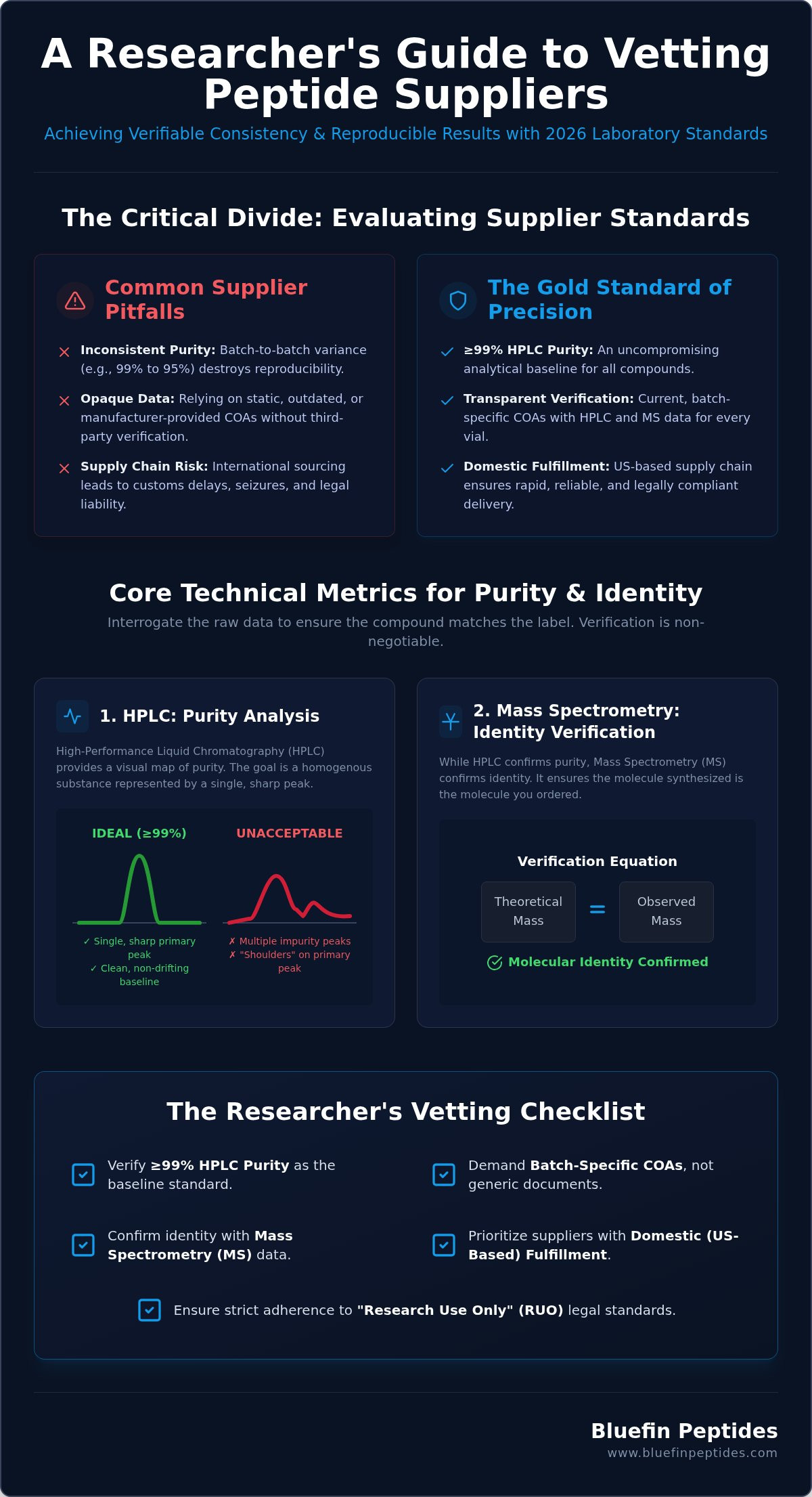
The chromatogram provides a visual map of the chemical landscape. Purity is determined through rigorous peak analysis. HPLC purity is the ratio of the main peak area to total peak area. A single, sharp peak indicates a homogeneous substance. Multiple smaller peaks, or "shoulders" on the primary peak, indicate the presence of truncated sequences or residual reagents. Demand the full report. A summary percentage can mask significant impurities that a visual inspection of the baseline would reveal. The baseline must be clean. The movement must be fluid. If the chromatogram shows significant noise, the synthesis was flawed.
Mass Spectrometry Verification
Identity confirmation is the second pillar of quality control. While HPLC measures purity, Mass Spectrometry (MS) confirms identity. It ensures the molecule synthesized is the molecule ordered. Theoretical mass must align with observed mass within a narrow tolerance. Discrepancies here indicate a failure in the synthesis process. To maintain experimental integrity, you must Interpret HPLC reports for lab use with an eye for these molecular deviations. If the observed mass does not match the theoretical weight, the research results will be invalid. Precision is non-negotiable.
Opaque reporting is a significant red flag. Stale analytical reports, often dated months or years prior to the current stock, are common among high-volume retail vendors. When evaluating reagent vendors, the date on the Certificate of Analysis must correspond to the current batch number. Analytical documentation should be as fluid as the supply chain itself. If the data is static, the quality is suspect. When you compare research peptide suppliers, prioritize those who provide batch-specific documentation for every order. At Bluefin Peptides, we provide batch-specific COAs for all HPLC-verified research peptides, ensuring that the documentation you receive is as fresh as the compound.
Logistics and Transparency: Beyond the Chemical Profile
Chemical purity is irrelevant if the compound remains sequestered in an international customs facility. To effectively compare research peptide suppliers, you must look beyond the molecular weight and into the physical movement of the inventory. International procurement in 2026 carries significant risks, including unpredictable lead times and potential batch degradation due to improper temperature control during extended transcontinental transit. Domestic, US-based stock eliminates these variables. It provides a predictable current for laboratory procurement. High-stakes research cannot wait for transoceanic logistics. Reliability is a logistical achievement. Speed is security.
Technical inquiries require technical answers. When evaluating a supplier, test their responsiveness to specific laboratory questions regarding counter-ion content or trifluoroacetic acid (TFA) removal. A high-performance partner provides more than a product; they provide a depth of expertise that mirrors the complexity of your research. If a vendor's support team cannot discuss the nuances of lyophilization or peptide stability, they are a retail entity, not a laboratory partner. Professionalism requires a high-level technical register. Verification requires a knowledgeable peer.
The Speed of Scientific Discovery
Active laboratories operate on tight schedules. Rapid domestic fulfillment is not a convenience; it's a structural requirement. Lyophilized powder offers relative stability, yet prolonged exposure to uncontrolled environments during international shipping can compromise the structural integrity of the peptide. Minimizing the duration between synthesis and bench-level application is critical for maintaining experimental integrity. For insights into maintaining compound viability after arrival, consult our guide on the Long-term storage of lyophilized vials. Bluefin Peptides ensures this momentum by offering same-day shipping for orders placed by 2 PM EST. Precision in fulfillment. Speed in discovery.
Documentation and Traceability
Traceability is the foundation of a robust audit trail. In 2026, regulatory scrutiny has reached a peak, making it essential to maintain a clear chain of custody and verifiable testing data. A Certificate of Analysis (COA) must be more than a static document; it must be a verifiable link to the specific lot in your possession. Verifying a COA's authenticity requires matching batch numbers on the vial to the analytical report provided. Opaque suppliers often use a 'COA on request' policy. This is a significant red flag. It suggests that the data is not immediately available or, worse, that the testing is not batch-specific. Transparency should be the default state. A disciplined supplier provides comprehensive documentation as a standard protocol. When you compare research peptide suppliers, prioritize those who offer immediate access to HPLC and mass-spec data. Security. Documentation. Verification.
A Researcher's Checklist for Vetting Domestic Suppliers
A systematic approach is the only defense against laboratory variance. When you compare research peptide suppliers, a structured audit prevents the intrusion of uncontrolled variables into your experimental environment. The transition from a retail procurement mindset to a high-performance laboratory partnership requires a cold, objective evaluation of the supplier's operational core. Security is built on verification. Discipline is maintained through data.
- Step 1: Confirm the presence of batch-specific HPLC and MS data for every catalog item to ensure molecular identity and purity.
- Step 2: Verify domestic US-based shipping and stock availability to bypass the inherent risks of international customs delays.
- Step 3: Evaluate the catalog focus. Specialization in a refined list of compounds often correlates with superior analytical oversight.
- Step 4: Audit the supplier's commitment to RUO (Research Use Only) standards. Professionalism requires strict adherence to legal boundaries.
- Step 5: Test the 'urgent precision' of their fulfillment process. Reliable partners provide same-day shipping for orders placed by 2 PM EST to maintain research momentum.
Specialization vs. Generalization
Generalist resellers often don't have the resources to verify every batch independently. A specialist laboratory partner focuses on a disciplined catalog, allowing for deeper analytical focus on complex sequences. Complex research compounds require high-level verification protocols that "everything-under-the-sun" vendors rarely possess. For instance, you can review our Retatrutide analytical specifications to see the technical depth required for long-chain peptide confirmation. Specialization breeds precision. Generalization introduces risk. When you compare research peptide suppliers, look for those who understand the physical state and chemical nature of their offerings at a granular level.
Assessing Supplier Longevity and Reputation
Longevity in the scientific community is earned through transparency. Audit the supplier's communication style. Marketing hype and aggressive sales language are red flags in a professional environment. You should look for technical clarity and secure infrastructure. If a vendor's website security or payment protocols appear improvised, their laboratory standards likely follow the same pattern. High-performance partners provide the tools for verification rather than asking for blind trust. They treat the researcher as a peer. They prioritize the "how" of their processes to ensure the "what" of your results. Professionalism is a constant state, not a marketing claim.
Establish a reliable domestic supply chain by selecting a partner that meets these rigorous standards at Bluefin Peptides.
Bluefin Peptides: Precision Synthesis and Rapid Domestic Fulfillment
Bluefin Peptides operates as a high-performance laboratory partner. We provide the empirical evidence required for advanced biochemical research. When you compare research peptide suppliers, the distinction lies in the commitment to verification over marketing claims. We maintain a US-based inventory to ensure fluid, high-speed logistics. Our catalog is specialized. We focus on high-demand compounds like Retatrutide Research Peptide and Tirzepatide Research Peptide to maintain a higher degree of analytical oversight. Precision. Verification. Security.
The Bluefin Standard of Verification
Our protocol requires ≥99% HPLC-verified purity on all catalog items. We don't ask for blind trust. We provide the tools for verification. Every order includes batch-specific COAs and Mass Spectrometry confirmation as a standard protocol. This academic-style approach to transparency ensures that researchers have immediate access to the data necessary for audit trails and experimental reproducibility. Security is the foundation. Trust is the result of data accessibility. We treat the researcher as a peer in a scientific field, prioritizing raw data over marketing fluff.
Logistical Excellence for Active Labs
Speed without precision is a liability. We act as a disciplined logistics specialist, offering same-day shipping for orders placed by 2 PM EST. This urgent precision ensures that research timelines remain intact. Our inventory includes lyophilized powders and complex research blends designed for stability and accuracy. For instance, our Ipamorelin CJC-1295 research blends are synthesized with the same deep-sea precision as our single-chain sequences. We focus on the "how" of our processes to ensure the "what" of your results. Fluid movement is our logistical baseline.
Choosing a laboratory partner is a decision of scientific consequence. Bluefin Peptides provides the security of domestic US stock and the reliability of batch-level details. We understand the high-stakes nature of laboratory environments. When you compare research peptide suppliers in 2026, the baseline is transparency. Our commitment to strict testing protocols and legal boundaries remains unwavering. We're a traditionalist in quality control but an innovator in logistical speed. Every sequence is a commitment to data integrity.
Advancing Laboratory Standards Through Analytical Rigor
Experimental success in 2026 is predicated on the absolute elimination of chemical variables. To effectively compare research peptide suppliers, a researcher must prioritize vendors who treat analytical data as a standard deliverable rather than a special request. Verification is the only path to reproducibility. By demanding ≥99% HPLC purity and batch-specific mass spectrometry confirmation, you secure the structural integrity of your data. Domestic fulfillment remains the final pillar of this technical framework, ensuring that high-purity compounds move from the laboratory to your bench with fluid efficiency and deep-sea precision.
Bluefin Peptides serves as a disciplined partner in this pursuit. We provide the precise tools for verification to ensure your research remains secure and your supply chain remains resilient. Our commitment to strict testing protocols and logistical speed reflects the high-stakes nature of your work. We invite you to Secure High-Purity Compounds for Your Laboratory at Bluefin Peptides, where every sequence is backed by a batch-specific COA and rapid domestic US shipping. Maintain the momentum of your scientific discovery with a partner focused on analytical transparency and unwavering professionalism.
Frequently Asked Questions
What is the difference between HPLC and Mass-Spec in peptide testing?
High-Performance Liquid Chromatography (HPLC) and Mass Spectrometry (MS) serve distinct analytical functions. HPLC measures the purity of the sample by separating chemical components to determine the concentration of the target peptide relative to impurities. Mass Spectrometry confirms molecular identity by measuring the exact mass to charge ratio. One defines the quantity of the pure substance; the other verifies that the substance is chemically correct.
Why is ≥99% purity required for research peptides?
A purity level of ≥99% is the laboratory gold standard required to eliminate uncontrolled variables in experimental models. Compounds with lower purity contain truncated sequences or residual reagents that can interfere with cellular signaling and metabolic pathways. In high-stakes research, even a 1% margin of unknown impurities can invalidate longitudinal data. Precision is a requirement for reproducible results.
How can I verify if a peptide supplier's COA is authentic?
Authenticity verification requires matching the batch number on the physical vial to the data on the analytical report. A legitimate Certificate of Analysis (COA) must include a recent timestamp and the specific laboratory's letterhead. When you compare research peptide suppliers, look for third-party verification seals and contact the testing facility directly if the data appears static or templated. Transparency is the default state of a professional partner.
What are the risks of sourcing research peptides from outside the USA?
International procurement introduces significant risks of customs seizures and batch degradation due to improper environmental controls during transit. Prolonged shipping durations compromise the physical state of lyophilized powders. Sourcing domestically ensures a fluid supply chain and immediate recourse if analytical discrepancies are discovered. Logistics is a critical component of quality control. Security. Trust. Speed.
Does Bluefin Peptides provide batch-specific testing for every order?
Yes, Bluefin Peptides provides batch-specific HPLC and Mass-Spec verification for every catalog item. We maintain a disciplined "show, don't tell" philosophy regarding quality. Every order includes the specific analytical documentation for that lot. This ensures that the compound you receive matches the laboratory standard required for your specific research model. We prioritize raw data over marketing fluff.
Can research peptides be used for human or veterinary applications?
No, research peptides are strictly for laboratory research use only. They are not for human consumption or veterinary use. Bluefin Peptides does not sell human-grade pharmaceuticals, medical consultations, or retail supplements. Adherence to these legal and ethical boundaries is a core tenet of our professional laboratory partnership. We operate with clinical precision and unwavering professionalism.
What should I look for in a peptide supplier's shipping policy?
A professional shipping policy must prioritize speed and environmental stability. Look for suppliers offering same-day fulfillment and domestic US stock to minimize transit time. To effectively compare research peptide suppliers, evaluate if they provide tracking and use secure logistics for sensitive blends. Reliability in delivery is as critical as purity in synthesis. Momentum is maintained through logistical excellence.
How do I store lyophilized research peptides to maintain stability?
Lyophilized peptides should be stored at -20°C for long-term stability or 4°C for short-term laboratory use. Protect the vials from light and moisture to prevent hydrolysis or oxidation. Once reconstituted, the stability window narrows significantly. Proper storage protocols ensure the chemical nature of the compound remains static until the point of application. Precision in storage ensures the integrity of the results.
For laboratory research use only. Not for human or veterinary use. This content is educational and does not constitute medical, dosing, or usage guidance.
Browse the BLUEFIN catalog