Mass Spec Peptide Verification: Ensuring Analytical Integrity in Research

A 99% purity rating on a Certificate of Analysis is a hollow metric if the underlying molecular identity remains unverified. High-performance liquid chromatography measures the quantity of a substance; it does not confirm its fundamental existence. Without rigorous mass spec peptide verification, researchers risk basing entire protocols on an elegant, high-purity ghost. Uncertainty regarding batch-to-batch consistency is a volatility that high-stakes laboratory environments cannot afford. Precision is the only acceptable baseline.
You recognize that even a minor deviation in an amino acid sequence can result in catastrophic experimental failure and wasted resources. This guide serves as your analytical compass. It provides the technical depth required to navigate complex m/z peaks and audit Certificates of Analysis with absolute autonomy. We will examine the instrumentation standards required for ISO/IEC 17025 compliance, the nuances of mass-to-charge ratios, and the critical distinction between purity and identity. By the conclusion, you will possess the tools to verify that your research materials are chemically identical to your specifications; this ensures your results are anchored in verifiable data rather than assumptions.
Key Takeaways
- Understand why high-purity HPLC results are analytically incomplete without definitive mass spec peptide verification to confirm molecular identity.
- Learn to interpret mass-to-charge (m/z) ratios and isotopic patterns to independently audit the accuracy of a Certificate of Analysis.
- Identify critical synthesis anomalies, such as deletion sequences or incomplete deprotection, that can lead to catastrophic experimental failure.
- Recognize the importance of ISO/IEC 17025 accreditation and batch-specific, third-party testing in maintaining rigorous laboratory standards.
The Role of Mass Spectrometry in Synthetic Peptide Verification
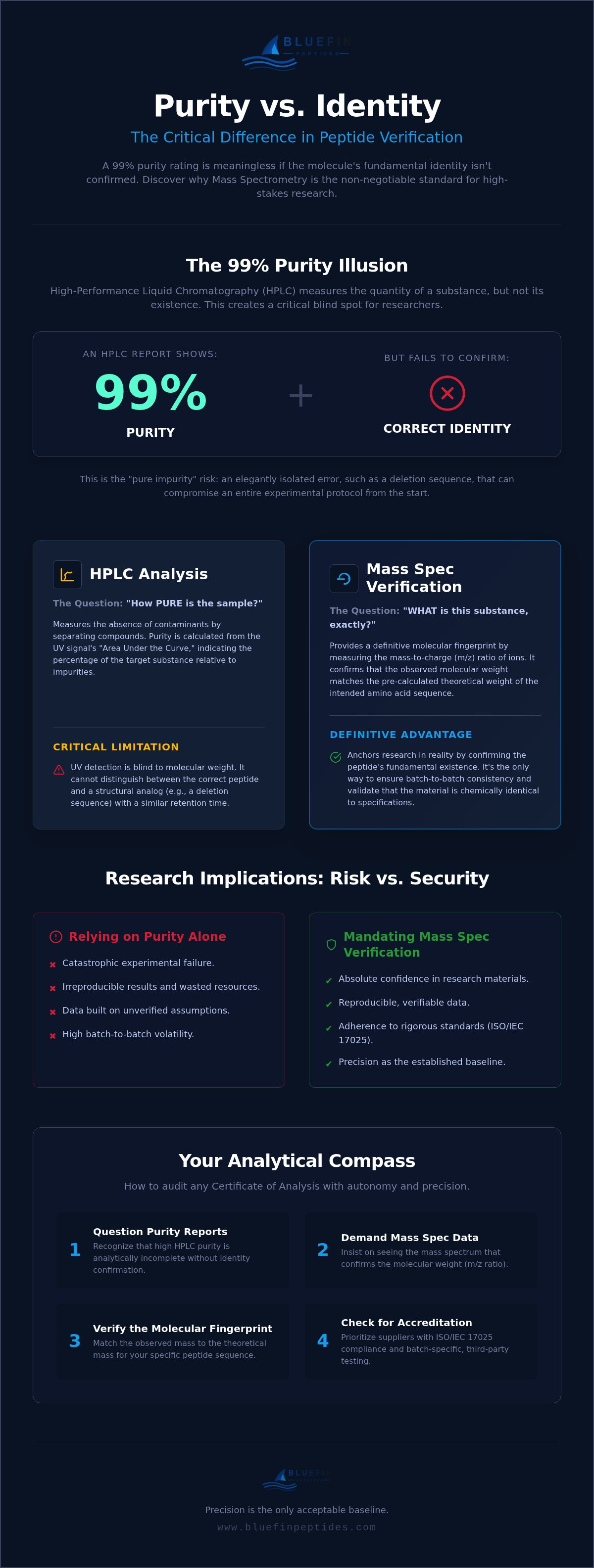
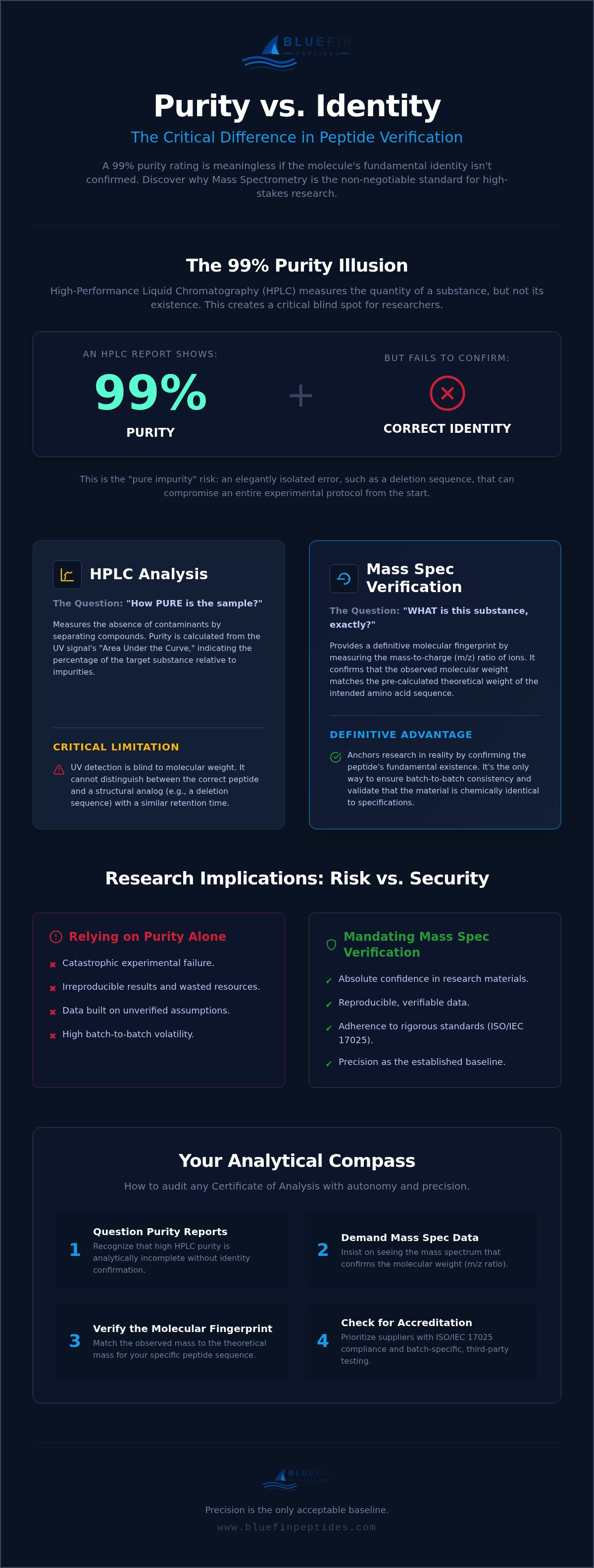
Mass spectrometry serves as the analytical bedrock of molecular identification. It functions by measuring the mass-to-charge ratio (m/z) of ions with clinical precision. In the field of mass spec peptide verification, this process is the only definitive method to confirm that a synthetic sequence matches its intended design. While other metrics like HPLC provide data on purity, they're silent on the matter of identity. A researcher might receive a sample that is 99% pure, yet if that 99% is the wrong molecule, the experiment is compromised from the start. MS anchors the research in reality. It's the difference between assumption and verification.
The process begins with ionization. This involves the transition of a lyophilized powder into gas-phase ions. It's a high-stakes conversion. The resulting digital spectrum provides a molecular fingerprint that is impossible to forge. For complex research peptides like Retatrutide or Tirzepatide, this verification ensures every amino acid is in its correct position. This level of scrutiny is essential for high-stakes research where batch-to-batch consistency is non-negotiable. It's a disciplined approach to laboratory standards.
The Fundamental Mechanism of Peptide Ionization
Peptide analysis primarily utilizes Electrospray Ionization (ESI). It's a soft ionization technique. Unlike harsher methods, ESI preserves the integrity of the peptide chain during its transition to the gas phase. It's the preferred choice for research peptides because it often produces multiple charge states. This allows the mass spectrometer to weigh individual molecules with dalton-scale precision. The data then moves from a physical chemical sample to a digital spectrum. This digital output provides the raw data necessary for deep-sea precision in analytical auditing. It's an efficient, highly organized method of quality control.
Verification vs. Discovery: The Researcher's Perspective
Verification is not discovery. In de novo sequencing, the researcher searches for an unknown. Rigorous mass spec peptide verification focuses on confirming a known sequence. This requires matching the observed mass from the spectrometer to a pre-calculated value. Theoretical mass is the calculated sum of the exact atomic masses of all constituent atoms in a specific amino acid sequence, assuming the most abundant isotopes are present. When the observed mass aligns with this theoretical value within a strict tolerance, identity is confirmed. This alignment is the primary service advantage of a verified batch. It provides the security and trust required for high-performance laboratory environments.
HPLC vs. Mass Spec: Why Purity Reports Alone are Insufficient
Purity is a metric of isolation. Identity is a metric of existence. High-Performance Liquid Chromatography (HPLC) serves as an analytical filter that separates a target peptide from its synthesis byproducts. It measures the absence of contaminants by monitoring UV absorbance as the sample elutes. However, HPLC is fundamentally incapable of confirming that the resulting peak is the intended molecule. Only mass spec peptide verification provides the molecular weight confirmation necessary to bridge the gap between "pure" and "correct." Without this second pillar, a researcher may be working with an elegantly isolated error.
The danger lies in the "pure impurity." During solid-phase peptide synthesis, a failed coupling step can produce a deletion sequence. If this truncated peptide shares similar hydrophobic characteristics with the target, it may co-elute at nearly the same time. On a standard HPLC chromatogram, these two distinct compounds might appear as a single, clean peak. Relying on this data alone is an analytical gamble. It's why we mandate strict research peptide quality standards for every batch. Verification requires looking beneath the surface of the chromatogram to confirm the underlying chemical signature.
Understanding HPLC Chromatograms
HPLC calculates purity via the Area Under the Curve (AUC). A 99% purity rating simply indicates that 99% of the detected UV signal originates from a single elution event. It offers no insight into the primary structure or amino acid sequence. UV detection is blind to molecular weight. It cannot distinguish between a target peptide and a structural analog with a similar retention time. This limitation makes HPLC a valuable tool for quantification but an insufficient one for absolute identification.
The Synergy of LC-MS in Analytical Chemistry
Liquid Chromatography-Mass Spectrometry (LC-MS) combines the separation power of the LC with the identification precision of the MS. The LC component organizes the sample flow, while the mass spectrometer provides a real-time molecular weight for every eluting peak. This synergy reduces experimental noise and ensures that the "pure" peak is indeed the target peptide. By incorporating advanced protein sequence analysis, laboratories can verify the parent ion with absolute certainty. Researchers requiring this level of transparency can examine our batch-specific documentation to see this dual-verification protocol in action. It is a disciplined approach to laboratory integrity.
Deciphering the Mass Spectrum: From m/z Ratios to Isotopic Patterns
The mass spectrum is a raw data map. It requires disciplined interpretation to extract verifiable truth from electronic signals. In a standard report, the base peak represents the ion with the highest relative abundance; however, this is not always the parent ion. For a retatrutide research peptide, the target identity is confirmed by the (M+H)+ or (M+nH)n+ peaks. This process of mass spectrometry peptide verification ensures that the observed mass-to-charge ratio aligns with the calculated theoretical value of the sequence. If the observed mass deviates beyond a strict tolerance, the batch fails the audit. There is no room for approximation in high-performance laboratory environments.
Verification involves navigating through the "monoisotopic mass" and the "average mass." The monoisotopic mass is the sum of the masses of the most abundant isotopes for each element in the peptide. For smaller sequences, this is the most prominent peak. For larger research compounds, the average mass becomes the center of the isotopic cluster. Auditing a Certificate of Analysis (COA) requires comparing these spectral results against the known molecular weight of the target. It's a show-don't-tell philosophy regarding quality. We provide the data; you verify the results. This transparency is the cornerstone of analytical integrity.
Reading the m/z (Mass-to-Charge) Ratio
Peptides are polybasic. During electrospray ionization, they often acquire multiple protons, appearing as +2, +3, or higher charge states. This phenomenon allows for the measurement of large molecules within the standard mass range of most detectors. The math is direct: the observed m/z is the sum of the peptide mass and the added protons, divided by the number of charges. To calculate the neutral mass of a peptide from a +2 ion peak, multiply the observed m/z value by two and subtract the mass of two protons. This calculation provides the immediate clarity required to confirm the primary structure of the sample.
Recognizing Isotopic Envelopes
Peptides don't appear as single, isolated lines. They exist as isotopic envelopes. This distribution is driven primarily by the natural abundance of Carbon-13. Larger peptides contain more carbon atoms, which increases the probability of having one or more C-13 isotopes, resulting in a broader cluster of "satellite" peaks. Distinguishing between this natural signal and background noise requires deep-sea precision. A disciplined analyst looks for the characteristic spacing of these peaks to confirm the charge state and the overall health of the sample. If the isotopic pattern is distorted, it may indicate the presence of impurities or degradation products that HPLC alone cannot detect.
Common Anomalies in Peptide Verification and Their Research Implications
Synthesis is a complex chemical orchestration. Even under optimal conditions, artifacts emerge. These anomalies represent more than just numerical deviations; they are potential contaminants that can invalidate biological assays. Rigorous mass spec peptide verification is the only method for identifying these subtle structural flaws. Common artifacts include salt adducts, where sodium (+23 Da) or potassium (+39 Da) ions attach to the peptide during the ionization process. While often harmless, these shifts must be correctly identified to avoid miscalculating the parent ion mass. More concerning are oxidation events, typically adding 16 Da to methionine or tryptophan residues, which can significantly alter binding affinity. Dimerization, where two peptide chains bond together, effectively doubles the molecular weight and often renders the sample biologically inactive.
Residual protecting groups present an additional layer of risk. Incomplete deprotection leaves moieties like tert-butyl (tBu, +56 Da) or 2,2,4,6,7-pentamethyldihydrobenzofuran-5-sulfonyl (Pbf, +252 Da) attached to the amino acid side chains. These residues act as steric inhibitors. They prevent the peptide from interacting with its target receptor. A disciplined analyst uses mass spectrometry to ensure these groups have been completely cleaved during the final stages of synthesis. This level of verification provides the security required for high-stakes research. It ensures the physical state of the offering matches the chemical design.
The Impact of Synthesis Artifacts on Laboratory Results
Experimental sensitivity is absolute. A 1% impurity can significantly skew data in cell-based assays or receptor binding studies. This is particularly true if the impurity is a structural analog with partial agonist or antagonist activity. Relying on HPLC alone is insufficient because it may fail to resolve these closely related species. Researchers must Compare research peptide suppliers based on their artifact reporting and transparency. High-performance laboratory partners provide full spectral data to account for every peak. For those requiring immediate analytical clarity, access our batch-specific verification reports to ensure your data is anchored in chemical truth.
Verifying Truncated Sequences
Failed coupling steps lead to truncated sequences. These are often referred to as 'N-1' peaks, where a single amino acid is missing from the chain. In complex molecules like the tirzepatide research peptide, sequence fidelity is paramount for metabolic stability. A 'noisy' mass spectrum indicates a lack of synthesis control. A clean, dominant parent peak signifies a high-performance batch. Identifying these deletion sequences requires deep-sea precision in data interpretation. It's the first line of defense against faulty synthesis. Rigorous mass spec peptide verification serves as the final audit for every batch we fulfill.
Sourcing Verified Compounds: The Bluefin Standard for Mass-Spec Confirmation
Verification is the bedrock of analytical integrity. At Bluefin Peptides, we operate with a show-don't-tell philosophy regarding quality. We don't ask for blind trust. We provide the tools for independent audit. Every batch of research peptides undergoes a rigorous 'Clinical Precision' protocol. This mandate requires both HPLC for purity quantification and mass spec peptide verification for absolute identity confirmation. We utilize batch-specific, third-party verification to ensure our data remains objective and beyond reproach. This is the standard required for high-stakes laboratory environments.
Transparency is our primary service advantage. While other vendors may offer a truncated summary or a generic, non-batch-specific report, we provide the full Certificate of Analysis (COA). This documentation includes the complete mass spectrum and HPLC chromatogram for the specific vial you receive. Our logistical framework is designed for efficiency and security. We maintain our verified inventory within the United States. This allows for rapid deployment to your laboratory without the volatility of international customs or unverified transit conditions. It's a disciplined approach to research support that prioritizes the physical state and chemical nature of the offering.
Academic-Grade Documentation for Every Researcher
Precision is reflected in our documentation. Every vial we fulfill is linked to a specific batch number. This number serves as the anchor for your analytical audit. We encourage researchers to match the batch number on the vial against the provided COA for their laboratory records. Our reporting reflects an aquatic-inspired precision; data flows logically from raw spectral peaks to final identity confirmation. This organization allows for efficient navigation during internal audits or peer-review preparations. It ensures your research is anchored in verifiable chemical truth. We treat every researcher as a peer in a professional scientific field.
Securing Your Research Integrity
Cheap, unverified peptides represent a false economy in science. The cost of a failed experiment or a retracted paper far outweighs the marginal savings of procurement from unverified sources. Domestic, verified supplies offer the security and trust required for high-performance research. By choosing a partner that prioritizes methodology over marketing fluff, you secure the integrity of your findings. We remain traditionalists in our adherence to strict testing protocols while innovating in logistical speed. Our commitment is to the "how" of our processes to ensure the "what" of your results. Explore our HPLC and mass-spec confirmed catalog to secure your next batch with clinical certainty.
Anchoring Research in Analytical Truth
Analytical integrity is not a static achievement. It's a continuous process of verification and rigorous auditing. You've seen that relying solely on HPLC purity is a vulnerability; true security requires the molecular weight confirmation that only mass spec peptide verification provides. By identifying synthesis artifacts and interpreting isotopic envelopes, you transition from assumption to empirical certainty. This discipline ensures your results are repeatable and your data is anchored in chemical reality. Navigate your protocols with the confidence that only deep-sea precision can provide.
Every experiment deserves a foundation of clinical precision. We provide the documentation required to maintain these standards. With batch-specific COAs, ≥99% HPLC-verified purity, and secure US-based laboratory fulfillment, we act as your high-performance laboratory partner. Secure your research integrity with Bluefin's mass-spec verified peptides. Your pursuit of discovery is supported by our commitment to transparency and verifiable truth. We look forward to facilitating your next breakthrough.
Frequently Asked Questions
What is the difference between HPLC and mass spec in peptide testing?
HPLC measures quantity; MS measures identity. HPLC uses UV absorbance to identify impurities and calculate purity percentages based on the area under the curve. Mass spectrometry measures the mass-to-charge ratio of ions to confirm the molecule's fundamental existence. A sample may be HPLC-pure yet chemically incorrect. Both metrics are required for laboratory integrity.
Can I rely on a mass spec report if the HPLC purity is below 95%?
No. Analytical integrity requires both metrics to be within strict tolerances. Mass spectrometry confirms that the target molecule is present, but low HPLC purity indicates the sample contains significant contaminants. These impurities can skew assay results and lead to experimental failure. Always demand ≥98% purity alongside identity confirmation for high-stakes research.
How do I calculate the molecular weight of a peptide from its m/z peaks?
Multiply the observed m/z value by the charge state (z). Subtract the mass of the added protons; this is approximately 1.007 Da per proton. This calculation reveals the neutral molecular weight of the peptide. Direct comparison against the theoretical value is then possible. Precision is the only acceptable baseline in these calculations.
What are 'adducts' in a mass spectrometry report and should I be worried?
Adducts are non-covalent associations between the peptide and ions such as sodium (+23 Da) or potassium (+39 Da). These occur during the ionization process. They shift the observed mass but don't indicate a synthesis error. They must be correctly identified to verify the parent ion. They are common artifacts that require disciplined interpretation.
Why do some peptides show multiple peaks in a mass spec report?
Multiple peaks typically represent different charge states of a single molecule. Peptides often acquire several protons during electrospray ionization. Additionally, isotopic envelopes appear due to the natural abundance of Carbon-13. This creates a rhythmic cluster of peaks rather than a single line. It's a sign of a complex molecular structure rather than contamination.
Does mass spectrometry confirm the sequence order or just the total mass?
Standard MS confirms total molecular mass. It does not confirm sequence order. Confirming the specific arrangement of amino acids requires tandem MS/MS or enzymatic mapping. Total mass is a necessary but not exhaustive proof of identity. It's the first line of defense in sequence verification and an essential component of analytical auditing.
How often should a research peptide batch be re-verified by mass spec?
Verification is mandatory for every unique batch. Stability varies based on amino acid sequence and storage conditions. For high-stakes protocols, mass spec peptide verification provides the necessary audit trail for every new lot. It prevents experimental drift and ensures batch-to-batch consistency. Security and trust depend on this rigorous and disciplined schedule.
Is mass spec verification necessary for simple blends like BPC-157 / TB-500?
Verification is non-negotiable for blends like BPC-157 / TB-500. Components must be individually confirmed within the mixture. This ensures the blending process hasn't introduced degradation or artifacts. mass spec peptide verification acts as the final analytical gate for these complex offerings. Precision is the only standard we accept for laboratory fulfillment.
For laboratory research use only. Not for human or veterinary use. This content is educational and does not constitute medical, dosing, or usage guidance.
Browse the BLUEFIN catalog