How to Identify Legit Peptide Companies Online: A Laboratory Procurement Guide

In a landscape where the 2026 collapse of major vendors like Peptide Sciences has redefined market stability, blind trust is a laboratory liability. Federal enforcement and the reclassification of many sequences as biologics have decimated the traditional gray market. You recognize that the "research use only" disclaimer no longer provides a shield against analytical inconsistency or sudden supply chain evaporation. Finding legit peptide companies online now requires a transition from evaluating marketing volume to auditing technical transparency and logistical discipline.
This guide establishes the rigorous analytical and operational benchmarks necessary to verify a supplier for high-precision laboratory research. You'll learn to navigate the complexities of batch-specific documentation and the necessity of ≥99% HPLC verification to ensure your longitudinal studies remain anchored in empirical fact. We provide a methodical framework for assessing a partner's domestic fulfillment capabilities and their commitment to the deep-sea precision required in modern biochemistry. Total transparency is the only currency that matters when the integrity of your data is at stake.
Key Takeaways
- Audit analytical documentation to ensure every batch meets ≥99% HPLC-verified purity standards before initiating procurement.
- Identify legit peptide companies online by verifying their strict adherence to the Research Use Only (RUO) framework and their separation from consumer retail models.
- Evaluate domestic logistical infrastructure to ensure chemical stability and rapid fulfillment through US-stocked inventory.
- Recognize critical red flags, such as generic or outdated COAs and medical claims, that signal a lack of laboratory-grade discipline.
- Establish a transparent supply chain for longitudinal studies by prioritizing vendors who provide mass-spec confirmation for every unique batch.
Defining Legitimacy in the Online Research Peptide Market
Legitimacy in the peptide sector is defined by the rigid separation of chemical reagents from consumer commodities. For a laboratory procurement officer, the primary indicator of a supplier's integrity is their adherence to the Research Use Only (RUO) framework. This isn't a mere legal disclaimer. It's a fundamental operational boundary. Legit peptide companies online operate with the understanding that their products are intended for in vitro or animal studies conducted by qualified professionals. They prioritize chemical stability and analytical verification over the aesthetic appeal of packaging or the urgency of retail discounts. Navigating the currents of regulatory shifts requires a partner who understands that research integrity is anchored in data, not marketing volume.
The Legal Framework for Research Peptides
The distinction between research-grade chemicals and human-grade pharmaceuticals is absolute. Legitimate suppliers maintain a disciplined distance from the clinical application of their products. They don't offer dosage protocols. They don't provide medical consultations. Instead, they provide data. Procurement requires a verification of researcher status, ensuring that materials like Retatrutide or Tirzepatide are utilized within controlled environments. This adherence to legal boundaries protects the integrity of the supply chain and the validity of the research being conducted. When a vendor begins to blur these lines by suggesting therapeutic benefits, they signal a departure from established research peptide quality standards and enter a territory of high regulatory risk.
Verifiable Identity: The Foundation of Trust
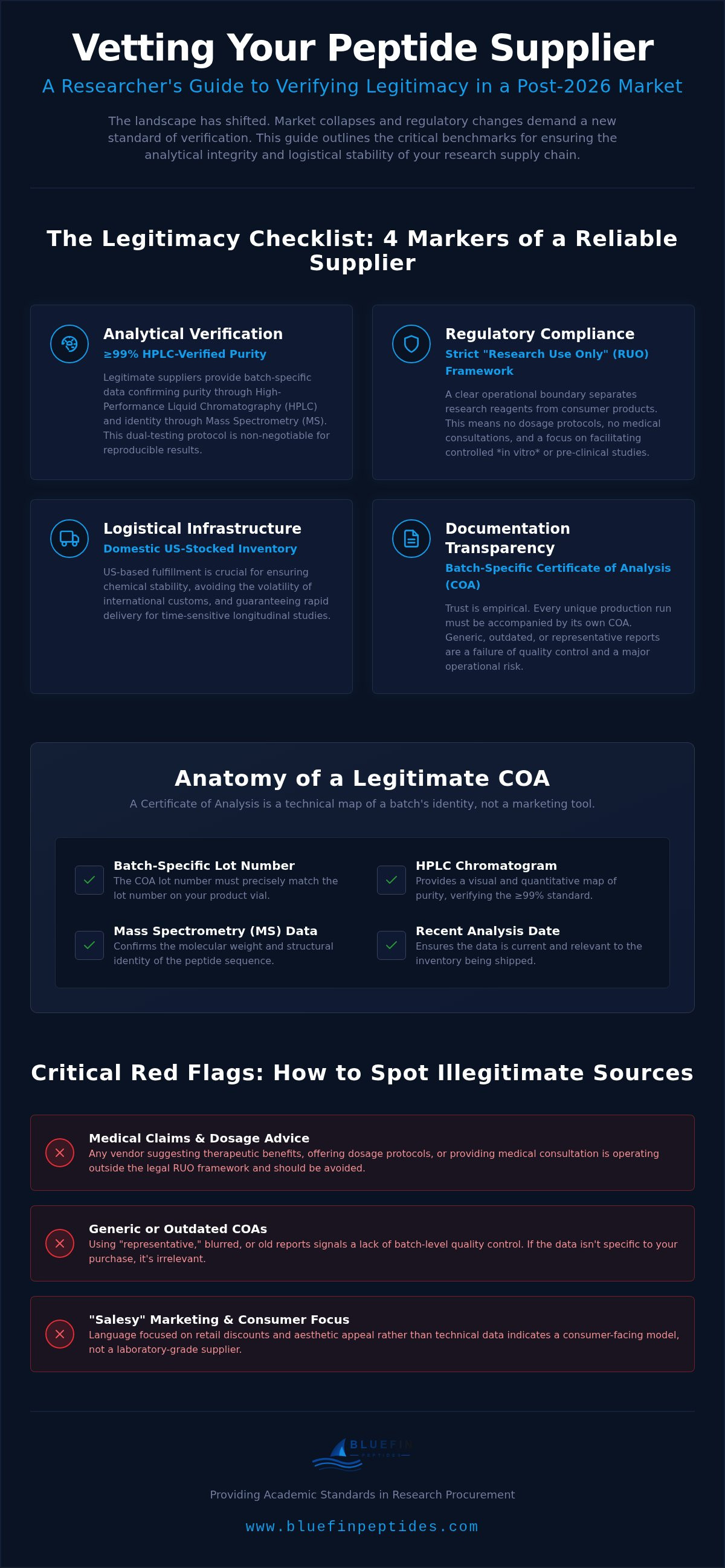
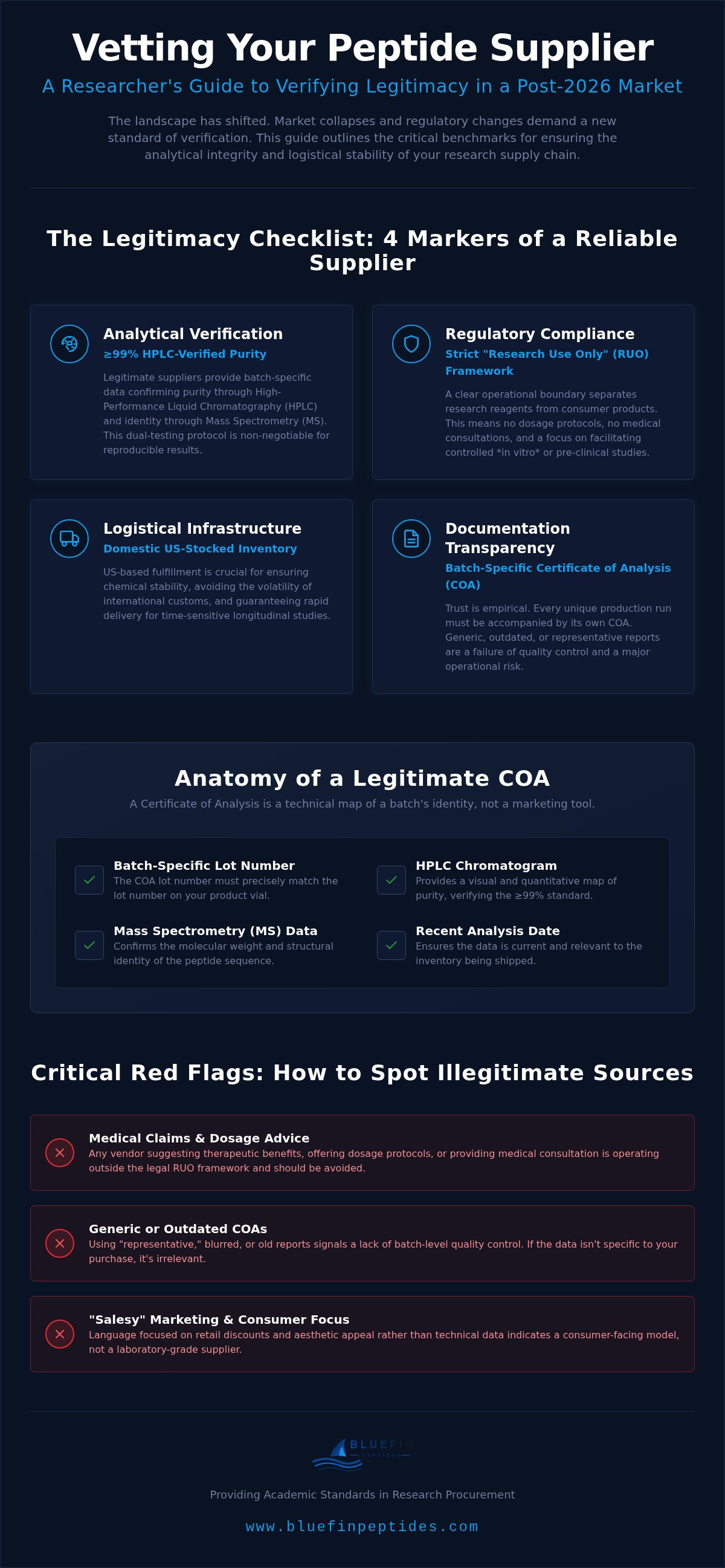
Trust is an empirical value, not an emotional one. Identifying legit peptide companies online begins with verifying the supplier's physical and logistical footprint. High-performance labs require US-based stocking to avoid the volatility of international customs and the degradation of temperature-sensitive compounds during prolonged transit. A supplier's identity is further confirmed by their commitment to documentation. A batch-specific Certificate of Analysis serves as the primary instrument of verification. It should include High-Performance Liquid Chromatography (HPLC) results and Mass Spectrometry (MS) data.
If a company relies on generic, outdated, or blurred reports, they fail the baseline test for legitimacy. Professionalism is found in the technical register of the communication. Legitimate suppliers treat the reader as a peer in a scientific field, utilizing objective terminology that assumes professional knowledge. They replace marketing "fluff" with raw data points. This cold, authoritative delivery is the hallmark of a disciplined logistics specialist focused on the "how" of their processes to ensure the "what" of their results. By steering clear of salesy language and focusing on mass-spec confirmation, these companies provide the security required for high-stakes laboratory environments.
The Anatomy of a COA: Beyond the 99% Purity Claim
In the search for legit peptide companies online, the "99% purity" claim is ubiquitous. It's often used as a marketing facade to obscure a lack of analytical depth. True legitimacy is found in the raw data of a Certificate of Analysis (COA). Adhering to research peptide quality standards requires a deep dive into the specific analytical methodology used for verification. A COA isn't just a document. It's a technical map of a batch's chemical identity and refinement. Without verifiable data, a purity claim is merely a suggestion, not a fact.
Generic COAs are a significant operational risk. They represent a "representative" sample, not the specific batch in your possession. For high-stakes studies, batch-specific data is mandatory. Without it, researchers face the risks of buying peptides online from sources that lack rigorous quality control. Legitimate suppliers prioritize transparency, providing both High-Performance Liquid Chromatography (HPLC) and Mass Spectrometry (MS) results for every unique production run. This dual-testing protocol ensures that the peptide's purity and identity are confirmed before it enters your laboratory environment.
Interpreting HPLC Chromatograms
HPLC analysis provides a visual and quantitative map of chemical purity. You should look for a clean, singular peak with a stable baseline. A high signal-to-noise ratio indicates a lack of significant trace impurities. A singular, sharp peak indicates a high concentration of the target molecule. Conversely, "shoulders" or secondary peaks suggest the presence of truncated sequences or residual solvents. These impurities are quantified by measuring the area under the curve relative to the main peak. High-Performance Liquid Chromatography (HPLC) is the gold standard for peptide purity verification. For those conducting high-stakes studies, you can review our guide on interpreting HPLC reports for compounds like Retatrutide.
Mass Spectrometry Confirmation
While HPLC confirms purity, Mass Spectrometry (MS) confirms identity. It ensures the synthesized sequence actually matches the target molecule. The mass-to-charge ratio (m/z) provides an exact fingerprint of the molecular structure. The report must show an observed mass that aligns with the theoretical molecular weight of the peptide. Discrepancies here indicate a failed synthesis or a mislabeled product. This level of verification is non-negotiable for longitudinal studies. Identifying legit peptide companies online requires a commitment to this disciplined testing protocol. This rigorous filtration ensures that the fluid movement of your research isn't stalled by contaminated reagents. You can verify our current batch specifications to see these standards in practice.
Operational Markers of a Reliable Domestic Supplier
Speed is irrelevant without stability. In high-performance laboratory procurement, we operate under a model of "Urgent Precision." This philosophy dictates that the momentum of a supply chain must never outpace the analytical verification of the product. Legit peptide companies online are distinguished by their logistical control as much as their chemical purity. While competitors focus on retail volume, a disciplined supplier prioritizes the physical state of the compound from the moment of synthesis to the point of delivery. This requires a supply chain characterized by fluid movement and deep-sea precision, ensuring that the integrity of your research remains uncompromised by logistical friction.
US-Based Stocking vs. Drop-Shipping
International drop-shipping introduces variables that are unacceptable in a controlled research environment. Transoceanic transit exposes sensitive peptide sequences to extreme temperature fluctuations and prolonged customs delays. These external stressors can initiate premature degradation, rendering the chemical data on a COA obsolete by the time the package arrives. Legitimate companies maintain their own domestic inventory within climate-controlled environments. By sourcing from US-stocked inventory, you eliminate the volatility of international shipping and ensure batch consistency across longitudinal studies. This logistical transparency is a primary marker of a partner who treats procurement with academic seriousness.
Stability and Fulfillment Standards
The science of lyophilization is the standard for preserving peptide integrity. This freeze-drying process removes moisture through sublimation, creating a stable, porous cake that resists thermal degradation. However, the stability of a lyophilized powder is only as reliable as the fulfillment protocols that follow. Packaging must be engineered to protect vials from light exposure and mechanical stress during the last mile of transit.
Real-time tracking and secure, tamper-evident seals are non-negotiable requirements for professional laboratory planning. These operational benchmarks provide the security needed to maintain a consistent research schedule. For a detailed analysis of how these standards apply to specific sequences, you may review our technical specifications on lyophilized peptide storage and purity verification. A disciplined logistics specialist doesn't just ship a product. They manage a cold-chain environment that mirrors the precision of the laboratory itself. This commitment to the "how" of fulfillment ensures the "what" of your experimental results remains valid and reproducible.
Red Flags: How to Spot Illegitimate Peptide Sources
Identifying legit peptide companies online requires a critical, almost adversarial approach to vendor claims. In an era of increased federal oversight, many entities have transitioned to a gray market model where they prioritize retail volume over analytical discipline. These sources often lack a verifiable US business identity and fail to provide batch-specific documentation. If a supplier provides an outdated report or a generic "representative" scan, they've failed the most basic requirement of laboratory procurement. Transparency isn't a marketing choice. It's a technical necessity. Opaque shipping practices often signal a lack of domestic infrastructure. Illegitimate sources frequently hide behind anonymous PO boxes or use shell identities to evade regulatory scrutiny. A verifiable US business identity is a prerequisite for professional trust.
The absence of granular technical specifications is a definitive warning sign. For instance, a professional supplier will provide exhaustive tirzepatide research peptide data, including its amino acid sequence, theoretical mass, and specific storage requirements. When a vendor relies on salesy urgency or slang rather than empirical specifications, they reveal a retail-centric model that is incompatible with high-precision research. These companies often downplay the risks of international transit, ignoring the potential for chemical degradation during customs delays.
The Danger of Medical Claims
A primary indicator of an illegitimate source is the presence of medical claims or dosage instructions. Legit peptide companies online strictly adhere to "Laboratory Use Only" terminology. They don't discuss fat loss, muscle gain, or therapeutic outcomes. Any mention of human consumption or veterinary application is a breach of the RUO framework. These gray market sites masquerade as research suppliers but prioritize consumer sales, creating significant legal and safety risks for the buyer. A disciplined supplier understands that their role is to provide a chemical reagent, not a medical consultation. If you encounter a site offering "cycles" or "stacking" advice, it's a clear signal to terminate the procurement process.
Analytical Inconsistencies
Forged or "photoshopped" Certificates of Analysis are increasingly common in the unregulated market. You must scrutinize the metadata and formatting of any provided report. Look for inconsistencies in fonts, blurred logos, or dates that don't align with the current batch. The "too good to be true" price trap is another operational red flag. High-purity synthesis and rigorous third-party verification require significant financial investment. If a price is drastically lower than the industry standard, it's likely that the analytical chemistry has been bypassed. Purity below 98% is generally unacceptable for modern laboratory standards. To ensure your procurement meets these rigid benchmarks, procure HPLC-verified research peptides from a disciplined logistics specialist focused on data integrity.
Bluefin Peptides: Academic Standards in Research Procurement
Bluefin Peptides operates as a high-performance laboratory partner, not a retail vendor. Our infrastructure is built on the premise that data is the only valid trust signal. In a market saturated with marketing declarations, we provide the tools for empirical verification. We maintain a singular focus on providing ≥99% HPLC-verified compounds to support the integrity of longitudinal studies. Finding legit peptide companies online often feels like navigating unmapped waters, but our commitment to clinical precision provides the necessary anchor for your procurement strategy. We prioritize transparency over declarations, treating every researcher as a peer in a disciplined scientific field.
The Bluefin Analytical Protocol
Every synthesis batch undergoes a multi-step filtration process before it enters our inventory. We don't ask for blind trust. Instead, we provide mass-spec confirmation and HPLC purity data for every unique production run. This third-party validation ensures that the chemical identity of your reagents is beyond reproach. Researchers can access batch-specific reports for their laboratory records, ensuring total transparency in their analytical chain. For those requiring complex sequences, our GHK-Cu BPC-157 TB-500 research blends are subjected to the same rigid testing protocols as our single-molecule offerings.
Logistics Without Compromise
Our fulfillment model is defined by "Urgent Precision." We recognize that research timelines are rigid. Consequently, we maintain US-stocked inventory to ensure fluid movement throughout the supply chain. This domestic footprint eliminates the volatility of international transit and the risk of customs-induced degradation. We manage every step of the chain of custody to protect the chemical stability of our lyophilized powders. Our process is designed to move with the speed of a high-performance lab without ever cutting corners on the underlying data verification.
Reliability is a function of discipline. Our maritime-inspired logistics ensure your materials arrive with deep-sea precision and speed. We prioritize the "how" of our fulfillment to guarantee the "what" of your experimental data. This stoic reliability makes us the preferred choice for researchers who demand academic standards in their procurement. You can explore our catalog of HPLC-verified research peptides to secure the reagents necessary for your next study. We remain committed to providing the verifiable data required for high-stakes laboratory environments.
Advancing Research with Analytical Certainty
Procurement in the modern research landscape requires a transition from evaluating marketing volume to auditing technical transparency. Legit peptide companies online are identified not by their retail reach, but by the depth of their analytical documentation. Every vial must be an empirical fact, backed by batch-specific HPLC and Mass-Spec reports that confirm ≥99% purity and molecular identity. This rigorous filtration ensures that the fluid movement of your longitudinal studies isn't stalled by contaminated reagents or logistical volatility.
Establishing a reliable supply chain demands a partner who operates with maritime-grade precision. Domestic US fulfillment and a strict adherence to Laboratory Use Only standards provide the security required for high-stakes laboratory environments. By prioritizing suppliers who provide verifiable data over vague declarations, you anchor your research in empirical truth. We remain committed to the disciplined logistics and analytical rigor necessary for your success. Secure high-purity compounds for your next laboratory study and ensure your data remains beyond reproach. Your research deserves the security of a disciplined laboratory partner.
Frequently Asked Questions
How can I verify if a peptide company is legit?
To verify legitimacy, you must audit the supplier's analytical and logistical transparency. Legit peptide companies online provide batch-specific HPLC and Mass-Spec reports rather than generic purity declarations. They maintain a US-based footprint to ensure chain of custody and avoid the volatility of international transit. If a vendor utilizes retail slang or makes therapeutic claims, they've abandoned the professional standards required for high-precision laboratory procurement.
What should I look for in an HPLC report for peptides?
A professional HPLC report should display a singular, sharp peak with a stable baseline. You must evaluate the signal-to-noise ratio to ensure trace impurities are minimal. The report should quantify purity by measuring the area under the curve, targeting a value of ≥99%. Any secondary peaks or "shoulders" indicate the presence of truncated sequences or residual solvents, which can compromise the validity of your research data.
Why is batch-specific testing more important than general purity claims?
General purity claims are marketing declarations that lack empirical weight. Batch-specific testing is mandatory because every synthesis cycle introduces unique chemical variables. By reviewing a report for your specific batch, you ensure the reagent in your laboratory matches the analytical specifications required for your study. This level of granular detail is the primary differentiator for legit peptide companies online, providing the security needed for longitudinal research.
Is it legal to buy research peptides online in the USA?
Procurement of research peptides is legal in the United States when the chemicals are intended exclusively for laboratory use by qualified professionals. The Research Use Only (RUO) framework provides the necessary legal boundary for these transactions. Suppliers must operate with the understanding that these compounds are not for human, veterinary, or consumer use. Adherence to these strict protocols protects the integrity of the scientific supply chain.
What is the difference between research-grade and pharmaceutical-grade peptides?
Research-grade peptides are high-purity chemical reagents intended for in vitro or animal studies within a laboratory environment. Pharmaceutical-grade peptides are regulated drugs approved for human therapeutic use and require a prescription. Bluefin Peptides provides research-grade materials for scientific inquiry. These compounds are never intended for clinical application, and legitimate suppliers maintain a disciplined separation between laboratory supplies and pharmaceutical products.
Why do legitimate peptide companies avoid giving dosage instructions?
Legitimate suppliers avoid dosage instructions because their products are strictly for laboratory research. Providing therapeutic guidance would violate the Research Use Only (RUO) framework and signal a lack of professional discipline. A partner focused on laboratory procurement treats the reader as a peer in a scientific field, prioritizing chemical data over medical advice. This boundary ensures that the supplier remains a logistics specialist rather than a medical consultant.
How does domestic shipping impact research peptide stability?
Domestic fulfillment ensures the fluid movement of materials from a climate-controlled inventory to your laboratory. Rapid transit reduces the exposure of lyophilized powders to extreme temperature fluctuations and mechanical stress. International shipping introduces the risk of prolonged customs delays, which can initiate premature chemical degradation. By utilizing US-stocked inventory, you maintain the chain of custody and ensure the chemical stability of your reagents throughout the fulfillment process.
Can I trust third-party testing reports provided by the supplier?
Trust in third-party reports is anchored in the raw analytical data provided. A verifiable report must include the chromatogram from the HPLC analysis and the molecular fingerprint from Mass Spectrometry. You should audit these reports for consistency in formatting and metadata. Legitimate suppliers provide these tools for verification rather than asking for blind trust, allowing researchers to independently confirm the purity and identity of every batch.
For laboratory research use only. Not for human or veterinary use. This content is educational and does not constitute medical, dosing, or usage guidance.
Browse the BLUEFIN catalog