Ipamorelin and CJC-1295 Research Applications: Analytical Standards for 2026
Precision isn't a variable; it's the baseline for high-stakes laboratory environments. You've likely encountered the frustration of batch-to-batch inconsistency or the absence of verifiable COAs that stall critical timelines. Data integrity requires more than a label. It demands absolute transparency. For Ipamorelin and CJC-1295 research applications, the margin for error is non-existent. Analytical standards for 2026 dictate a shift toward deep-sea precision in chemical sourcing. Reliability. Verification. Results.
This technical brief establishes a rigorous protocol for utilizing high-purity blends to investigate dual-pathway secretagogue mechanisms at the cellular level. We'll provide a comprehensive analysis of the synergistic interactions between these compounds while detailing the specific HPLC and Mass-Spec requirements necessary to verify sequence accuracy and ≥99% purity. By prioritizing batch-specific validation and US-based logistics, you'll secure the foundation of your longitudinal research against the persistent risks of chemical degradation and supplier opacity. Our focus remains on the verifiable data required to maintain the highest levels of laboratory security.
Key Takeaways
- Decipher the dual-pathway synergy between GHRH mimetics and selective ghrelin receptor agonists to amplify GH pulse amplitude in laboratory models.
- Standardize Ipamorelin and CJC-1295 research applications through the use of ratio-controlled blends that eliminate experimental variability during reconstitution.
- Verify chemical specifications using HPLC and Mass-Spec data to ensure a baseline of ≥99% purity for all analytical sequences.
- Streamline laboratory workflows with single-vial protocols designed for high-performance longitudinal studies and cellular analysis.
- Secure supply chain integrity by prioritizing US-based logistics and specialized cold-chain handling for sensitive lyophilized compounds.
Defining the Ipamorelin and CJC-1295 Synergistic Model
Precision in the lab requires a mapping of the somatotropic axis that accounts for both amplitude and frequency. The Ipamorelin and CJC-1295 synergistic model functions as a dual-pathway system. It navigates the biochemical currents of growth hormone regulation with surgical accuracy. By combining a ghrelin receptor agonist with a GHRH mimetic, researchers can investigate amplified secretory responses that a single-ligand approach cannot replicate. Reliability matters. This section details the molecular architecture and biochemical rationale underpinning Ipamorelin and CJC-1295 research applications in modern laboratory settings. It's a framework built on transparency and verifiable data.
Ipamorelin: A Selective Ghrelin Receptor Agonist
Ipamorelin is a synthetic pentapeptide (Aib-His-D-2-Nal-D-Phe-Lys-NH2) that exhibits high selectivity for the growth hormone secretagogue receptor (GHSR-1a). It belongs to the class of Growth hormone secretagogues (GHSs) that mimic the action of endogenous ghrelin. Unlike earlier generation secretagogues, Ipamorelin doesn't trigger the release of secondary hormones. Research models demonstrate a distinct absence of impact on cortisol or prolactin levels. This specificity allows for a cleaner data set. It ensures that observations of cellular growth or metabolic shifts are attributed directly to the GH pulse rather than systemic stress responses or hormonal interference. Depth of data is the primary anchor for credible results.
CJC-1295: The GHRH Analogue Framework
CJC-1295 is a modified version of the Growth Hormone Releasing Factor (GRF 1-29). It functions as a GHRH analogue by stimulating the pituitary's somatotrophs directly. In high-precision research, the "No DAC" version, also known as Mod GRF 1-29, is the analytical standard. It lacks the Drug Affinity Complex that extends half-life to durations that disrupt natural rhythms. This absence of DAC allows researchers to maintain the natural pulsatile rhythm of growth hormone release. The molecular chain is engineered for enhanced stability against enzymatic degradation. It provides a reliable baseline for investigating long-term pituitary sensitivity and receptor down-regulation without the signal "bleeding" common in long-acting analogues.
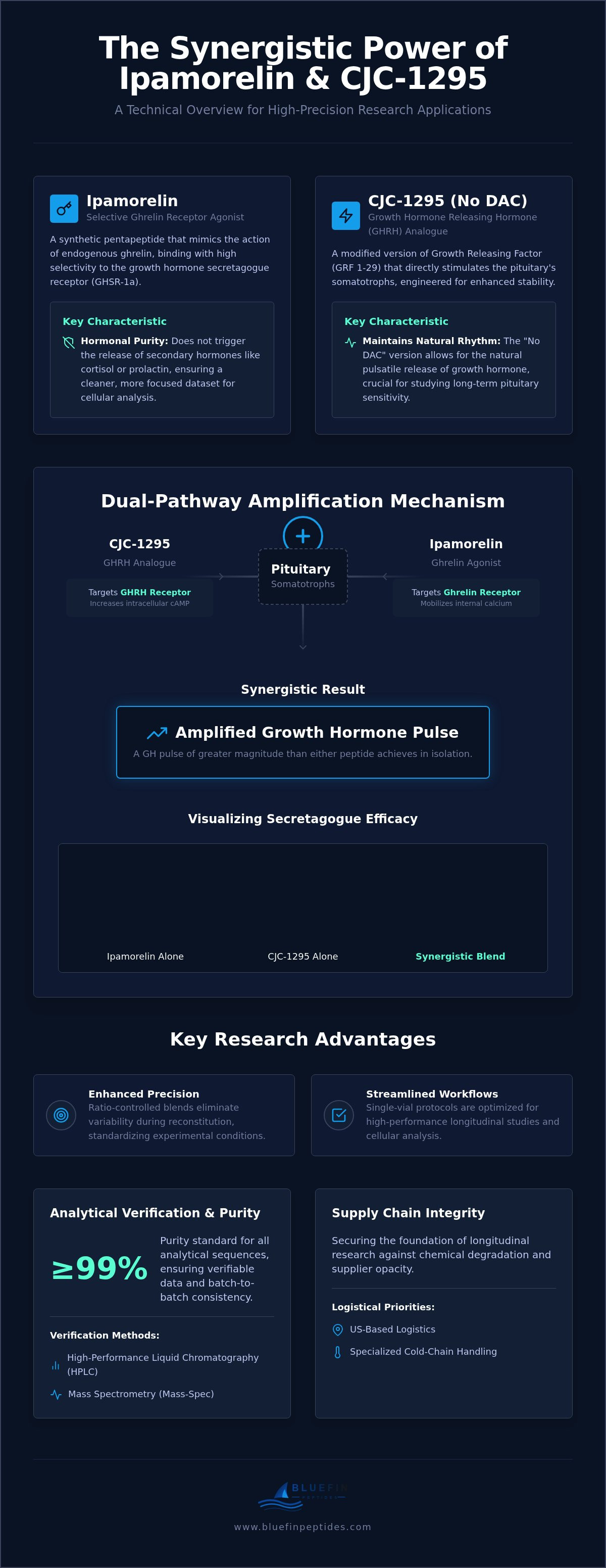
The biochemical rationale for this blend rests on the dual-pathway stimulation of the somatotrophs. Ipamorelin acts as a ghrelin mimetic, suppressing the inhibitory influence of somatostatin. Simultaneously, CJC-1295 triggers the GHRH receptor. This creates a synergistic amplification. The result is a GH pulse of greater magnitude than what either peptide achieves in isolation. For Ipamorelin and CJC-1295 research applications, this dual-action model provides a more robust framework for studying cellular regeneration and protein synthesis in vitro. It's a methodology that prioritizes analytical depth over surface-level observations.
Mechanistic Pathways of GH Secretagogues in Laboratory Models
The somatotropic axis functions through a complex interplay of stimulatory and inhibitory signals. To understand Ipamorelin and CJC-1295 research applications, one must map the fluid dynamics of hormonal signaling. These compounds operate through distinct, non-competing pathways. CJC-1295 targets the Growth Hormone Releasing Hormone (GHRH) receptor. Ipamorelin binds to the Ghrelin receptor. When these ligands arrive at the pituitary somatotrophs simultaneously, they initiate a cascade of intracellular events that amplify the natural tides of growth hormone release. This dual-action mechanism is the cornerstone of modern secretagogue research.
Signal Transduction and Pulsatile Release
CJC-1295 initiates signal transduction by activating adenylate cyclase. This process increases intracellular cyclic adenosine monophosphate (cAMP) levels. Higher cAMP concentrations trigger protein kinase A, which opens calcium channels and facilitates GH vesicle exocytosis. Ipamorelin adds a second layer of stimulation. By activating the Growth Hormone Secretagogue Receptor (GHSR), it triggers the phospholipase C pathway. This leads to the mobilization of internal calcium stores. The convergence of these two pathways creates a synergistic surge. Laboratory environments often reference a clinical trial on GH secretagogues to establish baseline expectations for secretory behavior. In vitro somatotroph cultures show that this combined signaling produces a GH pulse amplitude significantly higher than the sum of its parts.
Research Applications in Metabolic Studies
Metabolic research relies on the stability of these signaling pathways under varying environmental conditions. Murine models investigating lipid metabolism utilize the CJC/Ipamorelin blend to observe changes in adipocyte signaling. The increased GH levels facilitate lipid oxidation and influence nutrient partitioning. High-purity compounds are essential for these assays. Researchers often seek HPLC-verified research blends to ensure that metabolic shifts are the result of peptide interaction rather than chemical impurities. Precision is the only way to secure valid data.
Nitrogen retention and lean mass research frameworks also benefit from this dual-pathway model. By stimulating the GH/IGF-1 axis, the blend allows for the study of protein synthesis rates in skeletal muscle tissues. The pulsatile nature of the release, facilitated by the "No DAC" version of CJC-1295, prevents receptor desensitization. This maintains the integrity of the signal over long-term longitudinal studies. Accurate mapping of these pathways provides the foundation for 2026 analytical standards. It ensures that every laboratory observation is anchored in verifiable biochemical reality. The focus remains on the "how" of the process to secure the "what" of the result.
Comparative Advantages of the CJC/Ipamorelin Blend in Research
Efficiency and reliability are the twin pillars of successful laboratory operations. While mono-peptide protocols provide foundational data, they often fail to capture the complex signaling dynamics required for advanced metabolic studies. Utilizing a pre-formulated blend optimizes research workflows. It ensures that the chemical foundation of your study remains as steady as a vessel in calm waters. By integrating these compounds into a single-vial system, researchers can bypass the logistical friction and technical variability inherent in manual multi-peptide mixing.
Synergy vs. Mono-Peptide Protocols
Research comparing CJC-1295 mono-therapy against a combined secretagogue model reveals a significant discrepancy in GH pulse height. Single-receptor pathways often encounter a "ceiling effect." At this point, increasing the ligand concentration fails to produce a linear increase in secretory output due to receptor saturation. The blend bypasses this limitation. By engaging both the GHRH and Ghrelin receptors simultaneously, the secretagogue response remains robust and amplified. In high-precision secretagogue research, the standard synergistic ratio is typically a 1:1 milligram-to-milligram concentration. This specific ratio ensures that neither pathway is under-stimulated, providing a balanced and repeatable data set for Ipamorelin and CJC-1295 research applications.
Data Consistency in Pre-Mixed Blends
Precision in the lab is frequently compromised by minor human errors during the reconstitution and mixing phases. Pipetting errors introduce subtle variability that can skew longitudinal results and complicate the peer-review process. Pre-mixed blends eliminate this risk. Co-lyophilization ensures that the peptides are bonded in a stable state before they ever reach the lab bench. This process provides several distinct advantages:
- Standardized Concentration: Every vial contains an exact, verified ratio of each peptide sequence.
- Co-Lyophilization Stability: Lyophilizing the peptides together ensures they remain chemically stable and resistant to degradation during transit.
- Reduced Reconstitution Steps: Fewer handling steps mean fewer opportunities for environmental contamination or accidental peptide shearing.
For laboratories requiring high-purity standards, sourcing an Ipamorelin CJC-1295 research blend USA ensures that the analytical specifications meet the rigorous demands of 2026 research. Procurement of these pre-blended vials offers a clear advantage for large-scale studies. It reduces the overhead associated with inventorying multiple single-peptide SKUs and streamlines the logistics of multi-site trials. When the "how" of procurement is simplified, the "what" of the research results becomes more reliable and easier to verify via HPLC. Ipamorelin and CJC-1295 research applications thrive when the baseline chemistry is beyond reproach.
Analytical Verification and Purity Standards
Data integrity is the primary currency of the laboratory. For Ipamorelin and CJC-1295 research applications, the margin for chemical deviation is non-existent. A failure in purity is a failure in the entire experimental protocol. We prioritize absolute transparency. Verification isn't a suggestion; it's a requirement for any credible peer-reviewed study. Batch-specific Certificates of Analysis (COAs) serve as the vital documentation that anchors your research in verifiable fact. Without these tools, you're navigating without a compass. Credibility depends on the depth of your analytical verification.
HPLC Analysis: Quantifying Chemical Purity
High-Performance Liquid Chromatography (HPLC) serves as the primary tool for quantifying chemical purity. The chromatogram provides a visual map of the sample. It identifies the primary peptide peaks and reveals any underlying impurities or degradation products. In the HPLC readout, the area under the curve for the main peak must represent at least 99% of the total detected signal. While some vendors accept a 98% threshold, high-stakes assays require a baseline of ≥99% to eliminate confounding variables. Even a 1% deviation can introduce bioactive contaminants that skew metabolic data. Adhering to strict research peptide quality standards ensures that the results you observe in your assays are the direct result of the intended peptide interaction. Precision is the only path to repeatable science.
Mass Spectrometry: Confirming Molecular Identity
Purity alone doesn't guarantee identity. Mass Spectrometry (Mass-Spec) provides the final word by verifying the molecular weight of the peptide sequence. This process ensures that the amino acid chain hasn't been truncated or subjected to incorrect substitutions during synthesis. Truncated sequences are a common byproduct of inefficient peptide synthesis. Mass-Spec captures these errors by revealing molecular weights that fall outside the calculated theoretical mass of the Ipamorelin or CJC-1295 sequences. It's the deep-sea scan of the molecular structure. Mass spectrometry distinguishes between CJC-1295 with and without DAC by identifying the specific mass shift associated with the addition of the Drug Affinity Complex. This level of detail is critical for ensuring you're working with the "No DAC" version required for pulsatile GH research.
Every batch must undergo this rigorous double-verification process. We provide the raw data required to satisfy institutional review boards and exacting laboratory standards. When you buy HPLC-verified research peptides, you're securing the foundation of your experimental model. Don't settle for surface-level claims. Demand the data. The security of your results begins with the verification of your materials.
Strategic Procurement for Laboratory Continuity
Laboratory continuity depends on more than just chemical purity. It requires a disciplined logistics framework. Research projects often stall due to supplier inconsistency or transit delays that compromise chemical integrity. For Ipamorelin and CJC-1295 research applications, securing a reliable supply chain is a foundational requirement. Bluefin Peptides operates as a high-performance laboratory partner. We prioritize US-based inventory to ensure rapid fulfillment and minimize the environmental stressors associated with international transit. Reliability. Speed. Security. This approach ensures that your analytical standards remain as steady as a vessel in deep water.
Logistical Precision in Peptide Fulfillment
Environmental stress is the primary enemy of peptide stability. Heat, moisture, and prolonged agitation during shipping can lead to chemical degradation, even in lyophilized powders. Domestic US shipping is critical for maintaining the integrity of sensitive compounds. Reducing the duration of transit limits exposure to uncontrolled temperature fluctuations. This is especially true for complex sequences like GH secretagogues and Retatrutide research peptide analogues. Our cold-chain logistics protocols are designed to preserve the physical state and chemical nature of the offerings from our facility to your laboratory bench. We don't ask for blind trust; we provide the logistical data to support our quality claims.
Compliance and Laboratory Standards
We adhere to a strict "Research Use Only" designation for all offerings. This isn't a legal formality. It's a commitment to laboratory standards. Every batch of the Ipamorelin and CJC-1295 blend undergoes rigorous testing to ensure batch-to-batch consistency. This consistency is vital for longitudinal studies where even minor shifts in concentration can invalidate months of data. Our approach is one of clinical precision. We provide batch-specific COAs and Mass-Spec confirmation for every sequence. Transparency is the bedrock of our operation. It ensures that your laboratory documentation is beyond reproach when subjected to institutional review.
Bluefin Peptides provides the tools for verification. Our US-based inventory ensures that your laboratory never faces a supply deficit. By choosing a partner focused on deep-sea precision and analytical rigour, you secure the future of your Ipamorelin and CJC-1295 research applications. We invite you to explore our inventory of analytical-grade supplies. Secure your data. Maintain your continuity. Visit Bluefin Peptides for HPLC-verified research materials that meet the rigorous standards of 2026.
Advancing Laboratory Standards for Somatotropic Research
The integration of GHRH mimetics and selective ghrelin receptor agonists represents more than a combined protocol; it's a dual-pathway model for achieving deep-sea precision in cellular signaling assays. By utilizing ratio-controlled blends, researchers eliminate the technical variability that often compromises longitudinal data. Data integrity remains the primary anchor. Ipamorelin and CJC-1295 research applications require a baseline of ≥99% purity to ensure that metabolic observations are the direct result of intended ligand interactions. These 2026 analytical standards serve as the baseline for all high-stakes laboratory environments.
Security in procurement is the final step in ensuring laboratory continuity. Batch-specific COAs and Mass-Spec sequence confirmation provide the verifiable documentation necessary for institutional review. US-based laboratory stock further reduces environmental stress during transit, protecting the physical state and chemical nature of lyophilized powders. Consistency isn't a variable; it's a commitment to the "how" of the process to ensure the "what" of the results. This disciplined approach to logistics protects your research from the persistent risks of chemical degradation.
Procure HPLC-Verified Ipamorelin / CJC-1295 Blends for Research to secure the foundation of your experimental model. We don't cut corners on underlying data. We remain committed to providing the tools for verification and the logistical speed required for modern science. Your data deserves absolute clarity.
Frequently Asked Questions
What is the standard research ratio for Ipamorelin and CJC-1295 blends?
The standard concentration for these blends in laboratory settings is a 1:1 milligram-to-milligram ratio. A common specification involves a 10mg total vial containing 5mg of Ipamorelin and 5mg of CJC-1295. This balanced ratio ensures that both secretagogue pathways are stimulated with equal intensity. It allows researchers to maintain a consistent baseline when investigating the synergistic effects of dual-pathway GH stimulation without one compound saturating its respective receptor prematurely.
How does CJC-1295 without DAC differ from the DAC version in research applications?
CJC-1295 without DAC lacks the Drug Affinity Complex that extends the peptide's half-life to several days. In Ipamorelin and CJC-1295 research applications, the "No DAC" version is preferred because it mimics natural pulsatile growth hormone release. The DAC version creates a "GH bleed" effect that can lead to receptor desensitization. Using the version without DAC allows for more precise control over the frequency and amplitude of secretory events in laboratory models.
Is the Ipamorelin / CJC-1295 research blend stable at room temperature?
Lyophilized powders exhibit short-term stability at room temperature during the logistics and fulfillment process. However, long-term stability requires controlled environments to prevent chemical degradation. For analytical consistency, these peptides should be stored at temperatures between 2 and 8 degrees Celsius. Exposure to high heat or direct light triggers molecular breakdown. Maintaining a cold-chain protocol ensures that the chemical integrity remains intact from the initial synthesis through the final laboratory assay.
What purity level is required for Ipamorelin/CJC-1295 in cellular assays?
Sensitive cellular assays require a minimum purity level of 99% as verified by High-Performance Liquid Chromatography. Lower purity levels, such as the 98% threshold common in some markets, introduce confounding variables and bioactive contaminants. These impurities can skew metabolic data or trigger unintended cellular responses. High-purity standards are essential for securing valid, repeatable results. Every batch must undergo HPLC and Mass-Spec verification to confirm that the chemical foundation is beyond reproach.
Can Ipamorelin and CJC-1295 be reconstituted in the same vial?
Yes, these peptides are frequently co-lyophilized into a single-vial blend to streamline laboratory workflows. Reconstituting them together reduces handling time and minimizes the risk of pipetting errors that occur during manual mixing. This pre-formulated approach ensures that the 1:1 ratio remains constant throughout the study. It provides a more stable and predictable environment for investigating the synergistic amplification of growth hormone pulses in various in vitro models without the risk of cross-contamination.
What are the primary storage requirements for lyophilized research peptides?
Lyophilized research peptides must be stored in a cool, dark, and dry environment to prevent degradation. For short-term use, refrigeration at 4 degrees Celsius is sufficient. For long-term storage exceeding three months, researchers should maintain the vials at -20 or -80 degrees Celsius. Vials must remain sealed until the point of reconstitution to prevent moisture ingress. These protocols preserve the peptide's primary structure and ensure that the analytical results remain accurate over time.
How does the blend affect growth hormone pulse amplitude vs frequency?
The synergistic interaction between Ipamorelin and CJC-1295 primarily increases the amplitude of growth hormone pulses rather than their frequency. CJC-1295 stimulates the somatotrophs to release GH, while Ipamorelin suppresses somatostatin and further triggers the GHSR pathway. This dual action results in a significantly higher peak concentration during secretory events. It provides a robust model for studying the downstream effects of elevated GH levels on protein synthesis and lipid metabolism in controlled research environments.
Where can I find HPLC and Mass-Spec reports for Bluefin Peptides products?
Bluefin Peptides provides batch-specific Certificates of Analysis (COAs) for every product in our catalog. These reports include raw HPLC chromatograms and Mass-Spec data to verify both purity and molecular identity. We prioritize transparency by ensuring these documents are available to researchers upon procurement. This philosophy regarding quality allows you to confirm that every vial meets the ≥99% purity standard required for high-stakes analytical work and laboratory continuity across all Ipamorelin and CJC-1295 research applications.
For laboratory research use only. Not for human or veterinary use. This content is educational and does not constitute medical, dosing, or usage guidance.
Browse the BLUEFIN catalog