Common Peptide Research Pitfalls in 2026: Laboratory Guide to Experimental Integrity
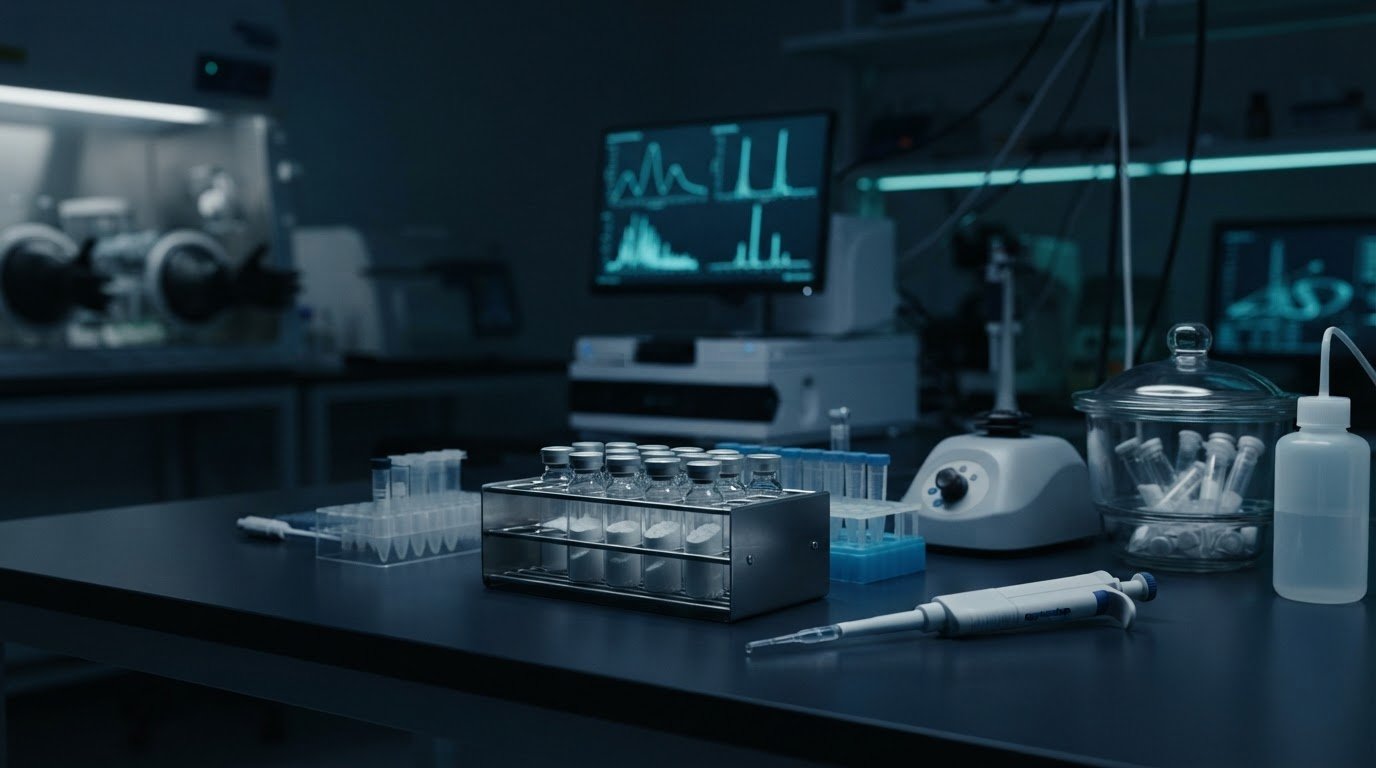
Experimental reproducibility rarely fails at sequence design; it collapses quietly at the bench during solubilization and analytical verification. When identical assay replicates yield erratic baseline readings or unexpected precipitation in standard buffers, investigators routinely question synthesis quality. In reality, diagnosing common peptide research pitfalls 2026 demands scrutinizing routine physical handling. Even with modern analytical standards establishing a 99% purity baseline verified by HPLC and mass spectrometry confirmation, minor benchtop oversights can silently compromise chemical integrity before an assay begins.
It's frustrating to watch months of disciplined work compromised by baseline drift, unverified counterion salts, or rapid degradation across repeated thermal cycles. You shouldn't have to guess whether an anomalous readout stems from biological response or degraded stock solutions. This laboratory guide establishes precise bench protocols to eliminate handling artifacts, accurately calculate net active peptide mass accounting for moisture, and maintain structural integrity. Ahead, we dissect critical solubility techniques, third-party analytical interpretation, and optimal storage parameters required to ensure rigorous, reproducible data.
Key Takeaways
- Differentiate gross lyophilized vial weight from true active peptide content by accounting for residual counterions and structural hydration.
- Cross-reference HPLC purity traces with mass spectrometry identity confirmation to avoid common peptide research pitfalls 2026 before initiating testing.
- Calculate sequence net charge systematically to select compatible reconstitution solvents and prevent hydrophobic beta-sheet aggregation.
- Mitigate premature hydrolysis and cryo-concentration artifacts by enforcing desiccator temperature equilibration and single-use aliquoting.
- Standardize experimental baselines using batch-specific analytical documentation and verified domestic cold-chain storage.
Bench-Level Flaws: Why In Vitro Peptide Assays Fail in 2026
In vitro assay reproducibility frequently collapses long before experimental exposure occurs. Ambient humidity rapidly compromises unsealed lyophilized powder cakes, causing immediate hygroscopic water absorption and triggering accelerated hydrolysis. Simultaneously, uncharacterized synthesis deletions and truncated sequences act as silent competitive antagonists at target receptors, generating spurious baseline readings. Systematically resolving common peptide research pitfalls 2026 requires understanding that physical handling dictates assay survival just as much as purity percentages.
The Discrepancy Between Gross Mass and Net Peptide Content
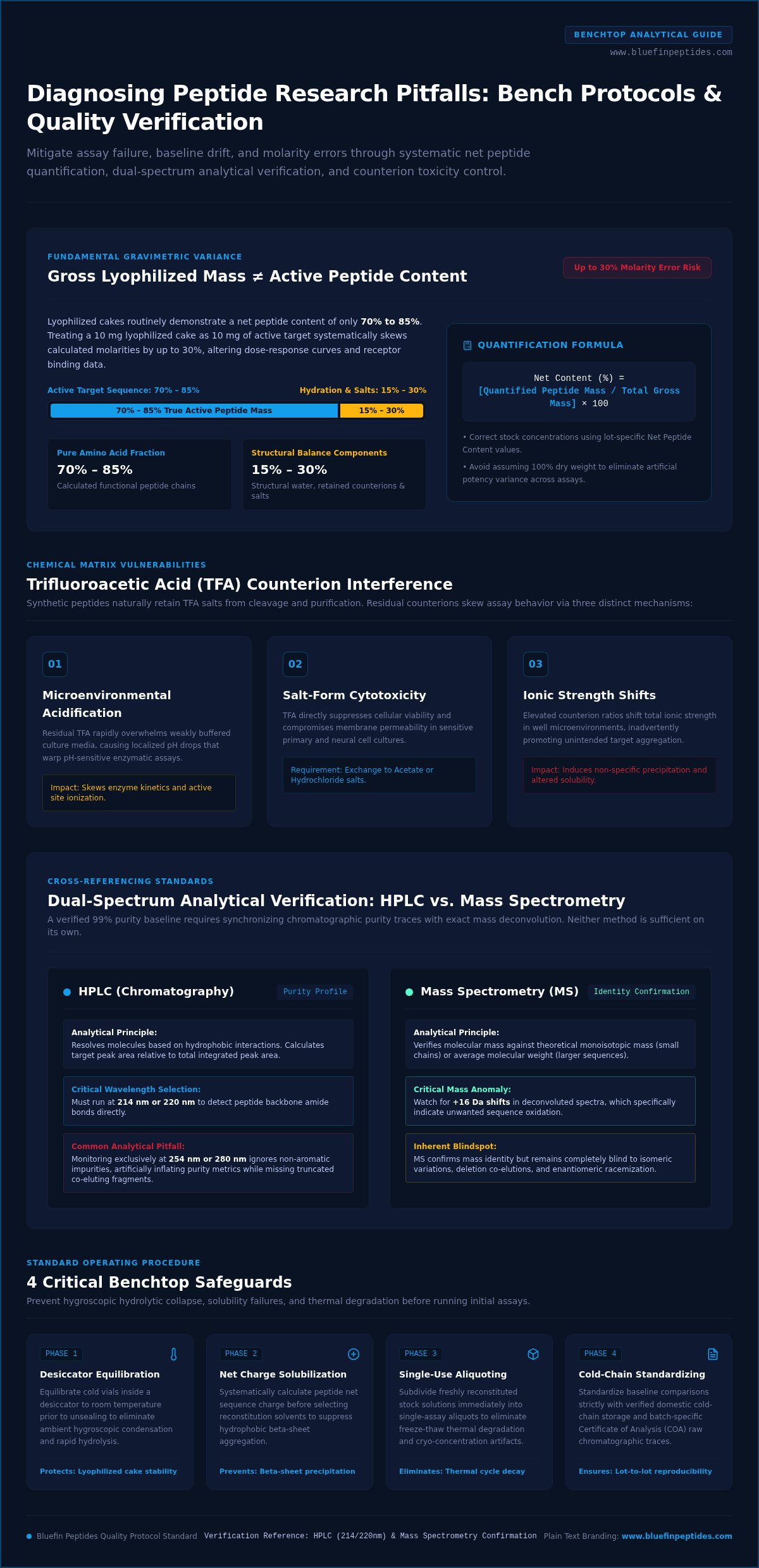
Gravimetric weight does not equal peptide weight. Following solid-phase chemical peptide synthesis and subsequent cleavage, lyophilized cakes routinely demonstrate a net peptide content of only 70% to 85%, with the balance consisting of structural water, retained counterions, and residual salts. Net peptide content defines the actual weight percentage of pure peptide amino acid sequence relative to the total gross weight of the lyophilized material, calculated as the quantified peptide mass divided by total mass multiplied by 100. Treating a 10 mg lyophilized cake as 10 mg of active target skews calculated molarities by up to 30%, systematically shifting dose-response curves and masking receptor binding affinities.
Counterion Cytotoxicity and Assay Interference
Residual counterions present another unmonitored variable that undermines cellular data. Most standard synthetic peptides retain trifluoroacetic acid (TFA) salts derived from cleavage and purification protocols. TFA exhibits direct cellular toxicity, suppressing viability and altering membrane permeability in sensitive in vitro models. These counterions directly alter experimental dynamics through several mechanisms:
- Microenvironmental acidification: Residual TFA rapidly overwhelms weakly buffered media, dropping local pH and warping pH-sensitive enzymatic assays.
- Salt-form toxicity: Primary cell lines and sensitive neural assays require validated counterion exchange to acetate or hydrochloride formats to preserve physiological relevance.
- Ionic strength shifts: High counterion ratios alter ionic strength in assay wells, triggering unintended target aggregation or altered ligand solubility.
Evaluating counterion identity and mass fractions is essential to avoid these common peptide research pitfalls 2026 and protect quantitative assay baselines.
Analytical Verification Errors: Misinterpreting HPLC and Mass Spectrometry Data
Accepting a supplier's blanket purity claim without scrutinizing batch-specific analytical records is among the most pervasive common peptide research pitfalls 2026 presents to investigators. A Certificate of Analysis (COA) must provide raw, lot-specific analytical traces rather than a static historical reference. High-Performance Liquid Chromatography (HPLC) establishes chromatographic purity by resolving molecules based on hydrophobic interactions. It verifies the percentage of target peak area relative to total integrated peak area; it doesn't confirm sequence identity. Conversely, mass spectrometry (MS) verifies molecular mass but remains blind to isomeric variations or enantiomeric racemization. True verification requires synchronizing both analytical readouts.
Evaluating HPLC Chromatograms for Co-Eluting Artifacts
Chromatographic scrutiny prevents downstream error. Inspect the baseline integration thoroughly. Broad peak shoulders or asymmetrical fronting often conceal truncated sequences and deletion fragments that co-elute alongside the primary analyte. Detection wavelength is equally critical. Analytical runs must be acquired at 214 nm or 220 nm to capture peptide backbone amide bonds directly. Monitoring runs exclusively at 254 nm or 280 nm ignores non-aromatic impurities, artificially inflating reported purity metrics while missing critical process contaminants.
Mass Spectrometry Interpretation and Deconvolution
Mass spectra demand meticulous deconvolution. Compare observed m/z values against theoretical monoisotopic masses for smaller chains, or average molecular weight for larger synthetic structures. Investigators often dismiss minor mass deviations as baseline noise. Look closely for +16 Da shifts that signal side-chain oxidation on methionine or tryptophan residues, or +22 Da and +39 Da shifts caused by sodium and potassium adducts. Structural variants can alter receptor engagement entirely while preserving chromatographic retention times.
Neither HPLC nor standard MS alone identifies D-amino acid racemization, which alters target folding without shifting molecular formula weight. Aligning batch data against verified analytical quality standards for research peptides establishes a reproducible baseline. For laboratories requiring uncompromised assay baselines, procuring materials with batch-specific mass-spec traces from Bluefin Peptides eliminates analytical guesswork before experimental execution begins.
Solubilization Pitfalls Across Complex Hydrophobic Sequences
Forcing an unfamiliar peptide directly into standard physiological buffers is a primary operational failure mode. Lyophilized peptides don't behave uniformly in aqueous environments. When hydrophobic sequences contact neutral phosphate-buffered saline, unshielded nonpolar residues drive self-association. This triggers rapid, irreversible beta-sheet fibrillization. Once macroscopic precipitation or optical turbidity manifests, the peptide's native conformation is lost, rendering subsequent assay dilutions biochemically invalid. Avoiding these common peptide research pitfalls 2026 requires predicting solvation behavior directly from primary sequence composition.
Determining Isoelectric Points and Net Sequence Charge
Sequence stoichiometry governs solvent selection. Before introducing a single drop of liquid, calculate the peptide's net theoretical charge at neutral pH by tallying basic residues (arginine, lysine, histidine) against acidic residues (aspartic acid, glutamic acid). Sequences carry specific dissolution requirements based on their net charge profiles:
- Net positive (basic peptides): Dissolve initially in sterile, deoxygenated water. If stubborn, wet the lyophilized cake with a minimal volume (10–50 µL) of 10% to 30% sterile acetic acid before diluting to working concentration with neutral buffer.
- Net negative (acidic peptides): Reconstitute using a minimal volume of 0.1% to 1.0% ammonium hydroxide (NH₄OH) or basic buffer, followed by dilution into experimental media.
- Net neutral or hydrophobic peptides: Chains featuring high ratios of aliphatic residues (leucine, isoleucine, valine, phenylalanine) fail rapidly in pure water. These necessitate organic pre-wetting with dimethyl sulfoxide (DMSO) or acetonitrile. Employ a two-step solubilization method by dispersing the cake in 25% organic solvent before stepping down to aqueous analytical buffers.
Solvent Carryover and Biological System Compatibility
Co-solvents demand strict threshold monitoring. While DMSO breaks intermolecular hydrogen bonds effectively, downstream cell cultures and receptor-binding assays remain vulnerable to solvent toxicity. Keep DMSO concentrations strictly below 0.5% (v/v) in final working biological assays to prevent membrane permeabilization artifacts. When attempting to dissolve resilient aggregates, bath sonication must be pulsed in brief bursts within an ice bath. Uncontrolled probe sonication generates severe localized cavitation heat, inducing backbone fragmentation and deamidation. For specialized combinatorial formulations, cross-reference handling parameters in our GHK-Cu BPC-157 TB-500 analytical guide to systematically prevent aggregation before pipetting begins.
Handling, Aliquoting, and Thermal Degradation Safeguards
Physical degradation vectors threaten synthetic peptide stocks immediately upon freezer removal. Condensation inside sub-ambient vials remains the primary driver of rapid, bench-level peptide bond hydrolysis. Simultaneously, repeated thermal cycling exposes reconstituted solutions to cryo-concentration artifacts, where pure water freezes first, forcing solute molecules into localized micro-pockets of extreme concentration and disrupted ionic strength. Overcoming these common peptide research pitfalls 2026 requires rigid physical containment and precise environmental equilibration before any vial septum is pierced.
Vial Equilibration and Atmospheric Moisture Management
Lyophilized cakes act as powerful desiccants. Removing a storage vial directly from -20°C or -80°C into ambient laboratory humidity pulls moisture directly onto the porous powder cake, initiating instant hydrolytic cleavage. Always equilibrate sealed containers to ambient room temperature inside a dedicated desiccator for at least 30 to 60 minutes before uncapping. Sequences bearing oxidation-sensitive residues such as methionine, cysteine, and tryptophan require additional protection; purge vial headspaces with sterile, high-purity argon or nitrogen gas prior to resealing to arrest oxidative degradation.
Aliquoting Protocols and Low-Retention Consumables
Reconstituted peptide integrity degrades rapidly under fluctuating temperatures. Dividing master stocks into single-use experimental volumes is essential to preserve baseline data. Reconstituted stocks generally remain stable up to 4 weeks at 2°C to 8°C, but extended storage demands storage at -20°C or -80°C free from repeated freeze-thaw cycles. Protect your working concentrations by observing key handling parameters:
- Use low-binding polypropylene: Hydrophobic residues readily adhere to standard borosilicate glass and untreated plastics, depleting nanomolar-range solutions.
- Pre-wet tips: Pipette tips should be pre-rinsed with the peptide solution to saturate potential adsorption sites prior to volumetric dispensing.
- Avoid frost-free freezers: Automatic defrost cycles oscillate internal temperatures, driving ice-crystal formation and denaturing tertiary structures.
To eliminate baseline variability and protect your laboratory assays from the start, order verified research peptides from Bluefin Peptides with guaranteed lot-specific analytical confirmation and cold-chain integrity.
Standardizing Experimental Protocols with Analytical Reference Standards
Assay repeatability demands uncompromising chemical baselines. In vitro controls that fluctuate across production lots obscure true biological phenomena, introducing unquantifiable systematic bias into cellular models. Reliable reproducibility rests upon a transparent chain of custody and temperature-regulated logistics that safeguard synthetic integrity long before arrival. Eliminating common peptide research pitfalls 2026 requires laboratory standard operating procedures (SOPs) that mandate systematic lot quarantine, baseline characterization, and uncompromising lot-release thresholds.
Establishing Stringent In-House Lot Acceptance Criteria
Incoming synthetic peptide lots must never bypass rigorous intake screening. Laboratories should establish formal intake checklists to verify cake morphology, moisture absence, and complete optical clearance upon reconstitution. Reject any lot displaying chromatographic baseline instability, asymmetric peak shoulders, or unexpected mass fragmentation patterns. Quantitative assays require documented proof of chemical identity and purity before any experimental pipetting begins. For complex synthetic targets, benchmark your acceptance criteria against the empirical guidelines detailed in the Retatrutide Research Peptide Laboratory Standards to prevent downstream experimental failure.
Procuring Verified High-Purity Compounds for In Vitro Studies
Reagent provenance dictates experimental fidelity. Procuring synthetic peptides through opaque distribution channels or international brokers exposes materials to unchecked customs delays and thermal stress inside cargo holds. Exposure to uncontrolled heat initiates deamidation and side-chain cleavage before materials ever reach a laboratory freezer. Mitigating these common peptide research pitfalls 2026 requires sourcing through domestic supply houses that maintain end-to-end cold chains and publish verified, lot-specific analytical documentation. Utilizing reference standards with confirmed ≥99% HPLC purity and mass spectral validation ensures that cellular responses stem exclusively from the defined sequence. Researchers can source validated catalog sequences and advanced blends through Bluefin Peptides, establishing rock-solid analytical control across every assay replicate.
Protecting Experimental Reproducibility at the Laboratory Bench
Rigorous in vitro data relies on eliminating operational errors before an experiment begins. You now possess the bench protocols required to avoid common peptide research pitfalls 2026, from correcting gross mass calculations for net peptide content to predicting solubility from amino acid sequences. Desiccator equilibration, nitrogen headspaces, and single-use aliquoting prevent the subtle hydrolysis and cryo-concentration artifacts that routinely ruin longitudinal assay series. High-level reproducibility isn't accidental; it's engineered through disciplined bench technique and uncompromising chemical verification.
Eliminate baseline variance by building your workflows on verified reference standards. When you secure HPLC-verified compounds at Bluefin Peptides, you receive ≥99% HPLC purity guaranteed with lot-specific chromatographic traces and mass spectrometry confirmation on every batch. With a 100% US-stocked inventory ensuring rapid, climate-controlled domestic dispatch, your laboratory can bypass shipping degradation and focus entirely on generating defensible, reproducible scientific discoveries.
Frequently Asked Questions
Why is net peptide content different from HPLC purity percentage?
HPLC purity measures the proportion of target peptide relative to other peptide-like impurities, whereas net peptide content quantifies the actual weight fraction of pure peptide within the total gross lyophilized cake. Synthesized cakes typically contain only 70% to 85% active peptide material. The remaining mass consists of non-peptide components such as structural water, counterions, and residual salts. Failing to distinguish between these metrics is among the common peptide research pitfalls 2026 researchers must avoid to calculate accurate working concentrations.
How do I prevent hydrophobic peptides from precipitating during reconstitution?
Pre-wet hydrophobic sequences using a minimal volume of sterile organic co-solvent, such as 25% acetonitrile or pure dimethyl sulfoxide (DMSO), before slowly introducing aqueous buffers. Adding neutral physiological buffers directly to nonpolar sequences forces rapid, irreversible beta-sheet self-aggregation. Forcing rapid dissolution with excessive agitation often worsens precipitation. Investigators should calculate the sequence's net charge first, using dilute acetic acid for basic sequences or dilute ammonium hydroxide for acidic peptides to ensure complete optical clearance.
What happens if a lyophilized peptide vial is opened while still frozen?
Opening a frozen vial exposes the lyophilized cake to ambient humidity, which condenses instantly on the cold powder. Lyophilized peptides act as potent desiccants, absorbing atmospheric moisture within seconds. This rapid condensation triggers immediate hydrolytic cleavage of labile peptide bonds, destabilizing the sample before reconstitution even begins. Always equilibrate sealed vials inside a desiccator at room temperature for 30 to 60 minutes prior to piercing the septum or removing the seal.
Can repeated freeze-thaw cycles alter peptide activity in cell cultures?
Repeated thermal cycles cause cryo-concentration, where pure water freezes first and forces peptide molecules into hyper-concentrated micro-domains. This physical crowding induces non-covalent aggregation, denatures secondary conformations, and can accelerate chemical deamidation. When introduced to cell culture models, these aggregated structures often yield skewed baseline activity or fail to bind target receptors. Researchers should aliquot reconstituted peptides into single-use experimental working volumes immediately following reconstitution to preserve baseline integrity.
Why is trifluoroacetic acid (TFA) removal critical for specific cellular assays?
Residual TFA salts act as cytotoxic agents that impair cellular viability, alter membrane permeability, and suppress cell proliferation independent of the target peptide sequence. In weakly buffered in vitro systems, excess TFA lowers the local microenvironmental pH, interfering with sensitive enzymatic readouts and receptor-ligand kinetics. For fragile cellular assays or neurobiological models, exchanging residual counterions for acetate or hydrochloride formats eliminates confounding toxicity and maintains physiological relevance.
How do I know if an HPLC purity report is authentic and reliable?
An authentic HPLC report displays lot-specific raw chromatographic data rather than a generic or reused spectrum. Check that detection was performed at 214 nm or 220 nm to monitor peptide backbone bonds, and inspect the main peak for shoulders or integration cutoffs. Batch-specific analytical confirmation backed by matching mass spectrometry deconvolution represents the gold standard. Scrutinizing these technical details helps laboratories sidestep common peptide research pitfalls 2026 by verifying that catalog lots genuinely achieve ≥99% purity.
What labware is recommended to prevent peptide loss from surface adsorption?
Use certified low-retention polypropylene microcentrifuge tubes and pipette tips rather than untreated plastic or standard borosilicate glass. Hydrophobic and amphipathic peptide sequences readily adsorb to conventional silica and polymer surfaces, which can deplete nanomolar and micromolar working solutions by up to 50%. Pre-wetting pipette tips with the diluted peptide solution before dispensing further saturates non-specific binding sites, ensuring accurate volumetric transfer across critical serial dilutions.
For laboratory research use only. Not for human or veterinary use. This content is educational and does not constitute medical, dosing, or usage guidance.
Browse the BLUEFIN catalog