Buy Retatrutide: Research Standards & Guide 2026

The integrity of a triple-agonist study is only as stable as the molecule's analytical verification. When you buy retatrutide for research, the margin for error is nonexistent. You recognize that batch-to-batch variance isn't just a minor logistical hurdle. It's a direct threat to the reproducibility of your data set. Ambiguous testing documentation and extended international lead times often stall critical laboratory momentum; they create a fog of uncertainty where clinical precision is required.
Precision. Security. Verification. This guide establishes the rigorous standards required to acquire high-purity peptides for your facility. We provide a framework for sourcing Retatrutide with ≥99% HPLC-verified purity and mass-spec identity confirmation. This article details the protocols for secure US-based fulfillment and the necessity of batch-specific Certificates of Analysis. You'll gain a clear understanding of laboratory storage requirements, reconstitution best practices, and the logistical pathways that ensure your research models remain uncompromised by substandard chemical inputs. We focus on the analytical depth required to anchor your findings in verifiable fact.
Key Takeaways
- Analyze the triple-pathway mechanism of Retatrutide and its synergistic effect on GIP, GLP-1, and Glucagon receptors within laboratory models.
- Differentiate between standard chemical offerings and HPLC-verified compounds to ensure your data is anchored in absolute analytical purity.
- Learn the strategic advantages of domestic fulfillment when you buy retatrutide for research, including the mitigation of international shipping degradation.
- Implement precise storage and reconstitution protocols to maintain the structural integrity and bioactivity of your research peptides.
- Evaluate the necessity of batch-specific Certificates of Analysis to eliminate batch-to-batch variance and secure repeatable experimental results.
The Analytical Profile of Retatrutide in Laboratory Research
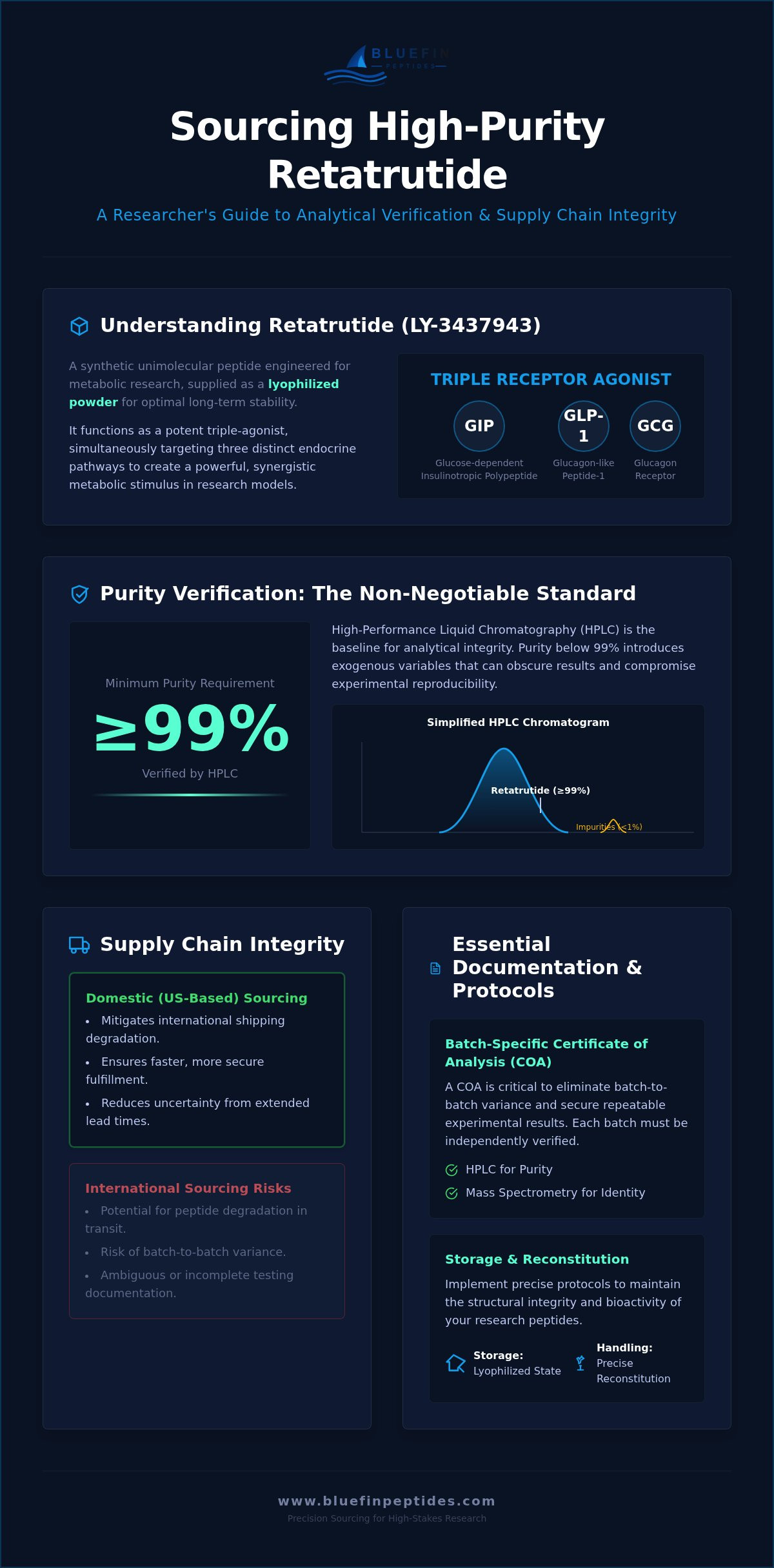
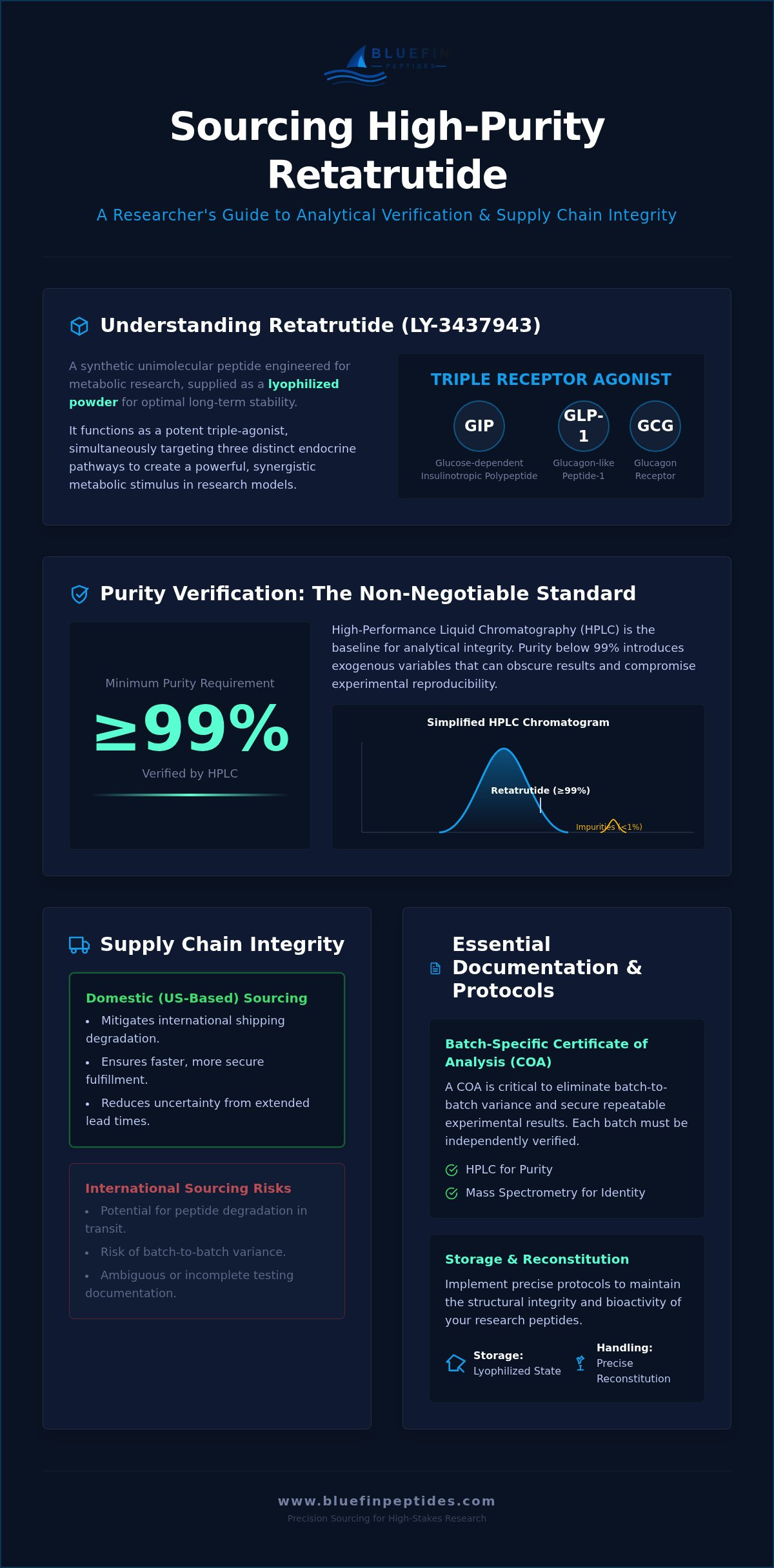
Retatrutide represents a significant shift in metabolic research. It is a synthetic unimolecular peptide engineered to target three distinct endocrine pathways simultaneously. Specifically, Retatrutide (LY-3437943) is a synthetic unimolecular peptide that functions as a triple agonist, concurrently targeting the glucagon-like peptide-1 (GLP-1), glucose-dependent insulinotropic polypeptide (GIP), and glucagon (GCG) receptors. This multifaceted profile distinguishes it from previous dual-agonists or single-receptor ligands. For investigators who seek to buy retatrutide for research, understanding this structural complexity is the first step toward experimental validity. The compound is typically provided as a lyophilized powder. This physical state is optimized for long-term chemical stability and resistance to degradation during transit.
Mechanism of Triple Receptor Agonism
The synergy of GIP, GLP-1, and Glucagon receptor agonism creates a potent metabolic stimulus within research models. GLP-1 and GIP interaction is well-documented in glucose-dependent insulin secretion and satiety research. However, the inclusion of glucagon agonism introduces a new vector: energy expenditure. Glucagon signaling in the liver and adipose tissue is a primary focus for studies involving thermogenesis and lipid oxidation. Molecular integrity is paramount. Even minor structural deviations can diminish receptor binding affinity, leading to inconsistent data. High-purity sourcing ensures that each receptor pathway is activated with the intended potency. It's the anchor of credible research; without it, the experimental current pulls the data off course.
Applications in Molecular Biology
Researchers utilize this triple-agonist to map complex metabolic pathways in both in-vitro and in-vivo models. It serves as a benchmark in comparative GLP-1 analogue studies, allowing for a direct assessment of how triple-agonism differs from traditional dual-agonist therapies. When you buy retatrutide for research, the focus often lies on peptide-driven thermogenesis and glucose homeostasis. These studies require a compound that maintains its structural configuration throughout the assay. Common applications include:
- Metabolic pathway analysis: Investigating the intersection of incretin signaling and glucagon activity.
- Thermogenic response mapping: Measuring energy expenditure changes in response to triple-receptor stimulation.
- Comparative pharmacology: Using Retatrutide as a high-performance control against older peptide generations.
- Glucose homeostasis: Analyzing the efficacy of multi-pathway regulation in metabolic models.
The depth of the molecular profile demands a disciplined approach to procurement. Substandard materials introduce variables that laboratory environments don't tolerate. Precision in the chemical state leads to precision in the results.
Verifying Purity: HPLC and Mass Spectrometry Requirements
High-Performance Liquid Chromatography (HPLC) isn't just a preferred metric; it's the baseline for analytical integrity in metabolic studies. When investigators buy retatrutide for research, they require data that mirrors the rigorous protocols seen in large-scale studies like the TRIUMPH-3 clinical trial. Purity below the ≥99% threshold introduces exogenous variables that can obscure receptor binding results or trigger unintended metabolic responses in in-vivo models. This level of precision is the anchor of our quality control process, ensuring that the chemical signature of the compound remains consistent across every experimental run.
Interpreting HPLC Chromatograms
A chromatogram serves as a visual map of chemical composition. The primary peak represents the target peptide, while smaller peaks, often referred to as "shoulders," indicate synthesis byproducts or residual solvents. Purity is calculated via peak area percentage, which must be scrutinized to ensure secondary peaks don't compromise the concentration of the active ligand. Identifying these impurities is a disciplined process. Truncated sequences or deamidated peptides can mimic the target peak if the chromatography isn't high-resolution. For a deeper technical breakdown of these reports, researchers should consult our guide on interpreting HPLC reports for lab use to ensure their dosing calculations remain accurate.
Mass Spectrometry: Confirming Molecular Identity
Identity verification requires a separate analytical layer. While HPLC confirms the purity of the sample, Mass Spectrometry (MS) confirms the exact amino acid sequence by measuring the mass-to-charge ratio (m/z). The theoretical molecular weight of Retatrutide is 4731.2 g/mol. Any deviation from this signature suggests a structural flaw or a different analogue entirely. Mass spectrometry prevents the misidentification of complex analogues by providing a definitive molecular weight signature that distinguishes the target peptide from structurally similar variants. This verification is essential for maintaining batch-to-batch consistency in synthetic peptide production. It acts as a laboratory compass, ensuring the researcher is working with the precise molecule intended for the study.
Analytical integrity is the foundation of credible findings. Synthesis byproducts can interfere with receptor agonism, leading to data that is difficult to replicate or interpret. We maintain a stoic adherence to these testing protocols to eliminate batch-to-batch variance. This transparency allows you to focus on the results of your research model rather than the quality of your inputs. If your laboratory requires materials that meet these exacting standards, you can source verified research peptides from our domestic inventory to secure your next study's data integrity.
Evaluating Supply Chain Integrity: Domestic Sourcing and Batch COAs
Analytical purity is a static measurement; supply chain integrity is a dynamic safeguard. International procurement often exposes sensitive compounds to regulatory friction and uncontrolled environmental variables. When investigators buy retatrutide for research, the logistical pathway is as vital as the initial synthesis. High-stakes investigations, such as those documented in the Retatrutide Phase 3 Clinical Trial, rely on materials that haven't been compromised by the volatility of global transit. We prioritize domestic fulfillment to eliminate these risks, ensuring that the structural integrity of every lyophilized vial remains unblemished by the currents of international shipping.
The Importance of US-Based Fulfillment
Stability. Speed. Security. Domestic stocking isn't merely a convenience; it's a protocol for maintaining chemical efficacy. Reducing transit time minimizes the window for thermal degradation, even for stable lyophilized powders. We navigate the tide of modern logistics using expedited domestic channels that bypass the delays typical of customs inspections. Secure transport protocols protect these sensitive reagents from the physical stressors of long-haul logistics. It's a disciplined approach to fulfillment that treats every shipment as a critical laboratory supply rather than a retail parcel. This proximity to the end-user ensures that the "cold chain" remains intact from our facility to your benchtop.
Verifying Batch-Level Documentation
Transparency is the anchor of procurement. A Certificate of Analysis (COA) is only valid if it's tied to a specific production lot. Investigators must verify that the lot number etched on the vial's seal matches the documentation provided. Generic reports that lack batch-specific data are significant red flags in the research chemical industry. They suggest a lack of oversight or, worse, a failure to test every synthesis run. For a comprehensive overview of the metrics required for validation, review our documentation on Retatrutide analytical specifications. This level of batch-level scrutiny ensures that the compound you receive is the exact molecule verified in the laboratory report. Trust is built on data, not claims. We provide the tools for verification so you can proceed with your research models in total confidence. Every batch is a new commitment to precision.
Laboratory Reconstitution and Storage Protocols
The transition from a stable, lyophilized state to a bioactive aqueous solution requires disciplined laboratory oversight. When you buy retatrutide for research, the analytical purity verified via HPLC is only as resilient as your handling protocols. Triple-agonist peptides are inherently complex. Their efficacy in metabolic models depends on maintaining a specific structural configuration. Protecting the lot from exogenous factors such as UV light, ambient heat, and moisture is essential for preventing premature peptide cleavage. Stability is not a suggestion; it's a requirement for data reproducibility.
Reconstitution Methodology
Methodical preparation begins with environmental control. Allow the vial to equilibrate to room temperature before removing the seal to minimize the risk of moisture ingress. For most laboratory assays, bacteriostatic water is the preferred diluent due to its ability to inhibit bacterial proliferation. Introduce the solvent with precision. Aim the needle toward the inner wall of the vial, allowing the liquid to cascade gently over the lyophilized powder. This slow-drip approach prevents the formation of foam. Gentle swirling, never shaking, facilitates dissolution while protecting the peptide's secondary structure. Vigorous agitation is a common failure point that can lead to protein denaturation and unreliable experimental data. Precision in the lab ensures precision in the results.
Stability and Degradation Factors
Stability is a function of thermal management. Lyophilized Retatrutide should be anchored in long-term storage at -20°C, a protocol that preserves chemical integrity for up to 24 months. Once the compound is in solution, the stability window narrows significantly. Reconstituted peptides must be stored at 2-8°C and used within a 30-day period to ensure maximum potency. Repeated freeze-thaw cycles must be avoided. The mechanical stress of crystallization can compromise the peptide's binding affinity. Maintaining the vacuum seal until the moment of reconstitution further protects the compound from atmospheric oxygen and humidity. These steps are vital for researchers who buy retatrutide for research and expect consistent, high-fidelity outcomes across multiple assays.
If your research requires compounds that arrive with their structural integrity fully intact, order HPLC-verified research peptides to secure the foundation of your laboratory studies.
Bluefin Peptides: Precision Sourcing for High-Stakes Research
Bluefin Peptides operates with a singular focus: the delivery of analytical certainty. We function as a high-performance laboratory partner rather than a retail vendor. Our infrastructure is designed to meet the exacting requirements of professional investigators who buy retatrutide for research and demand absolute transparency. We maintain a stoic adherence to clinical precision, ensuring that every compound in our inventory is anchored by verifiable data. Our maritime-grade logistical infrastructure ensures that every shipment moves with deep-sea precision and speed, bypassing the volatility of international supply chains to deliver US-stocked reagents directly to your benchtop.
The Bluefin Standard of Verification
Transparency is our primary metric. We operate under a "show, don't tell" philosophy regarding chemical purity. While other suppliers may offer generic documentation, we provide batch-specific HPLC and Mass-Spec data for every production run. This commitment to academic transparency allows researchers to verify the ≥99% purity and exact molecular identity of their materials before the first assay begins. We treat our clients as peers in a scientific field, providing the tools for independent verification of every lot. For those investigating multi-peptide synergies, our technical documentation also covers other high-performance offerings, such as the Ipamorelin CJC-1295 research blend USA. We eliminate the fog of batch-to-batch variance, allowing you to focus on the data your research models generate.
Procurement for Institutional Research
Efficiency is a requirement for modern laboratory environments. We have streamlined our procurement process to support high-volume institutional requirements and complex study timelines. Our US-based fulfillment centers utilize secure protocols to protect the structural integrity of your reagents during transit. Professional researchers can contact our analytical team for detailed technical specifications or batch-level inquiries. We uphold the highest ethical standards in the industry; all products are strictly for laboratory use and are not for human or veterinary consumption. This disciplined approach to sourcing ensures that your facility receives only the highest-fidelity compounds. When you are ready to advance your metabolic studies with a partner that prioritizes data over marketing, you can secure your Retatrutide lot for research today through our professional portal. Precision in sourcing leads to precision in results.
Advancing Metabolic Discovery with Analytical Certainty
The pursuit of triple-agonist metabolic data requires a foundation of absolute chemical stability. We've established that the complex profile of Retatrutide demands rigorous verification through HPLC and Mass Spectrometry to eliminate batch-to-batch variance. Maintaining the structural integrity of these molecules through disciplined laboratory storage and secure domestic fulfillment is the only way to ensure your findings remain reproducible. When you buy retatrutide for research, you aren't just acquiring a reagent; you're securing the credibility of your study's results. Precision is the anchor that prevents experimental drift.
Bluefin Peptides provides the infrastructure necessary for high-stakes laboratory investigations. We deliver ≥99% Purity HPLC Verified compounds with a Batch-Specific COA Included for every lot. Our Expedited US Shipping ensures your compounds arrive without the degradation risks associated with international transit. Secure the integrity of your next study with a partner committed to clinical transparency.
Procure HPLC-Verified Retatrutide for Research
Frequently Asked Questions
Is Retatrutide available for human consumption?
Retatrutide is strictly for laboratory research use and is not available for human consumption. It has not received FDA approval for clinical use outside of authorized trials. Bluefin Peptides provides these compounds exclusively for in-vitro and in-vivo research models. Any use of these chemicals in a medical or veterinary capacity is prohibited. Researchers must adhere to institutional safety guidelines and legal boundaries when they buy retatrutide for research purposes.
How do I verify the HPLC report for my Retatrutide batch?
Verification requires matching the lot number on your vial to the specific batch report. You should examine the chromatogram for a dominant primary peak and calculate the peak area percentage to confirm purity levels. A legitimate report will also include a timestamp and a clear molecular signature. If the peaks show significant shoulders or secondary elevations, the compound may contain synthesis byproducts that could compromise your experimental data integrity.
What is the purity standard for Bluefin Peptides research chemicals?
The baseline purity standard for all Bluefin Peptides offerings is ≥99% as verified by High-Performance Liquid Chromatography. We don't accept the industry average of 98% because minor impurities can interfere with receptor binding affinity in sensitive metabolic studies. Every batch undergoes mass spectrometry to confirm the exact molecular weight and amino acid sequence. This rigorous dual-testing protocol ensures that the chemical signature remains consistent across every research lot we fulfill.
How should lyophilized Retatrutide be stored upon arrival?
Lyophilized Retatrutide should be stored in a freezer at -20°C for long-term stability. This temperature range preserves the peptide's structural integrity for up to 24 months if the vacuum seal remains intact. Upon arrival, vials should be protected from light and moisture ingress. Once you buy retatrutide for research and decide to reconstitute it, the storage requirements change to 2-8°C. Reconstituted solutions are significantly more volatile and require usage within 30 days.
Does Bluefin Peptides ship Retatrutide internationally?
Bluefin Peptides focuses exclusively on domestic fulfillment within the United States. We don't ship internationally to avoid the regulatory friction and thermal degradation risks associated with global customs delays. By maintaining a national scope, we ensure that our maritime-grade logistics can deliver US-stocked reagents with maximum speed and security. This domestic infrastructure is designed to safeguard the structural integrity of every peptide from our facility to your laboratory benchtop.
What diluent is recommended for Retatrutide reconstitution in a lab?
Bacteriostatic water is the standard recommendation for reconstituting Retatrutide in a laboratory setting. This diluent contains 0.9% benzyl alcohol, which inhibits the growth of potential contaminants during multi-use assays. Sterile saline is an alternative for specific in-vivo models where pH balance is a primary concern. However, researchers must ensure the diluent is introduced gently to avoid foaming. Agitation should be limited to gentle swirling to protect the peptide's secondary structure from denaturation.
Can I request a batch-specific COA before purchasing?
Yes, you can request batch-specific Certificates of Analysis before finalizing your procurement. We operate with a "show, don't tell" philosophy regarding chemical purity and academic transparency. Providing these reports allows your analytical team to verify the HPLC and mass-spec data prior to integration into your study. This protocol eliminates the uncertainty of batch-to-batch variance and ensures that the materials meet your facility's specific quality control requirements for high-stakes research.
What is the difference between Retatrutide and other GLP-1 analogues in research?
Retatrutide is a unimolecular triple agonist, whereas most traditional analogues target only the GLP-1 receptor. It concurrently activates the GLP-1, GIP, and glucagon receptors to create a synergistic metabolic stimulus. This triple-pathway mechanism is a significant focus in energy expenditure and thermogenesis studies. While dual-agonists like Tirzepatide target two receptors, Retatrutide's inclusion of glucagon agonism allows researchers to investigate metabolic vectors that single-receptor ligands cannot effectively map in laboratory models.
For laboratory research use only. Not for human or veterinary use. This content is educational and does not constitute medical, dosing, or usage guidance.
Browse the BLUEFIN catalog