USA Based Research Peptide Suppliers: A 2026 Procurement Guide for Laboratories

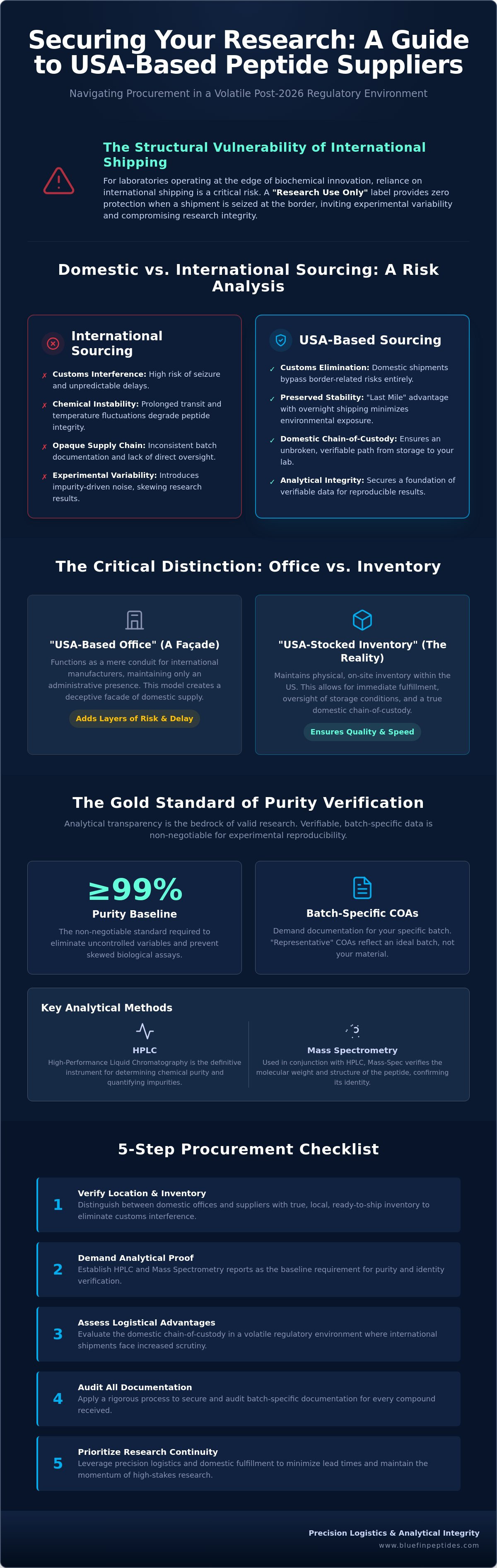
A "Research Use Only" label provides zero protection when a shipment is seized at the border or a batch fails to meet its advertised specifications. In the wake of the July 23, 2026, FDA advisory committee reviews, the margin for error in procurement has vanished. For laboratories operating at the edge of biochemical innovation, reliance on international shipping routes is a structural vulnerability that invites experimental variability. Securing USA based research peptide suppliers is no longer a matter of convenience; it's a requirement for maintaining analytical integrity through a domestic chain-of-custody.
You recognize that the success of a study hinges on the absolute purity of the underlying compounds, yet the market remains saturated with opaque data and inconsistent batch documentation. This guide provides a rigorous framework for securing a domestic supply chain that withstands current regulatory shifts and eliminates impurity-driven noise. We'll examine the necessity of independent HPLC/MS verification, the logistics of US-stocked fulfillment, and the specific protocols required to ensure your research remains anchored in verifiable data.
Key Takeaways
- Distinguish between entities with domestic offices and true USA based research peptide suppliers that maintain local, ready-to-ship inventory to eliminate customs interference.
- Establish HPLC and Mass Spectrometry as the baseline requirements for purity verification, ensuring experimental data remains free from impurity-driven noise.
- Evaluate the logistical advantages of domestic chain-of-custody in a volatile 2026 regulatory environment where international shipments face increased scrutiny.
- Apply a rigorous procurement checklist to audit third-party analytical methodologies and secure batch-specific documentation for every compound.
- Leverage precision logistics and domestic fulfillment to minimize lead times while maintaining the continuity of high-stakes laboratory research.
The Landscape of USA Based Research Peptide Suppliers in 2026
The role of USA based research peptide suppliers has undergone a fundamental transformation. In 2026, the scientific community no longer views domestic sourcing as a luxury of convenience but as a baseline requirement for procedural security. Laboratories now face a volatile global supply chain where international transit is synonymous with risk. A domestic supplier acts as a buffer. They provide a stable environment for procurement that is insulated from the unpredictable nature of cross-border logistics. This domestic anchor ensures that research timelines remain steady, regardless of shifting international trade currents.
Precision in research requires a clear distinction between a "USA-based office" and "USA-stocked inventory." Many vendors maintain domestic administrative headquarters while functioning as mere conduits for international manufacturers. This creates a deceptive facade. True domestic suppliers maintain on-site inventory within the United States. This physical presence allows for immediate oversight of storage conditions and ensures that the chain-of-custody remains unbroken from the moment of domestic receipt to final delivery. Without domestic stock, a supplier is simply a broker, adding layers of risk to the procurement process.
The legal framework surrounding these compounds remains rigid. All products are strictly designated for Research Use Only (RUO). This classification isn't a mere formality; it's a legal boundary that defines the permissible scope of use. Suppliers must adhere to these standards to ensure the longevity of the research ecosystem. This designation signifies that the products aren't intended for human or veterinary use, maintaining a clear separation between laboratory investigation and clinical application. For those interested in health products that are actually intended for human use and backed by rigorous data, you can learn more about TRU BLOOM and their clinically proven hair growth vitamins.
The Evolution of the Domestic Peptide Market
The market has pivoted from high-volume international drop-shipping toward localized quality control hubs. Modern researchers demand granular data. The surge in studies involving GLP-1 analogues, specifically Retatrutide and Tirzepatide, has accelerated this shift. Quality is no longer assumed; it's verified. Advanced chemical peptide synthesis methods allow for high-purity production, but the final analytical transparency rests with the domestic distributor. Third-party verification has become the industry's primary currency, replacing the blind trust of previous decades.
Why Proximity Matters for Chemical Stability
Lyophilized peptides are sensitive to environmental stressors. Prolonged transit times in international shipping expose these delicate structures to extreme temperature fluctuations and mechanical vibration. These variables degrade chemical integrity before the vial even reaches the lab. Domestic sourcing provides a "Last Mile" advantage. By utilizing overnight shipping within the U.S., suppliers minimize the duration of environmental exposure. This speed ensures that the physical state of the peptide remains optimal for precise experimental reconstitution. It's a logistical safeguard against the degradation currents that plague international freight.
The Gold Standard: HPLC and Mass-Spec Verification
Analytical transparency is the bedrock of valid research. For USA based research peptide suppliers, providing a Certificate of Analysis (COA) is standard, but the quality of that data varies significantly. A "representative" COA is insufficient. It reflects a single ideal batch rather than the specific material in your hands. Researchers must demand batch-specific documentation to ensure experimental reproducibility. This rigor is critical given the increased regulatory pressure on the industry. For instance, an FDA Warning Letter on Research Peptides recently highlighted how deviations in marketing and quality oversight can compromise the entire supply chain. Security stems from verifiable data, not marketing claims.
Interpreting the HPLC Chromatogram
High-Performance Liquid Chromatography (HPLC) remains the definitive instrument for determining chemical purity. HPLC is the separation of compounds within a mixture to identify and quantify individual impurities. The resulting chromatogram displays peaks where the area under the curve represents the relative concentration of the peptide. In sensitive research models, ≥99% purity is the non-negotiable baseline. Anything less introduces uncontrolled variables that skew biological assays. Examine the baseline of the report. Excessive noise or improper peak integration often masks minor impurities that can disrupt cellular signaling or metabolic pathways.
Mass-Spec: Confirming Molecular Identity
While HPLC measures purity, Mass Spectrometry (MS) confirms identity. It validates that the synthesized sequence matches the theoretical molecular weight. MS is essential for detecting synthesis byproducts or truncated sequences that HPLC might miss. Matching observed mass to theoretical mass ensures the compound is exactly what was ordered. For a deeper technical dive into these metrics, consult our research peptide quality standards pillar article. Reliable identity confirmation is the only way to prevent the use of incorrect analogues in high-stakes environments.
Red flags often hide in the margins. Look for "ghost peaks" or integration lines that don't reach the baseline. These are signs of poor analytical technique or intentional data manipulation. Reliable USA based research peptide suppliers provide high-resolution, unedited data. Verification is the only path to security. If your current source provides blurred or truncated reports, your research is drifting into uncertain waters. You can examine batch-specific COAs to see the level of detail required for charting the analytical currents of modern laboratory standards.
Domestic vs. International Sourcing: A Risk-Based Analysis
Procurement strategy often collapses when it prioritizes nominal unit costs over structural logistical security. International sourcing introduces a chaotic variable into the laboratory environment. Between the point of synthesis and the point of delivery, a compound must navigate multiple jurisdictional boundaries and environmental stressors. Genuine USA based research peptide suppliers internalize these risks, providing an analytical and physical buffer that international drop-shippers cannot replicate. By maintaining domestic inventory, these suppliers ensure that the volatility of global trade currents doesn't disrupt the steady flow of your research.
The regulatory landscape in mid-2026 is characterized by heightened vigilance. Recent enforcement actions underscore the necessity for rigorous regulatory compliance for peptide suppliers. For a laboratory, the risk is not merely financial; it's operational. A seized shipment represents a catastrophic break in research continuity. When a batch is held by Customs and Border Protection (CBP), the researcher loses both the capital invested and the time required to re-order. This double-loss is a structural flaw in international procurement models that domestic sourcing eliminates.
Customs Risks and Regulatory Hurdles
International shipments of research chemicals face increasing scrutiny as regulatory agencies tighten oversight on unapproved compounds. Beyond the risk of total seizure, international transit often involves prolonged delays in non-climate-controlled customs warehouses. These environments subject lyophilized peptides to thermodynamic stress that can compromise chemical stability. Domestic sourcing mitigates this by utilizing localized, rapid-fulfillment networks. Shipping from within U.S. borders ensures that cold chain integrity is maintained through shorter transit durations, protecting the physical state of the material from the moment it leaves the supplier's climate-controlled facility.
Chain of Custody and Accountability
Accountability is the primary advantage of dealing with US-governed business entities. When you partner with USA based research peptide suppliers, you gain a direct line of communication with a technical support team that operates under the same legal and ethical standards as your laboratory. This proximity allows for rapid resolution of batch inquiries and immediate access to raw HPLC data. If a discrepancy arises, domestic recourse is a reality, not a theoretical impossibility. Secure logistics aren't just about speed; they're about the certainty that every vial in your rack has a documented, verifiable history that stands up to the most rigorous analytical audit.
This degree of accountability is a cornerstone of professional laboratory management. Beyond chemical sourcing, many institutional researchers and clinicians use GetMedicalDevice to procure specialized equipment and medical supplies from top-tier global brands, ensuring the same level of logistical reliability across their entire operation.

5-Step Procurement Checklist for Qualified Researchers
Navigating the procurement process requires a systematic filter to separate disciplined logistics specialists from simple retail vendors. For an institutional researcher, the vetting of USA based research peptide suppliers must go beyond surface-level reviews. It demands a forensic approach to verification. This five-step checklist serves as a protocol for ensuring that every compound entering your laboratory meets the rigorous standards of modern biochemistry. By applying these criteria, you eliminate the noise of marketing fluff and anchor your research in verifiable data.
Step 1: The COA Audit
Documentation is only as valid as its source. A primary red flag is the presence of "typical" or "representative" results that don't correspond to the specific inventory batch in question. You must audit the date of the analytical report against the lot number on your vials. Ensure the testing laboratory is a third-party, independent entity with verifiable credentials. A complete audit includes the HPLC purity percentage and the mass spectrometry data required to confirm the specific peptide sequence. This dual-verification eliminates identity errors that can derail long-term studies.
Step 2: Logistical Verification
Physical location determines the speed and security of your supply chain. Confirm the shipping origin to ensure the supplier isn't utilizing international drop-shipping under the guise of a domestic office. Packaging standards are equally critical. Vials must be protected against UV degradation and kinetic stress through professional-grade containment. This is particularly vital for high-demand compounds like Retatrutide, where maintenance of chemical integrity is paramount. Domestic inventory status ensures the material is stored in climate-controlled environments until the moment of fulfillment.
Review the supplier's stability standards. Lyophilization quality is the anchor of long-term storage viability. A professional supplier will provide clear storage protocols and understand the specific thermodynamic requirements of the compounds they offer. Evaluating USA based research peptide suppliers based on their technical expertise is the final safeguard. A disciplined partner provides the tools for verification and stands behind the analytical data. To secure your laboratory's supply chain with these standards, you can source HPLC-verified research peptides directly from our domestic inventory.
Bluefin Peptides: Precision Logistics and Analytical Integrity
Bluefin Peptides operates at the intersection of biochemical accuracy and logistical speed. We recognize that USA based research peptide suppliers must provide more than just proximity. We provide certainty. Our commitment to ≥99% HPLC-verified purity isn't a marketing target; it's a baseline scientific requirement for meaningful research. Every compound in our inventory is anchored by batch-specific documentation. This includes both HPLC and Mass Spectrometry data. We eliminate the guesswork by providing direct access to the raw analytical reports that define the identity and purity of your research materials. This level of transparency allows you to audit our quality before a single vial is reconstituted in your laboratory.
The Bluefin Advantage: Beyond the Vial
Our catalog is curated for advanced metabolic and cellular research. We specialize in high-purity GLP-1 analogues like Retatrutide and Tirzepatide. Every offering adheres to strict Research Use Only (RUO) protocols. This ensures professional safety and regulatory clarity for your institution. We prioritize transparent data sharing with qualified researchers. This creates a collaborative environment where analytical integrity is the standard. Precision synthesis meets disciplined oversight in every vial we fulfill. We don't just sell compounds; we provide the analytical foundation for your next discovery. Our methodology is rooted in a "show, don't tell" philosophy. We provide the tools for independent verification because we trust our processes to withstand the most rigorous scrutiny.
Securing Your Research Supply Chain
Fulfillment speed is a critical variable in time-sensitive studies. We maintain a US-stocked inventory to ensure immediate deployment to your laboratory. This eliminates the unpredictability of international transit and customs interference. Our fulfillment process mirrors maritime precision. It moves with fluid speed while remaining anchored in strict testing protocols. Our climate-controlled storage facilities are designed to preserve the physical state of lyophilized compounds. We navigate the complexities of domestic logistics with the same precision used in deep-sea navigation. Every shipment is tracked with granular detail. This ensures that the chain-of-custody remains unbroken from our facility to your benchtop.
In a volatile global market, Bluefin Peptides serves as a reliable domestic partner. We provide the stability required to maintain experimental momentum without compromising on data quality. Our logistics specialists handle every batch with the discipline of a high-performance laboratory partner. We manage the "how" of our storage and shipping to ensure the "what" of your results remains consistent. Explore our catalog of HPLC-verified research peptides to secure your laboratory's future requirements and maintain the integrity of your scientific mission.
Charting a Path Toward Analytical Certainty
The 2026 procurement landscape demands an uncompromising focus on analytical transparency and logistical security. Relying on USA based research peptide suppliers that maintain domestic inventory is the only viable method for insulating your laboratory from international supply chain volatility. Verification is the baseline. Research built on the foundation of batch-specific COAs and ≥99% HPLC-verified purity ensures experimental reproducibility. These rigorous standards eliminate the noise of impurities and anchor your data in verifiable truth. Security stems from documentation, not blind trust.
Precision logistics and domestic fulfillment provide the stability required to advance complex metabolic and cellular studies without interruption. By securing a domestic chain-of-custody, you protect the chemical integrity of your compounds from environmental stressors and regulatory hurdles. Efficiency. Security. Data-driven results. These are the markers of a high-performance laboratory partner. Secure your laboratory supply with Bluefin Peptides to leverage our USA-stocked inventory and commitment to maritime precision. We provide the analytical depth and logistical speed necessary to keep your research moving forward with absolute confidence. Your scientific mission deserves compounds that meet the highest analytical register.
Frequently Asked Questions
How do I verify if a research peptide supplier is actually based in the USA?
Check the physical shipping origin and business registration to confirm a domestic presence. Many vendors use domestic PO boxes but drop-ship from overseas. Verifiable USA based research peptide suppliers maintain domestic warehouses and provide tracking numbers that originate from within the United States. Cross-referencing business licenses with the Secretary of State's office ensures the entity is governed by domestic legal standards. This transparency anchors your supply chain in a verifiable physical location.
What is the difference between HPLC and Mass Spectrometry for peptide testing?
HPLC measures chemical purity while Mass Spectrometry confirms molecular identity. High-Performance Liquid Chromatography separates the mixture to quantify impurities relative to the target peptide. Mass Spectrometry validates the molecular weight of the compound to ensure the synthesized sequence is correct. Both are required to ensure the material is both pure and accurately identified. Relying on a single test is like navigating without a secondary compass; you risk experimental drift.
Are research peptides legal to purchase in the United States?
Research peptides are legal to purchase when designated strictly for laboratory research use only. These compounds aren't approved by the FDA for human or veterinary consumption. Purchasing them is permissible for qualified researchers conducting in vitro or in vivo studies within a controlled environment. Suppliers must adhere to strict labeling requirements to maintain this legal status. Navigating the regulatory currents requires a disciplined adherence to these Research Use Only boundaries.
Why is batch-specific COA more important than a general purity claim?
A batch-specific COA reflects the exact purity and identity of the material in your possession. General or "representative" purity claims are often based on historical data or ideal synthesis runs that may not match current inventory. For USA based research peptide suppliers, providing a unique report for every lot ensures that experimental variables remain controlled. This specific data acts as a structural anchor for your laboratory's analytical integrity and reproducibility.
How does domestic shipping affect the stability of lyophilized peptides?
Domestic shipping minimizes the duration of environmental exposure, preserving the thermodynamic stability of the peptide. International transit often subjects vials to extreme temperature fluctuations in customs warehouses. Rapid domestic fulfillment ensures the lyophilized state remains optimal. This speed reduces the risk of chemical degradation that occurs during prolonged transit. Localized logistics allow for a more fluid movement of materials while maintaining the physical state required for precise research results.
What should I look for in an HPLC report to ensure 99% purity?
Examine the integration table and the baseline of the chromatogram to verify data quality. The main peak area must account for ≥99% of the total integrated area. Ensure the baseline is stable and that minor peaks aren't being masked by excessive noise. Professional reports will show a clear separation of the target compound from any synthesis byproducts. If the report lacks high-resolution peaks or clear integration lines, the analytical data is insufficient for professional laboratory standards.
Can research peptides be used for human or veterinary applications?
No, research peptides are strictly prohibited from human or veterinary use. These substances are unapproved new drugs and lack the safety data required for clinical application. Utilizing these compounds outside of a laboratory research context violates federal regulations. While researchers prioritize these substances for study, health-conscious consumers seeking natural wellness support can explore products intended for human consumption from Gara Health. Maintaining this distinction is essential for the legal and ethical continuity of the scientific research community.
Why are some peptides sold as blends, such as BPC-157 and TB-500?
Blends are formulated to allow researchers to observe the synergistic interactions between multiple compounds in a single study. These combinations, such as BPC-157 and TB-500, are designed for specific experimental models where dual-signaling pathways are under investigation. Every component within the blend must still undergo independent HPLC and MS verification to ensure the ratio and purity of the individual peptides meet laboratory standards. This allows for a deeper dive into complex biological interactions.
For laboratory research use only. Not for human or veterinary use. This content is educational and does not constitute medical, dosing, or usage guidance.
Browse the BLUEFIN catalog