Peptide Quality Control Standards: 2026 Analytical Guide

A Certificate of Analysis that lacks raw data is not a validation of quality; it is a liability. In the high-stakes environment of 2026 research, you shouldn't have to guess whether a compound meets the required purity or if residual TFA content will compromise your results. Inconsistent batch quality remains the primary cause of failed experiments and non-reproducible data. This guide ensures you master the peptide quality control standards for labs necessary to verify every milligram of material with absolute certainty.
We provide the technical framework to interpret complex HPLC and mass-spec confirmation reports while identifying the specific benchmarks for endotoxin and sterility testing required in the current regulatory landscape. You'll gain the analytical tools to establish a standardized verification protocol, allowing you to secure reliable partners through batch-specific documentation. From understanding the 99% purity threshold to navigating the 2026 FDA reclassifications, this guide serves as your definitive roadmap for analytical integrity. We prioritize transparency and clinical precision to ensure your laboratory operates with unwavering confidence.
Key Takeaways
- Identify the three essential pillars of verification, Identity, Purity, and Content, to establish a rigorous baseline for chemical integrity.
- Master the interpretation of HPLC and Mass Spectrometry reports to enforce strict peptide quality control standards for labs and prevent experimental failure.
- Evaluate secondary metrics like residual solvent levels and TFA counter-ion content to ensure biological compatibility in high-stakes research environments.
- Learn to audit Certificates of Analysis by cross-referencing batch-specific data and verifying the recency of analytical testing.
- Understand why a minimum threshold of 99% purity is the necessary benchmark for maintaining batch consistency and scientific reproducibility.
Defining Peptide Quality Control Standards in Modern Research
Peptide quality control standards for labs represent the analytical foundation of reproducible science. These benchmarks ensure chemical identity, purity, and batch-to-batch consistency. Without rigorous verification, the data generated in high-stakes environments remains anecdotal. Quality control is a dynamic process. It bridges the gap between chemical synthesis and experimental reliability. Standardized protocols are essential for cross-laboratory reproducibility and the integrity of peer-reviewed publications. In the current 2026 landscape, the distinction between generic manufacturer specifications and batch-specific Certificates of Analysis (COAs) has become the primary metric for supplier reliability.
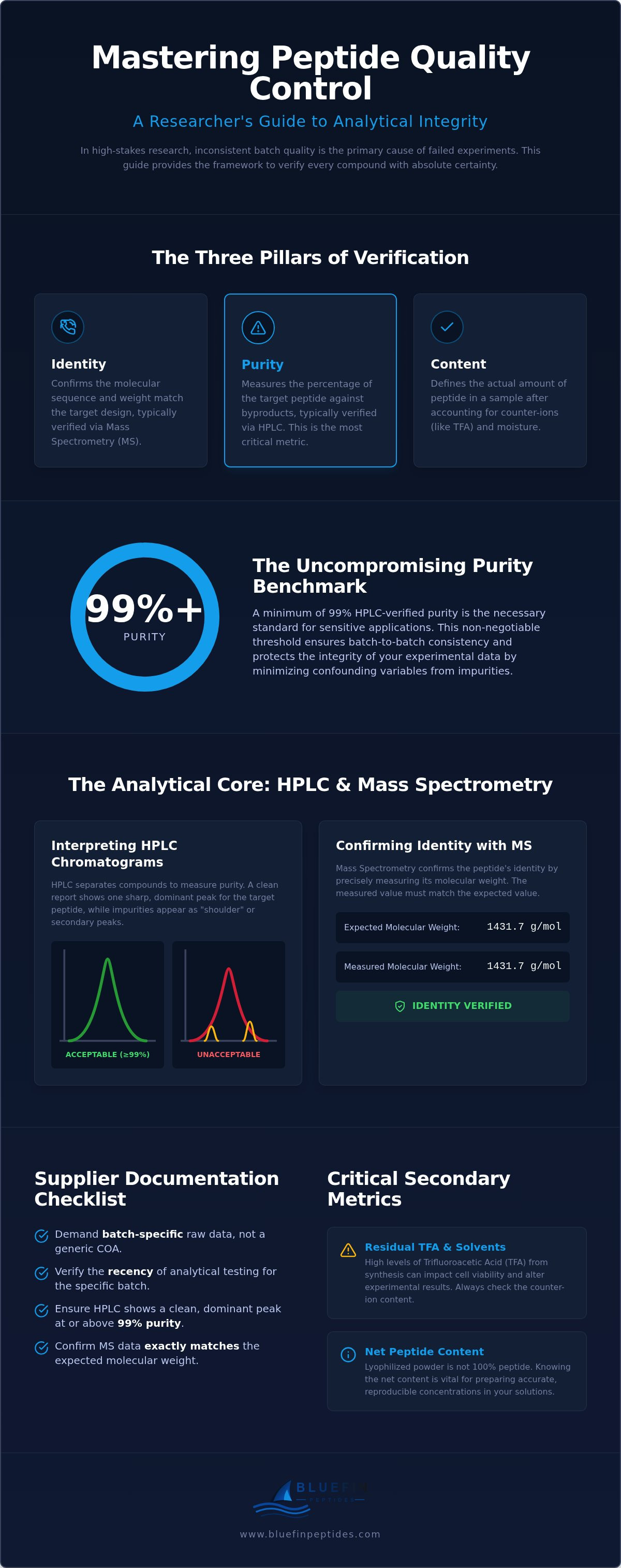
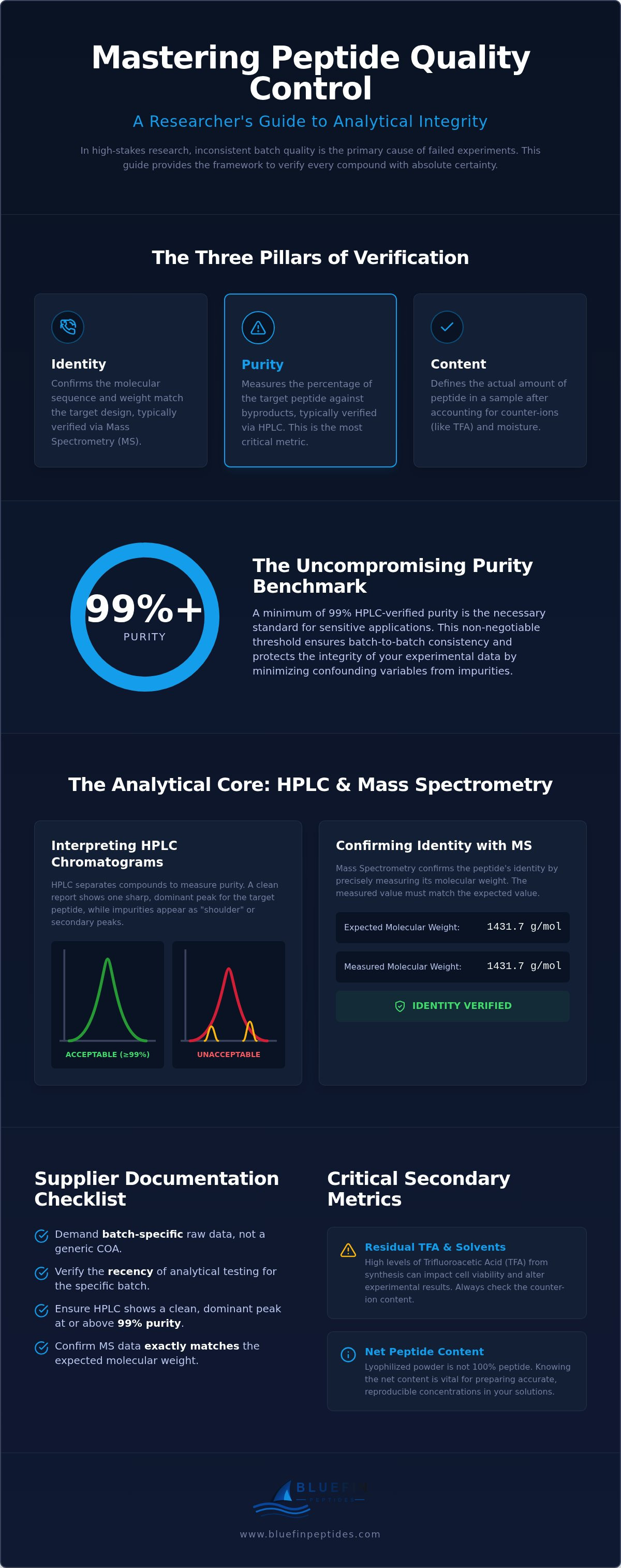
The verification of research compounds rests on three analytical pillars. Identity confirms that the molecular sequence and weight match the target design. Purity measures the ratio of the target peptide against synthesis byproducts or residual contaminants. Content defines the actual amount of peptide present in a lyophilized sample, accounting for counter-ions and moisture. During Commercial peptide synthesis QC, these metrics are typically validated through High-Performance Liquid Chromatography (HPLC) and Mass Spectrometry (MS). For the researcher, accepting anything less than batch-specific data is an unnecessary risk to project longevity.
The Impact of Substandard Peptides on Experimental Data
Impurities are not inert. They act as confounding variables in cellular models and in vivo studies. Truncated sequences or misfolded peptides can generate false-positive results or lead to unexpected toxicity. If a sequence is missing a single amino acid, its binding affinity may change entirely. This structural inaccuracy compromises the validity of the entire study. The financial cost of unverified materials is high; the temporal cost of repeating months of work is often higher. Precision is the only safeguard against these systemic failures.
Regulatory Context for Research-Grade Compounds
The regulatory environment for peptides underwent significant shifts in 2026. While the FDA removed twelve peptides from the Category 2 "do not compound" list in April 2026, research-grade materials remain in a distinct category from USP or EP pharmaceutical standards. Adhering to research peptide quality standards is critical for maintaining lab safety and ensuring that compounds are handled within legal boundaries. These materials are exclusively for qualified researchers. They are not for human or veterinary use. Establishing strict peptide quality control standards for labs ensures that every compound remains a tool for discovery rather than a source of analytical noise. We maintain a "show, don't tell" philosophy, providing the raw data necessary for researchers to verify every batch independently.
The Analytical Core: HPLC Purity and Mass Spectrometry Identity
Analytical rigor is the only currency in high-stakes research. For any facility implementing peptide quality control standards for labs, the dual-verification process involving High-Performance Liquid Chromatography (HPLC) and Mass Spectrometry (MS) is non-negotiable. While many suppliers claim high purity, a minimum of 99% HPLC-verified purity is the necessary benchmark for sensitive applications where even minor synthesis byproducts can disrupt cellular signaling or receptor binding assays. Verification must be batch-specific; general specifications are insufficient for validating the chemical nature of a compound. We provide the raw analytical data for our verified research compounds to ensure complete transparency regarding these metrics.
Interpreting HPLC Chromatograms
HPLC is the separation of chemical components based on their interaction with a stationary phase. In a standard report, the primary metric is peak integration, specifically the area under the curve (AUC). A single, sharp peak indicates a high concentration of the target molecule, representing a clean, fluid movement through the column. Conversely, the presence of "shoulder peaks" or secondary elution signals reveals the existence of synthesis by-products, such as truncated sequences or diastereomers. These impurities often share similar chemical properties with the target peptide, making them difficult to remove without precise purification protocols. Analyzing the AUC ensures that the ratio of the target peptide to impurities meets the ≥99% threshold required for reproducibility.
Mass Spectrometry: Beyond Molecular Weight
While HPLC confirms purity, Mass Spectrometry (MS) confirms identity with deep-sea precision. It verifies the mass-to-charge (m/z) ratio against the theoretical molecular formula. This is particularly vital for validating tirzepatide research peptide batches, where the complex sequence must be verified for accuracy down to the Dalton. MS analysis also detects salt adducts and fragmentation patterns that may indicate chemical degradation or improper storage. By cross-referencing the observed molecular weight with the theoretical value, researchers can confirm that the peptide sequence is intact and free from structural inaccuracies.
For complex analogues like retatrutide research peptide, relying on a single test is an analytical failure. The structural complexity of these molecules requires the urgent precision of dual-verification to ensure that the compound delivered matches the sequence intended for the study. Maintaining these peptide quality control standards for labs eliminates the variables that lead to failed experiments, providing a secure foundation for laboratory data and peer-reviewed accuracy.
Assessing Secondary Metrics: Residual Solvents and Net Peptide Content
Analytical integrity requires more than a primary peak. It demands a deep-sea screening of the chemical environment. Residual solvents such as Dimethylformamide (DMF), Acetonitrile, and Piperidine represent standard synthesis residues that must be monitored via GC-MS. These volatile organics can act as confounding factors in delicate cellular assays, potentially inducing stress responses that skew data. High-performance peptide quality control standards for labs also mandate elemental impurity profiling. Screening for heavy metals like lead (Pb), arsenic (As), cadmium (Cd), and mercury (Hg) is a baseline requirement for experimental safety. We ensure every batch undergoes this rigorous filtration to maintain the urgent precision our partners expect. A failure to account for these residues can lead to analytical drift, where results vary across batches despite identical HPLC purity scores.
The Problem with Residual TFA
Trifluoroacetic acid (TFA) is the ubiquitous counter-ion used in solid-phase peptide synthesis. It's effective for cleavage but carries inherent risks. In cell culture models, residual TFA causes significant pH shifts that compromise cell viability and disrupt receptor binding kinetics. It's a silent variable. Researchers must determine if their specific model requires an acetate or HCl salt exchange to mitigate these effects. Low-TFA or TFA-free formulations are essential when the experimental outcome is sensitive to acidic environments. We prioritize providing clear documentation on counter-ion levels to ensure your laboratory environment remains stable and predictable. Transparency regarding these chemical signatures isn't an option; it's a requirement for high-stakes research.
Calculating Net Peptide Content
Lyophilized powder weight is deceptive. It represents the gross weight, which includes the target peptide, residual moisture, and counter-ions. Accurate reconstitution requires the net peptide content. This value is typically determined through Nitrogen Analysis or Amino Acid Analysis (AAA). If the net content is 80%, a 10mg vial contains exactly 8mg of the target sequence. Ignoring this discrepancy leads to incorrect molar concentrations and inconsistent dosing in longitudinal studies. Precise quantification is the difference between a repeatable study and a failed replication. Every shipment from our US-stocked inventory includes the specific data points needed to calculate these concentrations with absolute certainty. We don't ask for trust; we provide the tools for verification.
Validating Supplier Documentation: A Researcher’s Checklist
Verification is the final checkpoint before reconstitution. It's the boundary between rigorous data and anecdotal observation. A researcher's audit of supplier documentation must be methodical. Every Certificate of Analysis (COA) must be anchored to the specific batch number etched on the vial. Recycled data is a common failure point in the industry. Verify the date of analysis to ensure the compound hasn't been subjected to environmental degradation during prolonged storage. Current analytical data is the only way to satisfy peptide quality control standards for labs. Transparency is the primary metric of trust. Check for third-party lab verification or internal QC reports that provide raw data rather than summary tables. Cross-referencing the chromatogram peaks with the reported purity percentage is essential. If the AUC doesn't align with the listed purity, the documentation is unreliable. We provide batch-specific analytical reports for every compound to eliminate this uncertainty.
Red Flags in Peptide Documentation
Analytical shortcuts are easy to identify if you know where to look. Generic COAs that lack actual chromatograms or mass-spec graphs are the first warning sign. They provide a conclusion without the evidence. Discrepancies between the theoretical molecular weight and the observed m/z ratio in the MS report indicate synthesis errors or sequence truncation. Perhaps most critically, treat any claim of 100% purity with extreme skepticism. In the fluid reality of commercial synthesis, 100% is a mathematical impossibility. It suggests a lack of analytical resolution or intentional data smoothing. These peptide quality control standards for labs exist to filter out such statistical noise.
Batch-to-Batch Variability Management
Long-term research projects require a deep-sea focus on consistency. Establishing internal benchmarks for acceptable purity fluctuations is vital for longitudinal study integrity. We recommend historical data tracking of every batch used in a project to identify subtle shifts in chemical behavior. If a batch returns an out of spec result, the supplier's response is the ultimate test of their professionalism. Reliable partners offer immediate remediation and transparent re-testing. This disciplined approach to documentation ensures that your research remains focused on the how of the process to secure the what of the results. Security and trust are built on this foundation of verifiable data.
Bluefin Peptides: Precision Logistics and Analytical Integrity
Bluefin Peptides operates at the intersection of biochemical accuracy and logistical speed. Our commitment is absolute. We mandate a minimum of 99% HPLC-verified purity across our entire catalog of research compounds. This isn't a marketing claim; it's an analytical floor. Every shipment is anchored by verifiable, batch-specific analytical data. We utilize optimized lyophilization processes to ensure structural stability during transit, preserving the chemical nature of the offerings. By maintaining US-stocked inventory, we eliminate the degradation risks inherent in prolonged international shipping. This domestic fulfillment ensures that the peptide quality control standards for labs we enforce are never compromised by environmental fluctuations during delivery. We provide the tools for verification because high-stakes research demands certainty.
Verification Protocols for Specialized Blends
Multi-peptide formulations present unique analytical hurdles that require advanced resolution. The GHK-Cu BPC-157 TB-500 research blend requires precise peak separation to confirm the identity and ratio of each constituent. Our protocols solve these challenges through high-resolution chromatography that maps every molecule with deep-sea precision. For the ipamorelin CJC-1295 research blend USA, we provide batch-level verification that accounts for the synergistic stability of the combined sequences. We navigate the complexities of multi-component synthesis to ensure that the fluid movement of each peptide in the blend remains consistent with its theoretical profile. This methodical approach prevents the analytical drift often found in unverified mixtures.
The Bluefin Standard: Reliability in Every Vial
Our "Show, Don't Tell" philosophy defines our persona as a high-performance laboratory partner. We don't ask for blind trust; we provide the raw data necessary for independent researcher verification. Rapid response logistics move materials from our facility to your lab with urgent precision. This speed is balanced by a traditionalist adherence to strict testing protocols. It's a disciplined approach to logistics and science. We focus on the "how" of our processes to ensure the "what" of your results. By maintaining these peptide quality control standards for labs, we act as a stoic anchor for your research projects. Security and trust are built into every vial we fulfill. We remain the preferred partner for environments where analytical variability is not an option.
Advancing Laboratory Integrity Through Analytical Rigor
Experimental reproducibility rests on the clinical foundation of chemical verification. Mastery of HPLC chromatogram interpretation and mass spectrometry confirmation isn't optional for high-stakes research; it's a requirement. By accounting for secondary metrics like residual TFA and net peptide content, you eliminate the variables that lead to analytical drift. Implementing these peptide quality control standards for labs ensures your data remains a verifiable tool for discovery. Security in your findings begins with a disciplined audit of every batch-specific COA.
We provide the raw data necessary to anchor your studies in absolute certainty. Our offerings are defined by ≥99% HPLC-verified purity and mass-spec confirmation on all vials. We focus on the how of our processes to ensure the what of your results. Procure HPLC-Verified Peptides for Your Next Study and secure the analytical integrity your research demands. Every shipment includes batch-specific COAs to provide immediate clarity and stoic reliability. We look forward to supporting your next breakthrough with unwavering precision.
Frequently Asked Questions
What is the difference between peptide purity and net peptide content?
Peptide purity represents the percentage of the target sequence relative to chemical impurities as measured by HPLC peak integration. Net peptide content identifies the actual mass of the peptide within the lyophilized powder after accounting for moisture and counter-ions like TFA. A vial with 99% purity might only have 80% net peptide content. This distinction is critical for calculating precise molar concentrations during reconstitution to ensure experimental accuracy and reproducibility in laboratory settings.
Why is HPLC considered the gold standard for peptide quality control?
HPLC provides high-resolution separation of chemical components based on their interaction with a stationary phase. It allows researchers to quantify the target peptide against synthesis by-products with absolute precision. This methodology is the cornerstone of peptide quality control standards for labs because it identifies "shoulder peaks" that other methods miss. Without HPLC data, the purity of a compound remains a theoretical estimate rather than a verifiable analytical fact that researchers can trust.
Can I rely on a generic Certificate of Analysis (COA) for my research?
Generic Certificates of Analysis are insufficient for validating the chemical integrity of high-stakes research materials. A reliable COA must be batch-specific and include raw HPLC chromatograms and mass spectrometry graphs. Relying on recycled or summary-only data introduces unnecessary risk to your data sets. We provide batch-specific documentation for every shipment to ensure that the material in your vial matches the analytical profile reported in the laboratory during the initial synthesis and purification cycles.
How does residual TFA affect laboratory experiments?
Residual Trifluoroacetic acid (TFA) acts as a silent variable that can skew biological data by inducing significant pH shifts. In cell culture models, these acidic residues often compromise cell viability or interfere with receptor binding kinetics. Researchers must evaluate if their specific assay requires a salt exchange to acetate or HCl to mitigate these effects. Understanding the counter-ion profile is a fundamental component of maintaining rigorous peptide quality control standards for labs to prevent confounding results.
What are the most common impurities found in synthetic peptides?
Synthetic peptides frequently contain truncated sequences where amino acid coupling was incomplete during the synthesis cycle. Diastereomers, which result from amino acid racemization, are also common and can be difficult to detect without high-resolution HPLC. Residual solvents like Dimethylformamide (DMF) and Acetonitrile represent additional contaminants that must be monitored via GC-MS. Identifying these impurities through mass-spec confirmation and analytical chromatography is the only way to ensure the compound's structural and chemical purity remains within acceptable benchmarks.
How should lyophilized peptides be stored to maintain quality standards?
Lyophilized peptides should be stored in a freezer at -20°C or ideally -80°C to prevent chemical degradation and moisture absorption. Vials must remain tightly sealed in a desiccated environment and protected from light exposure to maintain long-term stability. Repeated freeze-thaw cycles should be avoided by aliquoting the peptide after initial reconstitution. Proper storage protocols are essential to preserve the analytical benchmarks established during the initial quality control verification process and ensure the compound remains viable for future studies.
Is mass spectrometry enough to verify a peptide’s identity?
Mass spectrometry confirms the molecular weight and sequence identity but provides no information regarding the purity of the sample. While it verifies that the correct peptide was synthesized, it cannot determine the concentration of impurities or by-products present. A peptide can have a perfect mass-spec report while containing significant levels of truncated sequences or residual solvents. Verification requires the concomitant use of HPLC to quantify purity and MS to confirm the chemical signature of the target molecule accurately.
Why is 99% purity often required for in vitro research models?
In vitro research models are highly sensitive to minor chemical variations and synthesis by-products. A purity threshold of 99% minimizes the presence of confounding variables that could trigger unintended cellular stress responses or non-specific binding. Lower purity levels increase the risk of experimental noise, which can lead to false-positive results or a lack of reproducibility. Maintaining this high benchmark is the standard for researchers who cannot afford analytical variability or chemical interference in their experimental data sets.
For laboratory research use only. Not for human or veterinary use. This content is educational and does not constitute medical, dosing, or usage guidance.
Browse the BLUEFIN catalog