Interpreting a Peptide COA: A Researcher’s Guide to Analytical Verification
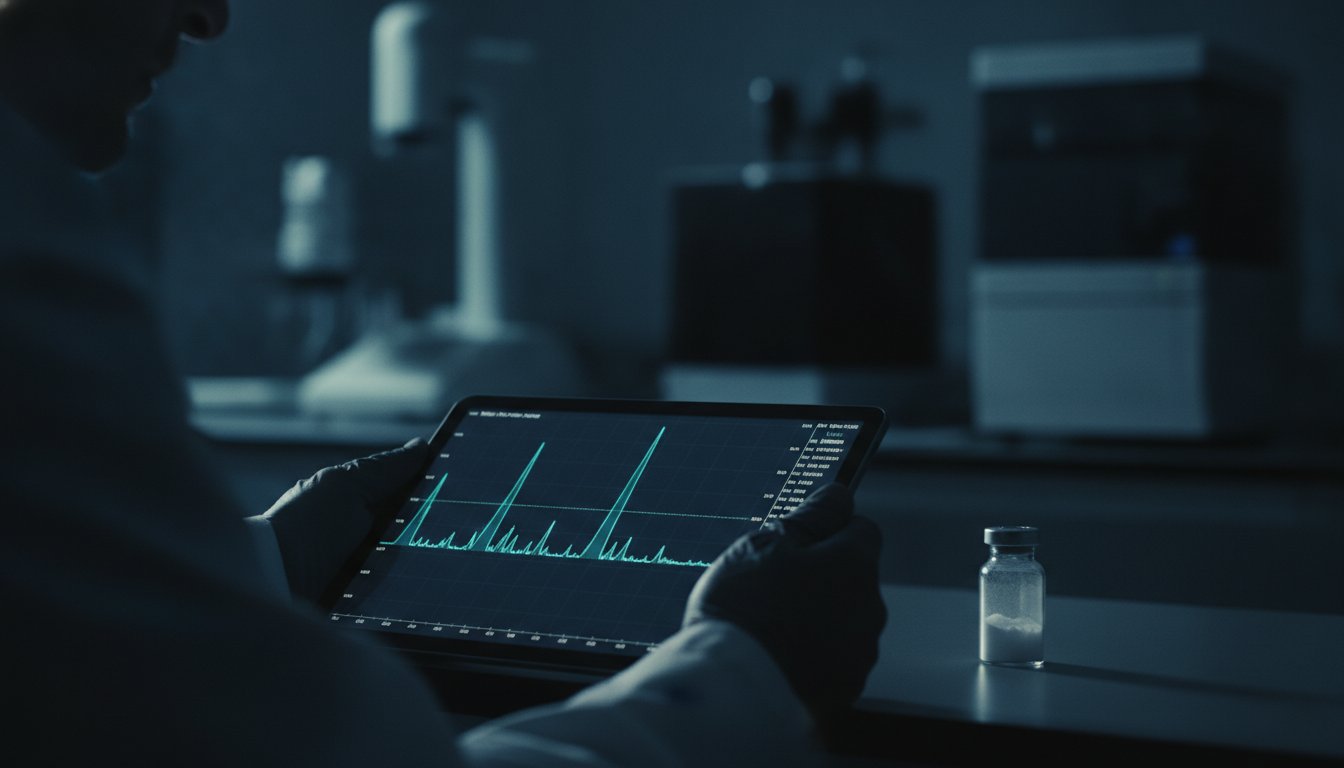
A Certificate of Analysis is a forensic fingerprint; interpreting it requires analyzing the intersection of molecular identity and chemical purity with deep-sea precision. Precision. Verification. Security. Following the April 2026 FDA reclassification of twelve peptides, the burden of analytical verification has shifted more heavily onto the researcher. Interpreting a peptide COA isn't a peripheral task but a core requirement for ensuring that your laboratory materials meet rigorous standards. Without a disciplined approach to these reports, you risk the integrity of your entire research project on the basis of a single forged or misinterpreted document.
You understand that batch-to-batch consistency is the bedrock of reproducible science. This guide provides the tools to move beyond blind trust and master the technical nuances of HPLC chromatograms and Mass-Spec data. We'll detail how to confidently validate purity levels of 99% or higher and identify identity issues when molecular weight deviations exceed 0.5%. You'll learn to audit supplier documentation with clinical precision, ensuring that every compound, from Tirzepatide to Retatrutide, aligns with its theoretical profile. This protocol transforms the COA from a static sheet into a dynamic instrument of security.
Key Takeaways
- Validate chemical purity with clinical precision by analyzing HPLC chromatograms for primary peak integration and secondary impurity detection.
- Ensure molecular identity through Electrospray Ionization Mass Spectrometry, maintaining a strict tolerance between theoretical and observed molecular weights.
- Establish a disciplined protocol for interpreting a peptide COA to distinguish between generic specification sheets and lot-specific analytical data.
- Protect laboratory integrity by identifying red flags in documentation, including recycled reports or altered peak data that indicate compromised authenticity.
- Leverage batch-level transparency to maintain security in research environments, focusing on the forensic verification of compounds like Retatrutide and Tirzepatide.
The Role of Analytical Documentation in Peptide Research
A Certificate of Analysis (COA) serves as the definitive forensic record for any chemical compound. It isn't merely a marketing supplement; in a laboratory environment, it functions as a primary instrument of verification. Interpreting a peptide COA is the first line of defense against batch-level failures. A common error involves confusing a "standard" specification sheet with a lot-specific analytical report. While a specification sheet outlines the intended parameters of a product, a COA documents the actual measured results of a specific batch. This distinction is critical. Without batch-level transparency, the reproducibility of your data is compromised.
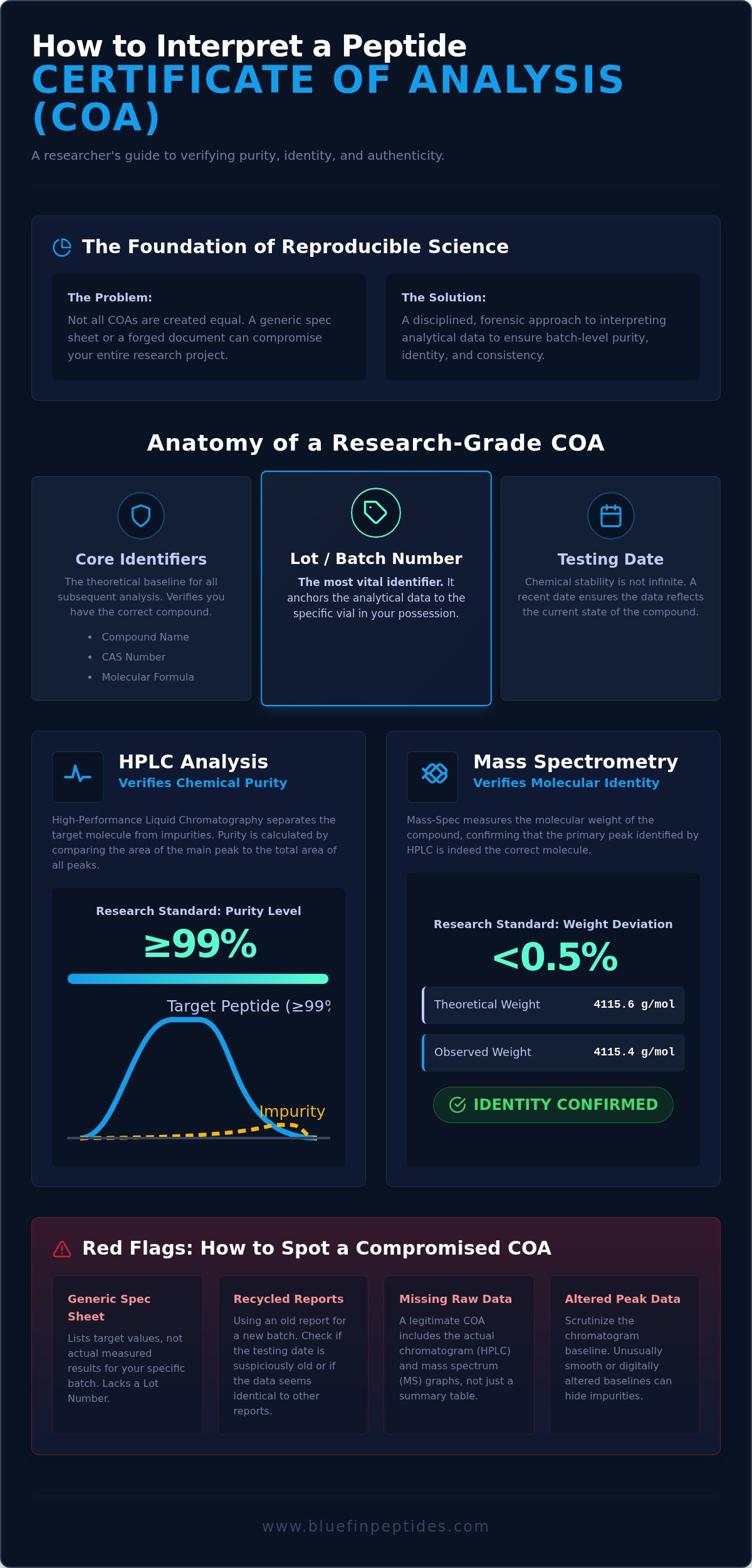
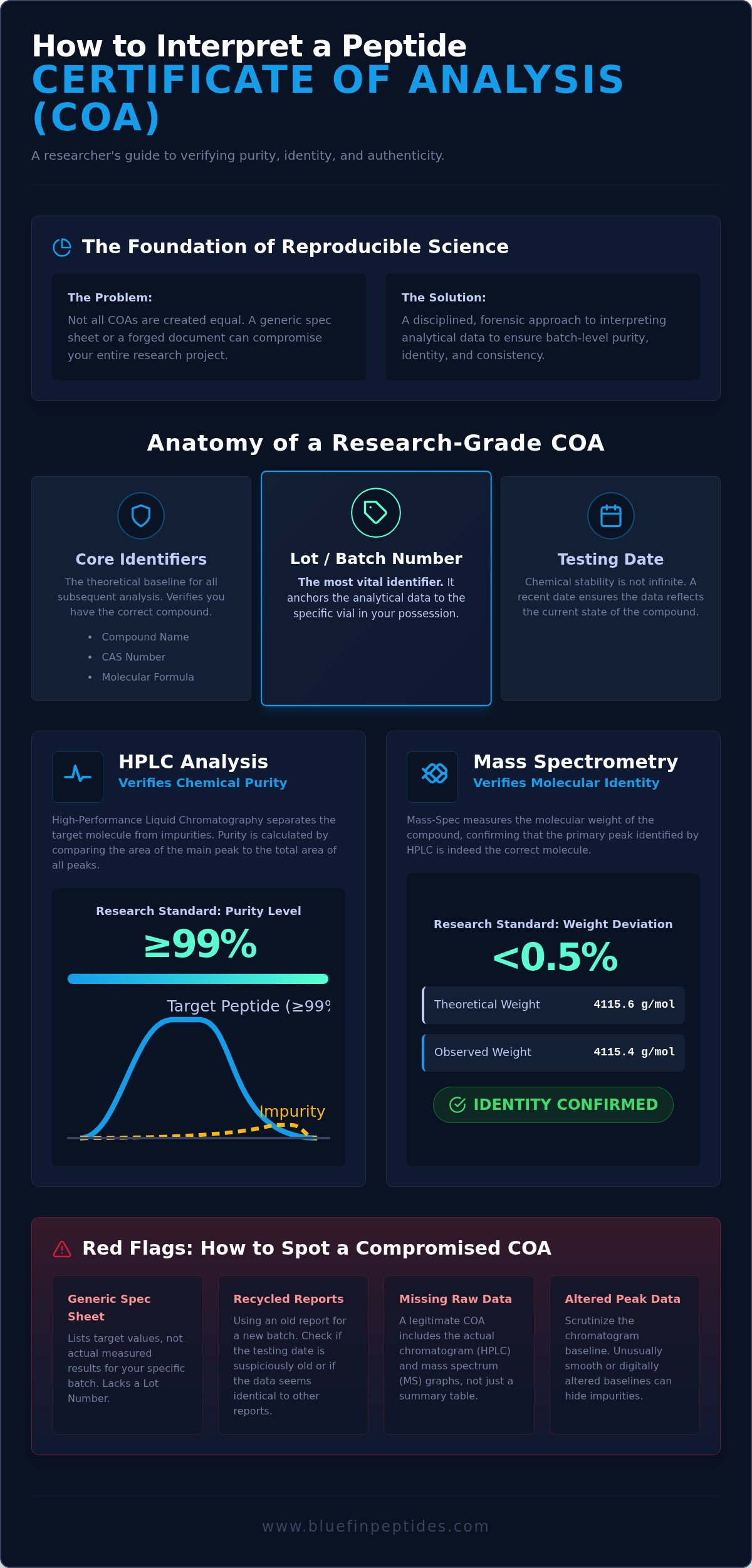
Purity is a multi-dimensional metric that requires a dual-pronged analytical approach. High-Performance Liquid Chromatography (HPLC) measures the concentration of the target molecule relative to impurities. However, HPLC cannot definitively confirm the identity of that molecule. This is why orthogonal testing is mandatory. Mass Spectrometry (Mass-Spec) verifies the molecular weight, ensuring the substance is exactly what it claims to be. A report lacking either component is an incomplete document that invites uncertainty into the research environment.
The Anatomy of a Research-Grade COA
Effective analysis begins with absolute vial traceability. A valid COA must list the compound name, its unique CAS number, and the molecular formula. These data points provide the theoretical baseline for all subsequent testing. The Lot or Batch number is the most vital identifier. It anchors the analytical results to the specific physical unit in your possession. Researchers must also verify the testing date. Chemical stability is not infinite. A report that is several years old may no longer reflect the current state of the lyophilized powder, especially if storage conditions have fluctuated.
Regulatory Context for Research Chemicals
Peptides intended for laboratory use carry the "Research Use Only" (RUO) designation. This label dictates a specific set of research peptide quality standards that prioritize raw data over commercial aesthetics. In this context, third-party laboratories play a pivotal role. They provide an objective, independent lens through which a supplier’s claims are scrutinized. Interpreting a peptide COA requires a skeptical eye that looks for original laboratory headers and digital signatures rather than transcribed summaries. Authenticity is verified through the presence of raw chromatograms and mass spectra, which offer the transparency required for high-stakes scientific inquiry.
Decoding HPLC: Measuring Chemical Purity with Precision
High-Performance Liquid Chromatography (HPLC) remains the gold standard for assessing chemical purity in laboratory compounds. When interpreting a peptide COA, the chromatogram provides the most significant visual evidence of a compound's quality. The primary peak represents the target molecule, while secondary peaks, appearing as smaller fluctuations along the baseline, signify impurities. Most detectors calculate these values by measuring UV absorbance at 220 nm, the wavelength where peptide bonds absorb light most effectively. HPLC area percentage is a measure of relative purity based on the mathematical integration of the target peak area relative to the total area of all detected peaks in the chromatogram. It's vital to note that area percentage represents the purity of the peptide fraction itself, not the absolute mass percentage of the entire vial's contents.
Understanding Peak Integration and Resolution
Accurate quantification depends on baseline resolution. This occurs when the detector can clearly distinguish the end of one peak and the start of another. Accurate integration requires navigating the baseline with deep-sea precision to ensure no trace signals are ignored. Precise flow rates and specific column selections are required to achieve this separation. For high-stakes retatrutide research peptide studies, a purity benchmark of ≥99% is the standard. Anything less introduces variables that can skew metabolic data. Researchers should scrutinize the integration tables provided to ensure that even trace impurities have been accounted for in the final percentage.
Impurities and Residuals in Lyophilized Powders
Purity on an HPLC report refers specifically to the peptide content. It distinguishes the target sequence from related peptide impurities, such as truncated or incorrectly folded sequences. However, lyophilized powders also contain non-peptide residuals. Trifluoroacetic acid (TFA) is frequently used as a counterion to stabilize the peptide during synthesis. Additionally, residual solvents and salts may remain. Water content, measured via Karl Fischer titration, is also a factor. These elements contribute to the "net peptide content," which is the actual weight of the peptide relative to the total mass of the powder. For those requiring maximum transparency, Bluefin Peptides provides batch-specific data that accounts for these technical nuances.
Mass Spectrometry and Molecular Identity Verification
While HPLC quantifies the concentration of a sample, it's fundamentally incapable of confirming molecular identity. A single, sharp peak on a chromatogram indicates a pure substance, but it doesn't prove that substance is the target peptide. Electrospray Ionization Mass Spectrometry (ESI-MS) serves as the necessary identity check. When interpreting a peptide COA, the mass spectrometry report provides the molecular weight of the compound, which must align with the theoretical weight derived from the amino acid sequence. This step prevents the "wrong peptide" error where a high-purity report masks a fundamental synthesis mistake. MS identifies the primary molecular ion peak, often denoted as [M+H]+, representing the peptide molecule with a single added proton.
The acceptable variance between theoretical and observed mass is typically less than 0.5%. If the expected weight is 5000 Da and the report shows 5030 Da, the discrepancy indicates a potential identity issue or significant contamination. Precision. Verification. Identity. Navigating the spectrum with deep-sea precision allows researchers to anchor their findings in verifiable data. Without this confirmation, the physical state of the research material remains an unverified assumption.
Interpreting the Mass Spectrum
For larger molecules, the spectrum often displays multiple-charged ions, such as [M+2H]2+ or [M+3H]3+, which require deconvolution to determine the neutral mass. This is particularly relevant for the tirzepatide research peptide, as its complex 39-amino acid sequence and lipid side chain necessitate precise mass confirmation to ensure no synthesis errors occurred. Mass shifts can reveal truncation, where the sequence is incomplete, or incomplete deprotection, where protecting groups remain attached to the side chains. Identifying these shifts is a critical component of forensic documentation.
Orthogonal Verification Protocols
True analytical integrity relies on the synergy between HPLC and Mass-Spec. A report boasting 99% purity is scientifically meaningless if the mass spectrometry data identifies the wrong compound. Modern MS equipment requires rigorous calibration to maintain standard deviations within acceptable laboratory thresholds. A disciplined protocol for interpreting a peptide COA prioritizes this data match above all else. This orthogonal verification ensures that the chemical nature of the offering matches the promised specifications. It's a commitment to quality that treats the researcher as a peer in a professional field.
Identifying Red Flags and Document Authenticity
Verification is not a passive act. It's a rigorous, active investigation. When interpreting a peptide COA, the researcher must act as a forensic auditor, scrutinizing the document for inconsistencies that suggest manipulation or reuse. Recycled COAs are a significant risk in the supply chain; these are authentic reports from a previous high-quality batch that are attached to inferior, current lots. To prevent this, every batch of ipamorelin CJC-1295 research blend USA must be cross-referenced. The lot number on the vial must match the invoice and the analytical report with absolute precision. Any deviation in these identifiers indicates a break in the chain of custody. A disciplined approach to interpreting a peptide COA protects the laboratory from the currents of misinformation.
The 5-Point COA Audit Checklist
A systematic audit ensures that no technical detail is overlooked. Follow this protocol for every new shipment:
- Step 1: Confirm the report date. Analytical data should be no more than 12 to 18 months old. Reports exceeding this window may not reflect the current degradation state of the compound.
- Step 2: Evaluate the chromatogram. The signal must show a clear, singular peak. High baseline noise or "ghost peaks" suggest poor resolution or significant contamination.
- Step 3: Verify mass accuracy. The observed mass must reside within 0.1% of the theoretical molecular weight. This is a tighter tolerance than the general 0.5% identity threshold, ensuring high-fidelity synthesis.
- Step 4: Check for professional sign-off. A valid document requires a digital or physical signature from a qualified analytical chemist.
- Step 5: Validate laboratory credentials. Ensure the testing facility is an independent, third-party entity with verifiable contact information.
Red Flags in Analytical Reporting
Subtle anomalies often hide significant quality failures. Cropped HPLC chromatograms are a primary red flag. If the baseline data is missing or the x-axis is truncated, the supplier may be hiding secondary impurity peaks. Vague compound names or the absence of a CAS number suggest a lack of forensic accountability. Additionally, researchers should note any discrepancies between the physical state of the material and the report. If a COA claims 99.5% purity but the lyophilized cake is discolored or collapsed, the document is likely fraudulent. For researchers who demand uncompromised data, you can source HPLC-verified compounds that include full, uncropped analytical documentation for every lot.
Bluefin Peptides: A Standard of Analytical Transparency
Bluefin Peptides operates at the intersection of logistical velocity and analytical depth. We define this as Urgent Precision. It's the commitment to rapid fulfillment without the sacrifice of batch-level verification. Every research compound in our inventory is anchored by a forensic digital footprint. Interpreting a peptide COA becomes a seamless process when the data is readily accessible. We maintain a comprehensive digital library for every lot. This allows researchers to cross-reference every vial against its specific HPLC and Mass-Spec origins with absolute certainty. Transparency. Verification. Speed. We don't ask for blind trust; we provide the instruments for validation.
Our workflows mirror the precision of deep-sea navigation. We track the movement of every lot from initial synthesis to final lyophilization. This ensures the chemical nature of the offering remains uncompromised by environmental variables. For complex formulations such as the GHK-Cu BPC-157 TB-500 blend, stability is maintained through strict storage protocols. We prioritize the physical state of the compound through cold-chain integrity and light-protected environments. Our logistical discipline ensures that the material arriving at your facility matches the data on the report.
Analytical Rigor in Every Vial
Confidence is built on verifiable data. We exclusively offer ≥99% HPLC-verified compounds to ensure that your metabolic and cellular studies are not skewed by trace impurities. Our US-based facilities maintain a rigid chain of custody for all research reagents. This infrastructure eliminates the variables common in international procurement. By providing the tools for interpreting a peptide COA at the batch level, we empower researchers to maintain high-fidelity laboratory environments. You focus on the data. We secure the documentation.
Procurement for Qualified Laboratories
Efficiency is a requirement for modern scientific discovery. Our streamlined e-commerce platform provides immediate access to high-purity chemical compounds for qualified professionals. Batch-specific COAs empower laboratories to achieve reproducible results across multiple phases of study. Every report represents a firm commitment to quality and a rejection of marketing fluff. All products are intended exclusively for laboratory and research use; they're not for human, veterinary, or consumer applications. Adherence to strict laboratory standards is mandatory. We provide the reagents. You provide the discovery.
Securing the Future of Analytical Integrity
Analytical verification is the anchor of reproducible science. By mastering the technical nuances of orthogonal testing, researchers move beyond surface-level trust into a state of forensic certainty. A sharp HPLC peak confirms purity, but mass spectrometry confirms the molecule's chemical nature with deep-sea precision. Mastering the art of interpreting a peptide COA ensures that your laboratory reagents meet the highest standards of the field. You've learned to identify the red flags of recycled documentation and the critical importance of baseline resolution. These protocols are the bedrock of high-stakes discovery.
Bluefin Peptides remains committed to this standard of clinical precision. We provide the tools for your success through ≥99% HPLC-verified purity and batch-specific mass spectrometry confirmation for every lot. Our US-based stock ensures rapid national shipping, maintaining a secure chain of custody from our facility to yours. Procure HPLC-Verified Research Peptides today to anchor your research in verifiable data. We provide the transparency. You provide the innovation.
Frequently Asked Questions
What is the difference between HPLC purity and peptide content?
HPLC purity refers to the area percentage of the target peak relative to other UV-absorbing peptide impurities. In contrast, net peptide content accounts for the total mass of the peptide molecule within the lyophilized powder, excluding non-peptide components like water and salts. When interpreting a peptide COA, researchers must distinguish between these metrics to calculate precise molar concentrations. A 99% HPLC purity does not equate to 99% peptide mass by weight.
How recent should a peptide COA be for valid laboratory research?
A valid analytical report should ideally be dated within the previous 12 to 18 months. While lyophilized peptides are stable under proper storage, chemical degradation is a continuous process that accelerates with temperature fluctuations. An outdated COA fails to reflect the current physical state of the compound. For high-stakes laboratory research, utilizing batch-specific documentation ensures that the analytical data remains a relevant forensic record of the material's integrity.
What does it mean if an HPLC chromatogram has multiple peaks?
Multiple peaks on an HPLC chromatogram signify the presence of chemical impurities or related peptide substances. The largest signal is the target molecule, while smaller "ghost peaks" indicate truncated sequences, diastereomers, or residual protecting groups from the synthesis process. High-performance research requires baseline resolution where these secondary peaks are clearly separated from the primary signal. If interpreting a peptide COA reveals significant secondary integration, the compound's purity is compromised for precise metabolic studies.
Can I use a COA from a previous batch for a new lot of the same peptide?
Utilizing a COA from a previous batch for a new lot is a violation of laboratory traceability protocols. Every synthesis run is a unique event subject to variables in reagent quality and environmental conditions. Lot-specific documentation is the only way to anchor your results in verifiable data. Batch-level transparency requires a fresh HPLC and Mass-Spec run for every new lot number to maintain the chain of custody and ensure scientific reproducibility.
Why is the observed mass in the Mass-Spec report slightly different from the theoretical mass?
Minor discrepancies between observed and theoretical mass occur due to the natural isotopic distribution of elements and the calibration limits of ESI-MS equipment. Theoretical mass is a mathematical ideal based on atomic weights, while observed mass reflects the actual detected ions. A variance of less than 0.5% is the standard threshold for identity confirmation. Deviations exceeding this limit suggest a fundamental error in the amino acid sequence or significant deprotection failure during synthesis.
What is an independent third-party laboratory in the context of peptide testing?
An independent third-party laboratory is an analytical facility with no corporate or financial affiliation with the peptide manufacturer. These entities provide unbiased verification through blinded testing protocols, ensuring that purity and identity claims are scrutinized by an objective lens. This separation of interests is vital for researcher security. It transforms the COA from a self-reported claim into a verified forensic document that meets the rigorous demands of professional laboratory environments.
How does TFA (Trifluoroacetic acid) affect the interpretation of a COA?
Trifluoroacetic acid (TFA) is a common counterion used during the purification process to stabilize the peptide's primary structure. While TFA does not typically appear as a peak in HPLC UV-absorbance at 220 nm, it contributes to the total mass of the lyophilized powder. This reduces the net peptide content, often to between 70% and 85% of the total weight. Researchers must account for this residual acid when preparing solutions to ensure accurate molar dosing.
Is a COA required for all research-grade peptides?
Analytical documentation is mandatory for all research-grade peptides to ensure the integrity of laboratory data. A COA provides the forensic proof of identity and purity required for peer-reviewed publication and reproducible science. Without these documents, a researcher is operating on unverified assumptions rather than empirical evidence. Adhering to strict testing protocols is a hallmark of professional conduct, ensuring that every compound used in a study is fully characterized and documented.
For laboratory research use only. Not for human or veterinary use. This content is educational and does not constitute medical, dosing, or usage guidance.
Browse the BLUEFIN catalog