HPLC vs Mass Spectrometry: Peptide Purity Guide

A 99% purity rating on a chromatogram does not guarantee the presence of your target molecule. It merely indicates that 99% of the detected UV-absorbing material eluted at a specific time. For high-stakes laboratory research, understanding the technical divide of HPLC vs mass spectrometry for peptide purity is critical. Many researchers face the frustration of inconsistent batch quality and the hidden risk of research contamination due to co-eluting impurities. You require more than a single data point to secure your results. We understand the necessity of absolute precision in a professional setting.
This guide clarifies the technical nuances of these methodologies to ensure absolute identity and 99% verification in every vial. We provide a disciplined protocol for COA verification and sequence accuracy for complex analogues like Retatrutide or Tirzepatide. You will learn to interpret complex chromatograms and minimize experimental variables; transforming your procurement process into a rigorous verification system. Our analysis bridges the gap between raw data and verifiable scientific certainty. We will examine the specific mechanics of UV detection at 214–220 nm and the necessity of mass spectrometry identity confirmation within a 0.1 Da tolerance.
Key Takeaways
- Distinguish between quantitative purity via HPLC and qualitative identity via Mass Spectrometry to prevent sequence-level research failures.
- Identify the specific risks of co-eluting impurities by mastering the technical nuances of HPLC vs mass spectrometry for peptide purity.
- Master the interpretation of mass-to-charge ratios and UV chromatograms to verify the integrity of complex research compounds.
- Adopt a dual-method verification protocol that integrates LC-MS data for absolute batch-to-batch consistency and sequence accuracy.
- Utilize batch-specific documentation to minimize experimental variables and eliminate the risks associated with unverified analytical reports.
Purity vs. Identity: Why Single-Method Verification Fails in Peptide Research
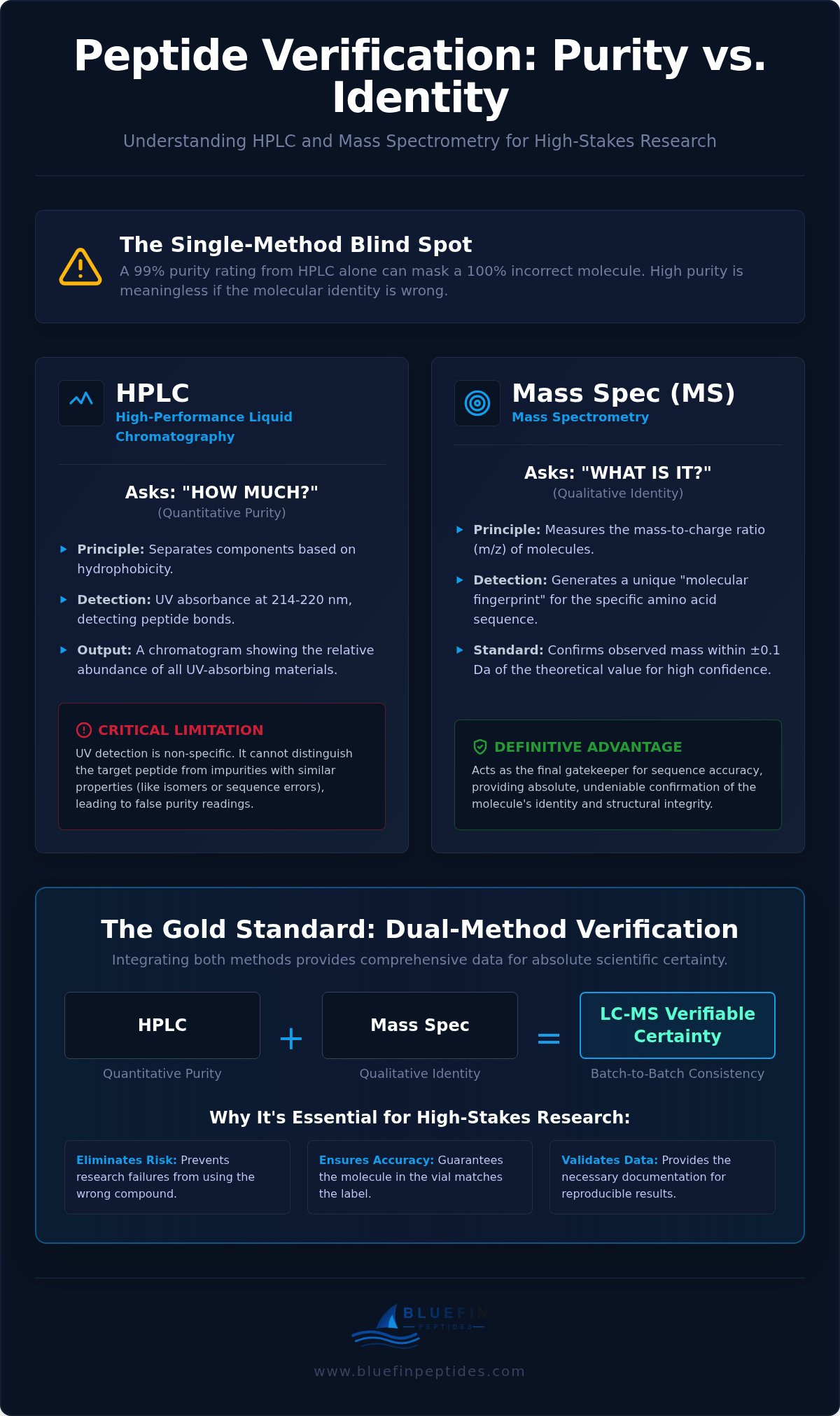
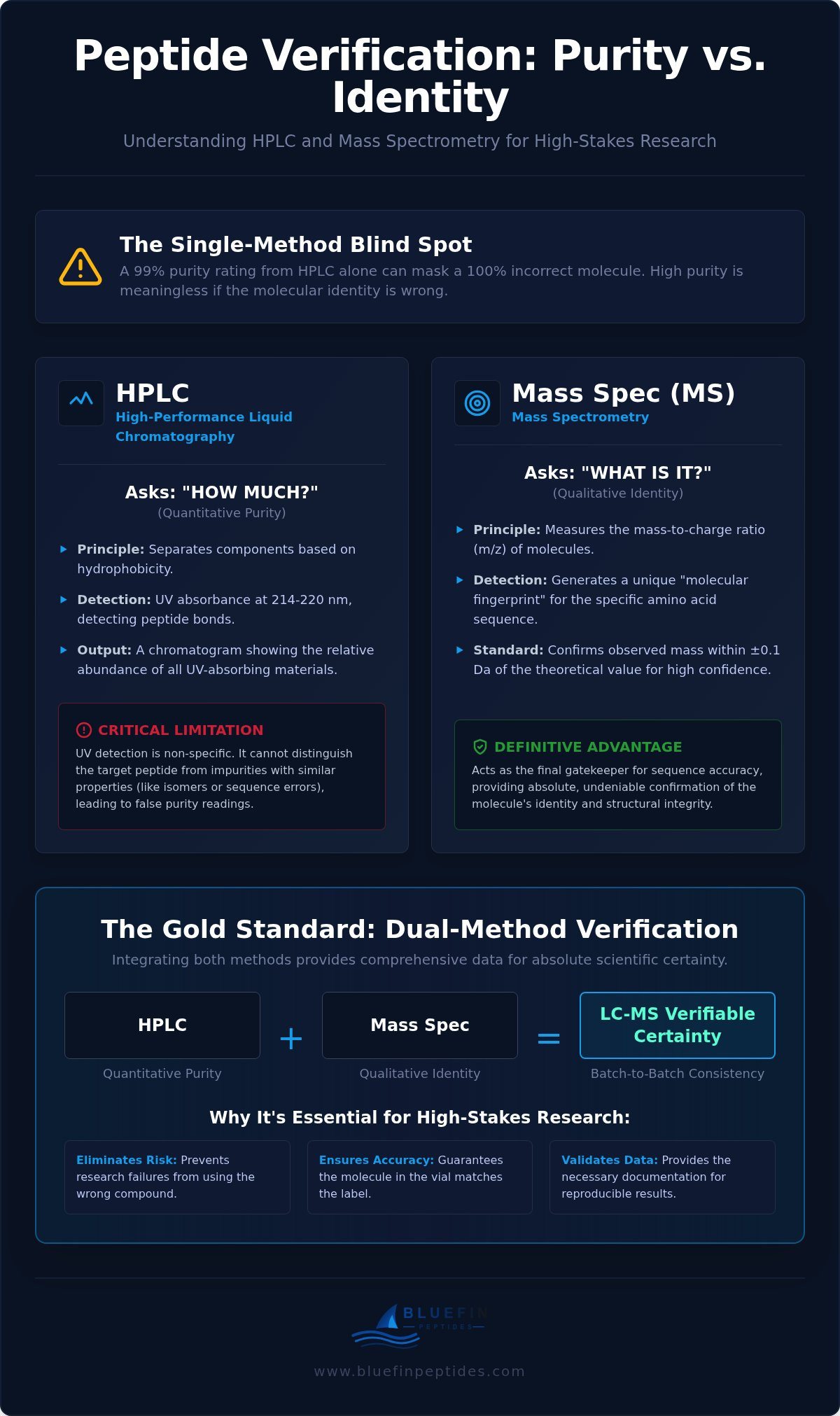
In laboratory research, the distinction between "how much" and "what" is the difference between valid data and total experimental failure. HPLC quantifies the abundance of a substance. Mass spectrometry verifies its molecular essence. Relying on a single metric creates a dangerous blind spot. The technical conversation regarding HPLC vs mass spectrometry for peptide purity often overlooks this fundamental dichotomy. A 99% HPLC purity rating can easily mask a completely incorrect peptide sequence if the impurities co-elute at the same retention time.
The research chemical industry often engages in "purity-wash." This is a practice where high percentages are used to distract from a lack of sequence confirmation. For researchers, the 2026 standard for high-stakes studies requires a dual-verification mandate. This ensures that the compound in the vial actually matches the sequence on the label, especially for complex analogues like Retatrutide or Tirzepatide. High purity is meaningless if the identity is compromised. It's a risk no serious lab should take. Meticulous verification is the only path to security.
The Limitation of UV Absorbance
HPLC typically relies on UV absorbance at 214–220 nm to detect peptide bonds. This is a non-specific detection method. It cannot distinguish between the target peptide and its diastereomers or isomers produced during solid-phase synthesis. If an impurity has the same hydrophobicity as the target, it will elute simultaneously. Identical UV profiles can hide significant sequence variations. This risk is particularly high with complex analogues where minor deletions or substitutions occur during the assembly process. UV detection measures the presence of bonds, not the specific arrangement of atoms. Without mass-spec, you're essentially flying blind.
Establishing the Identity Anchor
Mass spectrometry serves as the definitive identity anchor. By measuring the mass-to-charge ratio (m/z), researchers obtain a molecular fingerprint that is unique to the specific amino acid sequence. This verification prevents off-target results that can derail months of laboratory work. Within the context of HPLC vs mass spectrometry for peptide purity, mass spec acts as the final gatekeeper for sequence accuracy. High-resolution instruments must confirm the observed mass within ±0.1 Da of the theoretical value. To achieve this level of certainty, many facilities now utilize Liquid chromatography–mass spectrometry (LC-MS) to combine physical separation with mass analysis. Bluefin Peptides adheres to these rigorous protocols, providing an analytical quality standards for research peptides framework that prioritizes transparency over simple marketing claims. Verification is the baseline for modern science.
Reversed-Phase HPLC: The Purity Workhorse of Peptide Analysis
High-Performance Liquid Chromatography (HPLC) is a chromatographic technique used to separate, identify, and quantify each component in a mixture. Within the laboratory, Reversed-Phase HPLC (RP-HPLC) acts as the primary filter for synthetic integrity. This method relies on hydrophobicity-based separation, typically utilizing C18 columns to anchor hydrophobic molecules while more polar impurities elute earlier in the mobile phase. The stationary phase consists of silica particles bonded with octadecylsilane chains, creating a non-polar environment that requires specific solvent conditions for elution. When discussing HPLC vs mass spectrometry for peptide purity, HPLC remains the quantitative standard for determining the relative abundance of the target molecule within a specific sample matrix.
Detection occurs via UV absorbance, usually at 214nm, where the peptide bond exhibits its strongest signal. The resulting chromatogram serves as a map of the sample. By identifying "related substances," which include degradation products, oxidation states, or side-reaction artifacts, researchers can assess the chemical stability of lyophilized powders. Precision in this phase is paramount. Even minor deviations in the mobile phase composition or temperature can obscure critical impurities, leading to false-positive purity readings that jeopardize experimental outcomes. Reliability doesn't just happen; it depends on the clarity of this analytical data.
Quantifying the Main Peak
The calculation of "99% Purity" depends entirely on peak area integration. In this context, Area Under the Curve (AUC) represents the integral of the detector response over the elution time, providing a quantitative measure of the analyte's concentration relative to the total detected material. To resolve complex peptide blends, researchers employ acetonitrile gradients. These gradients act as a chemical tide, systematically increasing the organic solvent concentration to elute sequences with varying hydrophobicities. This methodical approach ensures that the main peak is isolated from closely related impurities, providing a verifiable percentage of the target compound.
Common HPLC Impurities in Synthetic Peptides
Solid-phase synthesis frequently generates deletion sequences and truncated fragments. These impurities often possess physical properties similar to the target peptide, requiring high-resolution separation to detect. Trifluoroacetic acid (TFA) is commonly used as a counter-ion in the mobile phase to improve peak shape and resolution by pairing with the basic residues of the peptide. Bluefin Peptides ensures every batch of tirzepatide research peptide meets these quantitative benchmarks through rigorous RP-HPLC analysis. To maintain experimental accuracy, researchers should prioritize verified analytical documentation before initiating any study. This data provides the security required for high-stakes laboratory work.
Mass Spectrometry: Confirming Molecular Identity and Sequence Accuracy
While HPLC maps the landscape of a sample, mass spectrometry provides the coordinates. The core measurement is the mass-to-charge ratio (m/z). This serves as a molecular fingerprint. In the technical evaluation of HPLC vs mass spectrometry for peptide purity, MS is the non-negotiable anchor for identity. It distinguishes between the target and closely related synthesis artifacts. Electrospray Ionization (ESI) is typically preferred for research peptides due to its ability to produce multiple charged ions; whereas MALDI-TOF is often reserved for larger proteins. Matching experimental data to the calculated theoretical mass is the only way to confirm a peptide's essence. Analytical depth requires this level of scrutiny.
Mass spectrometry identifies subtle identity shifts that HPLC might overlook. Oxidation adds precisely 16 Da. Deamidation adds 1 Da. These modifications can significantly alter biological activity despite having near-identical UV profiles on an HPLC chromatogram. High-stakes research cannot afford the ambiguity of "near-identical" results. Precision is a requirement, not a luxury. We prioritize the "how" of the process to ensure the "what" of the results.
Reading a Mass Spectrum
Interpretation begins with the parent peak. This peak represents the intact molecule. The isotopic distribution, driven by naturally occurring Carbon-13, provides a secondary layer of confirmation. Interpreters must account for salt adducts; sodium (+23 Da) and potassium (+39 Da) often appear as secondary signals in the spectrum. High-resolution mass spectrometry (HRMS) is the 2026 gold standard. It offers the sensitivity required to verify mass within a ±0.1 Da tolerance. This level of precision eliminates the ambiguity inherent in lower-resolution methods.
Mass Spec in Complex Analogue Research
Complexity demands rigorous verification. Verifying the 39-amino acid sequence of retatrutide research peptide requires MS to ensure every residue is correctly positioned. For multi-peptide formulations, such as the GHK-Cu BPC-157 TB-500 research blend, MS is the only tool capable of resolving the identity of each component in a single analytical run. Mass spectrometry prevents sequence-specific errors in GLP-1 research by providing absolute mass verification that safeguards against incorrect amino acid substitution. It's the hallmark of high-performance laboratory standards. Every data point must be verifiable.
HPLC vs. Mass Spectrometry: A Comparative Framework for Researchers
Effective laboratory protocols require an integrated analytical framework rather than isolated data points. While HPLC provides the quantitative volume of the main peak, mass spectrometry acts as the identity anchor. The technical distinction in HPLC vs mass spectrometry for peptide purity lies in the intersection of physical separation and molecular weight confirmation. High-stakes research demands both. Choosing between them is a false compromise that introduces unacceptable experimental variables. Purity is a measure of quantity; identity is a measure of essence.
Budgetary considerations often lead researchers to prioritize one method over the other. This is a strategic error. Comprehensive analytical validation justifies its resource allocation by eliminating the risk of research contamination or sequence errors. In 2026, the standard for rigorous scientific work is ≥98% purity confirmed by high-resolution MS. Investing in dual-method verification is an investment in the integrity of your data. Reliability is the only currency that matters in a professional laboratory environment.
The Synergy of Hybrid LC-MS
Hybrid LC-MS represents the apex of modern biochemistry. It runs separation and identity confirmation in a single, streamlined workflow. This synergy is non-negotiable for resolving co-eluting peaks where impurities possess identical hydrophobic signatures but different molecular masses. We call this "Deep-Sea Precision." It allows researchers to navigate complex sample matrices with absolute clarity. Tandem Mass Spec (MS/MS) further elevates this by enabling de novo peptide sequencing; breaking down the parent ion into fragments to verify the exact amino acid order. This ensures that the physical state of the offering matches the chemical claim.
Technical Comparison Table
| Metric | HPLC (UV-Vis) | Mass Spectrometry (MS) | Hybrid LC-MS |
|---|---|---|---|
| Primary Objective | Quantitative Purity | Molecular Identity | Integrated Verification |
| Sensitivity | Moderate (~0.1% LOD) | High (Picogram range) | Highest Resolution |
| Primary Use | Batch Consistency | Sequence Confirmation | Complex Blend Analysis |
When reading a hybrid report for an ipamorelin CJC-1295 research blend USA, you must cross-reference the retention times with the corresponding mass spectra. Each peak in the chromatogram must show a unique m/z signal matching the theoretical weights of the individual components. This level of transparency is what defines a high-performance laboratory partner. Secure the integrity of your next study by utilizing Bluefin’s dual-method verification standards for all research compounds.
Bluefin Peptides Standards: Integrated Verification for High-Stakes Research
Bluefin Peptides operates with a philosophy of clinical precision. We recognize that high-stakes laboratory research requires more than just a product; it requires a verifiable analytical foundation. Our "Urgent Precision" protocol addresses the critical need for speed by maintaining US-stocked inventory for rapid fulfillment. Speed doesn't compromise the depth of our analysis. Every batch in our inventory undergoes a rigorous dual-method verification process. When evaluating HPLC vs mass spectrometry for peptide purity, we treat these methods as inseparable components of a single quality standard. We provide batch-specific Certificates of Analysis (COAs) for every order. Transparency isn't an option; it's our baseline.
Procuring complex GLP-1 analogues like Retatrutide or Tirzepatide presents unique challenges. These high-complexity compounds are prone to synthesis errors that single-method testing often misses. Bluefin specializes in these sophisticated sequences, ensuring that our analytical specifications meet the demands of qualified US researchers. By providing both HPLC and MS data, we eliminate the uncertainty often found in overseas supplies. We focus on providing the tools for verification rather than asking for blind trust. Reliability is built through data.
Interpreting Your Bluefin COA
Every COA in our laboratory library is a detailed map of chemical integrity. To verify the quality of your specific batch, first examine the HPLC chromatogram's main peak. The Area Under the Curve (AUC) must indicate ≥99% purity at the 214nm detection wavelength. Next, cross-reference the mass spectrometry data. The observed molecular mass (m/z) should align with the theoretical calculated weight within a ±0.1 Da tolerance. A clean baseline in our 214nm chromatograms signifies the absence of significant co-eluting impurities. This dual-layered verification ensures your lab research starts with a confirmed molecular foundation, minimizing experimental variables from the outset.
The Bluefin Commitment to Laboratory Transparency
We prioritize cold, objective data over marketing fluff. Our persona is that of a high-performance laboratory partner, focusing on the "how" of our processes to guarantee the "what" of your results. Maintaining the security of your research through verified reagents is our primary objective. This disciplined approach allows you to focus on your experimental objectives without questioning the purity or identity of your materials. Security and trust are built through verification, not claims. Secure your next batch of HPLC-verified research peptides today to experience the Bluefin standard of analytical excellence.
Securing Analytical Integrity in Modern Peptide Research
Precision is the anchor of scientific discovery. Navigating the technical landscape of HPLC vs mass spectrometry for peptide purity ensures that your laboratory results remain irreproachable. HPLC provides the quantitative volume of the main peak; mass spectrometry confirms the molecular essence of the sequence. Relying on a single metric is an unacceptable risk in high-stakes environments. Integrated verification is the only path to absolute certainty. You've mastered the distinction between quantity and identity. Now; apply that discipline to your procurement process.
Bluefin Peptides provides the tools for this verification through our US-based laboratory stock and rigorous testing protocols. We deliver ≥99% purity guaranteed alongside batch-specific COA documentation for every vial. Our commitment to transparency eliminates marketing fluff in favor of cold; objective data. Secure the foundation of your next study with compounds that meet the highest analytical standards. We invite you to Procure HPLC and Mass-Spec Verified Research Peptides to ensure your research is built on a verified molecular foundation. Your success depends on the clarity of your reagents.
Frequently Asked Questions
Can HPLC alone confirm that I have the correct peptide sequence?
HPLC alone cannot confirm a peptide sequence. It functions as a quantitative tool for purity but lacks the specificity to verify molecular weight or amino acid arrangement. Relying solely on HPLC creates a risk where a different peptide with similar hydrophobicity elutes at the same time. Mass spectrometry is the only definitive method for sequence confirmation. This distinction is the core of the HPLC vs mass spectrometry for peptide purity debate in professional laboratories.
What is the significance of the 214 nm wavelength in peptide HPLC reports?
The 214 nm wavelength is the industry standard for peptide detection because it targets the absorbance of the amide backbone. Most peptide bonds exhibit maximum UV absorption in the 214–220 nm range; providing high sensitivity for even minor impurities. Reports utilizing this wavelength offer a comprehensive view of the sample's chromatographic purity. It's the primary metric for calculating the area under the curve (AUC) during reversed-phase analysis. Precision requires this specific detection parameters.
Why does a mass spec report show multiple peaks instead of just one?
Multiple peaks in a mass spectrum typically reflect the natural isotopic distribution of elements like Carbon-13 and Nitrogen-15. Additionally; peptides often form salt adducts with sodium or potassium during ionization; creating secondary signals. High-resolution instruments also detect multiple charge states of the same molecule. These signals are expected components of a molecular fingerprint; not indicators of synthesis failure. Researchers must distinguish these peaks from actual impurities in the analytical tide to ensure accuracy.
How does LC-MS/MS differ from standard LC-MS in peptide validation?
Standard LC-MS provides the intact molecular weight of a compound. LC-MS/MS; or tandem mass spectrometry; fragments the parent ion into smaller pieces to allow for de novo sequencing. This secondary fragmentation provides internal sequence verification that standard methods cannot achieve. For high-stakes research; MS/MS is the definitive tool for confirming the exact order of amino acids within a complex synthetic peptide chain. It eliminates sequence ambiguity and ensures absolute identity in every batch.
What are common impurities that HPLC might miss but Mass Spec will catch?
HPLC often fails to resolve impurities that have identical UV absorbance profiles or similar hydrophobicities. Common examples include deamidated sequences; which only differ by 1 Da; or oxidized residues that add 16 Da. While these may co-elute on a C18 column; mass spectrometry identifies them immediately through their distinct mass-to-charge ratios. Mass spec serves as the final filter for identifying these subtle chemical modifications that compromise experimental integrity. It secures the essence of the target molecule.
How do I interpret a peptide purity percentage above 99%?
A purity percentage above 99% indicates that the target analyte constitutes the vast majority of the UV-absorbing material detected at 214 nm. This value is a relative measure of quantity; not an absolute guarantee of chemical identity. When reviewing HPLC vs mass spectrometry for peptide purity; researchers must verify that the 99% peak corresponds to the correct molecular mass. Purity without identity confirmation is an incomplete data point in professional laboratory procurement.
Is a COA from six months ago still valid for a current peptide batch?
A six-month-old COA is invalid for a current batch. Analytical documentation must be batch-specific to reflect the unique synthesis and purification conditions of a particular lot. Peptides are subject to degradation; and synthesis variables change between production runs. Bluefin Peptides provides current; batch-specific COAs with every order to ensure researchers have access to the most accurate data. Using outdated reports introduces unnecessary experimental variables that can derail high-stakes research projects.
Why is mass spectrometry confirmation particularly important for Retatrutide and Tirzepatide?
Retatrutide and Tirzepatide are high-complexity analogues consisting of 39 amino acids. The length and specific side-chain modifications increase the probability of deletion sequences or truncated fragments during solid-phase synthesis. These impurities often possess near-identical hydrophobic signatures to the target peptide; making HPLC separation difficult. Mass spectrometry is essential to verify that the entire 39-amino acid sequence is present and correctly assembled. It's the only way to ensure sequence-level precision in GLP-1 research.
For laboratory research use only. Not for human or veterinary use. This content is educational and does not constitute medical, dosing, or usage guidance.
Browse the BLUEFIN catalog