GHK-Cu Cellular Mechanisms: A Research-Focused Overview
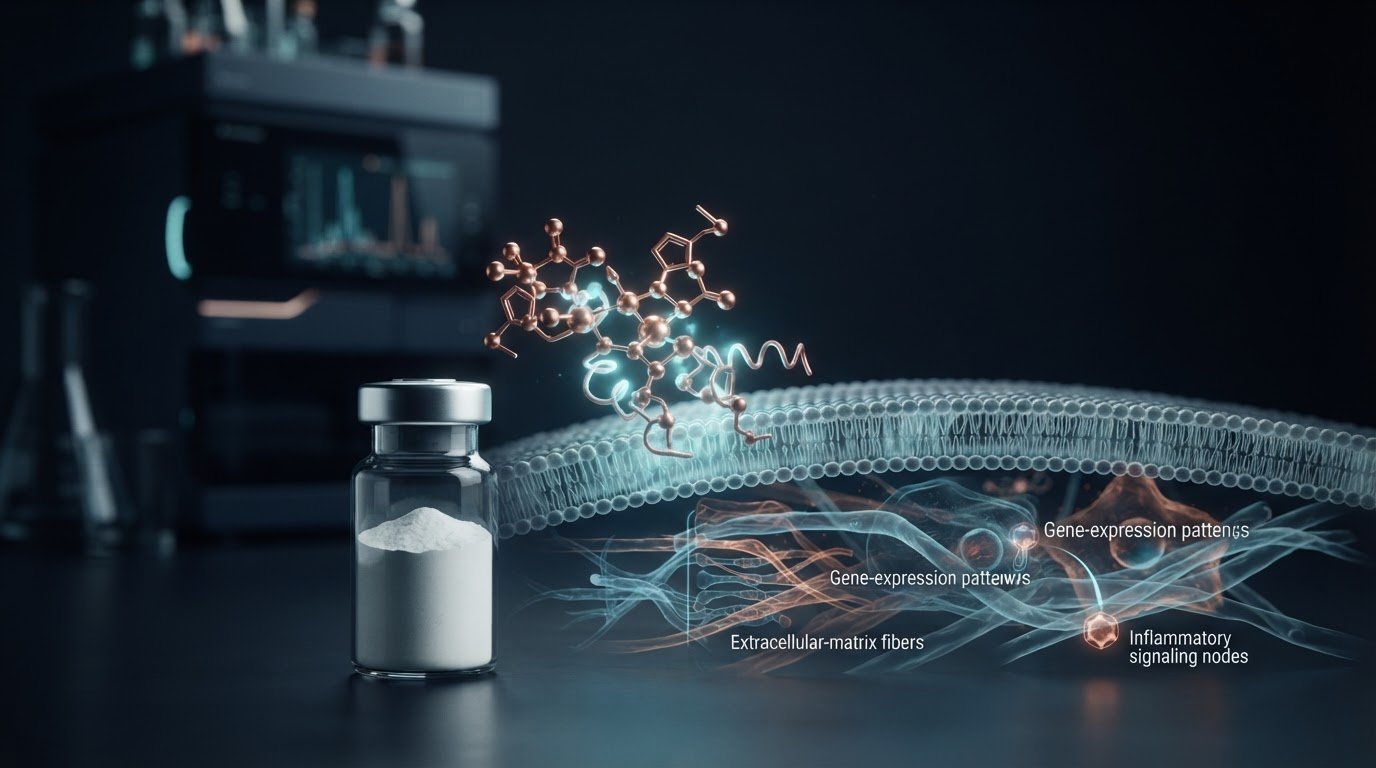
A pathway map is not proof of a mechanism. In ghk-cu cellular mechanisms research, proposed effects can involve gene expression, copper-associated activity, extracellular-matrix remodeling, and inflammatory signaling, but the evidence for each connection varies. This distinction matters because summaries sometimes place computational findings, cell-based observations, and broader biological interpretations on the same footing.
Results can shift with the cell model, concentration, exposure conditions, and selected endpoint. An observation in one system should not be treated as a universal cellular effect. This overview examines major pathways investigated in GHK-Cu research, separates measured findings from hypotheses, and identifies where evidence remains limited. It also offers a practical framework for comparing studies, interpreting results within their experimental models, and defining questions for follow-up. The aim is a clearer map, with uncertain areas marked rather than smoothed over.
Key Takeaways
- Distinguish the copper-associated tripeptide from broader claims about its cellular effects.
- Organize ghk-cu cellular mechanisms research by pathway, and assess each proposed signaling route on its own evidence.
- Separate measured cellular changes from interpretations by examining study models, controls, endpoints, and replication.
- Build a rigorous research framework by aligning the hypothesis, experimental model, and chosen endpoints.
- Use HPLC verification, mass-spectrometry confirmation, and batch-specific certificates of analysis to assess material identity and purity, not biological activity.
GHK-Cu Cellular Mechanisms: What Researchers Mean by the Term
GHK-Cu is the copper-associated form of glycyl-L-histidyl-L-lysine, a tripeptide that can bind a copper ion. The distinction matters: a study of the peptide alone is not automatically evidence about the copper-associated complex, and findings may depend on how the test material is characterized. The Copper peptide GHK-Cu overview provides background on the compound and proposed biological activities. Specific mechanistic claims still need to be assessed against the original experiments.
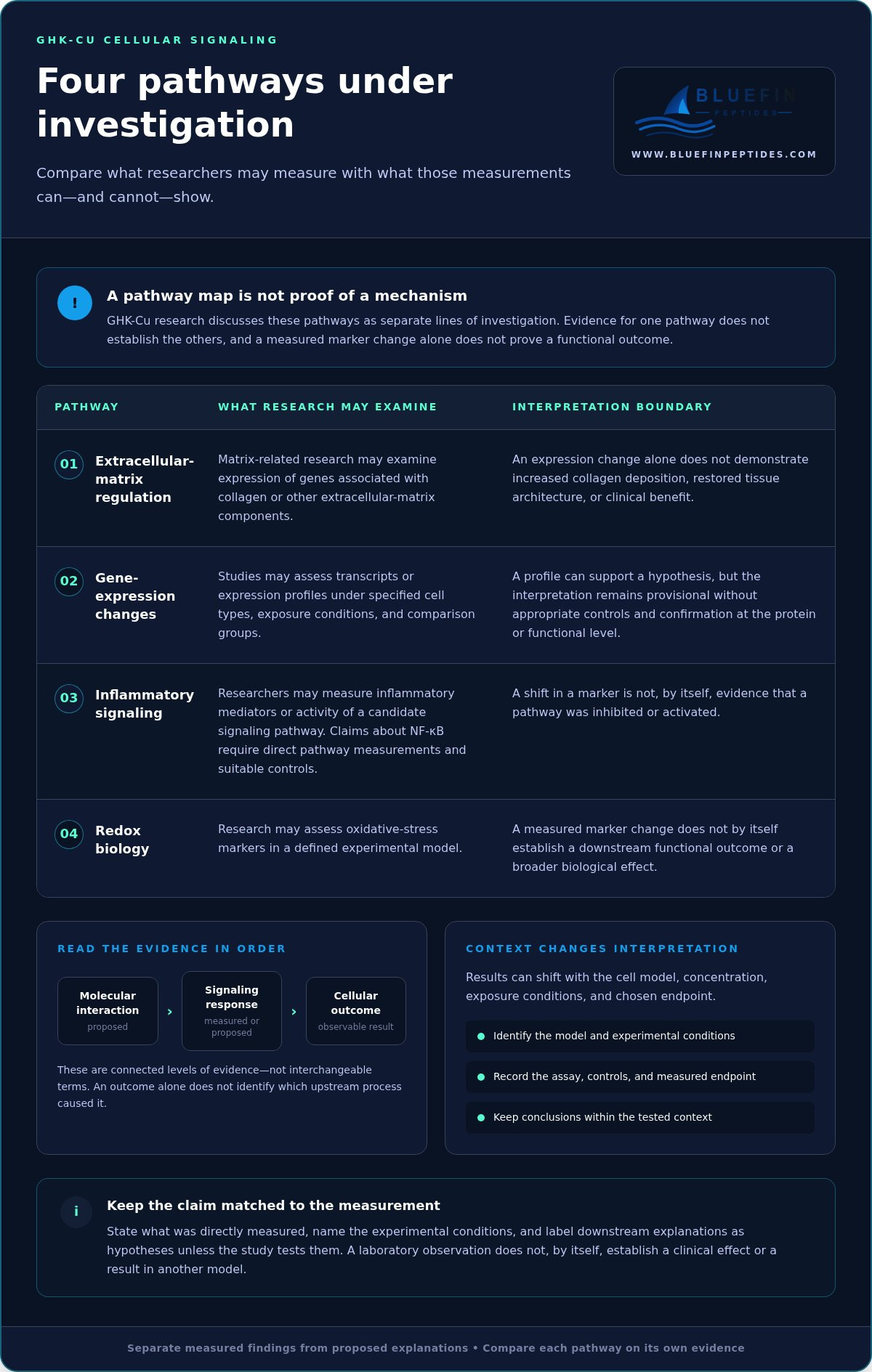
In research, a “cellular mechanism” is a process observed or proposed within a defined experimental model, not a single result. A molecular interaction may be proposed first, followed by a change in signaling, then altered gene expression, and finally a measurable cellular outcome such as a change in cell migration or matrix-related markers. These are connected levels of evidence, not interchangeable terms. A measured outcome alone does not establish which upstream process caused it.
This distinction is central to ghk-cu cellular mechanisms research. For each claim, identify what was directly measured and what the authors inferred. A change in a pathway marker may be consistent with a mechanism, but association does not prove that the pathway caused the observed phenotype. Stronger causal support generally requires experiments that test whether altering the proposed target or pathway changes the outcome, alongside appropriate controls and consideration of alternative explanations.
How to separate a mechanism from an outcome
A molecular target is a candidate interaction point; a signaling response is a downstream cellular event; a phenotype is the observable result. Read evidence in light of the model type. In vitro studies examine cells or biological components under controlled laboratory conditions, animal studies add organism-level context, and human research tests findings in people. Each category answers different questions. A result in one does not, by itself, establish effects in another.
Why model and context matter
Interpretation depends on the cell type, experimental conditions, exposure, and endpoint. A result measured in one cell model may not transfer to another with different biology or culture conditions. When reviewing a mechanistic claim, record its evidence type and publication date, then note the controls, assay, and outcome measured. This makes studies easier to compare than treating every reported pathway as equally established.
Mechanism evidence does not establish a clinical effect or support a human-use recommendation. A laboratory observation is bounded by the model and protocol that produced it. Keep each conclusion at the scale of its evidence: name the observed change, describe the proposed explanation as a proposal, and avoid extending either beyond the tested context.
GHK-Cu and Cellular Signaling: Pathways Under Investigation
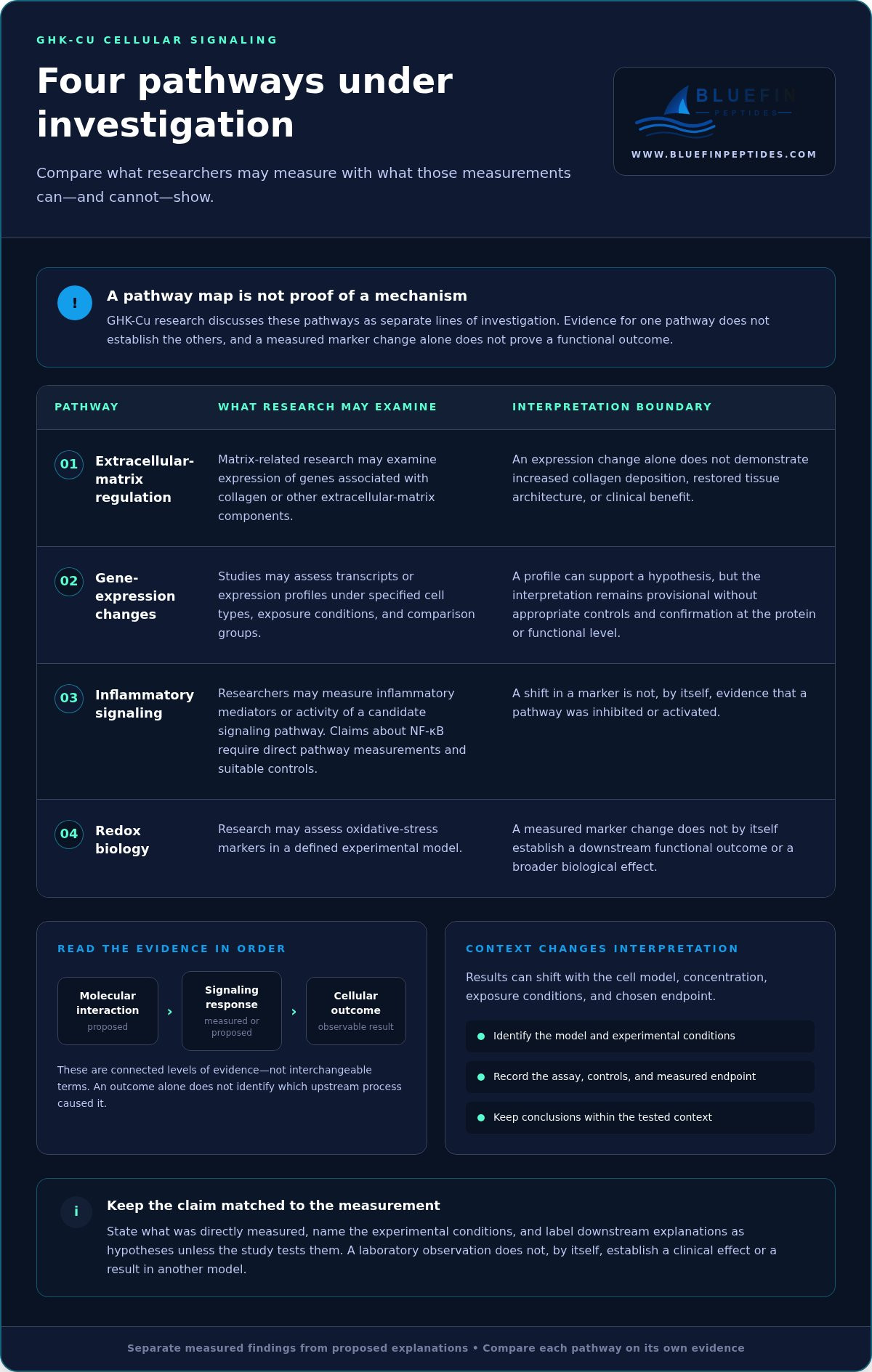
GHK-Cu findings are best organized by proposed pathway, not compressed into a single mode of action. Research discussions commonly focus on extracellular-matrix regulation, gene-expression changes, inflammatory signaling, and redox biology. These are separate lines of investigation: evidence for one does not establish the others. A broad review such as Regenerative and Protective Actions of the GHK-Cu Peptide synthesizes reported work, but should not be read as proof that every proposed mechanism has been confirmed.
For each pathway, separate the observation from its interpretation. A measured change in a transcript, protein, or signaling marker can support a pathway hypothesis, but does not by itself show a functional benefit. Citation-ready distinction: “The study measured changes in specified pathway markers under its experimental conditions; those measurements alone do not demonstrate a downstream functional outcome.” This wording keeps the result anchored to the assay rather than extending it into a claim about tissue repair or clinical effect.
Extracellular-matrix and gene-expression findings
Matrix-related research may examine expression of genes associated with collagen or other extracellular-matrix components. Assess each example using the actual methods: cell type, transcripts measured, exposure conditions, and comparison group. Without those details and a primary-study citation, a specific gene or direction of change should not be presented as an established GHK-Cu effect. Even a reproducible expression change would remain a molecular finding; it would not, by itself, demonstrate increased collagen deposition, restored tissue architecture, or clinical benefit.
Gene-expression analyses can also generate broader hypotheses about coordinated cellular responses. The next question is whether those changes are confirmed at the protein or functional level, and whether appropriate controls distinguish a GHK-Cu-associated effect from other experimental influences. A mechanism remains provisional when the evidence stops at an expression profile.
Inflammatory and redox signaling questions
Inflammatory and oxidative-stress endpoints are additional areas of investigation, but claims should name the assay and model rather than promise an effect. Researchers may measure inflammatory mediators, oxidative-stress markers, or activity of a candidate signaling pathway. A reported marker shift is not equivalent to demonstrated pathway inhibition or activation. For example, describe NF-κB as GHK-Cu-responsive only when a study directly measures relevant pathway activity and supports that interpretation with suitable controls.
For each finding, check whether the paper reports a direct measurement or proposes a downstream explanation. Ask whether the endpoint is a marker, a cellular function, or both; whether the comparison isolates the copper-associated peptide; and whether independent studies reproduce the result. This is the practical discipline of ghk-cu cellular mechanisms research: trace each claim to its assay, model, and level of evidence before connecting it to another pathway.
Qualified researchers reviewing material for laboratory investigation can consult Bluefin Peptides’ GHK-Cu-containing research blends. Analytical documentation can support assessment of material identity and purity, but cannot validate a signaling mechanism or establish biological activity.
What GHK-Cu Mechanism Studies Show, and What They Do Not
Mechanism claims need an evidence label. A paper may directly measure a cellular marker, interpret the result as support for a pathway, and then discuss a possible functional implication. Those steps are not equivalent. In ghk-cu cellular mechanisms research, keep the measured result distinct from the authors’ explanation and from any claim about human outcomes.
The table below offers a compact way to classify statements when reviewing a paper. These are evidence categories, not claims that a particular GHK-Cu effect has been established.
| Classification | What supports it | What it does not establish |
|---|---|---|
| Observed | A specified assay detected a change in a defined model under stated conditions. | That the change caused a functional outcome or will occur in another model. |
| Proposed | Authors interpret measured results as consistent with a pathway or mechanism. | Direct molecular binding or causal pathway involvement without targeted tests. |
| Unresolved | Key links, replication, or relevance across systems remain uncertain. | A firm conclusion about biological activity or clinical effect. |
How to evaluate strength of evidence
Start with the methods: identify the cell model, comparison groups, controls, exposure conditions, endpoint, and analytical assay. Then check whether the result is independently replicated or appears across relevant experimental systems. A single controlled experiment can support a bounded observation, while replication and converging methods strengthen confidence. Report limitations alongside the finding, including model constraints, assay scope, and gaps between measured markers and proposed function.
Common interpretation errors in peptide research
Three leaps weaken interpretation: turning an in vitro marker change into a clinical claim, treating pathway plausibility as proof of direct binding, and equating material purity with biological activity. Identity and purity tests characterize the material; they do not show how cells respond to it. Mechanistic conclusions require biological assays designed to test the proposed interaction or downstream effect.
Model type also sets the boundary of a conclusion. Cell-based studies can examine controlled molecular and cellular responses, while animal research adds organism-level context but still does not establish a human effect. Human evidence must be evaluated on its own design, population, endpoints, and limitations. Evidence does not automatically transfer from one level to the next.
This is the central limit: preclinical mechanism evidence cannot establish human outcomes. A plausible pathway is a research rationale, not proof of clinical benefit or a human-use recommendation. Describe what the study measured, classify the mechanism as observed or proposed, and state which causal or translational link remains unresolved. This preserves useful findings without allowing claims to extend beyond the experimental evidence.
A Research Framework for Studying GHK-Cu Cellular Mechanisms
A rigorous study begins with a bounded question, not a broad claim about what GHK-Cu does. Define the proposed process, identify what evidence would support or weaken it, then align the model and endpoints with that question. This helps distinguish a meaningful test from a collection of markers that happen to move in a favorable direction.
A high-level framework for ghk-cu cellular mechanisms research is:
- Define the hypothesis. Specify whether the proposed effect concerns signaling, gene expression, extracellular-matrix markers, or cell behavior. State what result would count against the hypothesis as well as what would support it.
- Select a relevant model. Choose a cell system suited to the biological question and describe its provenance and limitations. The model should make the target process measurable, not simply convenient.
- Choose aligned endpoints. Select outcomes that test the hypothesis directly, and distinguish primary endpoints from exploratory markers.
- Interpret against controls. Compare results with suitable negative and comparator controls, then limit conclusions to what the design can establish.
Match a hypothesis to a measurable endpoint
Endpoint choice should follow the question. A signaling hypothesis calls for a relevant signaling measure; a transcriptional hypothesis calls for specified gene-expression endpoints; a cell-behavior question needs a functional readout rather than expression data alone. For example: “To test whether GHK-Cu is associated with altered matrix-related transcription in a defined cell model, the study measured prespecified transcripts against matched controls.” This formulation connects a question to a measurable endpoint without claiming tissue repair.
Where scientifically appropriate, orthogonal assays can strengthen interpretation by assessing a process through different measurement principles. Agreement across methods can reduce reliance on a single assay, though it does not automatically prove causality. Each method still has limits, and endpoints should be selected before results are known where the study design allows.
Build controls and reporting into interpretation
Controls clarify what a comparison can support. Negative controls help identify background or nonspecific signals, while comparator controls provide a reference for interpreting the tested condition. Report the model’s source and relevant characteristics, assay methods, experimental conditions, and replicate structure. These details let readers assess reproducibility and identify where a result may depend on a particular system.
State uncertainty plainly. If a marker changes but a causal link is not tested, describe the observation and leave the mechanism provisional. If results vary across models or assays, report that variation rather than averaging it into a universal conclusion. Clear limitations are part of the result, not a disclaimer added afterward.
For qualified researchers sourcing materials for laboratory investigation, review GHK-Cu-containing research blends. Use analytical documentation to assess material identity and purity; it does not establish biological activity or validate an experimental hypothesis. These materials are for qualified research use only, not for human, veterinary, or consumer use.
Connecting Mechanism Research With Analytical Quality and Research Materials
Mechanistic interpretation begins with knowing what material entered the experiment. Analytical documentation helps characterize a research material, but it cannot show that the material activates a pathway, changes gene expression, or produces a cellular response. In ghk-cu cellular mechanisms research, keep these questions separate: what is in the sample, what happened in the assay, and whether the proposed mechanism explains that result.
Bluefin Peptides states that its peptides are at least 99% HPLC-verified, provides mass-spectrometry confirmation, and makes batch-specific certificates of analysis (COAs) available. These records support assessment of material identity and purity. They are not evidence of biological activity, efficacy, or a mechanism of action. For additional context on interpreting peptide documentation, consult this analytical quality standards guide.
What analytical documentation can and cannot establish
HPLC separates components in a sample and can provide a chromatographic basis for assessing purity. Mass spectrometry measures mass-to-charge characteristics that can support confirmation of molecular mass and identity. These methods address related but distinct characterization questions; neither alone establishes how a material will behave in a particular cellular model.
A COA records analytical information associated with a material or batch. For sound study documentation, match the record to the specific batch used and retain it alongside the experimental methods and results. This helps readers understand which material was tested. It does not replace biological controls, pathway-specific assays, or replication.
Where GHK-Cu-containing research blends fit
Bluefin Peptides offers the GHK-Cu / BPC-157 / TB-500 Research Blend as a research material. A response observed after testing a blend belongs to that blend under those experimental conditions. Without component-level controls that isolate the ingredients, the result cannot be assigned to GHK-Cu alone or used to establish its individual mechanism.
The GHK-Cu blend analytical profile provides material-specific context. Researchers can use such information to frame sample characterization and document the material under study, while keeping experimental conclusions bounded by the design. A blend’s analytical profile does not establish the contribution of each component to a measured outcome.
Bluefin Peptides supplies research-use peptide compounds exclusively to qualified researchers. Its materials are not intended for human, veterinary, or consumer use. Analytical verification supports a clearer starting point for laboratory work, while biological findings must come from appropriately designed experiments. Material documentation and mechanistic evidence occupy different points on the research map, and neither should be mistaken for the other.
Carry the Evidence Into the Next Study
The next step in GHK-Cu research is not a broader claim. It is a sharper experiment: one defined question, an endpoint that can answer it, and reporting detailed enough for others to assess the result. Treat each proposed pathway as a testable line of inquiry. This discipline will make future ghk-cu cellular mechanisms research easier to compare, reproduce, and interpret without extending findings beyond the model that produced them.
For qualified researchers planning laboratory work, material selection is part of that record. Bluefin Peptides states that its research materials are at least 99% HPLC-verified, with mass-spectrometry confirmation and batch-specific certificates of analysis available. These documents support material characterization, not biological activity, and the materials are exclusively for qualified researchers.
Review Bluefin Peptides’ research catalog as you plan your next investigation. Keep the hypothesis precise, the evidence traceable, and the conclusions proportional to the data. Strong research advances one well-supported step at a time.
Frequently Asked Questions
What is GHK-Cu at the cellular level?
GHK-Cu is the copper-associated form of the tripeptide glycyl-L-histidyl-L-lysine. That molecular identity describes the compound, not what it does inside a cell. Cellular effects must be measured separately, and interpretation depends on the experimental model, conditions, and selected endpoint. For example, a change in a transcript in one cell type describes that assay result; it does not establish a single pathway operating across other systems.
Which cellular pathways are most often investigated for GHK-Cu?
Research discussions include extracellular-matrix regulation, gene-expression patterns, inflammatory signaling, and oxidative-stress markers. These are areas of investigation, not universal or guaranteed effects. A paper may measure a specific transcript or marker in a particular model, while broader pathway descriptions may reflect the authors’ interpretation. Compare the model and assay used in each study before treating findings as consistent across systems or inferring an outcome that was not measured.
Does GHK-Cu directly activate one known receptor?
A reported pathway response does not, by itself, establish direct receptor activation or identify a binding target. Direct binding evidence requires experiments designed to test molecular interaction; downstream marker changes provide different, more indirect evidence. When a paper proposes a receptor or target, examine whether it measured binding, tested target dependence, and used appropriate controls. If those tests are absent, describe the target as a hypothesis rather than an established mechanism.
Can cell-culture findings on GHK-Cu predict human effects?
No. Cell-culture findings can generate hypotheses, but they cannot independently predict human outcomes. Cultured cells do not reproduce the full interactions, metabolism, tissue architecture, or other conditions present in a whole organism. Translation requires additional evidence from relevant models and well-designed human research. Keep conclusions tied to the system studied: a cell response can guide follow-up questions, but it does not establish that the same response occurs in people.
How should researchers distinguish a GHK-Cu mechanism from a correlation?
Look for controls, timing, direct measurements, plausible alternative explanations, and replication. If a marker and a cellular outcome change together, that association alone does not show that the marker caused the outcome. Stronger causal evidence comes from experiments that directly test whether changing the proposed pathway alters the outcome. Where such tests are absent, label the mechanistic link as a hypothesis and state what remains untested.
Do HPLC purity and mass-spectrometry confirmation prove biological activity?
No. HPLC and mass spectrometry support material characterization through different analytical measurements; neither demonstrates how cells respond. Biological activity requires appropriate functional experiments in a defined model. A batch-specific certificate of analysis can document analytical results for the material tested, but it cannot prove a cellular mechanism, efficacy, or suitability for human or veterinary use. Keep analytical records linked to the batch while evaluating biological claims independently.
For laboratory research use only. Not for human or veterinary use. This content is educational and does not constitute medical, dosing, or usage guidance.
Browse the BLUEFIN catalog