Domestic Research Peptide Shipping: Logistical Precision for Laboratory Procurement

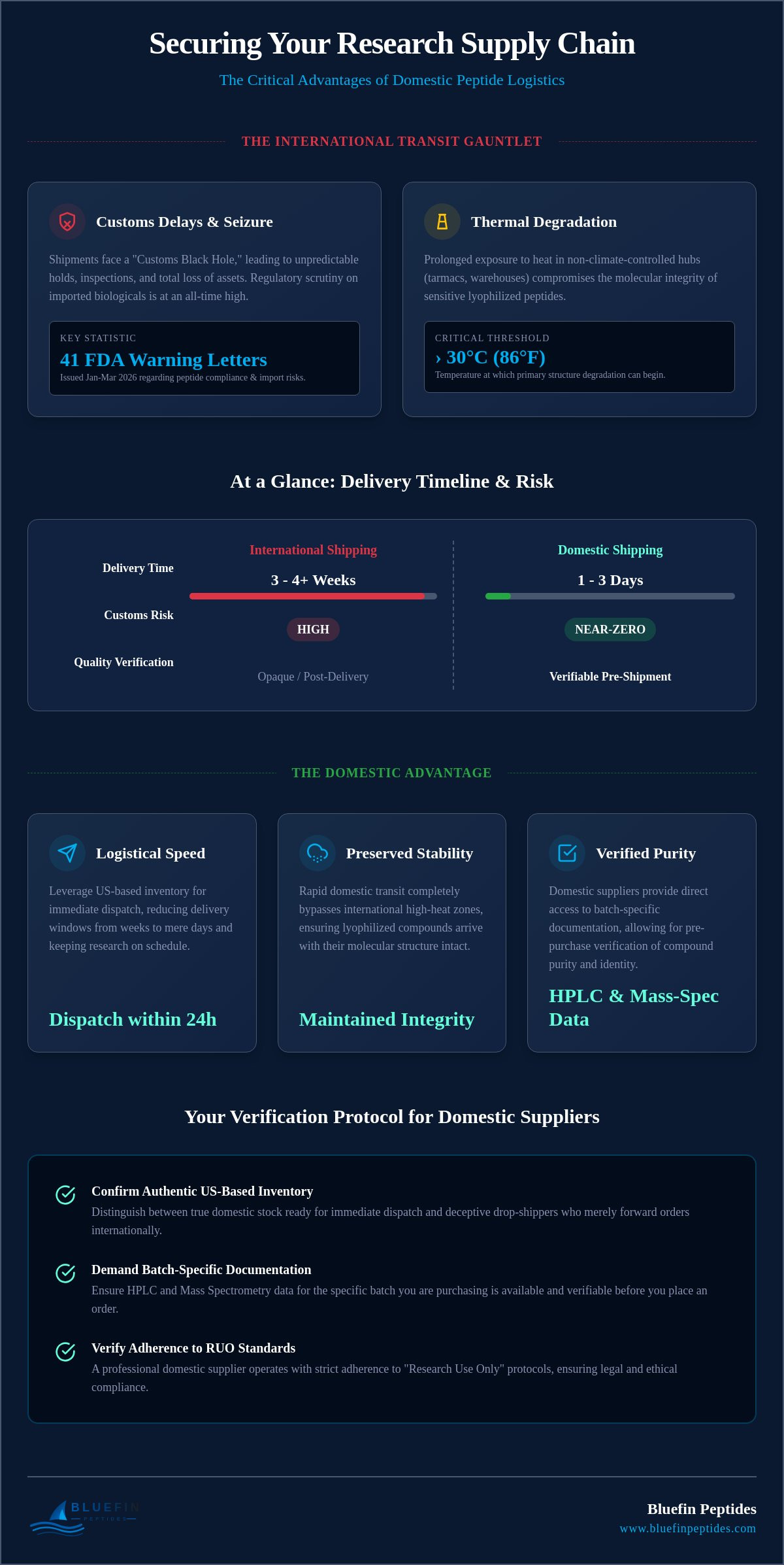
International transit is a structural failure point in laboratory procurement. Between January and March 2026, the FDA issued 41 warning letters regarding peptide compliance, frequently highlighting the opaque documentation and regulatory risks of imported goods. For the modern researcher, domestic research peptide shipping isn't just a convenience; it's a critical control against the variables of customs seizures and thermal degradation. Precision. Security. Speed.
You recognize that a 30-day international transit window is a direct threat to the chemical stability of sensitive lyophilized analogues. This technical guide provides the framework for securing your supply chain through US-based logistics to ensure your compounds arrive with verified integrity. We'll detail the documentation requirements for 2026, the logistical advantages of rapid domestic fulfillment, and the methodology for maintaining a secure, stability-optimized supply chain that operates with fluid efficiency.
Key Takeaways
- Understand how domestic research peptide shipping eliminates the "customs variable" to prevent the seizure or destruction of sensitive laboratory reagents.
- Discover why localized logistics are essential for maintaining the thermal stability of lyophilized peptide bonds during transit.
- Learn to distinguish between authentic US-based inventory and deceptive domestic drop-shipping to ensure immediate research readiness.
- Establish a rigorous verification protocol using batch-specific HPLC and Mass-Spec documentation to guarantee compound purity.
- Optimize laboratory procurement timelines by leveraging maritime-grade logistical speed to reduce delivery windows from weeks to days.
Defining Domestic Research Peptide Shipping in Laboratory Logistics
Domestic research peptide shipping is more than a delivery method; it's a strategic laboratory control. It defines the procurement of research compounds already cleared and stocked within US borders. This logistical posture eliminates the "Customs Variable," preventing the random seizure or thermal destruction of sensitive laboratory reagents. For researchers operating under the pressure of grant-funded milestones, domestic stock is the only way to ensure that experimental timelines remain intact. It's a matter of operational security.
The complexity of Peptide synthesis demands a stable environment from the laboratory bench back to the point of origin. In 2026, domestic availability has become the industry benchmark for reliability. It's a system built for speed and verification, ensuring that the supply chain is as precise as the research it supports. When the material is already on US soil, the risk of external interference drops to near zero, allowing for a fluid movement of assets from warehouse to workstation.
The Advantage of US-Based Inventory
Immediate availability provides a decisive advantage over the "pre-order" pitfalls common with international vendors. International procurement often forces researchers into a holding pattern where synthesis only begins after a purchase order is processed. This leads to 3-4 week delays. US-based inventory allows for immediate dispatch, often within 24 hours. This proximity reduces exposure to geopolitical trade fluctuations and global logistics bottlenecks that often stall international transit. Direct accountability is a secondary, yet vital, benefit. US-based entities operate under national commercial standards, ensuring that technical support and batch verification are accessible. It's about maintaining a maritime-grade level of logistical precision where every movement is tracked and every delay is minimized.
Regulatory Compliance and Research Intent
Navigating the legal framework of domestic chemical distribution requires a commitment to transparency. Strict adherence to "Research Use Only" (RUO) designations is the cornerstone of domestic commerce in this sector. This ensures that compounds like Tirzepatide or Retatrutide are handled with the appropriate professional rigor. Transparent business identities and clear operational footprints are essential. In the US peptide market, the "show, don't tell" philosophy regarding quality is backed by documentation that is physically present and verifiable before the order is even placed. This level of transparency is a safeguard, ensuring that the procurement process aligns with institutional oversight and federal guidelines without the ambiguity of cross-border transactions.
Mitigating Transit Degradation and Customs Seizures
International procurement introduces a "Customs Black Hole" where sensitive laboratory reagents are often held in non-climate-controlled environments for unpredictable durations. These hubs lack the thermal safeguards required to maintain the molecular integrity of complex chains. When a shipment sits on a tarmac or in a high-heat warehouse, the physical state of the compound is at risk. Domestic research peptide shipping bypasses these logistical doldrums, ensuring that the time between laboratory synthesis and bench-side application is measured in hours, not weeks. It's a necessary safeguard against the variables of global freight.
Physical inspections at international borders pose a secondary threat to vial integrity. Customs agents frequently handle containers in ways that compromise the sterile environment of the secondary packaging. Beyond physical damage, the statistical likelihood of seizure for GLP-1 analogues entering from overseas hubs has increased significantly. Regulatory bodies have intensified scrutiny on incoming biological materials, leading to a surge in documentation-related delays and total loss of assets. By adhering to USPS mailing regulations for domestic transit, researchers can eliminate the risk of random seizure and ensure their materials move through a transparent, legal pipeline. Securing your supply through verified domestic inventory is the most efficient way to maintain project momentum.
The Science of Lyophilized Stability
Lyophilized powders are engineered for robustness, yet they remain susceptible to extreme heat stress during prolonged transits. While a peptide bond is structurally sound in a vacuum-sealed vial, cumulative exposure to temperatures exceeding 30°C (86°F) can trigger primary structure degradation. Our "Cold-Strike" methodology prioritizes rapid domestic movement to preserve molecular structure, ensuring that the kinetic energy of transit doesn't translate into chemical instability. In 2026, the accepted threshold for GLP-1 analogue stability suggests that lyophilized compounds maintain peak purity only when transit temperatures remain below 25°C for the duration of the shipping window. Short-duration domestic transit is the only way to guarantee these conditions are met.
Navigating International Logistics Risks
X-ray scanning and invasive customs inspections can introduce ionizing radiation or contaminants into sensitive chemical compounds. These external stressors are often overlooked but can have profound effects on the analytical outcomes of your research. Documentation failures exacerbate these risks; international Certificates of Analysis (COAs) often fail to meet the rigorous laboratory audit standards required in the US. This lack of transparency forces researchers to conduct expensive, redundant testing. For a deeper analysis of these requirements, see our guide on research peptide quality standards. Choosing domestic fulfillment ensures that the documentation is as reliable as the compound itself, providing a verifiable chain of custody from the start.
Verifying Quality in US-Based Peptide Inventories
A US return address is a superficial metric for reliability. In the high-stakes environment of biochemical research, distinguishing between authentic domestic stock and deceptive domestic drop-shipping is a prerequisite for data integrity. Many vendors utilize "fulfillment centers" that act as mere conduits for overseas shipments, masking international transit times with a local label. True domestic research peptide shipping requires that the compounds are physically present, climate-controlled, and analytically verified within US borders before a purchase order is ever generated. Navigating the currents of the peptide market requires a skeptical eye toward these fulfillment claims.
Auditing a supplier's logistical chain is as critical as auditing the compound itself. Red flags often include hidden international tracking numbers that only activate after a "processing" delay or vague descriptions of warehouse locations. A disciplined laboratory partner provides transparency into their inventory status. This includes providing proof that the batch has already undergone US-based testing. Without this, the researcher remains exposed to the "Customs Black Hole" discussed previously, even if the package eventually arrives via a local carrier. A fluid supply chain is one where the data precedes the delivery.
The HPLC Benchmark for Domestic Stock
High-Performance Liquid Chromatography (HPLC) serves as the primary benchmark for assessing chemical purity. For US-based research, a purity threshold of ≥99% is the standard. This isn't a goal; it's a requirement. Domestic suppliers must demonstrate homogeneity across every batch to ensure experimental reproducibility. When you review our retatrutide research peptide specifications, the emphasis is on this analytical baseline. Purity is verified through independent US laboratories, providing a layer of objective distance between the vendor and the data. Precision is non-negotiable.
Mass Spectrometry: Confirming Molecular Identity
While HPLC measures purity, Mass Spectrometry (Mass-Spec) confirms molecular identity. It verifies that the molecular weight of the compound aligns perfectly with the theoretical sequence. This step is vital for detecting subtle synthesis errors or cross-contamination that international exporters might overlook in high-volume production. Every Certificate of Analysis (COA) should reflect this dual-verification process. These documents are not marketing assets; they are essential components of a transparent laboratory audit trail. They provide the "how" behind the "what," ensuring that every vial meets the clinical precision required for advanced study. This methodology ensures that the molecular structure remains intact from the point of synthesis to the final dispatch.

Optimizing Laboratory Timelines with Fast Research Peptide Delivery
Time is a finite reagent in laboratory environments. International transit windows, which typically range from 14 to 30 days, represent a structural lag in project momentum. In contrast, domestic research peptide shipping compresses this timeline to 2-5 business days. Bluefin Peptides utilizes a same-day or next-day dispatch protocol, treating every order with the "urgent precision" of a critical supply line. This rapid fulfillment isn't a mere upgrade; it's a safeguard for emergency procurement. When a primary supply fails or an unexpected experimental branch requires immediate reagents, domestic stock prevents the total collapse of the research schedule. Speed is the variable that preserves data continuity.
Tracking transparency is the cornerstone of this logistical speed. Real-time monitoring from US-based fulfillment centers to the laboratory bench allows for a fluid transition between procurement and application. Researchers aren't left to guess the location of their assets in an overseas hub. Instead, they receive granular data points that allow for precise bench-side preparation. This level of logistical visibility ensures that the laboratory team is ready to receive and store the compounds immediately upon arrival, further mitigating the risk of accidental thermal exposure at the receiving dock. For laboratories requiring immediate, high-purity reagents, procure US-stocked research peptides to maintain your project's clinical momentum.
Integration with Laboratory Management Systems
Predictable lead times allow for seamless integration with Laboratory Management Systems (LMS). When fulfillment is fast and reliable, researchers can move toward a "Just-in-Time" delivery model. This reduces the inventory overhead associated with bulk international storage. Stockpiling large quantities of peptides over several months increases the risk of cumulative degradation and ties up significant grant funding in stagnant assets. A cost-benefit analysis favors the high-frequency procurement of fresh, HPLC-verified domestic batches. This approach ensures that the compounds used in the final stages of a study are as stable as those used at the start. It's a strategy built for consistency and fiscal discipline.
US Peptide Shipping: Best Practices for Researchers
Professionalism in logistics extends to the physical state of the package. Best practices for US peptide shipping dictate the use of specialized, shock-absorbent materials and thermal-shielded packaging to protect vial integrity during the final mile. Delivery to institutional receiving docks must be handled with disciplined precision. Suppliers should utilize discreet, professional labeling that identifies the contents for research use only, adhering to all federal guidelines without attracting unnecessary external scrutiny. Verifying these shipping protocols is as essential as verifying the compound's purity. A disciplined logistics partner ensures that the physical state of the reagent is never the weak link in the experimental chain.
Bluefin Peptides: Precision Logistics for High-Purity Compounds
Bluefin Peptides operates as a disciplined partner in laboratory procurement. Our entire logistical infrastructure is built on an unwavering commitment to 100% US-stocked inventory, ensuring that your research reagents are never subject to the "Customs Variable" or international transit failures. We treat domestic research peptide shipping as a foundational standard of academic precision. Our maritime-grade logistical speed ensures that compounds move through the supply chain with fluid efficiency, arriving at your facility with the molecular integrity required for high-stakes study. This is a system designed for researchers who prioritize security and trust over the ambiguity of global freight.
Analytical transparency is the bedrock of our fulfillment process. We don't ask for blind trust; we provide the data necessary for verification. Every vial in our US warehouse is backed by batch-specific HPLC and Mass-Spec documentation, confirming purity levels of ≥99%. We operate with a high degree of confidence that is anchored in verifiable methodology. By maintaining all inventory within US borders, we ensure that the chain of custody is short, transparent, and legally compliant. Our professional register is tailored for peers in the scientific field who require a supplier that functions as a high-performance logistics specialist rather than a retail vendor. Precision. Security. Reliability.
The Bluefin Catalog: Verified GLP-1 and Multi-Peptide Blends
Our inventory is curated to meet the demands of modern biochemical research, specializing in lyophilized GLP-1 analogues and complex synergistic blends. We maintain immediate availability of Retatrutide Research Peptide and Tirzepatide Research Peptide, ensuring these high-demand compounds are ready for dispatch within 24 hours of a purchase order. Beyond single-sequence vials, our catalog includes precisely formulated research blends such as the BPC-157 / TB-500 Research Blend and the KPV / GHK-Cu / BPC-157 / TB-500 Research Blend. Every product undergoes rigorous batch-level verification in independent US laboratories before it's cleared for domestic distribution. This homogeneity across batches is essential for maintaining the clinical precision of your experimental design.
Secure Your Research with Domestic Fulfillment
Eliminating the uncertainty of international transit is the most effective way to protect your grant-funded milestones. Partnering with a supplier that prioritizes academic precision and logistical speed allows you to focus on data acquisition rather than supply chain management. Our "urgent precision" model ensures that your laboratory remains operational even during times of increased regulatory scrutiny or global trade fluctuations. By choosing localized stock, you're investing in the stability of your molecular reagents and the continuity of your research project. It's time to anchor your procurement in a system that values the "how" of the process as much as the "what" of the result. To maintain your laboratory's momentum, secure high-purity research peptides from our US inventory today.
Anchoring Research in Logistical Certainty
Laboratory success is contingent on the stability of its reagents. Transitioning from international procurement to domestic research peptide shipping eliminates the variables of customs interference and thermal degradation. It's a shift toward a disciplined, data-driven supply chain where the physical state of the compound is protected by maritime-grade precision. By prioritizing US-based inventory, researchers gain immediate access to high-purity compounds without the structural lag of global freight. This operational security allows project milestones to remain on course; every movement is tracked and every batch is verified.
Bluefin Peptides provides the infrastructure for this transition. We maintain US-based stock for immediate dispatch, providing batch-specific COAs and ≥99% purity verification as a standard operational protocol. Every vial is a commitment to analytical transparency. Don't let logistical ambiguity compromise your data integrity. Procure HPLC-Verified Peptides with Rapid US Shipping to secure your laboratory's momentum. We look forward to supporting your next breakthrough with the reliability your work deserves.
Frequently Asked Questions
What is the primary benefit of domestic research peptide shipping over international?
The primary benefit is the total elimination of the "Customs Variable" and the associated risk of thermal degradation during prolonged international transit. Domestic research peptide shipping ensures that compounds move through a secure, localized supply chain. This preserves the molecular integrity of sensitive analogues and prevents random seizures that can stall critical laboratory milestones for weeks or months. It's a matter of operational security.
How do I verify if a peptide supplier actually ships from within the United States?
Authentic domestic suppliers provide immediate tracking activation from US-based hubs rather than a "processing" delay associated with overseas drop-shipping. Verify the supplier's physical presence and check for batch-specific COAs from independent US laboratories. A disciplined partner will demonstrate analytical transparency and maintain a transparent chain of custody from their US warehouse directly to your facility. Transparency is the only benchmark for domestic research peptide shipping.
Does domestic shipping prevent peptide degradation better than international transit?
Shorter transit windows directly correlate with reduced thermal stress. Domestic shipping typically moves compounds in 2-5 days; international transit often takes 14-30 days. This reduction in time minimizes the cumulative heat exposure that triggers primary structure degradation in lyophilized powders. By bypassing non-climate-controlled international hubs, researchers ensure the kinetic energy of transit doesn't compromise chemical stability or experimental outcomes.
Are US-stocked peptides more expensive than those ordered directly from overseas?
While base procurement costs for US-stocked inventory may vary from international alternatives, the total cost of research is often lower due to the elimination of seized assets and degraded reagents. International orders carry hidden costs; these include redundant testing and project delays. Investing in domestic stock is a fiscally disciplined approach that prioritizes data integrity and project continuity over the high-risk variables of global freight.
What should I look for in a domestic peptide supplier's Certificate of Analysis (COA)?
A valid COA must include batch-specific HPLC and Mass Spectrometry data confirming a purity threshold of ≥99%. Ensure the testing was conducted by an independent US-based laboratory rather than an in-house synthesis team. The documentation should clearly state the molecular weight and verify homogeneity across the batch. These reports are essential components of a transparent laboratory audit trail; they provide the data behind the result.
Is a signature required for domestic research peptide deliveries?
Signature requirements vary based on institutional receiving protocols and the specific carrier used for dispatch. Most professional suppliers utilize secure delivery methods to ensure the package reaches the designated laboratory or receiving dock. Researchers should coordinate with their procurement department to ensure that someone is available to receive and store the compounds immediately upon arrival to maintain thermal stability. Professionalism in logistics requires precise coordination.
Can domestic shipping guarantee that peptides won't be seized by customs?
Domestic shipping bypasses international customs entirely because the inventory is already cleared and stocked within US borders. This logistical posture eliminates the risk of random seizure or inspection-related contamination at the border. It's the most effective way to ensure that legal, research-grade compounds move through a transparent and predictable domestic pipeline without external interference. It's a system built for laboratory reliability and legal compliance.
How quickly can I expect delivery for US peptide shipping?
Standard delivery windows for domestic transit range from 2 to 5 business days. Bluefin Peptides utilizes a same-day or next-day dispatch protocol to maximize logistical speed and maintain project momentum. This rapid fulfillment schedule is a standard operational control; it's designed to save research projects from critical supply failures and ensure that reagents arrive with their molecular integrity fully intact. Speed is a standard, not an upgrade.
For laboratory research use only. Not for human or veterinary use. This content is educational and does not constitute medical, dosing, or usage guidance.
Browse the BLUEFIN catalog