Common Mistakes in Peptide Reconstitution: A Laboratory Protocol Guide
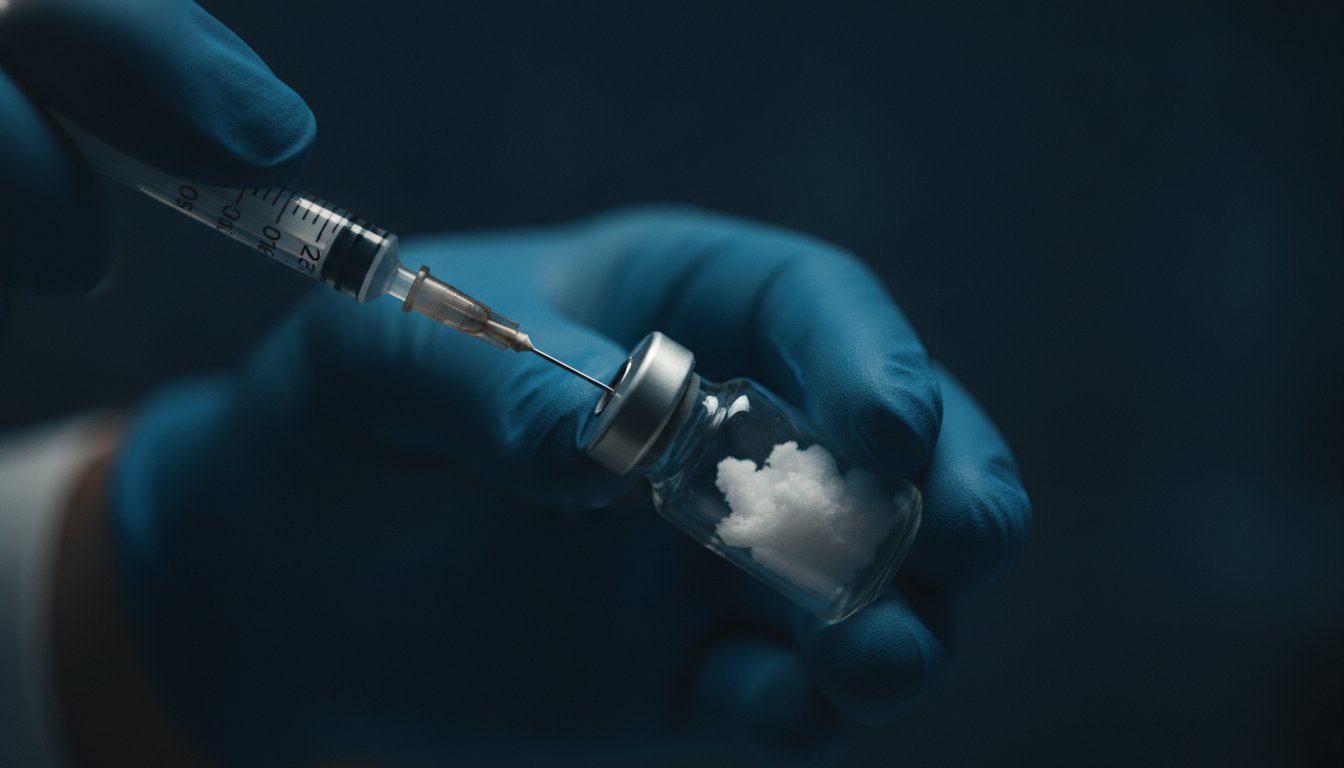
A single mechanical error during rehydration can instantly compromise a 99% HPLC-verified sample; precision in the lab begins long before the first assay. Maintaining peptide stability after reconstitution is a critical variable that many researchers overlook, leading to clouded solutions or precipitated sequences. Even the highest purity lyophilized powder is vulnerable to degradation if the transition to a liquid state is not handled with absolute technical rigor. You're aware that consistent, repeatable data depends entirely on the structural integrity of your reagents. Fragile molecular chains require a disciplined hand to prevent irreversible denaturation.
This protocol guide provides the technical nuances required to master peptide rehydration, protecting your molecular samples from the common pitfalls of laboratory handling. We will analyze the physics of solvent introduction, the impact of temperature on shelf life, and the specific mechanical techniques necessary to ensure experimental accuracy. By anchoring your process in these verified standards, you secure the bioactivity of your samples and eliminate the variables that lead to dosing errors. The following sections detail the exact methodology for maintaining clear, stable solutions from the initial puncture to the final aliquot.
Key Takeaways
- Identify how environmental stressors and improper handling techniques cause irreversible molecular denaturation during the transition from lyophilized powder to liquid phase.
- Evaluate the technical requirements for diluent selection, specifically the role of 0.9% benzyl alcohol in maintaining sterility without interfering with research assay results.
- Protect the molecular integrity of your reagents by mastering the physics of rehydration to ensure maximum peptide stability after reconstitution.
- Eliminate dosing calculation errors by anchoring volumetric measurements in total vial mass and accounting for syringe dead-space volume.
- Implement standardized post-reconstitution storage protocols, focusing on 2-8°C cold chain continuity and the prevention of photo-degradative UV exposure.
Beyond Simple Mixing: The Chemical Stakes of Peptide Reconstitution
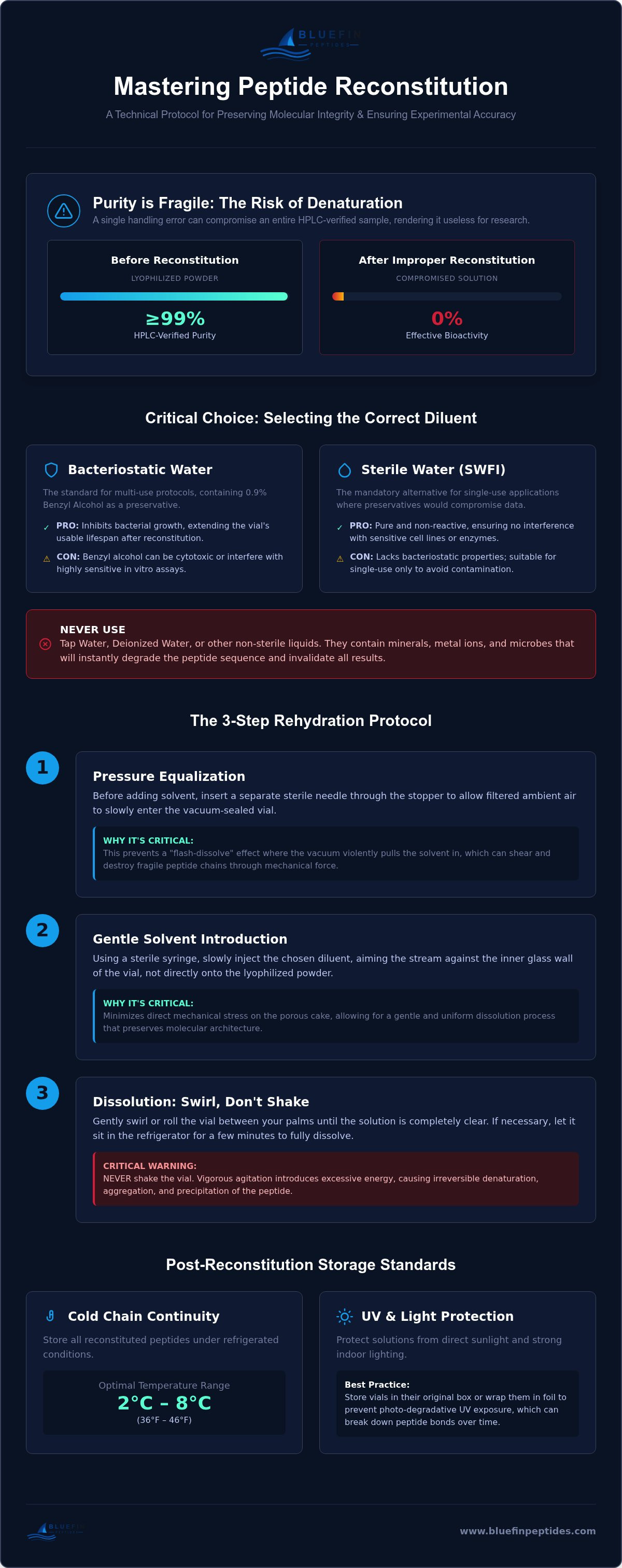
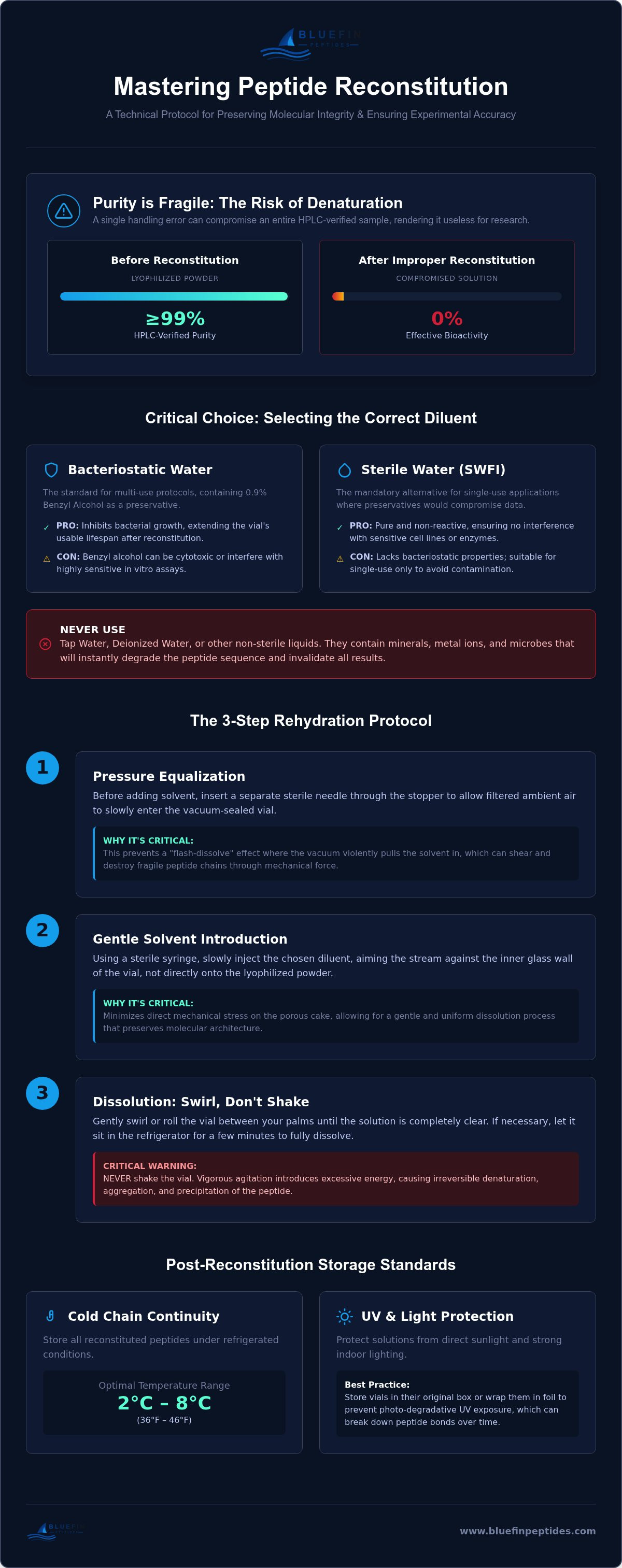
Reconstitution is the chemical restoration of a bioavailable liquid phase from an inert, lyophilized state. It's a delicate transition. Lyophilization preserves the molecular sequence by removing moisture through sublimation, yet the resulting lyophilized cake remains highly sensitive to environmental stressors. What are peptides? In a laboratory context, they are precise sequences of amino acids held together by covalent bonds. These structures are susceptible to irreversible denaturation when exposed to improper rehydration techniques. Peptide stability after reconstitution isn't guaranteed by the purity of the powder alone. Even a sample with ≥99% HPLC-verified purity can yield 0% experimental results if the protocol is flawed. Precision is mandatory. Standardized protocols serve as the anchor for laboratory reproducibility. They protect the data security of the entire research project.
The Physics of Lyophilized Stability
The lyophilized cake is a porous, fragile structure designed for maximum surface area. This architecture allows for rapid solvent interaction, but it also creates a significant mechanical vulnerability. Most research vials are vacuum-sealed to prevent oxidation and moisture ingress. If a researcher introduces solvent without equalizing this pressure, the differential can cause a "flash-dissolve" effect. This sudden, violent mechanical force can shear fragile molecular chains. Pressure equalization must be performed with clinical care. A sterile needle should be used to allow filtered ambient air to enter the vial slowly before the diluent is introduced. This prevents the solvent from being pulled into the powder with destructive velocity, preserving the underlying molecular architecture.
Purity Protection and HPLC Integrity
Maintaining peptide stability after reconstitution requires an acute understanding of chemical thresholds. Reconstitution errors often manifest as artifacts in analytical testing. For example, when handling high-complexity sequences like the retatrutide research peptide, maintaining the baseline purity depends heavily on the solvent's pH and ionic strength. If the diluent deviates significantly from the peptide's isoelectric point, the molecule may reach a precipitation threshold. This results in cloudy solutions or visible particulates. These aggregates represent a catastrophic loss of active mass. Protecting HPLC-verified integrity means ensuring the peptide remains in a fully monomeric state. Any deviation in the rehydration process can invalidate the batch-specific COA, rendering the research data unreliable. Precision in the liquid phase is the only way to verify the quality of the original lyophilized offering.
Solvent Selection and Diluent Deviations: Protecting Molecular Stability
Solvent choice is not a matter of convenience; it is a fundamental chemical requirement. The primary standard in modern laboratories is Bacteriostatic Water, which contains 0.9% Benzyl Alcohol. This preservative is essential for multi-entry protocols. It inhibits bacterial proliferation. However, it can become a "preservative trap" for sensitive in vitro models. Benzyl alcohol is known to induce cytotoxic effects in specific cell lines or interfere with sensitive enzyme assays. High-precision research must account for these diluent deviations. Sterile Water for Injection (SWFI) is the mandatory alternative for single-use assays where preservatives might compromise data. Never utilize tap or deionized water. Mineral content, metal ions, and microbial loads in non-sterile sources will instantly degrade the sequence and invalidate your results.
Bacteriostatic Water: The Multi-Use Anchor
Benzyl alcohol functions as a bacteriostatic agent by disrupting bacterial cell membranes. This is the anchor for extended study durations. When handling the tirzepatide research peptide, peptide stability after reconstitution is significantly enhanced by this preservative. Under refrigerated conditions (2-8°C), stability typically persists for 30 to 60 days. Beyond this window, even with preservatives, the risk of hydrolysis increases. Monitoring the diluent's expiration is mandatory. Expired bacteriostatic water can undergo pH shifts. This acidity can trigger peptide aggregation or cleavage, rendering the HPLC-verified baseline purity irrelevant.
Specialized Solvents for Research Blends
Complex formulations, such as the GHK-Cu BPC-157 TB-500 research blend, present unique solubility challenges. Copper-complexed molecules like GHK-Cu require specific ionic environments to remain in solution. While generally hydrophilic, certain research blends contain hydrophobic sequences that resist standard aqueous dissolution. In these instances, 0.6% sterile acetic acid is utilized to lower the pH and encourage solubility. Conversely, some acidic peptides require a basic shift using dilute sodium hydroxide. Precision is paramount. An incorrect pH adjustment will lead to immediate precipitation and a catastrophic loss of active mass. To ensure your protocols remain robust, always source HPLC-verified research peptides from trusted laboratory partners. Avoiding solvent-induced aggregation is the only way to maintain the 99% purity standard throughout the life of the reconstituted vial.
Mechanical Stress and Thermal Shock: The Physics of Fragile Chains
The molecular architecture of a peptide is held together by delicate non-covalent interactions, including hydrogen bonds and hydrophobic effects. Vigorous shaking introduces excessive kinetic energy, creating "shear force" that physically tears these bonds apart. This is not a reversible process. Once a peptide denatures due to mechanical stress, its biological activity is lost. Maintaining peptide stability after reconstitution requires a fundamental respect for fluid dynamics. Air bubbles and foaming are not merely aesthetic issues; they represent areas where peptides are trapped at the air-liquid interface, which often leads to unfolding and concentration loss. To mitigate this, researchers should utilize the Z-axis injection technique. This involves directing the solvent stream against the glass wall of the vial rather than directly onto the lyophilized cake. This allows the liquid to slide down the interior surface, minimizing the impact force on the fragile powder.
Temperature Acclimatization Protocol
Thermal shock is a common catalyst for molecular degradation. Reconstituting a vial taken directly from -20°C or -80°C storage is a violation of laboratory precision. The following steps ensure thermal equilibrium:
- Step 1: Allow lyophilized vials to reach ambient room temperature (20-25°C) before introducing any solvent. This typically requires 30 to 60 minutes of equilibration time.
- Step 2: Ensure the vial exterior is dry. Opening a cold vial in a humid environment causes immediate condensation inside the vial, which compromises volumetric accuracy and introduces moisture-driven hydrolysis risks.
- Step 3: Monitor for exothermic reactions. While rare in standard research concentrations, the rapid dissolution of highly concentrated samples can generate localized heat, which further threatens peptide stability after reconstitution.
The Gentle Swirl: Standardizing Mechanical Handling
Precision handling replaces agitation with patience. Shaking a vial is the most frequent cause of "opalescent" solutions, a visual indicator of large-scale protein aggregation. A clear, colorless solution is the only acceptable outcome for a successful reconstitution. If a peptide is particularly hydrophobic or resistant to dissolution, don't increase mechanical force. Instead, allow the vial to sit undisturbed at room temperature for 10-15 minutes. This time-based dissolution allows the solvent to penetrate the lyophilized matrix naturally without breaking the non-covalent bonds essential for proper peptide folding. Gentle, rhythmic swirling is the final step to ensure a homogenous concentration. This disciplined approach protects the HPLC-verified integrity of the sample, ensuring that your research results reflect the true nature of the molecule rather than artifacts of poor laboratory handling.
Volumetric Inaccuracies and Concentration Calculation Errors
Volumetric precision is the final safeguard for experimental accuracy. High-purity lyophilized powder serves as the baseline, yet the resulting molarity depends entirely on mathematical and mechanical rigor. Milligram vs. milliliter confusion remains a primary source of data corruption in modern laboratories. This error typically occurs when the total vial mass is ignored in favor of arbitrary solvent volumes. Low-volume research transfers are particularly susceptible to "dead-space volume," which is the residual liquid trapped in the syringe hub and needle after the plunger is fully depressed. In studies requiring precise micro-dosing, this hidden error can represent a 5-10% variance in the delivered amount. Concentration drift occurs when atmospheric exchange is allowed via improper sealing. Evaporation alters the solvent-to-solute ratio, slowly increasing the molarity and compromising peptide stability after reconstitution over time.
Mastering the Reconstitution Math
The standard laboratory formula for concentration is absolute: (Total Vial Mass in mg) / (Total Solvent Volume in ml) = Final Concentration in mg/ml. Researchers often fail to document the exact diluent volume on the vial label, leading to traceability failures during multi-day assays. For instance, when standardizing the ipamorelin CJC-1295 research blend USA protocols, a 5mg vial reconstituted with 2ml of bacteriostatic water yields 2.5mg/ml. A common error involves assuming a 1:1 ratio regardless of vial size. This oversight invalidates dosing calculations across multi-subject studies. Traceability requires that every vial carries a secondary label indicating the date, solvent type, and calculated concentration to prevent downstream errors.
Syringe Calibration and Volumetric Precision
Selecting the correct syringe gauge is essential for handling high-viscosity research solutions. Fine-gauge needles (29-31G) minimize septa damage but can introduce excessive shear force if the plunger is depressed too rapidly. Volumetric precision also depends on the "bubble-purge" technique. Trapped air bubbles displace active solution, leading to an under-delivery of the required mass. Loss-on-transfer during aliquotting procedures must be factored into the initial solvent volume to maintain the intended concentration. To avoid these mechanical variables and ensure your research is backed by verified data, always source HPLC-verified research peptides from a disciplined laboratory partner. Maintaining the intended molarity is as critical as the sequence purity itself.
Verification Protocols and Post-Reconstitution Storage Standards
Visual inspection serves as the primary laboratory filter for reagent integrity. A successfully reconstituted solution must be clear, colorless, and free of visible particulates. Cloudiness, opalescence, or precipitation are definitive indicators that peptide stability after reconstitution has failed. These aggregates represent denatured molecular chains that have lost their secondary and tertiary structures, rendering them useless for high-precision assays. Verification doesn't end at the initial mix; it's a continuous process of monitoring the solution's physical state against its expected analytical baseline. Any deviation from total clarity requires the immediate suspension of the research protocol for that specific vial.
Cold chain continuity is the anchor of post-rehydration storage. Maintaining a consistent temperature range of 2-8°C (35-46°F) is the laboratory standard for minimizing the kinetic energy that drives hydrolysis and oxidation. While lyophilized powders remain stable for years at -20°C, the liquid phase is significantly more volatile. Most sequences remain viable for 30 to 60 days when refrigerated, though peptides containing Cysteine or Methionine residues may degrade in as little as 7 to 14 days. If the research timeline exceeds 30 days, researchers should aliquot the solution into single-use volumes immediately after rehydration. This prevents the catastrophic ice-crystal effect. Repeated freeze-thaw cycles physically shear the molecular bonds, leading to irreversible degradation that no amount of pure reagent can overcome.
Storage Duration and Potency Decay
Potency decay is an invisible variable that can invalidate months of data. Reconstituted peptides can lose 5-10% of their potency within the first 30 days and up to 20% by day 60, even under ideal refrigeration. Storing these solutions at room temperature is a critical error; it can reduce the molecular half-life by 50-70%. Photo-degradation is equally destructive. Exposure to UV light can decrease a sample's potency by 15-25% within a 48-hour window. Utilizing amber vials or foil wrapping is essential to protect research peptide quality standards from light-induced oxidation. These protective measures ensure that fragile sequences, like growth hormone secretagogues, maintain their intended bioactivity throughout the study duration.
Documentation and Batch Traceability
Precision in the lab requires a closed-loop documentation system that links every reconstitution log to the original HPLC and Mass-Spec COA data. This traceability is the only way to verify that experimental results reflect the peptide's true nature rather than handling artifacts. Labeling is the final safeguard. Every vial in the cold storage unit must be marked with the following essentials:
- Date and time of initial reconstitution.
- Exact solvent and volume used (e.g., 2.0ml Bacteriostatic Water).
- Final calculated concentration in mg/ml.
- The researcher's initials for accountability.
Contaminated or degraded samples must be disposed of according to strict laboratory biohazard protocols. Maintaining these rigorous standards is the only way to protect the integrity of 99% HPLC-verified reagents like Retatrutide. When peptide stability after reconstitution is managed with this level of discipline, the "how" of your storage finally matches the "what" of your results.
Advancing Laboratory Precision through Standardized Reconstitution Protocols
The transition from a lyophilized state to a bioavailable liquid phase is a chemical restoration that demands absolute technical rigor. Every step, from initial pressure equalization to final thermal acclimatization, serves to protect the underlying molecular architecture. Maintaining peptide stability after reconstitution requires a disciplined adherence to these protocols to prevent irreversible denaturation and concentration loss. By eliminating mechanical stress and ensuring cold chain continuity, you anchor your research in verifiable accuracy. Precision in the liquid phase is the only path to repeatable, high-fidelity data.
To ensure your assays are supported by the highest analytical standards, Secure HPLC-Verified Peptides for Your Next Research Protocol. Bluefin Peptides provides ≥99% purity guaranteed, supported by batch-specific COAs and fast domestic US shipping for uncompromising logistics. Protect your research baseline by partnering with a laboratory specialist focused on the "how" of quality. We look forward to supporting your next breakthrough with clinical precision and unwavering reliability.
Frequently Asked Questions
Is bacteriostatic water the same as reconstitution solution?
No, "reconstitution solution" is a general category, while bacteriostatic water is a specific diluent containing 0.9% benzyl alcohol. Other solutions include sterile water or specialized acidic diluents. The choice depends on the peptide's chemical nature and the intended assay. Multi-entry protocols require the bacteriostatic agent to inhibit microbial proliferation, while single-use assays often utilize sterile water to avoid preservative interference with sensitive cell lines or enzyme assays.
Why is my peptide solution cloudy after mixing?
Cloudiness indicates that the peptide has reached its precipitation threshold or has formed large-scale molecular aggregates. This often occurs when the solvent pH is too close to the peptide's isoelectric point or when the concentration exceeds solubility limits. Mechanical stress, such as vigorous shaking, can also trigger this opalescence. Cloudy solutions represent a failure in peptide stability after reconstitution and signify a catastrophic loss of active monomeric mass in the sample.
Can I use a vortex mixer for peptide reconstitution?
No, a vortex mixer should never be used for peptide rehydration due to the extreme shear forces generated. These mechanical stressors physically tear the delicate non-covalent bonds responsible for proper peptide folding. Such agitation leads to irreversible denaturation and a total loss of bioactivity. Instead, researchers should utilize a gentle, rhythmic swirling technique. If the lyophilized cake resists dissolution, allow the vial to sit undisturbed at room temperature for several minutes.
How long can a reconstituted peptide stay at room temperature?
Reconstituted peptides should not remain at room temperature for longer than necessary to complete the laboratory procedure. Most sequences begin to degrade rapidly outside the cold chain, losing 50-70% of their half-life within days. While some stable molecules might survive several hours for an assay, peptide stability after reconstitution is best protected by immediate refrigeration at 2-8°C. Leaving vials on the benchtop invites hydrolysis and irreversible potency decay in fragile sequences.
Does reconstitution solution need to be refrigerated?
Unopened bacteriostatic water or sterile water vials generally don't require refrigeration and should be stored at controlled room temperature. However, once the vial is punctured, it must be handled according to its specific antimicrobial properties. Reconstituted peptide vials themselves must be refrigerated at 2-8°C immediately. Maintaining this thermal boundary is essential to suppress the kinetic energy that drives molecular degradation. Always check the manufacturer's documentation for specific diluent storage requirements before use.
What happens if I inject the solvent directly onto the lyophilized powder?
Injecting solvent directly onto the lyophilized cake causes "flash-dissolving," which introduces destructive mechanical impact. This sudden force can shear fragile molecular chains and cause excessive foaming. Foaming traps peptides at the air-liquid interface, leading to unfolding and concentration loss. Researchers should utilize the Z-axis technique, directing the solvent stream against the interior glass wall. This allows the liquid to flow gently down the surface, preserving the structural integrity of the sample.
Can I reconstitute multiple peptides in the same vial?
Reconstituting multiple peptides in a single vial is a high-risk laboratory practice that can lead to unpredictable cross-reactions or aggregation. Each sequence has unique solubility constants and isoelectric points. Mixing them in one liquid phase increases the probability of precipitation and chemical interference. For experimental accuracy and data security, each lyophilized sample must be rehydrated in its own dedicated vial unless using a pre-formulated, HPLC-verified blend designed for co-solubility and stability.
How do I know if my peptide has denatured during reconstitution?
Visual cues are the first line of detection for molecular denaturation. A clear, colorless solution is the only indicator of a successful rehydration. If the solution appears cloudy, contains visible particulates, or shows signs of persistent foaming, the peptide's secondary structure has likely been compromised. Denaturation involves the loss of the specific three-dimensional folding required for bioactivity. Once these structural anchors are broken, the sample no longer matches its original HPLC-verified analytical baseline.
For laboratory research use only. Not for human or veterinary use. This content is educational and does not constitute medical, dosing, or usage guidance.
Browse the BLUEFIN catalog