Common Impurities in Synthetic Peptides: Analytical Guide

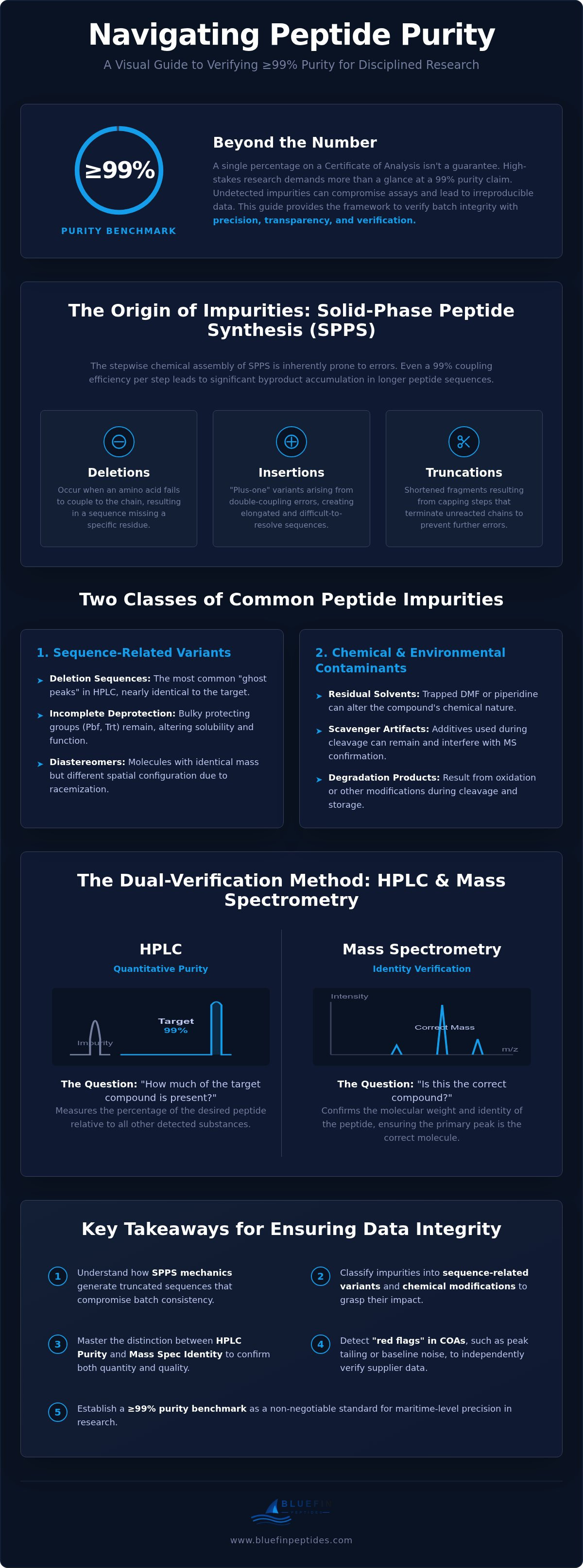
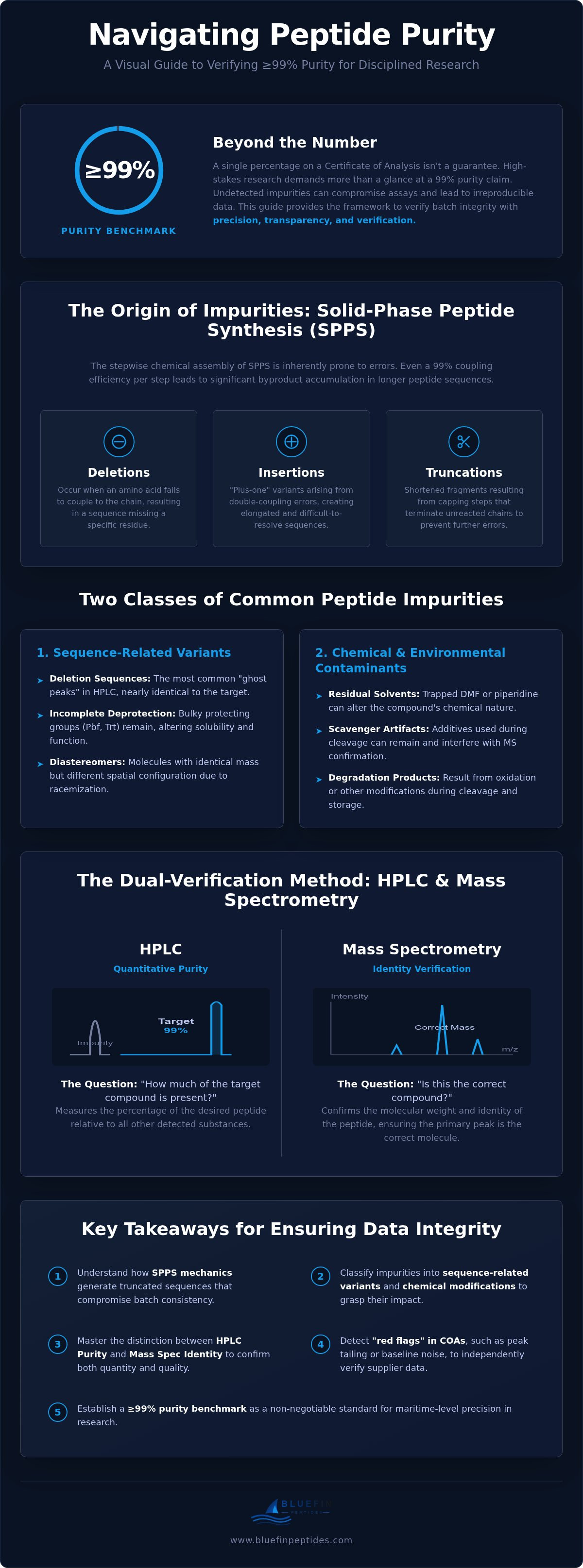
A single percentage on a Certificate of Analysis isn't a guarantee of research integrity; it's merely a starting point. High-stakes laboratory environments demand more than a cursory glance at a 99% purity claim. You understand that batch-to-batch variation often stems from undetected common impurities in synthetic peptides, which can compromise sensitive assays and lead to irreproducible data. It's a frustrating reality when complex HPLC chromatograms hide more than they reveal. Precision. Transparency. Verification.
We provide the analytical framework to navigate these chemical depths with absolute precision. This guide details the specific synthesis byproducts, such as truncated sequences and stereoisomers, that threaten your results. You'll learn to interpret analytical data independently and verify COA benchmarks against rigorous 2026 FDA and EMA standards. We'll examine the role of orthogonal testing, including mass spectrometry, to ensure every compound meets the 99% HPLC-verified threshold required for secure procurement and disciplined research. Move beyond blind trust and master the methodology behind every batch.
Key Takeaways
- Learn how Solid Phase Peptide Synthesis mechanics generate truncated sequences. These artifacts compromise batch consistency and data integrity.
- Classify common impurities in synthetic peptides into sequence-related variants and chemical modifications to understand their impact on sensitive assays.
- Master the distinction between HPLC quantitative purity and Mass Spectrometry identity verification. It's the only way to confirm molecular weight and identity.
- Detect "red flags" in Certificates of Analysis, such as peak tailing or excessive baseline noise, to independently verify supplier data.
- Establish a ≥99% purity benchmark as a non-negotiable standard. It ensures maritime-level precision in laboratory research.
The Origin of Impurities in Synthetic Peptide Production
Peptide synthesis is a high-stakes chemical assembly where precision is the only currency. The formation of common impurities in synthetic peptides isn't a failure of intent but an inherent characteristic of the multi-step chemical reactions involved. Every cycle of Solid-Phase Peptide Synthesis (SPPS) presents a potential for deviation. Incomplete coupling, side-chain deprotection, and environmental factors coalesce to create a complex mixture that requires rigorous analytical scrutiny. For the researcher, understanding these origins is the first step toward verifying batch-level integrity.
Reproducibility in sensitive assays depends on identifying the threshold where these artifacts transition from background noise to active interference. When impurities exceed the 1% margin, they risk masking biological signals or inducing off-target responses. This variability is the primary driver of unreliable research results. Precision. Control. Verification. These are the pillars of a disciplined laboratory environment.
Solid Phase Peptide Synthesis (SPPS) Byproducts
The stepwise nature of SPPS means that each amino acid addition must reach near-quantitative yields. Even a 99% coupling efficiency leads to significant byproduct accumulation in longer sequences. These byproducts typically manifest in three forms:
- Deletions: These occur when steric hindrance or peptide aggregation prevents the incoming amino acid from reaching the resin-bound N-terminus. The resulting chain is missing a specific residue.
- Insertions: Elongated sequences arise from double-coupling errors or the presence of amino acids with unstable protecting groups. These "plus-one" variants are often difficult to resolve from the target peak.
- Truncations: Laboratory protocols often utilize capping steps to terminate unreacted chains. This prevents deletion errors from propagating but leaves behind shortened fragments that must be meticulously removed during the purification phase.
Reagent-Derived and Environmental Contaminants
Beyond sequence-related variants, the chemical environment of the synthesis contributes non-peptidic contaminants. Residual solvents such as Dimethylformamide (DMF) or piperidine can remain trapped within the lyophilized matrix if the post-cleavage washing isn't exhaustive. These residues don't just affect purity; they can alter the chemical nature of the compound and its behavior in solution.
Scavenger artifacts also pose a risk. In the context of 2026 laboratory standards, a scavenger is a nucleophilic additive designed to intercept and quench reactive carbocations released during the acidic cleavage of protecting groups. If these scavengers aren't fully removed, they appear as distinct impurities that can interfere with mass-spectrometry confirmation. Maintaining a clean baseline requires a deep-sea level of precision in the final filtration and purification stages.
Categorizing Common Peptide Impurities and Variants
To maintain 99% purity, researchers must categorize common impurities in synthetic peptides into two distinct groups: sequence-related variants and chemical modifications. This distinction isn't academic; it's operational. Sequence-related impurities emerge from the synthesis process itself, while modifications often occur during cleavage, purification, or storage. Identifying these artifacts is essential for ensuring that sensitive assays aren't compromised by hidden chemical noise. Precision in categorization leads to precision in results.
Sequence-Related Impurities
Deletion sequences are the most frequent "ghost peaks" observed during RP-HPLC. They occur when a specific amino acid fails to couple, resulting in a chain that is nearly identical to the target but missing a single residue. Incomplete deprotection of side-chain groups, such as Pbf or Trt, leaves bulky artifacts that shift retention times and alter solubility; these residues are particularly problematic because they can shield the peptide from enzymatic action or change its folding characteristics. Diastereomers represent a more subtle threat; these are formed through the racemization of amino acids during activation, creating molecules with identical mass but different spatial configurations. They often elude standard purification, requiring deep-sea precision in chromatography to isolate and resolve from the desired L-enantiomer.
Chemical Modifications and Degradation Products
Degradation products often arise from the inherent sensitivity of specific residues during the cleavage and lyophilization phases. Oxidation is the primary concern for sequences containing Methionine or Cysteine. The formation of sulfoxides increases the polarity of the peptide, causing it to elude the main peak during reversed-phase separation and potentially altering binding affinity. Deamidation of Asparagine and Glutamine residues is equally critical; this pH-dependent conversion transforms a neutral amide into a negatively charged carboxylate, fundamentally altering the peptide’s charge and biological activity.
High-pH steps during synthesis or purification also introduce the risk of beta-elimination and further racemization. These transformations are often irreversible and difficult to detect without high-resolution mass spectrometry. The presence of even small amounts of these variants can significantly impact the kinetic data of an experiment. Every batch must be scrutinized for these artifacts to prevent the use of sub-standard compounds in sensitive assays. Researchers seeking HPLC-verified research compounds must prioritize suppliers who document these specific degradation profiles to ensure experimental reproducibility. This commitment to transparency is the hallmark of a high-performance laboratory partner.
Analytical Detection: HPLC and Mass Spectrometry Verification
Verification is the anchor of research integrity. While synthesis protocols provide the framework, analytical detection ensures that common impurities in synthetic peptides are identified and quantified with clinical precision. Relying on a single analytical method is a risk no disciplined laboratory should take. Instead, a dual-pronged approach using Reversed-Phase High-Performance Liquid Chromatography (RP-HPLC) and Mass Spectrometry (MS) is required to secure a 99% purity benchmark. This orthogonal testing ensures that what's measured is exactly what's delivered.
RP-HPLC for Purity Quantification
RP-HPLC remains the gold standard for quantitative assessment. By measuring the Area Under the Curve (AUC) of the primary peak relative to the total chromatogram, researchers can determine the percentage purity of a batch. However, the accuracy of this measurement depends entirely on the gradient selection. A shallow gradient is often necessary to resolve closely eluting impurities that might otherwise hide within the main peak's shoulder. Precision requires a clean baseline and sharp peak symmetry to avoid underestimating contaminant levels.
The resolution factor (Rs) between the target peptide and any closely eluting impurity must be at least 1.5 to ensure a definitive baseline separation required for 99% purity verification. Without this level of resolution, quantitative data remains speculative. High-performance columns and optimized mobile phases are the tools used to achieve this maritime-level precision, ensuring that "ghost peaks" are brought into clear view for proper integration.
Mass Spectrometry for Identity Confirmation
If HPLC provides the quantity, Mass Spectrometry provides the identity. It's the definitive tool for molecular weight verification, allowing researchers to confirm the chemical signature of the retatrutide research peptide by matching experimental mass-to-charge (m/z) ratios to theoretical values. This step is critical because HPLC alone cannot distinguish between the target sequence and certain diastereomers or sequence-related variants that share similar hydrophobicities but different molecular weights.
- Identity Verification: MS confirms the exact mass, ensuring no amino acid substitutions occurred during synthesis.
- Impurity Detection: It identifies "deletion peaks" by revealing fragments that are exactly one amino acid mass lighter than the target.
- Non-UV Detection: MS detects impurities that lack a chromophore and remain invisible to standard UV detectors used in HPLC.
The synergy of LC-MS is now a non-negotiable component of modern research peptide quality standards. It bridges the gap between seeing a peak and knowing exactly what that peak represents. By linking quantitative purity with qualitative certainty, this analytical duo provides the transparency required for high-stakes laboratory work. Every batch must pass this dual-gate verification to be considered research-grade.
Interpreting Certificates of Analysis (COAs) for Lab Use
A Certificate of Analysis (COA) isn't a marketing document; it's a technical blueprint for your research. Independent verification of batch-specific data against catalog specifications is the only way to ensure common impurities in synthetic peptides haven't compromised your starting material. Relying on generic, non-batch-specific documentation is a breach of laboratory protocol that risks irreproducible outcomes. Every researcher must develop the ability to scrutinize these reports with clinical precision to maintain a secure analytical anchor.
Identifying Red Flags in Analytical Reports
The HPLC chromatogram is the primary site for visual verification. Navigating the baseline requires attention to shoulder peaks. These small protrusions on the side of the main peak indicate closely related impurities that haven't been fully resolved during purification. Peak tailing is another critical indicator; it often points to column saturation or the presence of degradation products that interact poorly with the stationary phase. Inconsistent retention times between batches can signal variations in the synthesis environment or the salt form of the peptide. Finally, the absence of a clear mass-spectrometry trace is the most significant red flag. Without mass-spec, you're observing a peak without confirming its identity with deep-sea precision.
Peptide Purity vs. Peptide Content
Confusion between purity and content is a frequent source of error in reconstitution. Peptide purity refers to the percentage of the total peptide material that consists of the correct sequence. In contrast, "Net Peptide Content" accounts for the actual weight of the peptide within the lyophilized powder, which also contains counterions and residual moisture. For example, a sample with 99% purity might only have 80% peptide content due to the presence of Trifluoroacetic acid (TFA) or Acetate salts used during purification. Failing to account for this discrepancy leads to inaccurate molar concentrations in your assays.
Precise content calculation is particularly vital for complex sequences. The tirzepatide research peptide requires exact quantification of its salt form to ensure that reconstitution protocols yield the intended potency. Whether your research demands TFA-removed acetate forms for cellular assays or standard TFA salts, the COA must explicitly state these values. Secure your data by choosing a partner that provides batch-specific HPLC verification for every compound. Transparency isn't an option; it's the standard.
Bluefin Peptides: Achieving the ≥99% Purity Benchmark
Bluefin Peptides operates at the intersection of biochemical rigor and logistical efficiency. While the identification of common impurities in synthetic peptides is a complex analytical challenge, our protocol simplifies the researcher’s burden through radical transparency. We don't ask for trust; we provide the data that earns it. Every compound in our inventory undergoes a dual-gate verification process, ensuring that the theoretical purity discussed in previous sections is a physical reality in every vial. Precision. Verification. Security.
Our commitment to a ≥99% purity benchmark is non-negotiable. This standard is maintained through a "show, don't tell" philosophy, where the focus remains on providing the analytical tools for independent verification. By treating our clients as peers in a professional scientific field, we prioritize the clinical precision required for high-stakes laboratory environments. There is no room for marketing fluff when research reproducibility is on the line.
The Bluefin Verification Standard
Analytical integrity starts with batch-level documentation. We provide batch-specific Certificates of Analysis (COAs) with every order, including the ipamorelin CJC-1295 research blend USA. These reports are not generic templates; they are reflections of the specific chemical state of the compound you receive. To ensure objective quality data, we utilize independent third-party testing, providing an unbiased layer of security for your assays.
Verification becomes even more critical for complex multi-peptide formulations. The GHK-Cu BPC-157 TB-500 research blend requires sophisticated HPLC resolution to distinguish between multiple primary peaks and their respective sequence-related variants. Our mass-spectrometry confirmation ensures that every component of a blend is identified by its exact molecular weight, eliminating the risk of using sub-standard compounds in sensitive research applications.
Logistical Excellence and Research Integrity
Stability is the final frontier of peptide quality. Even a 99% pure compound can degrade if subjected to thermal stress during transit. We utilize advanced lyophilization techniques to ensure a stable physical state, followed by maritime-grade logistics that prioritize speed and temperature control. US-based inventory allows for rapid fulfillment, reducing the time compounds spend in the logistical "deep-sea" of international transit. This speed is a deliberate component of our quality control protocol.
Secure your laboratory inventory with verified, US-stocked compounds that meet the most stringent 2026 analytical standards. Rapid domestic shipping prevents the chemical degradation that often plagues imported materials. By maintaining a disciplined chain of custody from the laboratory to your facility, we ensure that the analytical profile on the COA matches the compound on your bench. Reliability is a function of process, and our process is built for the qualified researcher who demands unwavering professionalism.
Securing Analytical Integrity in Peptide Research
Achieving reproducible data requires a disciplined approach to chemical verification. You've seen how common impurities in synthetic peptides, from deletion sequences to deamidated variants, can compromise the stability of your assays. Precision. Transparency. Verification. These aren't just goals; they are the baseline for modern laboratory standards. By mastering the interpretation of HPLC chromatograms and Mass Spectrometry traces, you ensure that every compound used in your research meets the rigorous 2026 benchmarks set by global regulatory bodies.
It's time to move beyond the uncertainty of batch-to-batch variation. Secure your laboratory inventory with verified, US-stocked compounds that prioritize transparency over marketing fluff. Procure HPLC-Verified Research Peptides from Bluefin Peptides to access ≥99% purity benchmarks, batch-specific Mass-Spec confirmation, and rapid US-based fulfillment. Your research deserves the security of maritime-grade precision. Establish a foundation of trust through rigorous analytical data.
Frequently Asked Questions
What is the difference between 98% and 99% peptide purity?
The 1% difference represents a doubling of total impurity volume. A 98% pure sample contains 2% contaminants, while a 99% pure sample contains only 1%. In high-sensitivity assays, these additional sequence-related variants can mask subtle biological signals or induce off-target effects. Bluefin Peptides maintains a ≥99% purity benchmark to ensure maritime-level precision in your data, providing the security required for reproducible results in disciplined laboratory environments.
Can impurities in synthetic peptides interfere with cell culture assays?
Chemical contaminants can significantly interfere with cell culture assays by inducing cytotoxicity or altering intracellular signaling. Common impurities in synthetic peptides, particularly truncated sequences or residual solvents like DMF, often act as competitive inhibitors for target receptors. This interference leads to false-positive data or suppressed biological responses. Maintaining high purity is essential to ensure that every observed effect is attributed solely to the target sequence and not to synthesis byproducts.
How do I identify a deletion sequence in an HPLC report?
Deletion sequences typically manifest as shoulder peaks or small, closely eluting signals near the primary peak. Because these variants share similar hydrophobicity with the target peptide, they elude standard purification methods. You must examine the baseline for peak asymmetry or tailing. A high-resolution HPLC chromatogram with a shallow gradient is necessary to resolve these specific artifacts from the main signal and confirm that the quantitative purity meets your requirements.
What are the most common oxidation sites in research peptides?
Methionine and Cysteine residues are the primary targets for oxidation during synthesis and storage. These sulfur-containing amino acids can convert into sulfoxides or form unwanted disulfide bridges, fundamentally altering the peptide's polarity and biological activity. Detecting these modifications requires careful monitoring of retention time shifts in HPLC, as oxidized variants typically elute earlier than the native form. Precision in detection ensures that the chemical nature of your compound remains intact.
Why is mass spectrometry required if the HPLC purity is 99%?
HPLC measures quantitative purity based on UV absorbance but cannot confirm molecular identity. Mass spectrometry is the definitive tool for molecular weight verification; it ensures that the peak observed in the HPLC trace is actually the intended sequence. Without mass-spec, you cannot detect diastereomers or sequence-related variants that possess identical UV profiles but different chemical structures. It serves as the anchor of identity verification for every batch used in high-stakes research.
How does the choice of TFA vs. Acetate salt affect peptide research?
Trifluoroacetic acid (TFA) is the standard counterion for synthesis but can be cytotoxic in certain cell-based assays. Acetate salts are often preferred for biological studies to avoid the inhibitory effects of residual TFA. The choice of salt affects the net peptide content and solubility. Researchers must account for the weight of these counterions when calculating molar concentrations to ensure experimental reproducibility across different batches and maintain a consistent laboratory environment.
What happens if a research peptide is not properly lyophilized?
Incomplete lyophilization leaves residual moisture that accelerates chemical degradation through hydrolysis or deamidation. This moisture promotes the formation of common impurities in synthetic peptides during storage, fundamentally altering the compound's chemical nature. A collapsed or sticky lyophilized cake is a visual indicator of high moisture content, which compromises stability and shelf life. Secure your research by utilizing properly processed powders that maintain a stable physical state in a professional laboratory environment.
How often should I verify the COA of a recurring peptide batch?
You should verify the Certificate of Analysis for every single batch received. Synthesis is a stochastic process; batch-to-batch variation is a primary cause of inconsistent research results. Even if the catalog number remains the same, the analytical profile can shift due to changes in reagent lots or environmental conditions. Reviewing batch-specific HPLC and mass-spec data for every order is a non-negotiable standard for maintaining research integrity and ensuring secure procurement.
For laboratory research use only. Not for human or veterinary use. This content is educational and does not constitute medical, dosing, or usage guidance.
Browse the BLUEFIN catalog