CJC-1295 DAC vs No DAC Research: Comparative Pharmacokinetics and Laboratory Analysis

The assumption that CJC-1295 with and without the Drug Affinity Complex are interchangeable analogues is a fundamental error in experimental design. While they share a peptide backbone, the presence of the maleimidoproprionic acid linker creates two distinct pharmacodynamic profiles that cannot be reconciled in a single model. Many investigators find the nomenclature surrounding CJC-1295 DAC vs no DAC research intentionally opaque, leading to inconsistent batch procurement and compromised results. It's frustrating when nomenclature confusion between Modified GRF 1-29 and its DAC-conjugated counterpart undermines months of laboratory labor.
This article provides a rigorous biochemical comparison of these secretagogues to eliminate technical uncertainty and restore fluid movement to your experimental timeline. We'll define the exact structural divergence caused by albumin binding and establish the analytical validation standards necessary for high-precision research. You'll gain the clarity needed to select the proper analogue based on whether your protocol requires continuous elevation or pulsatile secretagogue kinetics. We prioritize the deep-sea precision required for verifiable data, moving past marketing fluff to focus on the cold, objective reality of peptide stability and systemic clearance.
Key Takeaways
- Distinguish synthetic GHRH analogues by identifying Modified GRF 1-29 as the accurate nomenclature for CJC-1295 without the Drug Affinity Complex.
- Quantify the divergence in systemic clearance kinetics within CJC-1295 DAC vs no DAC research, contrasting a thirty-minute half-life against multi-day albumin-shielded persistence.
- Determine the optimal secretagogue for specific experimental models by comparing physiological pulsatile release patterns with sustained endocrine elevations.
- Establish precise design criteria for metabolic and cellular regeneration studies by evaluating pituitary receptor responsiveness under acute versus continuous exposure.
- Implement rigorous analytical verification protocols, including HPLC and mass spectrometry, to ensure batch-specific purity standards exceed 99%.
Molecular Architecture and Nomenclature: CJC-1295 DAC vs No DAC
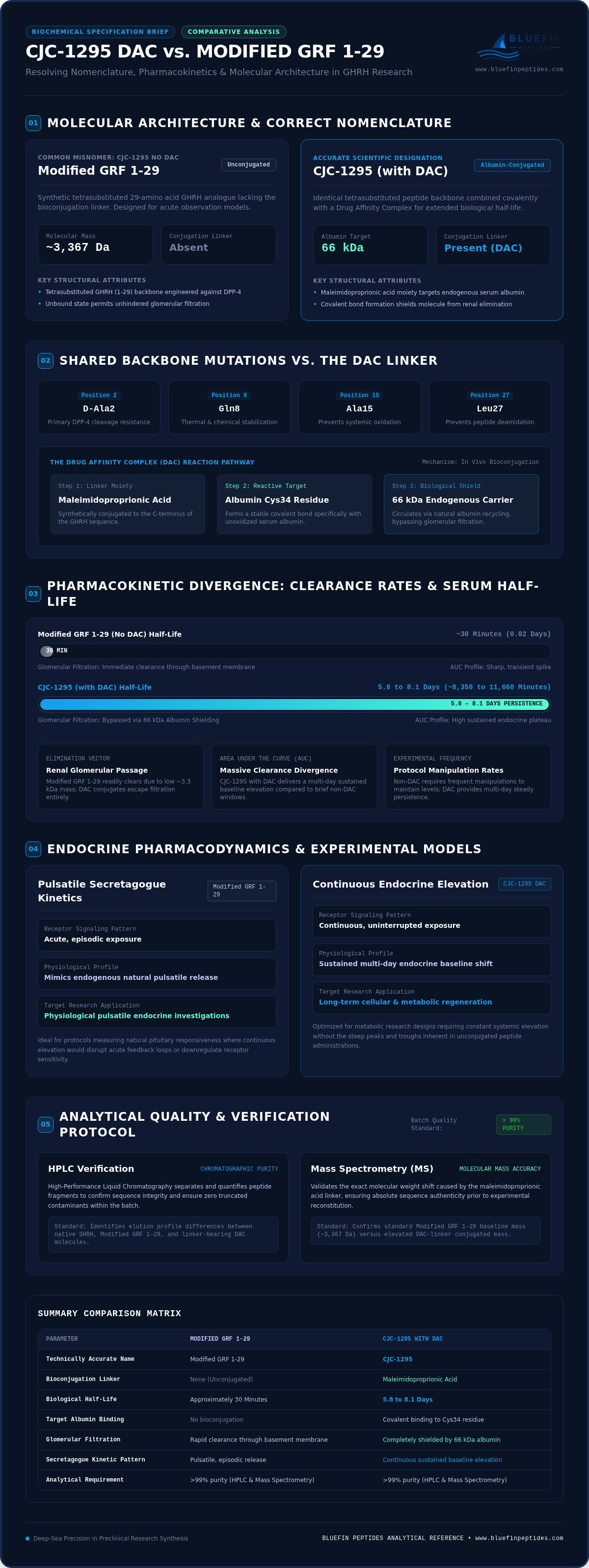
CJC-1295 is a synthetic tetrasubstituted 29-amino acid GHRH analogue. It represents a significant evolution from native GHRH, which is highly susceptible to rapid enzymatic degradation. In the context of CJC-1295 DAC vs no DAC research, investigators must first reconcile technical nomenclature to avoid experimental error. The term "CJC-1295 without DAC" is technically inaccurate; the correct scientific designation for this tetrasubstituted peptide is Modified GRF 1-29. This distinction isn't merely semantic. It defines the presence or absence of the maleimidoproprionic acid linker, a component that fundamentally alters the compound's physical state and physiological interaction.
Precision in nomenclature ensures that laboratory protocols remain reproducible. When researchers fail to distinguish between these two variants, they risk inconsistent data regarding pituitary receptor signaling. The structural divergence begins with the GHRH backbone but culminates in the bioconjugation potential provided by the Drug Affinity Complex. Understanding these molecular foundations is the first step toward achieving deep-sea precision in endocrine modeling.
Chemical Modifications of the GHRH Backbone
The core sequence of CJC-1295 and Modified GRF 1-29 incorporates four specific amino acid substitutions designed to resist enzymatic degradation. The D-Ala2 substitution is primary. It prevents cleavage by dipeptidyl peptidase-4 (DPP-4), the enzyme responsible for the rapid inactivation of native GHRH. Additional replacements at Gln8, Ala15, and Leu27 enhance thermal and chemical stability, preventing oxidation and deamidation. While native GHRH (1-29) possesses a half-life measured in mere minutes, these tetrasubstituted non-DAC variants extend that window to approximately thirty minutes. This creates a more stable secretagogue for acute laboratory observations without the permanence of albumin binding.
The Role of the Drug Affinity Complex (DAC)
The defining characteristic of CJC-1295 with DAC is the addition of a maleimidoproprionic acid moiety. This linker facilitates covalent bioconjugation to endogenous serum albumin, specifically targeting the Cys34 residue. Once introduced into a biological system, the peptide hitches a ride on albumin, which acts as a protective reservoir. This bioconjugation shields the peptide from rapid renal filtration and further enzymatic attack. The molecular weight shift is substantial. A standard Modified GRF 1-29 molecule sits at approximately 3,367 Daltons. The addition of the DAC linker increases this mass before it even binds to the 66 kDa albumin protein. In a lyophilized research state, the physical appearance may remain similar, but the analytical signature is distinct. HPLC verification and mass spectrometry are essential to confirm the presence of the linker and ensure sequence authenticity.
Pharmacokinetic Divergence: Clearance Rates and Serum Half-Life
The operational success of growth hormone secretagogue protocols hinges on understanding clearance velocity. Quantitative data from CJC-1295 DAC vs no DAC research reveals a stark divergence in serum residence times. Unconjugated Modified GRF 1-29 undergoes rapid elimination, maintaining a transient biological half-life of approximately 30 minutes. Conversely, the addition of the Drug Affinity Complex extends this window to an estimated 5.8 to 8.1 days. The difference isn't minor; it alters the entire area under the curve (AUC) and dictates the frequency of experimental manipulations required to maintain targeted endocrine baselines.
Renal filtration mechanisms treat these compounds differently based on their molecular mass. Unconjugated peptides easily pass through the glomerular basement membrane, leading to swift elimination. When the maleimidoproprionic acid linker conjugates with endogenous serum albumin, it creates a massive molecular shield. The resulting complex avoids renal filtration completely, utilizing natural albumin recycling pathways to remain in systemic circulation. For laboratories requiring verified peptide integrity to map these clearance curves, securing high-purity compounds from a dedicated partner like Bluefin Peptides is essential for baseline reproducibility.
Modified GRF 1-29 Rapid Elimination Kinetics
Preclinical rodent and porcine models demonstrate that Modified GRF 1-29 creates a sharp, transient spike in serum concentration. Systemic circulation pathways rapidly clear the peptide through endopeptidase cleavage and renal excretion. While the tetrasubstituted backbone resists immediate DPP-4 degradation, secondary proteolytic pathways active in the plasma eventually catabolize the remaining unconjugated GHRH fragments. Consequently, this rapid elimination demands precise temporal administration. Investigators tracking acute cellular responses must time their assays within narrow windows to capture peak receptor activation before systemic clearance occurs.
CJC-1295 with DAC Extended Systemic Stability
The inclusion of the DAC linker shifts the experimental paradigm from episodic exposure to continuous stimulation. Longitudinal research models show that a single dose of CJC-1295 with DAC achieves prolonged steady-state plasma concentrations, maintaining elevated mean plasma GH levels by 2- to 10-fold for six days or more. Persistent binding to albumin prevents the peptide from entering the active sites of circulating proteases, effectively mitigating rapid proteolytic degradation. This stability allows for extended observation windows without the confounding variables introduced by frequent repeat dosing protocols.
Endocrine Pharmacodynamics: Pulsatile vs Continuous Secretagogue Action
The endocrine response to GHRH analogues is determined by the duration of receptor occupancy. In CJC-1295 DAC vs no DAC research, the primary variable is the preservation versus the disruption of physiological pulsatility. Native growth hormone secretion occurs in discrete, episodic bursts rather than a constant flow. Utilizing a long-acting secretagogue like CJC-1295 with DAC fundamentally alters this rhythm, creating a sustained elevation of baseline GH levels. While this provides a consistent trophic stimulus, it bypasses the natural refractory periods that characterize mammalian endocrine systems. The choice isn't merely technical; it's a fundamental decision regarding the physiological state of the model.
Pituitary GHRH receptor responsiveness varies significantly under these different exposure models. Acute exposure allows the receptor to reset, maintaining sensitivity for subsequent pulses. Conversely, unyielding activation may lead to receptor downregulation or somatotroph fatigue. Investigators must decide whether their model requires the high-tide consistency of sustained signaling or the rhythmic ebb and flow of pulsatile induction. This choice directly impacts downstream IGF-1 production, which responds differently to transient spikes compared to uninterrupted elevations. Precision in these observations is mandatory for reproducible secretagogue data.
Preservation of Endogenous Pulsatility with Mod GRF 1-29
Short-acting analogues like Modified GRF 1-29 mirror physiological rhythms. Because the half-life is restricted to approximately 30 minutes, the peptide stimulates a sharp GH pulse before systemic clearance occurs. This allows the pituitary to return to a baseline state, preserving receptor sensitivity. This episodic action is highly effective when researchers seek to amplify natural secretion patterns. In many laboratory settings, this effect is optimized through the use of an Ipamorelin CJC-1295 Research Blend USA. The synergy between a GHRH analogue and a GHRP allows for precise pulse initiation and amplitude modulation, providing a comprehensive toolkit for acute endocrine modeling.
Continuous Trophic Stimulation Induced by CJC-1295 DAC
CJC-1295 with DAC induces a distinct pharmacodynamic state characterized by GH bleeding. This refers to the elevation of trough levels rather than an increase in pulse frequency. Research indicates a single dose can increase mean plasma IGF-1 concentrations by 1.5- to 3-fold for up to 11 days. With repeated administration, these levels can remain elevated for 28 days. This constant signaling provides a powerful anabolic environment but introduces the risk of cellular adaptation. Somatotrophs subjected to uninterrupted GHRH receptor activation may eventually show reduced responsiveness. This factor must be accounted for in long-term metabolic studies. The metabolic shift observed in constant secretagogue models is often more pronounced than in episodic ones, though it lacks the physiological nuance of pulsatile release.
Experimental Design Criteria for Preclinical Research Models
Selecting the correct secretagogue variant is the most critical decision in growth hormone research. In CJC-1295 DAC vs no DAC research, the experimental outcome is tethered to the duration of receptor occupancy. Investigators must define their criteria based on whether the study targets acute metabolic spikes or sustained trophic shifts. For instance, cellular regeneration models often benefit from the rhythmic pulses provided by unconjugated peptides, whereas studies on gene expression may require the steady-state elevation offered by DAC bioconjugation. Structural integrity must be maintained from the moment of receipt to the final assay.
Preserving structural integrity during the transition from lyophilized powder to aqueous solution is vital. Reconstitution should involve sterile bacteriostatic water or phosphate-buffered saline, introduced gently to avoid mechanical shearing of the peptide sequence. Harsh agitation can destabilize the tetrasubstituted backbone, leading to degraded fragments that yield inconsistent receptor signaling data. Structural stability is the bedrock of reproducible secretagogue data. To ensure your laboratory utilizes only HPLC-verified compounds for these sensitive protocols, procure analytical-grade research peptides from a partner committed to batch-level documentation.
Modeling Acute Endocrine Secretion Events
Acute models focus on the transient amplitude of GH release. When synchronizing secretagogues with nocturnal physiological cycles in animal models, the short residence time of Modified GRF 1-29 allows for precise temporal control. This mirrors natural mammalian pulses, which are often suppressed by somatostatin during waking hours. In vitro pituitary cell culture incubation protocols also rely on unconjugated peptides to prevent receptor saturation. Monitoring feedback inhibition mechanisms is easier when the secretagogue is cleared rapidly, allowing the somatotrophs to return to a baseline state between stimulated events. This episodic rhythm is essential for studying the natural refractory periods of the GHRH receptor.
Investigating Chronic Growth Factor Elevation
Chronic models require a different logistical approach. Longitudinal protocols examining tissue remodeling or metabolic shifts demand the continuous stimulation provided by DAC-conjugated peptides. When calculating active concentration in vivo, researchers must account for the circulating albumin volume of the subject species, as the peptide's efficacy is linked to its covalent binding capacity. This sustained signaling allows for the measurement of secondary organ biomarkers, such as hepatic IGF-1 output, without the confounding volatility of episodic spikes. Continuous IGF-1 receptor activation provides a stable baseline for investigating long-term gene expression changes in musculoskeletal and connective tissues, offering a window into sustained trophic adaptations.
Analytical Verification: HPLC and Mass Spectrometry Standards
Analytical rigor is the only safeguard against the nomenclature ambiguity that plagues growth hormone secretagogue procurement. In CJC-1295 DAC vs no DAC research, the chemical signature serves as the final arbiter of sequence authenticity. Relying on vendor labels without primary analytical data introduces unacceptable volatility into the laboratory environment. Precision is mandatory. Verification must extend beyond simple identity to include quantitative purity and molecular weight determination. Every batch requires a transparent audit trail to ensure the physical state of the peptide matches the intended experimental design.
Reverse-phase High-Performance Liquid Chromatography (RP-HPLC) serves as the primary tool for determining chemical purity. The methodology involves passing the peptide through a hydrophobic stationary phase, using a gradient of organic solvent to separate the target compound from synthesis byproducts. A chromatogram showing a single, sharp peak with a purity level of ≥99% is the benchmark for research-grade materials. This process ensures that no truncated sequences or residual reagents remain to interfere with pituitary receptor signaling. Deep-sea precision in these measurements prevents the confounding results often caused by batch-level impurities.
Distinguishing Analogues via Mass Spectrometry
Electrospray Ionization Mass Spectrometry (ESI-MS) provides the definitive molecular weight determination required to separate these secretagogues. Investigators must contrast the theoretical molecular weight of Modified GRF 1-29, which sits at approximately 3367 Da, with the DAC-conjugated variant at approximately 3647 Da. This mass shift of 280 Da confirms the presence of the maleimidoproprionic acid linker. High-resolution spectral readouts allow for the detection of incomplete synthesis fragments or unreacted linker residues that HPLC might miss. For a deeper analysis of these methodologies, see the analytical quality standards for research peptides.
Laboratory Procurement Best Practices
Acquiring reliable secretagogues requires a disciplined approach to documentation. Investigators should inspect batch-specific Certificates of Analysis (COAs) for verified retention times and low endotoxin thresholds. The presence of mass spectrometry data is non-negotiable for verifying tetrasubstitution accuracy. Once procured, compounds must be stored in a lyophilized state at sub-zero temperatures. This prevents deamidation and oxidation, preserving the fluid movement of the research timeline. To maintain unwavering professionalism in your experimental results, explore verified laboratory compounds at Bluefin Peptides, where batch-level transparency is the standard.
Advancing Precision in Endocrine Secretagogue Modeling
Success in CJC-1295 DAC vs no DAC research depends on reconciling structural divergence with intended physiological outcomes. Choosing between the thirty-minute residence time of Modified GRF 1-29 and the multi-day stability of the DAC-conjugated variant isn't just a logistical choice. It's a fundamental decision that dictates the endocrine rhythm of your model. Whether your protocol demands the sharp amplitude of pulsatile release or the constant trophic stimulus of steady-state elevation, the integrity of your results relies entirely on the chemical nature of the compound.
Verification is the bedrock of reproducible science. Every batch must meet uncompromising analytical standards to eliminate the risks of deamidation or sequence truncation. Bluefin Peptides provides the tools for this level of deep-sea precision. We provide ≥99% HPLC analytical purity documentation and electrospray mass spectrometry confirmation with every shipment. All compounds are synthesized and fulfilled within the United States strictly for laboratory research. It's time to restore fluid movement to your experimental timeline. Procure HPLC-Verified Research Peptides at Bluefin Peptides. Your commitment to analytical rigor ensures your findings will stand as a benchmark for future investigation.
Frequently Asked Questions
What is the primary biochemical difference between CJC-1295 with DAC and without DAC?
The primary difference is the addition of a maleimidoproprionic acid linker in the DAC version. This Drug Affinity Complex enables covalent bioconjugation to endogenous serum albumin at the Cys34 residue. Unconjugated variants lack this linker and cannot bind to blood proteins. This structural divergence is the sole reason for the massive disparity in systemic clearance rates observed in CJC-1295 DAC vs no DAC research.
Why is CJC-1295 without DAC frequently designated as Modified GRF 1-29 in scientific literature?
Modified GRF 1-29 is the correct nomenclature for the tetrasubstituted 29-amino acid GHRH analogue without the Drug Affinity Complex. Scientific literature uses this designation to distinguish the base peptide from its conjugated counterpart. The name reflects the specific substitutions at positions 2, 8, 15, and 27 of the native GHRH sequence. Using this term prevents experimental confusion and ensures researchers procure the specific secretagogue required for their pulsatile signaling models.
How does the Drug Affinity Complex alter the half-life of GHRH analogues in research models?
The Drug Affinity Complex extends the biological half-life from approximately 30 minutes to nearly 8 days. Once the maleimidoproprionic acid linker binds to albumin, the peptide is shielded from rapid renal filtration and enzymatic degradation. Albumin recycling pathways keep the complex in systemic circulation for extended durations. This transformation shifts the pharmacodynamic profile from a transient, acute spike to a sustained, steady-state elevation that persists for over a week.
Does continuous GHRH receptor activation by CJC-1295 DAC cause pituitary desensitization in animal models?
Continuous GHRH receptor activation by CJC-1295 DAC may lead to receptor downregulation or somatotroph fatigue in some animal models. Because the pituitary is subjected to unyielding trophic stimulation without refractory periods, the secretory response can diminish over time. This contrast is a focal point in CJC-1295 DAC vs no DAC research, as investigators must account for potential cellular adaptations when designing longitudinal studies involving constant growth factor elevations.
Can mass spectrometry distinguish between CJC-1295 with DAC and Modified GRF 1-29?
Electrospray ionization mass spectrometry (ESI-MS) definitively distinguishes these analogues by detecting a specific mass shift. The theoretical molecular weight of Modified GRF 1-29 is approximately 3367 Daltons, while the DAC-conjugated variant is approximately 3647 Daltons. This 280 Dalton difference confirms the presence of the maleimidoproprionic acid linker. High-purity compounds from Bluefin Peptides include mass spectrometry confirmation to ensure researchers receive the exact molecular identity required for their specific laboratory protocols.
What storage conditions are required to maintain the stability of lyophilized CJC-1295 research vials?
Lyophilized research vials must be stored at sub-zero temperatures, typically minus 20 degrees Celsius, to maintain long-term stability. Exposure to moisture or elevated temperatures can trigger deamidation and oxidation of the peptide backbone. Once reconstituted with bacteriostatic water or phosphate-buffered saline, the solution should be refrigerated at 2 to 8 degrees Celsius and utilized within a narrow window. Maintaining these conditions prevents structural degradation and ensures the reproducibility of secretagogue data.
Why do episodic secretagogue studies typically favor Modified GRF 1-29 over CJC-1295 DAC?
Episodic studies favor Modified GRF 1-29 because its 30-minute half-life allows for the precise mimicking of physiological pulses. The rapid systemic clearance ensures that the pituitary GHRH receptors aren't continuously saturated. This allows the endocrine system to return to a baseline state between stimulated events, preserving receptor sensitivity. Researchers often combine it with GHRPs like Ipamorelin to achieve synergistic, well-defined pulses that mirror natural mammalian growth hormone secretion patterns.
For laboratory research use only. Not for human or veterinary use. This content is educational and does not constitute medical, dosing, or usage guidance.
Browse the BLUEFIN catalog