Verifying Retatrutide Purity: HPLC & Mass-Spec Guide
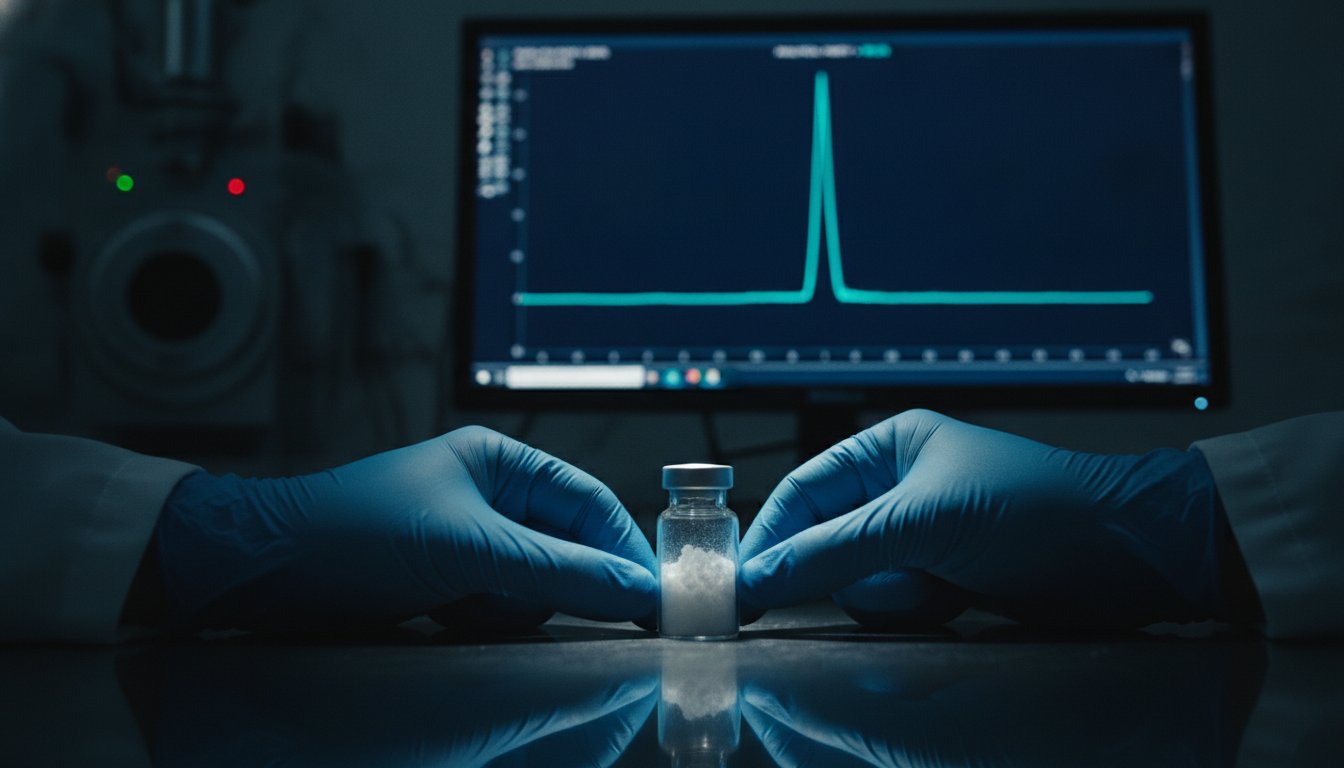
A printed Certificate of Analysis is merely a claim until you possess the analytical literacy to verify it yourself. In the high-stakes environment of metabolic research, relying on a supplier's summary without examining the underlying data is a variable your protocol cannot afford. You understand that the integrity of your results depends entirely on the chemical identity of your reagents. Ensuring your retatrutide HPLC verified status is accurate requires more than a cursory glance at a percentage; it demands a deep dive into the baseline noise and peak integration of the chromatogram.
This guide establishes a rigorous framework for interpreting HPLC and Mass-Spec reports with the same precision you apply to your own laboratory procedures. We'll move beyond the surface level to analyze how mass-to-charge ratios confirm molecular identity and how to cross-reference batch numbers against independent verification. You will gain the ability to spot inconsistencies before they compromise your research, providing a clear path to absolute compound certainty. By the end of this analysis, you'll have the tools to anchor your study in data that survives the most rigorous peer review.
Key Takeaways
- Interpret HPLC chromatograms with clinical precision by analyzing peak symmetry and baseline stability to confirm a retatrutide HPLC verified purity of ≥99%.
- Navigate the complexities of Mass Spectrometry to validate molecular identity, ensuring the 39-amino acid triple-agonist structure aligns perfectly with theoretical mass.
- Recognize how trace contaminants interfere with multi-receptor signaling pathways, potentially skewing data in GLP-1, GIP, and glucagon research.
- Implement a rigorous batch-verification protocol that synchronizes physical vial inspection with digital COA documentation for a transparent audit trail.
- Leverage US-stocked inventory and rapid logistics to preserve the chemical integrity and stability of lyophilized research compounds.
The Criticality of Purity in Triple-Agonist Research
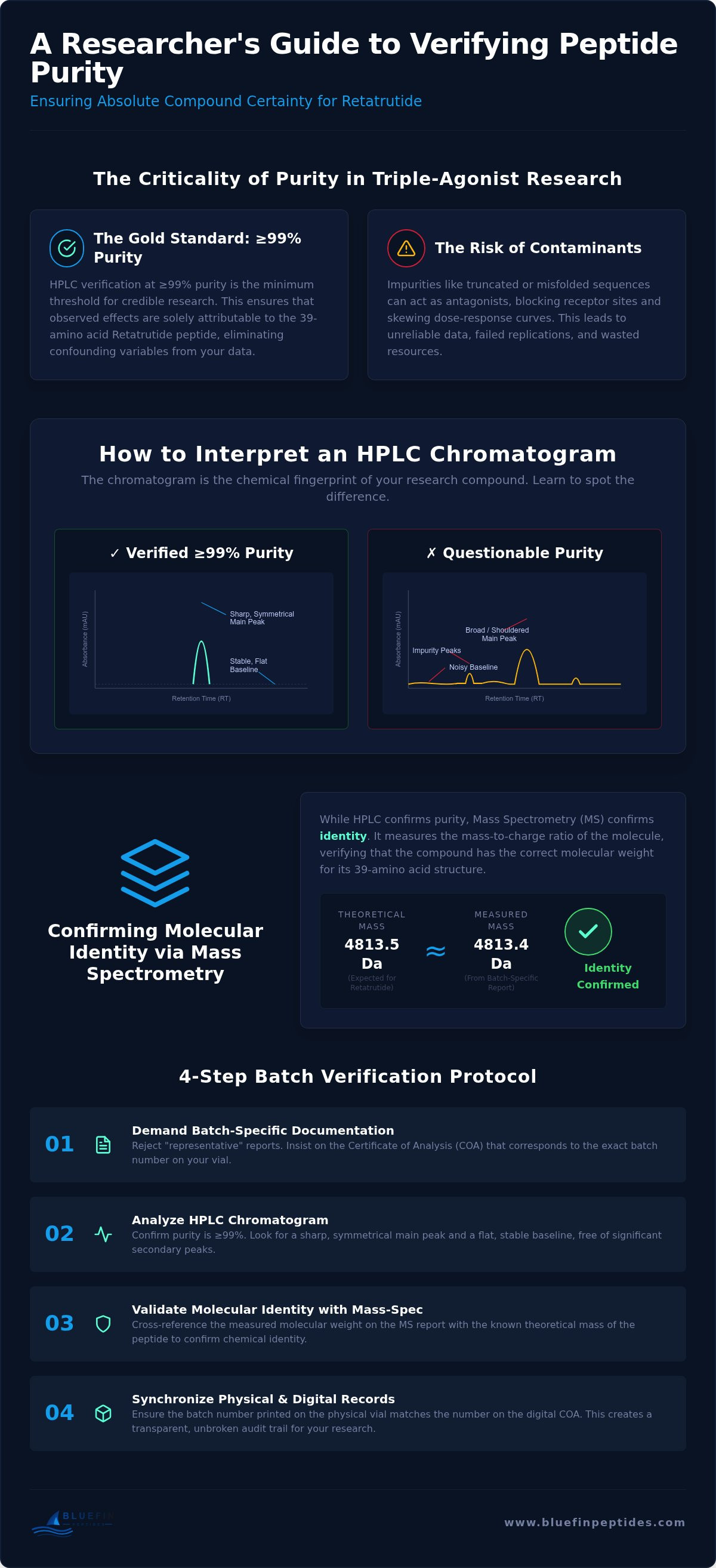
Precision is the baseline for any credible laboratory investigation. Retatrutide represents a significant leap in biochemical engineering; it's a complex 39-amino acid peptide that acts as a triple agonist. It target three distinct metabolic pathways: the glucagon-like peptide-1 (GLP-1), glucose-dependent insulinotropic polypeptide (GIP), and glucagon receptors. This multi-receptor engagement requires a high degree of structural fidelity. When a compound interacts with three different signaling systems, the margin for error disappears. Even a 1% impurity profile can lead to erratic signaling or cross-reactivity that compromises the entire dataset. In professional research, ensuring your material is retatrutide HPLC verified at the ≥99% threshold is the only way to guarantee that observed effects are solely attributable to the peptide itself.
The Risks of Sub-Standard Research Compounds
Compromised compounds introduce uncontrollable variables into cellular models. Synthesis errors often result in truncated sequences, where the 39-amino acid chain is incomplete or incorrectly folded. These fragments don't just fail to work; they can actively interfere with your results. These "ghost" peptides often act as partial antagonists at the receptor site. They occupy the binding pocket without initiating the intended biological cascade, effectively blocking the authentic peptide from its target. This leads to off-target effects and unreliable dose-response curves. The cost of using sub-standard material is rarely just the price of the vial. It's the thousands of dollars in lost reagents and weeks of abandoned labor when an experiment fails to replicate due to batch inconsistency.
Defining HPLC-Verified Retatrutide
High-Performance Liquid Chromatography (HPLC) is the industry's gold standard for determining chemical purity. It provides a quantitative breakdown of the compound's composition with academic-level accuracy. The mobile phase functions by transporting the dissolved peptide through a pressurized stationary phase, allowing for the precise separation of impurities based on differential molecular interactions. This process creates a visual peak on a chromatogram that represents the concentration of the target analyte. However, researchers must distinguish between "representative" reports and "batch-specific" data. A representative report is a marketing tool; a batch-specific report is an audit trail. Professional laboratory standards require confirming that the specific batch is retatrutide HPLC verified before beginning any protocol. Without this verification, the researcher is essentially navigating in the dark. Transparency in analytical data isn't optional; it's the anchor of scientific integrity.
How to Interpret a Retatrutide HPLC Chromatogram
Analytical precision requires moving past the final percentage to examine the raw data. The chromatogram serves as the chemical fingerprint of the batch. The X-axis tracks Retention Time (RT). It records the exact moment the analyte elutes from the column. The Y-axis measures Absorbance, typically in milli-Absorbance Units (mAU). This indicates the concentration of light-absorbing species at a specific wavelength, usually 214nm or 220nm for peptides. A reliable retatrutide HPLC verified report must show a stable relationship between these two variables.
Step 1: Locate the Main Peak
The primary peak represents the Retatrutide molecule itself. It should be sharp, narrow, and symmetrical. Symmetry indicates high molecular homogeneity. In a controlled chromatographic environment, the retention time for Retatrutide remains consistent across batches when using identical columns and mobile phases. Any deviation in this timing warrants investigation. Red flags include "shoulders," which are small bumps on the sides of the main peak. These indicate closely related substances or diastereomers that the mobile phase failed to fully resolve. Broad peaks are equally problematic. They often signal peptide degradation or poor synthesis techniques. Multiple tall peaks are a direct signal of a contaminated or entirely incorrect compound. For researchers who require absolute data integrity, reviewing a batch-specific COA ensures that the elution profile matches the expected standard for this 39-amino acid sequence.
Step 2: Evaluate the Baseline and Integration
The baseline should remain calm, a flat horizon that allows for the clear identification of trace contaminants. A "noisy" or drifting baseline is a major technical failure. It can mask small impurity peaks, which artificially inflates the final purity calculation. Examine the integration table at the bottom of the report. This table lists the Area Under the Curve (AUC) for every detected peak. Purity is the ratio of the main peak area to the total integrated area. You must verify that the software integrated all visible peaks. If the report claims 99% purity but the integration table ignores visible "noise" or secondary peaks, the data is compromised. Professional laboratory standards demand that every peak above the detection threshold is accounted for in the final percentage. This transparency is the only way to confirm a retatrutide HPLC verified status that survives a rigorous audit.
Beyond Purity: Confirming Molecular Identity via Mass Spectrometry
HPLC verifies that a sample is homogenous, but it doesn't distinguish between two different molecules that happen to share the same retention time under specific conditions. This is a critical distinction for high-stakes laboratory work. A sample could be 99% pure but contain an entirely different peptide sequence than intended. Mass Spectrometry (MS) resolves this ambiguity by measuring the mass-to-charge ratio of ionized particles. For a compound as complex as Retatrutide, MS is the definitive tool for identity validation. It detects residual solvents or high salt content that UV-based HPLC detection might bypass, ensuring the physical state of the offering is exactly as documented in the analytical specifications.
Reading the Mass-Spec (MS) Report
The spectrum displays several peaks representing different charge states of the peptide. You should look for the most prominent signal, often the [M+H]+ ion, which represents the parent molecule plus a single proton. You must compare this observed value against the theoretical specifications provided in the technical documentation. Retatrutide has a theoretical molecular weight of approximately 4731.33 Daltons. A variance of more than 1.0 Dalton (Da) in high-resolution MS reports indicates potential sequence errors or unintended modifications during the synthesis process. Precision at the atomic level is the only acceptable standard for validating molecular identity.
The Synergy of HPLC and MS
Relying on a single analytical method creates a vulnerability in your research protocol. A batch that is retatrutide HPLC verified only meets half of the requirement for a rigorous audit trail. The combination of HPLC for purity and MS for identity creates a unique chemical fingerprint for the batch. This dual-verification is non-negotiable for GLP-1 research peptides and related triple agonists because their structural complexity makes them prone to synthesis artifacts. When these two datasets align, you possess the empirical evidence needed to proceed with confidence. This methodical approach transforms a vendor claim into a verifiable scientific fact, providing the security required for peer-reviewed research.
A Step-by-Step Checklist for Verifying Your Research Batch
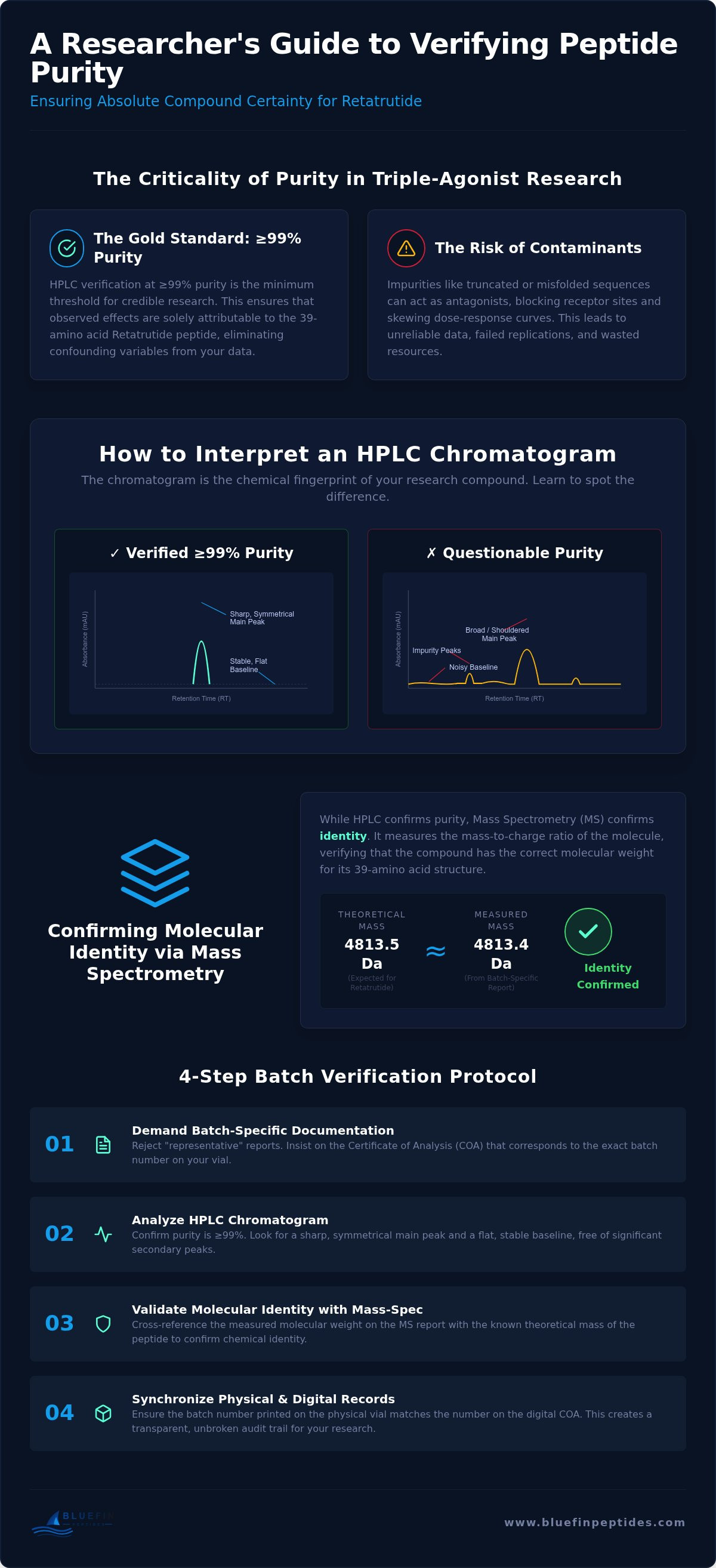
The moment of delivery is the final checkpoint in your procurement audit. You must verify that the physical material in your hands aligns perfectly with the data on your screen. The most basic, yet often overlooked, step is cross-referencing the batch number printed on the vial label with the batch ID listed on the analytical report. If these identifiers don't match, the retatrutide HPLC verified status is functionally void for your current study. You should also scrutinize the analysis date. Reports featuring "legacy" data from previous quarters are insufficient. Professional standards require contemporary testing to account for potential degradation or synthesis variations in the most recent production cycle.
Physical Inspection and Storage Audit
High-quality Retatrutide presents as a uniform, white, lyophilized "cake" or powder. Any signs of discoloration, "melting," or a collapsed cake structure suggest moisture ingress or thermal stress during transit. Vial integrity is paramount. A secure vacuum seal, often evidenced by a slight "hiss" of air upon the first needle insertion during reconstitution, confirms the environment remained anaerobic. Once received, adhering to strict lyophilized peptide storage protocols is necessary to anchor the compound's stability. US-based stocking provides a significant logistical advantage here. It minimizes the time the compound spends in uncontrolled shipping currents, where high temperatures can initiate peptide cleavage before the material even reaches your bench.
Documentary Audit
A valid report is more than a table of numbers. It's a legal and scientific testament. Every retatrutide HPLC verified document must display the testing laboratory's name, the specific date of the run, and a clear analyst signature. Look for security features such as digital watermarks or encrypted signatures that prevent unauthorized report tampering. If you have any doubt regarding the legitimacy of the data, you should contact the testing facility directly. Most reputable third-party labs maintain a database where you can verify a report's authenticity by providing the batch ID. This level of documentary rigor ensures that your audit trail remains unbroken and your results are defensible.
To maintain this level of precision in your laboratory, you can source verified research peptides that meet these exact analytical benchmarks.
Securing High-Purity Retatrutide for Laboratory Use
Securing high-purity material is the final step in establishing a robust experimental framework. Bluefin Peptides operates with a commitment to clinical precision that mirrors the standards of the laboratories we serve. We prioritize data-driven transparency over marketing claims. Every batch is retatrutide HPLC verified to meet or exceed a 99% purity threshold. This baseline ensures that your research is anchored in chemical stability and reproducibility. Our US-stocked inventory eliminates the degradation risks associated with prolonged international transit. This proximity preserves the integrity of the 39-amino acid sequence, preventing the thermal stress that often initiates peptide cleavage during global shipping currents.
The Bluefin Verification Standard
We provide a complete analytical dossier for every order. This includes batch-specific HPLC chromatograms and Mass-Spec identity confirmation as a standard requirement, not an optional request. We don't rely on representative data. By providing the exact mass-to-charge ratios and peak integration tables for your specific vial, we support research peptide quality standards that meet the demands of modern biochemistry. This methodology allows you to maintain a comprehensive audit trail for every study. It ensures that every peak in your chromatogram is accounted for and every molecular mass is confirmed before the first aliquot is drawn.
- Batch-specific HPLC chromatograms with full peak integration for quantitative purity.
- High-resolution Mass Spectrometry for absolute molecular identity validation.
- Physical state verification to ensure vial integrity and lyophilized stability.
Next Steps for Researchers
Adhering to the "Research Use Only" designation is a legal and scientific necessity. Bluefin Peptides focuses exclusively on laboratory-grade compounds for in vitro and in vivo modeling. This specialization ensures that our logistical and testing protocols are optimized for scientific rigor rather than retail commerce. Our offerings aren't intended for human or veterinary use. To procure material for your upcoming protocol, you can access our current inventory through our secure fulfillment system. For deeper analytical inquiries or specific batch documentation requests, our technical support team provides peer-level assistance. We offer direct-to-lab fulfillment within the United States. This provides a reliable conduit for researchers who require their retatrutide HPLC verified compounds to arrive with their chemical properties fully intact and ready for immediate reconstitution.
Advancing Research Through Analytical Rigor
The integrity of metabolic research rests entirely on the chemical fidelity of the underlying compounds. Mastering the interpretation of chromatograms and mass spectra allows you to eliminate the uncontrolled variables that compromise laboratory data. A retatrutide HPLC verified status represents more than a percentage; it's a commitment to ≥99% purity and absolute molecular identity. This analytical literacy ensures your study is anchored in verifiable facts rather than vendor assumptions. Bluefin Peptides facilitates this transparency by providing batch-specific documentation and Mass-Spec confirmation as a baseline standard. Our disciplined US-based logistical infrastructure ensures that these rigorous standards are maintained from the synthesis lab to your facility.
This methodical approach provides the security required for high-stakes protocols and peer-reviewed outcomes. Navigate your research with the certainty of high-resolution data that survives the most demanding technical audits. Your commitment to precision is the catalyst for the next breakthrough in metabolic science. To begin your next phase of investigation with absolute compound certainty, you can Procure HPLC-Verified Retatrutide for Laboratory Research and secure the batch-specific data your protocol demands.
Frequently Asked Questions
What does "HPLC verified" actually mean for Retatrutide?
It means the compound has undergone High-Performance Liquid Chromatography to quantify its purity profile. The process separates the target peptide from synthesis byproducts using a pressurized stationary phase. A retatrutide HPLC verified status indicates that the main peak area accounts for the stated percentage of the total integrated area on the chromatogram. This quantification is essential for establishing the precise concentration of the active analyte in your research protocol.
Why is 99% purity required for GLP-1 and GIP research?
High purity is necessary because Retatrutide is a triple agonist targeting three distinct receptor pathways simultaneously. Trace impurities can cause off-target effects or act as competitive antagonists at the GLP-1, GIP, or glucagon receptors. This interference compromises the dose-response curve and reduces the reproducibility of your data. Maintaining a ≥99% standard ensures that the biological responses observed are exclusively due to the target peptide sequence.
How can I tell if a Retatrutide COA is fake or reused?
You should inspect the document for digital tampering, such as inconsistent fonts or blurred watermarks. A legitimate Certificate of Analysis (COA) must include a unique batch ID that matches the label on your vial. Reused reports often feature "legacy" dates from previous months or years. You can also verify the report's authenticity by cross-referencing the results on the testing laboratory's official verification portal or by contacting the analyst directly.
Does Retatrutide require Mass Spectrometry in addition to HPLC?
Yes, Mass Spectrometry is vital for confirming molecular identity. While HPLC quantifies purity, it cannot definitively prove that the substance is Retatrutide. It only shows that the sample is homogenous. Mass Spectrometry measures the mass-to-charge ratio to ensure the 39-amino acid sequence is correct. A retatrutide HPLC verified sample must also have MS data to provide a complete analytical audit trail for laboratory use.
What should the molecular weight of Retatrutide be on a Mass-Spec report?
The theoretical molecular weight of Retatrutide is approximately 4731.33 Daltons (Da). On a Mass-Spec report, you should see a prominent peak representing the parent ion, often as [M+H]+ or in multi-charged states. High-resolution reports should show an observed mass within 1.0 Dalton of the theoretical value. Any significant deviation suggests synthesis errors, such as missing amino acids or unintended chemical modifications during the production cycle.
Can I verify the batch number directly with the testing lab?
Most reputable third-party laboratories allow researchers to verify batch numbers through their internal databases. You can typically enter the batch ID and the reported purity on the laboratory's website to confirm that the data matches their original records. This independent verification step is a standard practice for ensuring data integrity. It prevents the use of fabricated reports and anchors your procurement process in verifiable evidence.
How does the purity of Retatrutide affect its stability in storage?
Higher purity generally correlates with increased stability because there are fewer reactive synthesis byproducts present. Impurities like residual TFA or moisture can catalyze peptide degradation over time. A ≥99% pure compound is more resistant to cleavage when stored under proper lyophilized conditions. Maintaining high purity levels reduces the rate of primary sequence breakdown, ensuring that the compound remains viable for the entire duration of your storage protocol.
What are the most common impurities found in low-quality Retatrutide?
Common impurities include truncated sequences, where the amino acid chain is incomplete, and diastereomers formed during synthesis. Residual solvents and salts from the purification process can also remain if the material is poorly processed. These contaminants often appear as small "shoulders" or secondary peaks on an HPLC chromatogram. Identifying these fragments is crucial because they can interfere with receptor binding and skew the results of metabolic research models.
For laboratory research use only. Not for human or veterinary use. This content is educational and does not constitute medical, dosing, or usage guidance.
Browse the BLUEFIN catalog