GLP-1 Research Peptides: Technical Specifications and Analytical Standards
In the high-stakes environment of metabolic research, a 95% purity rating isn't a success; it's a failure. Precision. Verification. These aren't just goals; they're the bedrock of valid experimental outcomes. You recognize that batch-to-batch inconsistency in GLP-1 research peptides doesn't just stall a project. It contaminates the data stream. When your laboratory's integrity depends on the molecular stability of a lyophilized vial, the absence of transparent HPLC or mass-spec documentation is an unacceptable risk.
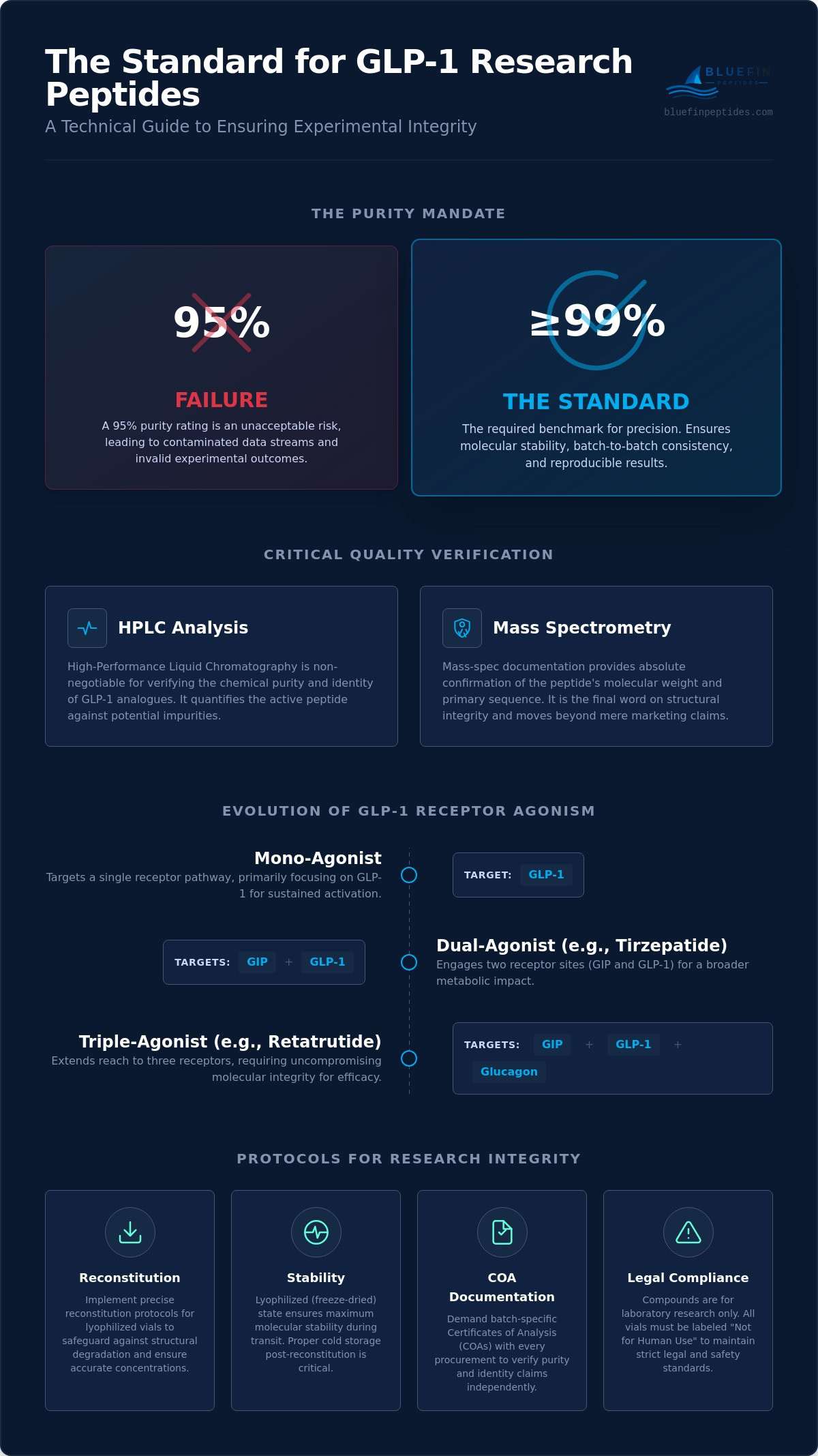
This technical guide serves as a manual for navigating the complex biochemistry and analytical standards of GLP-1 analogues. We'll outline the exact protocols for verifying ≥99% purity and securing batch-specific Certificates of Analysis (COAs) that move beyond mere marketing claims. You'll gain a deep understanding of the stability requirements for these sensitive compounds and the logistical precision that ensures fluid movement from synthesis to your cold storage. From structural analysis to storage optimization, we provide the data necessary to ensure your research remains anchored in absolute accuracy.
Key Takeaways
- Analyze the molecular docking mechanisms and signal transduction pathways, specifically cAMP and calcium mobilization, that govern receptor agonism.
- Verify the chemical identity and purity of your GLP-1 research peptides using high-level HPLC and Mass Spectrometry analytical standards.
- Implement precise reconstitution and storage protocols for lyophilized vials to safeguard against the risk of structural degradation.
- Navigate procurement with a focus on US-based inventory and rapid fulfillment to ensure the cold chain remains unbroken during transit.
Understanding GLP-1 Analogues in Modern Laboratory Research
Glucagon-Like Peptide-1 (GLP-1) is a potent incretin hormone analogue. In its native state, it's secreted by the L-cells of the distal ileum. It stimulates insulin secretion in a glucose-dependent manner. Modern laboratory research has moved beyond observing these fleeting endogenous signals. Scientists now utilize synthetic GLP-1 research peptides to achieve sustained receptor activation. These compounds are engineered to resist dipeptidyl peptidase-4 (DPP-4) degradation. This structural resilience allows for the rigorous study of metabolic signaling, gastric motility, and neuroprotection models. It allows researchers to probe the depths of cellular pathways with a level of control previously unattainable with native hormones.
Unlike clinical pharmaceuticals intended for patient administration, these materials are supplied as high-purity lyophilized powders. This physical state ensures molecular stability during transit and storage. It provides a blank canvas for researchers to establish precise concentrations for in vitro assays or non-clinical in vivo studies. This GLP-1 receptor agonist overview highlights the fundamental mechanisms that these research-grade analogues aim to replicate in controlled environments. By using stable, synthetic agonists, laboratories can bypass the volatility of endogenous peptides and focus on quantifiable data points.
The Evolution of GLP-1 Receptor Agonists (GLP-1RAs)
The trajectory of GLP-1 research has shifted from simple peptide replacement to complex multi-receptor agonism. Early models focused on extending the half-life of the GLP-1 molecule through specific amino acid substitutions. Current experimental currents favor dual and triple agonists. Tirzepatide functions as a dual GIP and GLP-1 receptor agonist. Retatrutide extends this reach as a triple agonist, targeting GIP, GLP-1, and glucagon receptors. This multi-receptor approach requires uncompromising molecular integrity. Even minor structural defects can alter binding affinity. Such inconsistencies jeopardize the reproducibility of data. Precision in synthesis is the only way to ensure results are anchored in reality. High-performance laboratory environments demand this level of technical rigor to maintain the momentum of discovery.
Research Scope and Legal Boundaries
The classification of these compounds is absolute. They are laboratory research chemicals. They're not human-grade pharmaceuticals. Every vial must be labeled "Not for Human Use" to maintain strict legal and safety compliance. These GLP-1 research peptides are intended exclusively for non-clinical applications. This includes in vitro cell culture experiments and established in vivo animal models. Researchers must adhere to these boundaries to ensure ethical standards and regulatory alignment. Sourcing through disciplined logistics specialists ensures that these high-purity compounds arrive with the necessary documentation, including batch-specific COAs, to support these rigorous research standards. Reliability in the "how" of procurement ensures the "what" of your experimental results remains valid.
The Biochemistry of GLP-1 Receptor Agonism
Molecular docking is a high-stakes event. For GLP-1 research peptides, this process involves the precise interaction between the peptide ligand and the extracellular domain of the GLP-1 receptor, a Class B G protein-coupled receptor (GPCR). The binding is absolute. It requires the N-terminal domain of the peptide to penetrate the transmembrane helical bundle with unwavering accuracy. This structural alignment is the primary determinant of binding kinetics. In mono-agonists, the focus remains on this singular pathway. In contrast, synergistic multi-agonists like Tirzepatide and Retatrutide utilize modified amino acid sequences to engage multiple receptor sites simultaneously. These engineered sequences allow for a broader metabolic impact, navigating the complex currents of GIP and glucagon receptor signaling alongside the primary GLP-1 pathway.
Signal transduction follows this initial docking. Once the ligand stabilizes the receptor's active conformation, it triggers the dissociation of heterotrimeric G proteins. This activation initiates the adenylate cyclase pathway, leading to a rapid increase in cyclic adenosine monophosphate (cAMP) levels. Understanding how GLP-1 receptor agonists work at this level is essential for interpreting downstream effects, such as intracellular calcium mobilization. These secondary messengers act as the engine for insulinotropic responses in cellular models. The precision of these signals depends entirely on the chemical nature of the agonist. Even a minor deviation in the peptide's primary sequence can dampen the cAMP response, leading to skewed experimental data.
Sequence Integrity and Binding Affinity
Analytical standards are the anchor of reliable research. Even minor impurities at the ≤1% level can significantly alter binding affinity and competitive inhibition assays. N-terminal modifications are frequently employed in GLP-1 research peptides to provide enzymatic resistance against DPP-4, extending the peptide's experimental half-life. Receptor agonism occurs when a peptide ligand stabilizes the active conformation of its cognate receptor, directly initiating the synthesis of cyclic AMP (cAMP) to propagate intracellular signaling. For researchers requiring absolute consistency, selecting HPLC-verified GLP-1 analogues ensures that the molecular docking observed in the lab reflects the intended chemical design.
Metabolic Signaling in Experimental Models
Incretin effect simulation is a cornerstone of modern metabolic research. By utilizing high-purity GLP-1 analogues, laboratories can replicate complex insulinotropic mechanisms in vitro. These models provide a window into glucagon suppression and the resulting modulation of hepatic glucose production. In animal models, researchers frequently observe slowed gastric emptying, a physiological response to sustained GLP-1 receptor activation. This delay in transit is a critical variable in pharmacokinetic studies. Maintaining structural integrity through proper storage is the only way to ensure these metabolic signals remain clear and reproducible across different experimental batches.
Critical Quality Metrics: HPLC and Mass Spectrometry Verification
In laboratory research, trust is a liability; verification is the only currency. High-stakes experiments involving GLP-1 research peptides demand an analytical rigour that transcends surface-level claims. Precision. Accuracy. Documentation. These aren't just preferences. They're the bedrock of experimental integrity. High-Performance Liquid Chromatography (HPLC) stands as the definitive measure of peptide purity. It functions by separating the sample components based on their specific chemical interactions with a stationary phase. A single, sharp peak on the resulting chromatogram indicates a high-purity product, while the area under this peak provides the quantifiable purity percentage.
Achieving ≥99% purity is the standard for reliable metabolic research. Even a 1% impurity level can introduce synthesis byproducts that interfere with the Molecular Mechanisms of GLP-1 Analogs, leading to aberrant signaling data or unexpected cellular responses. While HPLC measures purity, Mass Spectrometry (MS) confirms identity. It ensures that the synthesized sequence matches the intended molecular design. By measuring the mass-to-charge (m/z) ratio, MS validates the molecular weight of the peptide with deep-sea precision. Batch-specific Certificates of Analysis (COAs) are non-negotiable for researchers who refuse to leave their data to chance. These documents provide the raw chromatograms and mass spectra required to audit each specific vial before it enters the experimental workflow.
Interpreting HPLC Chromatograms
Analyzing an HPLC report requires a disciplined eye. The primary peak represents the target peptide, and the area under the curve (AUC) determines the final purity percentage. Secondary peaks, however small, indicate potential impurities, such as truncated sequences or residual solvents. HPLC analysis serves as a critical filter by ensuring the absence of synthesis byproducts like deprotected amino acid residues or racemic isomers. Identifying these anomalies early prevents the contamination of longitudinal studies. A clean chromatogram is the first sign of a stable, high-performance research compound.
Mass Spec Confirmation Protocols
Identity verification relies on comparing experimental mass-to-charge (m/z) ratios against theoretical values. Mass Spectrometry detects structural isoforms and subtle sequence errors that HPLC might overlook. This is particularly vital for complex multi-receptor agonists like Tirzepatide or Retatrutide, where the synthesis process involves intricate side-chain protections. MS confirms the success of these complex syntheses by providing a definitive molecular fingerprint. Without this confirmation, a researcher is navigating without a map. MS ensures the chemical identity of the GLP-1 research peptides is absolute, providing the security needed for high-impact laboratory work.

Stability and Reconstitution of Lyophilized Research Peptides
Lyophilization is the gold standard for preserving peptide structural integrity. This process, also known as freeze-drying, removes moisture through sublimation under a vacuum. It locks the peptide into a solid, stable matrix. For GLP-1 research peptides, this state is critical. It prevents the hydrolytic pathways that lead to premature degradation. Without this stabilization, delicate amino acid sequences succumb to chemical volatility long before reaching the laboratory bench. Maintaining this integrity requires a disciplined approach to storage and handling. It's a race against entropy that begins the moment synthesis is complete.
Degradation is a constant threat. Light exposure, moisture infiltration, and thermal fluctuations act as catalysts for molecular breakdown. Ultraviolet light can induce photolysis, while even trace amounts of humidity trigger deamidation or oxidation. These processes alter the peptide's primary structure, rendering experimental data useless. Precision in preservation is as vital as precision in synthesis. Researchers must treat each vial as a high-performance instrument, shielding it from environmental stressors to ensure the biochemical signals remain clear. Anchoring your experimental workflow in verified stability is the only way to ensure reproducible results.
Storage Guidelines for Lyophilized Vials
Short-term transit stability is often manageable at room temperature, but long-term reliability demands a deeper freeze. Vials should be stored at -20°C for periods up to several months. For multi-year preservation, -80°C is the required benchmark. Using desiccants within storage containers is a non-negotiable protocol. They act as a secondary barrier against moisture, preventing hydrolytic degradation. When handling multi-dose research vials, allow the container to reach room temperature before opening. This simple step prevents atmospheric condensation from contaminating the lyophilized powder and compromising the batch.
Post-Reconstitution Stability
The half-life of GLP-1 analogues drops significantly once they enter an aqueous solution. In this liquid state, the molecules are far more susceptible to aggregation and enzymatic breakdown. Immediate refrigeration post-reconstitution is mandatory to slow these kinetic processes. Mechanical stress is another critical factor. Don't shake the vial. Avoid aggressive agitation during the dissolution process. Instead, use a gentle swirling motion to encourage the powder to enter the solution. For laboratories requiring the highest standards of molecular integrity, sourcing HPLC-verified GLP-1 research peptides ensures that your starting material is free from the impurities that accelerate post-reconstitution decay.
Procuring High-Purity GLP-1 Research Compounds
Procurement is the final, critical hurdle in the research workflow. It's the point where theoretical planning meets physical reality. Sourcing GLP-1 research peptides from international vendors introduces variables that often compromise molecular stability. Long-haul transit involves unpredictable environments. Extended shipping times increase the risk of thermal degradation, especially for sensitive lyophilized powders. By maintaining a domestic US inventory, Bluefin Peptides eliminates these logistical vulnerabilities. This strategic stocking ensures that the compounds you receive haven't been subjected to the volatility of global shipping routes. It's a commitment to chemical integrity that begins long before a vial reaches your laboratory.
Reliability in sourcing requires more than just a product list. It demands a "show, don't tell" philosophy regarding quality. Researchers shouldn't have to guess the purity of their starting materials. Every batch of GLP-1 research peptides must be accompanied by comprehensive analytical documentation. This includes both HPLC and Mass-Spec reports. Accessing these documents is essential for maintaining academic-grade transparency. It allows for an independent audit of the chemical identity and purity level before any experimental work begins. In high-stakes laboratory environments, this level of verification isn't an optional feature. It's the only way to anchor your data in absolute accuracy.
Logistical Precision and Speed
Fulfillment is an exercise in disciplined coordination. Our maritime-inspired logistics model prioritizes fluid movement from order to delivery. Speed isn't just about efficiency. It's about maintaining the "cold chain" of research. Domestic stocking facilitates urgent precision, allowing for rapid fulfillment that bypasses the friction of international customs. Each shipment utilizes professional, secure packaging designed specifically for sensitive research vials. This protective barrier ensures that the structural integrity established during synthesis remains intact during transit. We act as a high-performance laboratory partner, focusing on the "how" of our processes to ensure the "what" of your results.
The Bluefin Catalog: Tirzepatide and Retatrutide
Our inventory is built on precision-engineered analogues. The Tirzepatide Research Peptide and Retatrutide Research Peptide offerings are ≥99% HPLC-verified. We provide batch-specific Certificates of Analysis for every research vial in our catalog. These reports confirm both molecular weight and chemical purity through rigorous Mass-Spec and HPLC protocols. This level of detail supports complex studies in metabolic signaling and neuroprotection. We prioritize academic-grade transparency because we understand that your research data is only as good as the peptides you use. By providing the tools for verification, we ensure your laboratory has the security needed for high-impact discovery.
Securing Analytical Integrity in Metabolic Research
The validity of experimental results depends on the chemical stability and analytical transparency of the compounds used. Precision in GLP-1 research peptides is the only way to avoid the noise of synthesis byproducts and the risk of structural degradation. You've seen how HPLC and Mass Spectrometry documentation serve as the definitive map for navigating molecular identity. Stability is not just a storage requirement; it's a logistical commitment that begins with domestic US inventory and rapid fulfillment to preserve the cold chain. Reliability is built on data, not marketing claims.
Every vial must function as a stable anchor for your data stream. By prioritizing ≥99% HPLC-verified purity and batch-specific COAs, you eliminate the variables that stall progress and compromise reproducibility. High-performance laboratory environments demand this level of technical rigor to ensure that findings are rooted in absolute chemical reality. Secure the high-performance tools your laboratory requires to maintain the momentum of discovery and ensure your results remain beyond reproach.
Procure HPLC-Verified GLP-1 Research Peptides featuring mass-spec confirmation and fast domestic US shipping.
Advance your research with the confidence of absolute chemical verification.
Frequently Asked Questions
What is the standard purity level for GLP-1 research peptides?
The technical benchmark for GLP-1 research peptides in high-performance laboratory environments is ≥99% purity. This stringent standard is required to minimize the presence of synthesis byproducts that can interfere with receptor binding assays or signal transduction studies. Lower purity levels introduce biochemical noise that compromises the reproducibility of experimental data and jeopardizes the validity of metabolic research.
Why is HPLC verification necessary for laboratory peptides?
High-Performance Liquid Chromatography (HPLC) serves as the definitive method for quantifying the purity of a peptide sample by separating the target molecule from impurities based on chemical affinity. This analytical process provides a clear chromatogram where the primary peak represents the intended compound. Without this verification, researchers risk utilizing contaminated materials that skew observations in metabolic signaling and cellular models.
How should lyophilized GLP-1 research vials be stored upon arrival?
Lyophilized vials must be stored in a temperature-controlled environment, ideally between -20°C and -80°C for long-term stability. Maintaining this deep-freeze state prevents hydrolytic degradation and deamidation of the peptide sequence. It's essential to use desiccants within the storage container to shield the powder from moisture infiltration. Always allow vials to reach room temperature before opening to avoid atmospheric condensation.
What is the difference between a research peptide and a clinical pharmaceutical?
Research peptides are intended exclusively for laboratory use in in vitro or non-clinical in vivo models and carry a strict "Not for Human Use" designation. Clinical pharmaceuticals are manufactured under different regulatory frameworks specifically for patient administration. Research compounds prioritize analytical purity and technical documentation over the specific delivery mechanisms and excipients found in retail medical products.
Can I access the Certificate of Analysis (COA) for my specific batch?
Yes. Bluefin Peptides provides batch-specific COAs for every shipment to ensure absolute transparency. These documents include the actual HPLC chromatograms and Mass Spectrometry reports required to verify the chemical identity and purity of the GLP-1 research peptides. This documentation allows laboratory professionals to audit their materials before initiating critical experimental protocols.
How long do GLP-1 analogues remain stable after reconstitution?
Stability drops significantly once a peptide enters an aqueous solution. Reconstituted GLP-1 analogues typically remain viable for a period of days to several weeks when kept under constant refrigeration at 2°C to 8°C. Mechanical stress and light exposure accelerate this decay. Researchers should only reconstitute the volume required for immediate experimental phases to ensure maximum molecular integrity is maintained.
Why is domestic US shipping important for peptide research?
Domestic fulfillment minimizes transit time and reduces the risk of thermal degradation during long-haul international shipping. It ensures the cold chain remains as secure as possible from synthesis to delivery. US-based inventory also bypasses the logistical friction and unpredictable delays associated with international customs. This speed facilitates urgent precision in laboratory procurement and maintains the momentum of active research projects.
What solvents are typically used for peptide reconstitution in a lab setting?
Common solvents include bacteriostatic water, sterile saline, or laboratory-grade buffers tailored to the specific requirements of the experimental model. The choice of solvent impacts the pH and ionic strength of the solution, which can influence peptide solubility and long-term stability. Researchers must select a medium that maintains the peptide's active conformation while remaining compatible with downstream assays or in vivo protocols.
For laboratory research use only. Not for human or veterinary use. This content is educational and does not constitute medical, dosing, or usage guidance.
Browse the BLUEFIN catalog