Understanding Peptide Mass Spectrometry Reports: A Researcher’s Guide

In the high-stakes landscape of peptide research, a Certificate of Analysis is not a guarantee. It's a raw data set that demands rigorous interrogation. You likely recognize the frustration of squinting at a chromatogram, attempting to discern whether a minor peak represents a critical impurity or harmless baseline noise. Using misidentified or low-purity compounds risks the entire trajectory of your study. Precision is the only acceptable standard when the integrity of your laboratory results is on the line.
This guide provides the analytical framework for understanding peptide mass spectrometry reports, ensuring you can verify batch integrity and confirm chemical identity with absolute precision. We'll navigate the technical nuances of correlating observed m/z values with theoretical mass, a process made more complex by the 2026 FDA draft guidances on peptide impurity thresholds. You'll learn to distinguish significant signals from the depths of electronic noise while establishing a standardized protocol for COA review. We'll also examine how 2026 hardware advancements, such as the Orbitrap Excedion, have redefined sensitivity limits for peptide analysis. By the end of this article, you'll possess the tools to transform ambiguous data into a definitive verification of purity.
Key Takeaways
- Decipher the mass-to-charge (m/z) ratio to confirm the molecular identity of synthetic research peptides with absolute certainty.
- Navigate the complex topography of a mass spectrum by identifying the critical relationship between the base peak and the molecular ion peak.
- Master understanding peptide mass spectrometry reports by calculating the delta between theoretical and observed mass within a strict ±1 Da tolerance.
- Detect red flags such as recycled data or mismatched HPLC chromatograms to ensure batch-specific integrity and research reliability.
- Establish a standardized protocol for reviewing Certificates of Analysis to maintain the rigid analytical standards required for reproducible results.
Fundamentals of Mass Spectrometry in Peptide Analysis
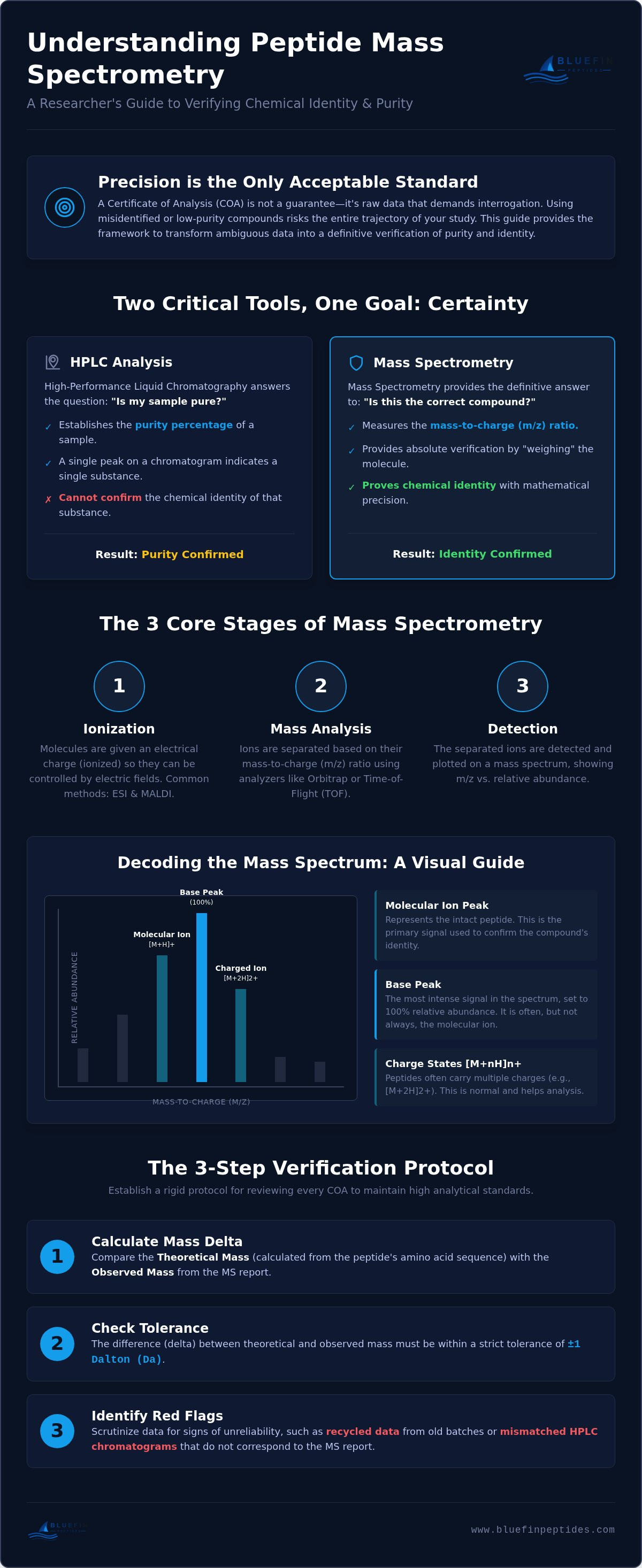
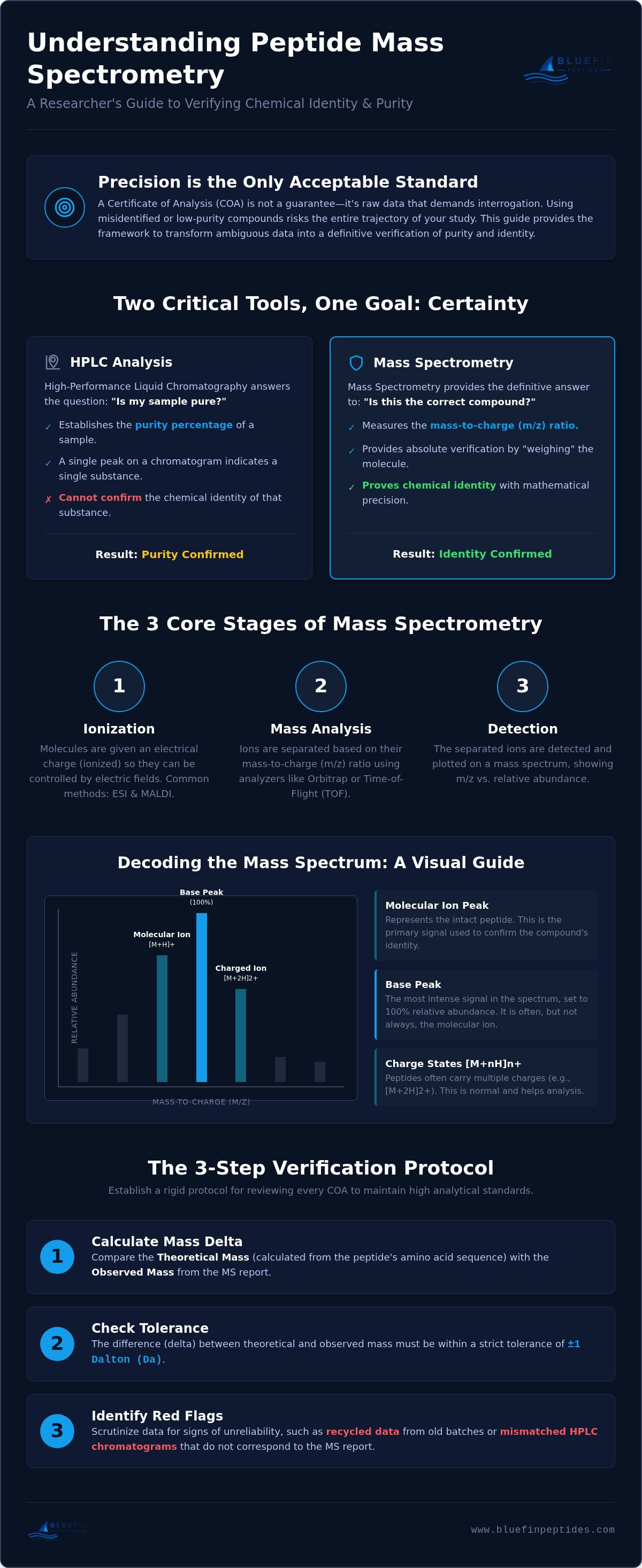
Mass spectrometry is the definitive analytical tool for measuring the mass-to-charge (m/z) ratio of ionized molecules. While High-Performance Liquid Chromatography (HPLC) establishes the purity of a sample, it cannot confirm chemical identity. A single peak on an HPLC chromatogram indicates a single substance; it doesn't prove that substance is the intended sequence. Mass spectrometry provides this missing link. By weighing the compound at the molecular level, researchers achieve absolute verification. Understanding peptide mass spectrometry reports requires a deep dive into these underlying mechanics to ensure batch integrity. Identity isn't assumed. It's mathematically proven.
The Fundamentals of Mass Spectrometry involve three core stages: ionization, mass analysis, and detection. In a professional laboratory, the transition from chemical synthesis to analytical verification is fluid and methodical. Every batch of lyophilized powder must undergo this gauntlet to eliminate the risk of misidentification or sequence errors. HPLC purity alone is insufficient. Without mass-spec confirmation, a 99% pure sample could theoretically be the wrong compound entirely. Precision demands both.
The Ionization Process: ESI vs. MALDI
Electrospray Ionization (ESI) is the standard for liquid chromatography-linked peptide analysis. It utilizes high voltage to create a fine aerosol, allowing for the soft ionization of peptides without significant fragmentation. This technique is particularly effective for verifying complex sequences like the retatrutide research peptide. In contrast, Matrix-Assisted Laser Desorption/Ionization (MALDI) is often reserved for larger biomolecules. ESI remains the preferred mechanism for high-performance laboratory verification because it allows for the analysis of multiple charge states, providing a more detailed molecular fingerprint.
Mass Analyzers: Orbitrap and Time-of-Flight (TOF)
Precision defines the mass analyzer. Orbitrap technology utilizes electrostatic fields to trap ions in orbital motion, offering unparalleled resolution for distinguishing between nearly identical mass differences. Time-of-Flight (TOF) analyzers measure the velocity of ions as they travel through a vacuum tube; lighter ions reach the detector faster. High-resolution mass spectrometry (HRMS) is a necessity in modern research. It allows for the resolution of isotopic distributions with clinical clarity. Understanding peptide mass spectrometry reports hinges on knowing which analyzer was used to generate the data. This choice dictates the precision of the observed m/z values and the overall reliability of the batch verification.
Navigating the Mass Spectrum: Peaks, Ions, and Ratios
A mass spectrum is a topographical map of molecular weight. The X-axis represents the mass-to-charge ratio (m/z), while the Y-axis denotes relative abundance. Understanding peptide mass spectrometry reports requires distinguishing between the base peak, which is the most intense signal in the spectrum, and the molecular ion peak. In many cases, these are not identical. The molecular ion peak represents the intact peptide, providing the primary evidence for identity. High-resolution data reveals the isotopic distribution, a rhythmic series of peaks caused by the natural occurrence of isotopes like Carbon-13. This pattern acts as a secondary verification of the elemental composition.
Peptides analyzed via Electrospray Ionization (ESI) frequently appear as multiply charged species. Protons attach to basic amino acid residues, resulting in ions such as [M+2H]2+ or [M+3H]3+. This phenomenon effectively shifts the observed signal into the optimal detection range of the mass analyzer. Successful analysis relies on a robust Peptide Identification Workflow to correlate these multiple signals back to a single theoretical mass. For researchers seeking absolute certainty, reviewing batch-specific analytical data is the only way to ensure the peptide sequence aligns with the intended design.
Interpreting Charge States and Deconvolution
Calculating the neutral molecular weight from a charged ion is a fundamental skill in data interpretation. The formula is straightforward: multiply the m/z value by the charge state (z) and subtract the mass of the added protons. Modern deconvolution software, such as the 2026 releases from major manufacturers, automates this process. It collapses complex, multi-charge spectra into a single, high-fidelity molecular mass. For standard research peptides, a clear charge state envelope is a hallmark of a clean, well-ionized sample. If the deconvolution fails to produce a sharp, singular mass, it's an immediate indicator of sample heterogeneity.
Noise vs. Signal: Distinguishing Impurities
Electronic and chemical noise are inevitable in the depths of a laboratory report. Establishing an acceptable baseline is critical for distinguishing significant impurities from stochastic fluctuations. Salt adducts are a common occurrence; sodium (+23 Da) or potassium (+39 Da) ions often bind to the peptide during ionization, creating secondary peaks that shift the observed mass. These aren't necessarily indicators of low purity but rather artifacts of the buffer environment. However, persistent peaks that don't correlate with known adducts or fragmentation patterns may signal the presence of truncated sequences or synthesis byproducts. Precision in interpretation ensures that noise never obscures the data.
Validating Identity through Theoretical vs. Observed Mass
Verification begins with a calculation. For any research compound, the theoretical molecular weight is derived from the sum of its amino acid residues, the N-terminal and C-terminal modifications, and any side-chain attachments. Understanding peptide mass spectrometry reports requires a direct comparison between this mathematical ideal and the empirical data captured by the mass analyzer. Batch-specific Certificates of Analysis (COAs) serve as the definitive link, anchoring the physical vial to its chemical identity through this alignment. Identity isn't a matter of trust; it's a matter of data matching.
Consider the tirzepatide research peptide as a case study in complexity. With its 39-amino acid sequence and C20 fatty acid diacid moiety, the margin for error is razor-thin. A single amino acid substitution or a missing side-chain modification shifts the mass significantly. Precision verification ensures the observed peak aligns with the theoretical mass of 4813.5 Da (monoisotopic), providing the security required for high-stakes laboratory environments. If the report doesn't show this alignment, the compound's integrity is unverified.
Monoisotopic Mass vs. Average Mass
Researchers must distinguish between monoisotopic and average mass to avoid interpretation errors. Monoisotopic mass is the sum of the masses of the most abundant isotopes for each element in the peptide. It's the standard for high-resolution mass spectrometry (HRMS) data generated by Orbitrap or TOF analyzers. Average mass, conversely, accounts for the weighted average of all natural isotopes. While useful in low-resolution systems, using average mass to verify high-resolution reports often leads to a discrepancy of several Daltons. Always prioritize the monoisotopic value when reviewing high-fidelity analytical documentation to ensure absolute precision.
Tolerance Levels and PPM Calculations
Mass accuracy is measured in parts per million (ppm), a metric that accounts for the relative deviation of the observed mass from the theoretical value. The formula is precise: [(Observed - Theoretical) / Theoretical] * 10^6. For modern research standards, a tolerance of ±10 ppm is the threshold for identity confirmation. A deviation exceeding this limit suggests a synthesis error, such as a missed coupling or an uncleaved protecting group. Understanding peptide mass spectrometry reports involves calculating this delta to ensure the compound's integrity hasn't drifted from its intended chemical state. If the ppm error is high, the batch integrity is compromised.
Identifying Discrepancies and Red Flags in MS Reports
Trust is not a laboratory standard. Verification is. Understanding peptide mass spectrometry reports requires navigating the data with a skeptical eye that looks beyond the prominent molecular ion peak. A common red flag in the research chemical market is the use of recycled reports. If the date stamp is several months old or the batch number is conspicuously absent, the report is likely a generic template rather than a batch-specific verification. A complete report must include instrument parameters, such as the ionization source and detector settings, to allow for independent replication. Without this metadata, the data exists in a vacuum. It lacks the anchor of traceability.
Inconsistencies between HPLC chromatograms and MS spectra are equally concerning. If the HPLC report claims 99% purity but the mass spectrum reveals multiple high-intensity signals outside the isotopic envelope, the batch integrity is compromised. These unexplained peaks aren't noise. They're contaminants. In high-stakes research, the stoic necessity of third-party verification cannot be overstated. Relying solely on vendor-provided data without a rigorous internal review is a gamble that risks the entire trajectory of your study. For researchers who demand absolute transparency, sourcing HPLC-verified research peptides ensures that every data point is anchored in batch-specific reality.
Spectral Clipping and Manipulation
Digital manipulation is a sophisticated threat to data integrity. Researchers should inspect the baseline of the mass spectrum for spectral clipping, where impurity peaks are digitally removed to create the illusion of a cleaner sample. Signs of axis manipulation, such as a truncated Y-axis, are often used to hide low-intensity contaminants that would otherwise indicate poor synthesis quality. Raw data availability is the only defense against these practices. If a laboratory partner refuses to provide high-resolution raw files for sensitive studies, the transparency of their process is in question. Hidden peaks represent hidden risks.
Batch Number Mismatch
The batch ID is the primary link in the chain of custody. This number must perfectly align across the MS report, the HPLC chromatogram, and the physical vial label. Any discrepancy, however minor, renders the documentation invalid. Batch-specific COAs are the only currency of trust. They prove that the specific powder you've received has undergone the exact gauntlet of testing described. If the batch numbers don't match, the compound's identity is unverified. Always request updated, batch-level documentation to ensure your research is built on a foundation of precision. Consistency is the hallmark of a professional laboratory partner.
Bluefin Peptides: Precision Verification and Batch Integrity
Bluefin Peptides operates as a high-performance laboratory partner rather than a simple retail vendor. We prioritize transparency over marketing fluff. Our commitment to quality is rooted in a "show, don't tell" philosophy regarding analytical data. Every batch of lyophilized powder undergoes a rigorous gauntlet of testing before it enters our inventory. Understanding peptide mass spectrometry reports is the foundation of this verification process. We don't ask for blind trust. We provide the raw data required for absolute certainty. Our methodology is exacting. We utilize high-resolution mass spectrometry to confirm the identity of every single batch. This ensures that the chemical structure you receive is exactly what your research requires.
The Anatomy of a Bluefin COA
Our Certificates of Analysis (COAs) are designed for clinical clarity. They aren't generic templates. Every report is batch-specific. We include the HPLC chromatogram to establish ≥99% purity standards. We anchor this with mass-spec confirmation to verify molecular identity with absolute precision. The aquatic precision of our maritime-inspired quality control ensures that no contaminant drifts into the final product. Every peak is accounted for. Every m/z ratio is verified against the theoretical mass within strict tolerance levels. We present this data in a rhythmic, organized flow to allow for efficient navigation by the researcher. This level of detail is the only way to establish a baseline of security and trust in a high-stakes laboratory environment.
Procurement for Qualified Researchers
We maintain a disciplined focus on the needs of the scientific community. Our offerings, including the ipamorelin CJC-1295 research blend USA, are manufactured to the highest research peptide quality standards. We adhere to strict laboratory-only protocols. These compounds are exclusively for qualified researchers. They aren't for human, veterinary, or consumer use. Our logistics are optimized for speed without sacrificing analytical depth. We stock and ship from the United States to ensure rapid fulfillment for urgent research timelines. This creates a rhythm of urgent precision. We move quickly to support your work, but we never cut corners on the underlying data. Understanding peptide mass spectrometry reports remains the cornerstone of our batch-level verification. Stoic reliability defines our fulfillment process.
Securing Research Integrity Through Analytical Rigor
Analytical rigor is the only barrier against the risks of misidentified compounds and compromised data. Understanding peptide mass spectrometry reports allows you to navigate the complexities of m/z ratios and isotopic distributions with clinical certainty. By correlating observed peaks with theoretical molecular weights, you establish a mathematically proven baseline for your study. Identity is never assumed; it's verified through the raw data of a batch-specific COA. Vigilance remains essential to detect spectral manipulation or recycled documentation that could jeopardize your findings. You must demand transparency to anchor your research in verifiable truth.
Maintaining this standard of precision ensures that your laboratory results remain reproducible and untainted by synthesis impurities. Bluefin Peptides provides the infrastructure for this level of verification. We deliver ≥99% purity verified by HPLC and mass-spec confirmation on every batch to ensure absolute integrity. Our domestic US shipping facilitates rapid laboratory supply, allowing you to move with momentum while maintaining a methodical approach to quality. We invite you to Procure HPLC-Verified Research Peptides with Batch COAs and advance your work with the security of professional-grade analytical support. Your pursuit of precision starts with the data.
Frequently Asked Questions
What is the difference between HPLC and mass spectrometry in peptide testing?
HPLC quantifies the purity of a sample by separating its components, while mass spectrometry confirms the molecular identity by measuring mass. Purity is a measure of how much target substance is present, whereas MS identifies what that substance is. A single peak on an HPLC chromatogram indicates a pure substance, but mass spectrometry is required to prove that peak is the intended peptide sequence.
How do I calculate the theoretical mass of a peptide for comparison?
Theoretical mass is calculated by summing the monoisotopic masses of each amino acid residue and adding a water molecule for the termini. Any N-terminal or C-terminal modifications, such as acetylation or amidation, must also be included. Understanding peptide mass spectrometry reports requires this mathematical baseline to verify that the observed m/z values align with the intended chemical structure and batch-specific documentation.
What does m/z mean on a mass spectrometry report?
The m/z ratio represents the mass of an ion divided by its charge number. Since mass spectrometers measure ions rather than neutral molecules, the detector records where these charged particles land on the spectrum. In peptide analysis, ions are typically formed by adding protons (H+), meaning a peptide with a mass of 1000 Da and two protons will appear at an m/z of 500.5.
Why do I see multiple peaks on my peptide mass spectrometry report?
Multiple peaks often represent the rhythmic isotopic distribution of the peptide or various charge states. High-resolution instruments reveal the natural occurrence of isotopes, creating a series of peaks that act as a molecular fingerprint. Additionally, the depths of a report may show salt adducts or fragmented ions. If these signals don't align with known chemical patterns, they represent impurities that have drifted into the batch, requiring rigorous interrogation.
How much mass deviation is acceptable in a research peptide COA?
Acceptable mass error in a professional Certificate of Analysis (COA) is typically within ±1 Da for low-resolution systems or ±10 ppm for high-resolution analyzers. This strict tolerance ensures the compound's elemental composition matches the theoretical model. Deviations beyond this threshold suggest a significant synthesis error, such as a missing amino acid or an incomplete side-chain modification, which compromises the integrity and precision of the research batch.
Can mass spectrometry determine the purity of a peptide?
Mass spectrometry is primarily a qualitative tool for identity verification rather than a quantitative tool for purity. While MS can detect specific impurities, it doesn't provide a percentage-based purity value. HPLC is the industry standard for determining that a compound meets ≥99% purity requirements. A comprehensive understanding peptide mass spectrometry reports involves using MS to confirm identity while relying on HPLC data to establish the concentration of the target molecule.
What is a monoisotopic peak and why is it important?
The monoisotopic peak represents the ion composed of the most abundant isotopes, such as Carbon-12 and Nitrogen-14. It's the first and usually most intense peak in an isotopic cluster for small to medium peptides. This peak is critical because it provides the most precise mass measurement for high-resolution analysis. Using the monoisotopic mass instead of the average mass avoids the smearing effect caused by heavier, less frequent isotopes.
What should I do if the observed mass does not match the theoretical mass?
When the observed mass deviates from the theoretical ideal, you must first account for potential ion adducts or protonation states. Re-calculate the sequence mass with maritime precision, ensuring every side-chain modification is included. If the delta remains outside the ±10 ppm tolerance, the compound's identity is unverified. In professional laboratory settings, such a mismatch is a critical red flag that necessitates rejecting the batch to protect the integrity of your findings.
For laboratory research use only. Not for human or veterinary use. This content is educational and does not constitute medical, dosing, or usage guidance.
Browse the BLUEFIN catalog