Tracking peptide batches for GLP: Dates and potency
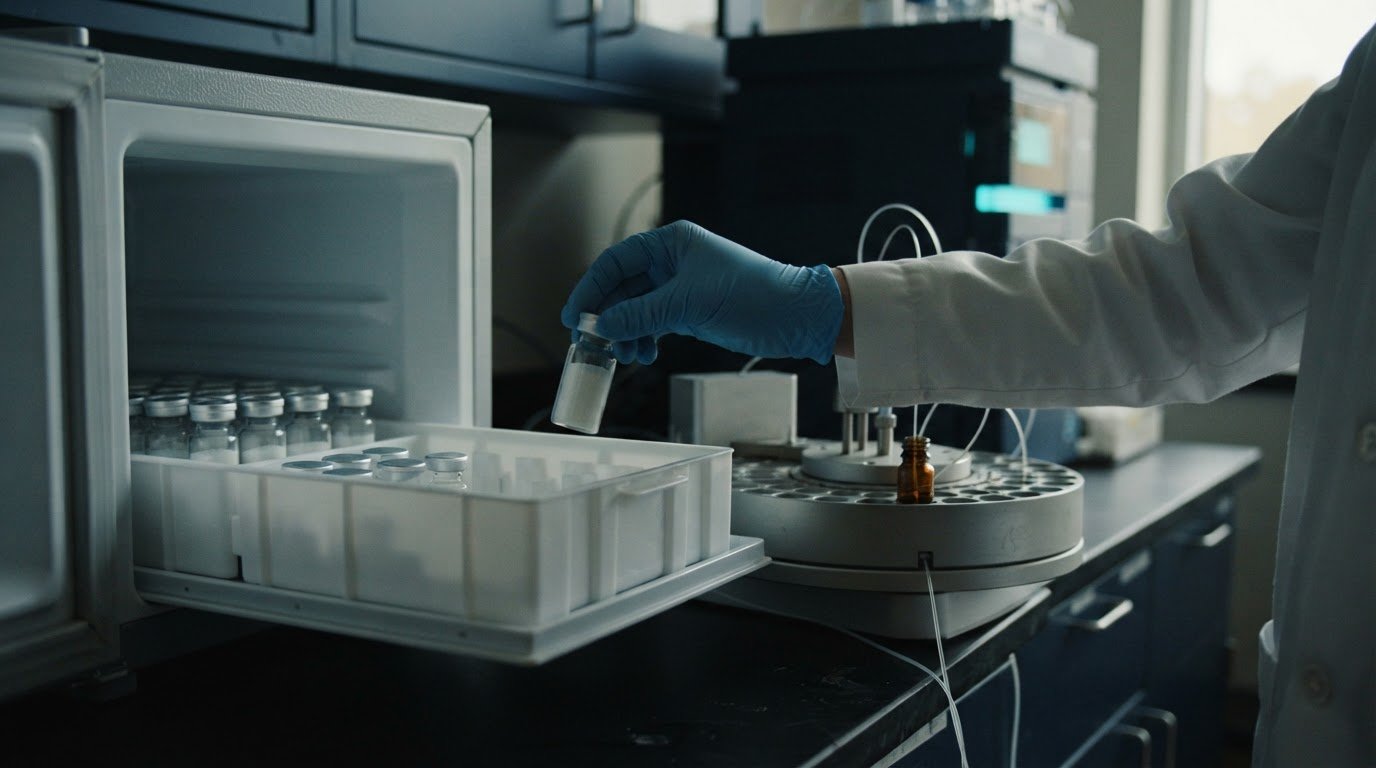
A date on a vial alone does not show whether a GLP peptide retains its intended potency. For laboratories tracking peptide batches for GLP work, useful records link each batch identifier to its certificate of analysis, dated storage and handling history, and a discard date supported by stability information. No single discard interval applies to every peptide or storage condition.
Batch identity and potency answer different questions. Identity records which material is under review; potency results show what testing found at a particular time. Read these records together, and do not treat a labeled date as a substitute for documented evidence.
This article covers the key fields in a batch record, how degradation can affect peptide quality, and what potency drift means when comparing results over time. It also explains how discard dates relate to stability data, helping your tracking process support clear, defensible laboratory decisions.
Key Takeaways
- Connect batch identifiers, handling records, and discard dates so each material’s history is traceable.
- Read a certificate of analysis for evidence of identity and purity, while recognizing that potency can change over time.
- Understand how applicable FDA and cGMP expectations shape documentation and control in regulated settings.
- Map records across raw materials, processing, storage, and distribution to support lot genealogy.
- Choose tracking systems that preserve batch relationships and make records accessible for review.
Batch documentation and defined discard dates
Reliable peptide records connect batch identity, analytical results, storage history, and a justified discard date. For GLP research, tracking peptide batches means treating these details as a linked history, not as isolated labels.
Requirements and Recordkeeping
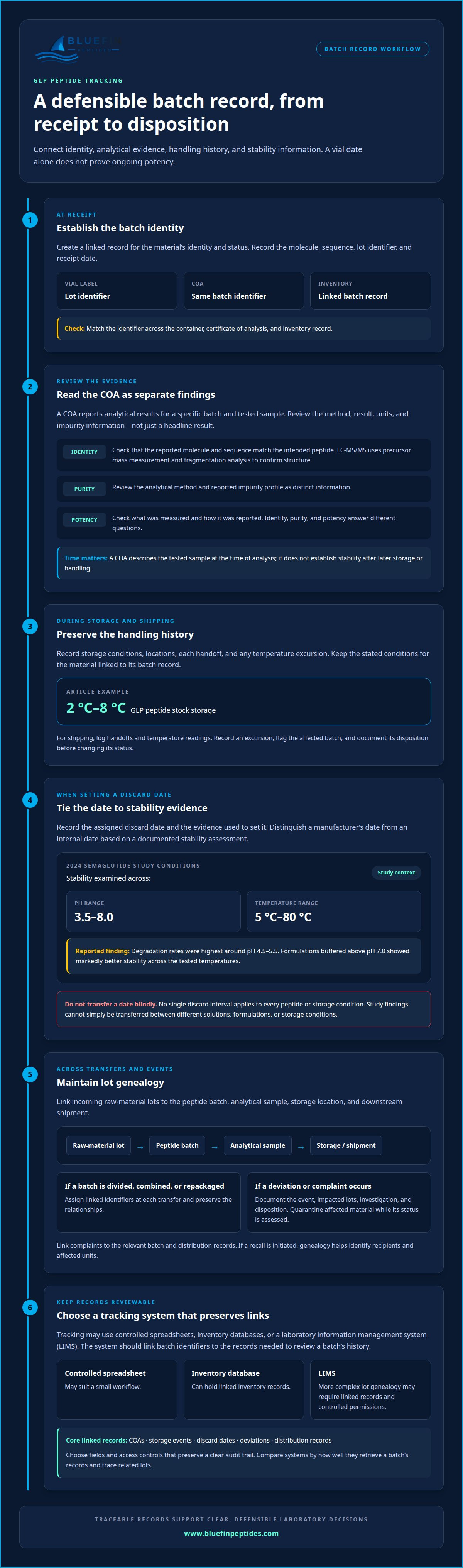
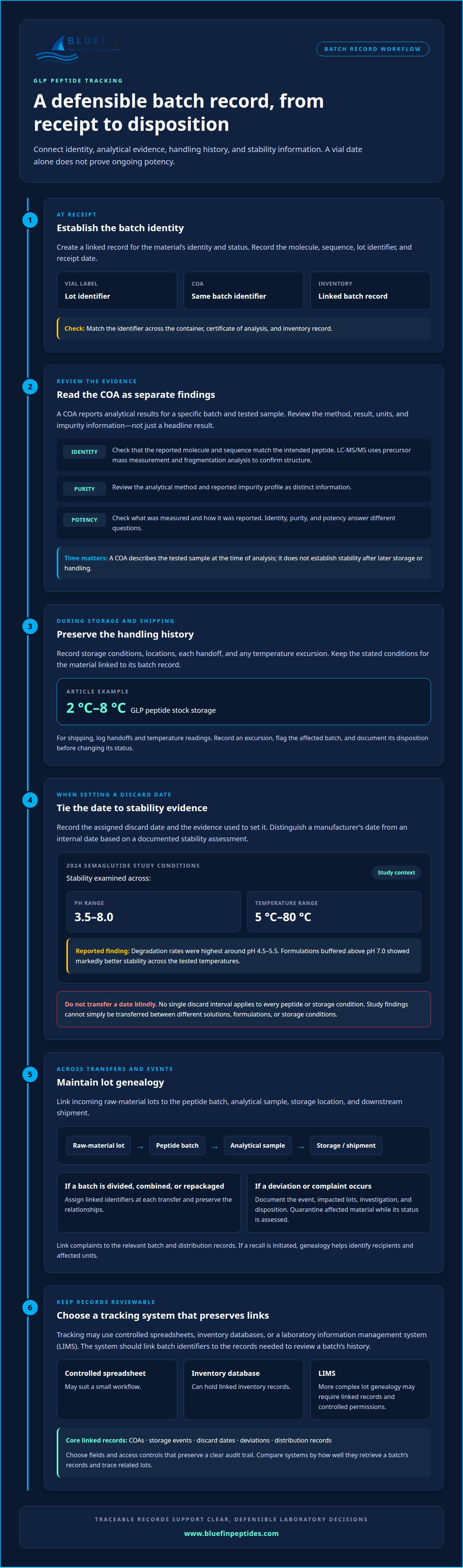
A batch record documents a material’s identity, processing, testing, storage, and status. A discard date only has meaning alongside the stability conditions and evidence used to set it. Record the molecule, sequence, lot identifier, receipt date, test results, storage conditions, and any assigned discard date. Distinguish a manufacturer’s date from an internal date based on a documented stability assessment.
Storage and shipping records should capture each handoff, the conditions stated for the material, and any temperature excursion. GLP peptide stocks were stored at 2 °C-8 °C, while a 2024 semaglutide study examined stability across pH 3.5-8.0 and temperatures from 5°C to 80°C. Those findings show why discard dates cannot be transferred between different solutions, formulations, or storage conditions. A common mistake is treating a label date as proof of ongoing potency.
Certificates and Batch Verification
A certificate of analysis (COA) records analytical results for a specific batch, supporting checks of identity and purity. Before relying on it, match its batch identifier to the container and inventory record. LC-MS/MS peptide sequencing uses precursor mass measurement and fragmentation analysis to confirm structure; it can also identify oxidation, deamidation, and other modifications. This distinguishes sequence identity from a potency measurement.
Review the test method, reported result, units, and impurity information as separate data points. A COA describes the tested sample at the time of analysis; it does not establish stability after later handling. Potency drift can therefore matter even when the sequence remains consistent. For example, semaglutide’s degradation rates were highest around pH 4.5-5.5 in the 2024 preformulation study, while formulations buffered above pH 7.0 showed markedly better stability across tested temperatures.
Lot Genealogy and Traceability
Lot genealogy links incoming raw-material lots to the peptide batch, analytical sample, storage location, and downstream shipment. This map matters when a result, complaint, or temperature excursion affects only part of the inventory. Assign linked identifiers at each transfer, then preserve the relationship when a batch is divided, combined, or repackaged. A broken link can make affected material difficult to isolate.
For a deviation, document the event, impacted lots, investigation, and disposition; quarantine affected material while its status is assessed. Link complaints to the relevant batch and distribution records. If a recall is initiated, genealogy helps identify recipients and affected units. A practical risk is releasing a lot before resolving a record discrepancy or excursion, or failing to link a complaint to its originating batch.
Tracking Systems and Costs
Batch tracking can use controlled spreadsheets, inventory databases, or a laboratory information management system (LIMS). Each system should link batch identifiers to COAs, storage events, discard dates, deviations, and distribution records. Choose fields and access controls that preserve a clear audit trail. A spreadsheet may suit a small workflow; more complex lot genealogy may require linked records and controlled permissions.
How much do peptide batch-tracking and LIMS systems cost? Cost depends on the software, implementation scope, integrations, and ongoing support, so there is no single defensible price for every laboratory. Compare systems by how well they retrieve a batch’s records and trace related lots. For shipping, log handoffs and temperature readings. Record any excursion, flag the affected batch, and document its disposition before changing its status.
How can peptide batch identity and purity be verified with certificates of analysis?
A certificate of analysis (COA) is a batch-specific record of analytical tests and results. Use it to compare the material’s stated identity with the container label and the laboratory’s sequence expectations. A COA supports verification, but does not establish that a sample remains unchanged after storage or handling. Treat identity, purity, and potency as related but distinct findings.
Start with the lot identifier. It should match across the COA, vial label, and inventory record. Then review the test method, result, units, and acceptance criteria shown on the document. LC-MS/MS uses precursor mass measurement and fragmentation analysis to confirm peptide structure. Comparing experimental fragmentation with predicted patterns and reviewing replicate analyses can help reveal inconsistencies in sequencing results.
- Identity: Confirm the reported molecule and sequence match the intended peptide.
- Purity: Review the analytical method and reported impurity profile, not just a headline percentage.
- Potency or content: Check what was measured, how it was reported, and whether it refers to the tested batch.
- Traceability: Match the batch identifier and testing date to associated inventory records.
These checks answer different questions. Mass spectrometry supports structural identity, while chromatographic analysis can separate a main peak from detectable impurities. Neither result alone proves that every vial has identical composition or that potency remains constant over time. For example, interpret a semaglutide COA in light of the tested batch and stated methods, rather than treating it as a universal property of all semaglutide material.
Impurity findings can reveal chemical changes that affect interpretation. GLP-1 peptide sequencing can identify oxidation, deamidation, and other modifications. Methionine or tryptophan oxidation adds 16 Da, a mass shift that can help flag an oxidized species during analysis. FDA presentation material has highlighted impurity analysis for synthetic peptides. Review whether the COA reports relevant impurities and whether the method can distinguish them from the principal peptide.
For a defensible record, preserve the original COA alongside the batch record, then log any independent analytical results under the same lot identifier. If a result conflicts with the stated sequence or purity profile, segregate that sample from routine use until the discrepancy is evaluated and documented. Laboratories assessing GLP-related materials can compare available research peptide specifications with their analytical requirements before selecting material.
What are the FDA and cGMP requirements for tracking peptide batches in the United States?
FDA and cGMP expectations depend on a peptide’s regulatory context and intended use. Laboratories should distinguish research documentation from records supporting regulated pharmaceutical manufacturing. That distinction shapes which controls apply and what each batch record must demonstrate. In either setting, clear identifiers and dated records help connect material, testing, and disposition.
For regulated operations, batch records should make decisions reconstructable. Record the material identity, manufacturing or receipt details, analytical results, deviations, and final status. Link each entry to its source document and responsible review. If a temperature excursion occurs, document the event, affected lot, assessment, and disposition. These records help establish whether a batch was released, held, or rejected, and why.
FDA guidance on highly purified synthetic peptides addresses impurity characterization in proposed generics. According to FDA guidance, a new impurity above 0.5 percent in a proposed generic is not acceptable. Impurities between 0.10 percent and 0.5 percent must be identified, characterized, and justified. These thresholds concern proposed generics; they should not be presented as universal acceptance limits for every research peptide or laboratory.
That scope matters. The impurity profile of a GLP-1 peptide may include modifications such as oxidation or deamidation, but a tracking system does not determine whether a specific result meets an applicable standard. It preserves the evidence and review trail. Record the analytical method, reported result, and batch link, then retain the rationale for any quality decision alongside the result.
USP <1032>, USP <1033>, and USP <1105> are listed among standards relevant to GLP-1 peptide analysis. Their relevance is analytical, not a standalone substitute for determining which regulatory obligations govern a particular activity. A record should identify the method used and connect its data to the correct material. This prevents results from one lot being mistaken for another.
In cGMP-controlled work, written procedures and contemporaneous records support consistent execution. A deviation record should identify what happened, when it happened, the affected batch, investigation findings, and documented disposition. Link complaint or recall records to lot genealogy and distribution details. Keep quarantine status visible until authorized review resolves the issue. These controls make the batch history reviewable rather than dependent on memory.
For research-use materials, do not confuse a COA or internal tracking log with evidence of pharmaceutical approval or cGMP compliance. The relevant framework depends on the activity and product status. Keep claims precise: document what was tested, which procedure governed the work, and how the batch was handled. This separation supports accurate oversight without extending requirements beyond their scope.
How should peptide batch records support traceability from raw materials through distribution?
Traceability links each incoming material to the peptide batch, analytical results, storage history, and final shipment. A complete record lets a laboratory follow the chain in either direction, from a vial back to its source lots or from a raw material forward to every affected shipment.
At receipt, record the material name, supplier lot identifier, receipt date, container identity, and accompanying certificate of analysis (COA). Link any incoming test results to that same identifier. If a GLP-1 peptide uses multiple raw materials, preserve each source-lot relationship in the manufacturing record. This creates the starting point for lot genealogy rather than relying on a standalone batch label.
During processing, connect the internal batch identifier to the raw-material lots used and each documented operation. Record sampling points, analytical results, processing dates, and any deviation against the batch involved. If a batch is divided into smaller containers, assign child identifiers that retain the parent-batch link. If material is combined, record every contributing lot and the resulting batch relationship.
- Raw materials: Link supplier identifiers, receipt records, and COAs to the internal batch.
- Processing: Attach operation records, samples, results, and deviations to that batch.
- Storage: Record location changes, status, and any temperature excursion against the affected identifier.
- Distribution: Connect shipment records and recipients to the exact batch or child lot dispatched.
Storage records should show where each container is located and when its status changes. For example, record a move from controlled storage to a staging area against the container’s identifier. If a temperature excursion occurs, identify the affected containers, preserve the event details, and document the resulting disposition. Do not overwrite earlier entries; retain a clear history of changes.
Distribution closes the chain. Link each shipment record to the batch identifier, quantity dispatched, destination, and shipping documentation. If a complaint later concerns a particular shipment, this connection helps identify related units and the upstream batch history. Likewise, a batch investigation can use distribution links to locate all recorded recipients.
For a deviation, complaint, quarantine, or recall, preserve batch links while recording the event, investigation, affected material, and disposition. Test traceability by starting with a shipment and retrieving its batch, test records, and raw-material sources. Then start with a source lot and follow its descendants through processing and distribution. Missing links, duplicated identifiers, or unrecorded splits can break that path.
Use controlled fields and consistent identifiers across paper records, spreadsheets, or a laboratory information management system. Keep the COA, analytical data, handling history, and shipment record connected, even when stored separately. This structure makes batch genealogy searchable and keeps the evidence aligned from receipt through distribution.
What systems or software are used to track peptide batches and lot genealogy
Peptide laboratories can track batches with controlled spreadsheets, databases, laboratory information management systems (LIMS), or manufacturing software. The right fit depends on workflow complexity, record volume, and how often lots are split or combined. A spreadsheet may organize a small inventory, while connected systems can link laboratory, production, and distribution records. Whichever you choose, make each batch’s history searchable and preserve its relationship to related lots.
A controlled spreadsheet can work for a limited workflow when users apply consistent identifiers and restrict editing. Separate tabs can record inventory, test results, storage events, and shipment references. The main weakness is fragmented information: a copied lot number or overwritten cell can disconnect records. Use validation rules, version history, and a named record owner to reduce errors. Define a process for corrections and review, too.
A relational database stores linked records in structured tables. For example, one batch entry can connect to raw-material lots, analytical results, containers, and shipments without duplicating every detail. A LIMS adds laboratory-focused workflows, such as sample registration, test assignment, and result association. An electronic laboratory notebook can preserve experimental context, while manufacturing execution or enterprise resource planning software may connect production and inventory operations.
- Spreadsheet: Track a compact inventory with controlled fields and version history.
- Database: Link records when batches have multiple inputs, splits, or descendants.
- LIMS: Associate samples, analytical work, and results with batch identifiers.
- Integrated platform: Connect laboratory records with production, inventory, or distribution workflows.
Before selecting software, map the records users need to retrieve. Test a forward search from a raw-material lot to resulting batches and shipments. Then test the reverse path from a shipment to its batch, sample results, and source records. Include a split-batch example, since child containers should remain linked to their parent. These searches reveal gaps more clearly than a feature list alone.
Access controls and change history matter in every system. Assign permissions by role, retain previous values when records change, and capture the reason for corrections. For example, a temperature excursion entry should remain linked to affected inventory and its review status. Define how users handle duplicate identifiers, missing fields, and system outages before they disrupt routine work.
Choose software in proportion to actual workflow needs. A complex platform can add setup and maintenance demands; a basic tool can become difficult to govern as linked records multiply. Document the chosen system’s purpose, identifier conventions, backup process, and record-retention approach. Then train users with scenarios involving a sample, a batch split, and a shipment.
For laboratory work involving research peptides, review research peptide options alongside the tracking fields your workflow requires.
Bluefin Peptides: Retatrutide Research Peptide
Bluefin Peptides offers Retatrutide Research Peptide for laboratory research workflows that require documented material and batch-level review. Its peptides are ≥99% HPLC-verified, with mass-spec confirmation and batch certificates of analysis (COAs). These records can support your own lot-tracking process, while your laboratory remains responsible for maintaining its storage, handling, and testing history.
Before incorporating a batch into a GLP-related workflow, align its identifier and COA with your inventory records and analytical requirements. Keep the documentation with your internal batch history so each material’s provenance remains traceable. Bluefin Peptides offers Retatrutide Research Peptide for research use only, not for human administration.
Visit Bluefin Peptides online to review the Retatrutide Research Peptide.
Build a stronger research workflow from here
Make batch traceability part of routine laboratory practice, not a task reserved for investigations. As workflows change, review whether identifiers, record access, and review steps still connect each material to its supporting documentation. This keeps tracking peptide batches for GLP work aligned with how your laboratory handles research materials.
When sourcing research peptides, match the material to your study requirements and maintain your own records for receipt, storage, and use. Bluefin Peptides offers Retatrutide Research Peptide, Tirzepatide Research Peptide, and BPC-157 / TB-500 Research Blend for research use.
Contact Bluefin Peptides to discuss research peptide offerings. A disciplined recordkeeping process gives your next study a clearer course from batch receipt to final review.
Frequently Asked Questions
What does GLP mean for peptide batch tracking?
GLP means Good Laboratory Practice, a framework associated with the quality and integrity of nonclinical laboratory work. For batch tracking, it means keeping material records clear enough to connect a peptide to the work in which it was used. Tracking peptide batches for GLP research can also help separate laboratory inventory records from study data, keeping a sample’s identity and use understandable during later review.
What information should a peptide batch tracking record include?
A useful record should identify the material, its source lot, receipt and use dates, and the study or sample linked to it. Include the person making each entry and preserve corrections so changes remain interpretable. For example, if a vial is divided into study samples, give each sample a distinct identifier and link it to the original vial. This lets a reviewer follow the material without relying on memory or informal notes.
How are peptide lots and batches assigned and labeled?
A manufacturer assigns its lot identifier to a production group, while a laboratory can assign a separate internal identifier when receiving or subdividing material. Keep both identifiers visible in the inventory record, and use the internal identifier consistently on storage locations and sample records. If a parent vial is divided, use linked child identifiers rather than reusing the parent label. This distinction helps prevent a laboratory sample code from being mistaken for the manufacturer’s lot.
For laboratory research use only. Not for human or veterinary use. This content is educational and does not constitute medical, dosing, or usage guidance.
Browse the BLUEFIN catalog