Tirzepatide Research Protocols: Safety, Trials and Effects

Tirzepatide research protocols are study frameworks, not instructions for treating people. Tirzepatide is a 39-amino-acid peptide; the FDA approved it as Mounjaro for type 2 diabetes in May 2022 and as Zepbound for chronic weight management in November 2023. Research-grade tirzepatide is manufactured for laboratory or experimental purposes, not patient use, so research procedures must remain distinct from prescribed clinical care.
Understanding this distinction is essential when interpreting trial results or planning laboratory work. This guide explains tirzepatide’s effects, summarizes findings from the SURPASS and SURMOUNT trials, and reviews studied dose-escalation schedules, subcutaneous administration, safety monitoring, contraindications, interactions, and reported effects. It also clarifies what clinical evidence can and cannot establish about research-grade material. Use it as a structured reference for evaluating protocols while keeping experimental research separate from medical use.
Key Takeaways
- Separate clinical-trial findings by population, treatment duration, and outcome measure to interpret weight and blood-sugar results accurately.
- Identify key safety considerations, including gastrointestinal effects and personal or family history of medullary thyroid carcinoma or MEN 2.
- Understand the studied once-weekly subcutaneous schedule and how dose escalation is structured in clinical protocols.
- Compare cardiovascular and metabolic outcomes across studies, including the populations and conditions each trial examined.
- Use the dose schedules and monitoring considerations as a framework for understanding research methods, not as instructions for self-treatment.
Safety monitoring and blood tests
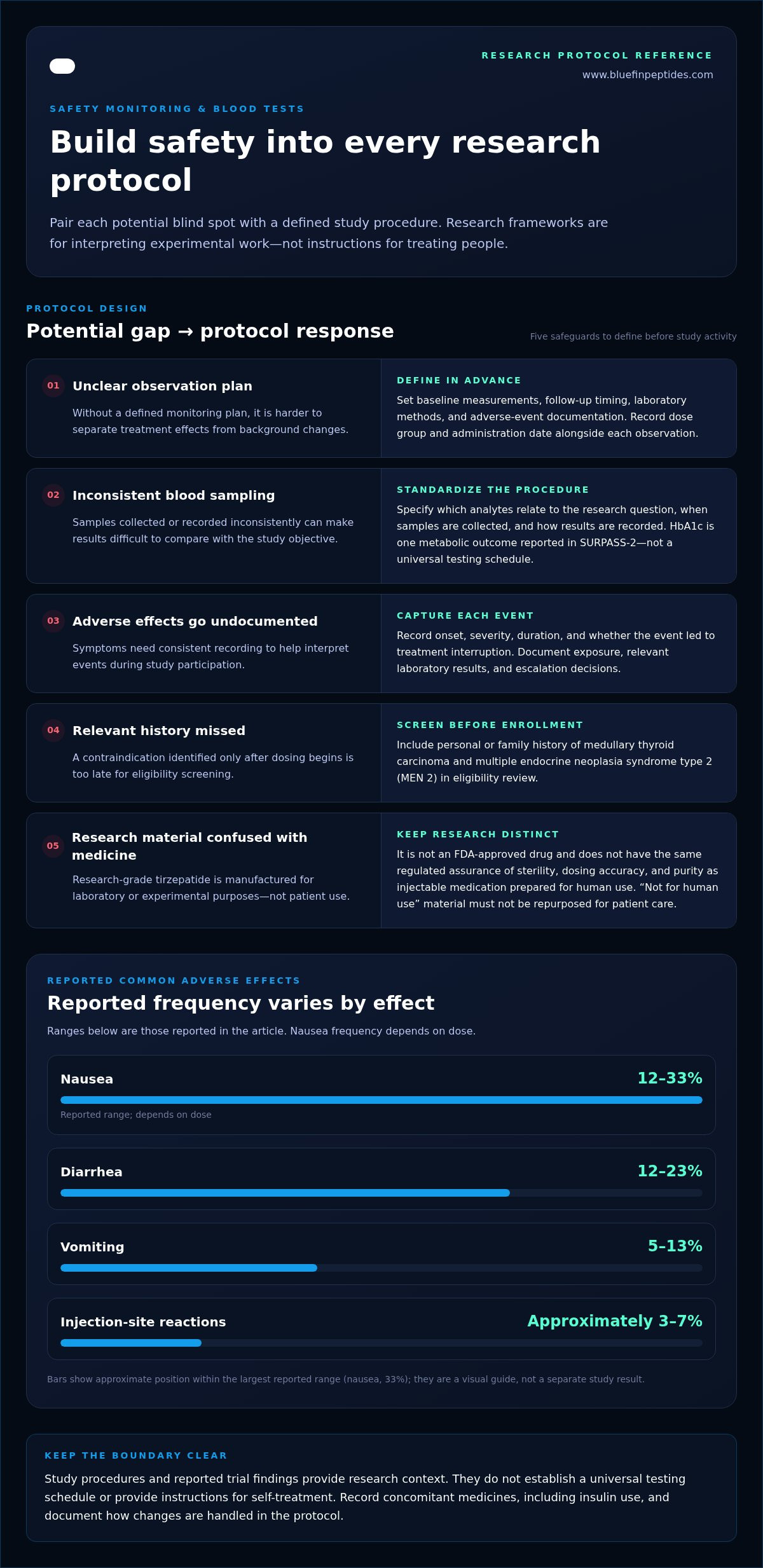
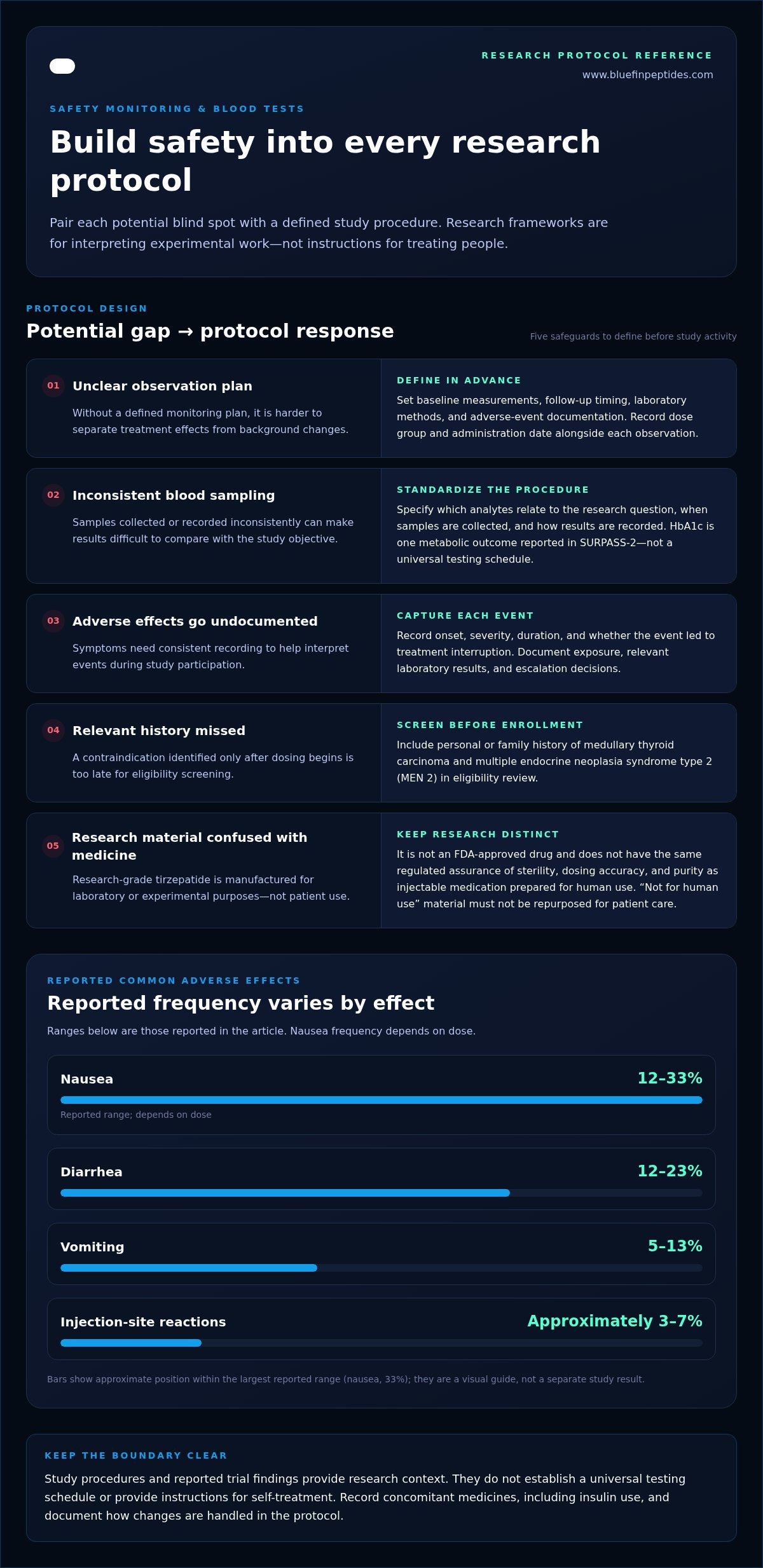
Safety monitoring is the planned observation and recording of possible harms during a study. For tirzepatide research protocols, define each assessment before enrollment: baseline measurements, follow-up timing, laboratory methods, and adverse-event documentation. Record the dose group and administration date alongside each observation. This helps distinguish treatment effects from background changes.
Blood-test monitoring is the collection and analysis of blood samples under a consistent study procedure. Protocols should specify which analytes relate to the research objective, when samples are collected, and how results are recorded. For example, a metabolic study may track HbA1c as an outcome, as SURPASS-2 reported HbA1c reductions. That research endpoint is not a universal testing schedule.
Research-grade tirzepatide is manufactured for laboratory or experimental purposes, not patient use. It is not an FDA-approved drug and is not produced under the same sterile pharmaceutical conditions required for injectable medications. Products labeled “not for human use” must not be repurposed for patient care. Human administration requires prescription medication prepared for human use through regulated clinical care.
For compounded products, the FDA declared the tirzepatide shortage resolved on October 2, 2024. After that resolution, mass compounding by pharmacies and outsourcing facilities is no longer permitted under FDA enforcement discretion, subject to narrow exemptions. That rule does not convert research material into a patient-ready product. Investigational study design must keep laboratory work distinct from clinical administration.
Common adverse effects are unwanted symptoms reported during treatment or study participation. Nausea affects 12-33% of tirzepatide users, depending on dose; diarrhea affects 12-23%, and vomiting affects 5-13%. Injection-site reactions occur in approximately 3-7% of users. Report each event consistently, including onset, severity, duration, and whether it led to treatment interruption.
Contraindications are conditions that make tirzepatide unsuitable for a person. Personal or family history of medullary thyroid carcinoma or multiple endocrine neoplasia syndrome type 2 (MEN 2) is identified as a contraindication. These histories belong in eligibility screening, not as an afterthought once dosing begins.
Safety risks include harm made harder to detect or manage without clinical oversight. Research-grade GLP-1 products lack regulated assurance of sterility, dosing accuracy, purity, and medical supervision. Patient risks also include no accountability for adverse effects. Study records should capture exposure, symptoms, relevant laboratory results, and escalation decisions. Insulin use is also relevant when reviewing effects: protocols should record concomitant medicines and define how changes are documented.
SURMOUNT and SURPASS clinical trials
SURMOUNT studies evaluated obesity outcomes, while SURPASS trials examined type 2 diabetes. Their populations, comparators, treatment periods, and endpoints determine how results should be interpreted. For tirzepatide research protocols, trial design provides essential context for comparing findings.
SURMOUNT Obesity Trials
SURMOUNT trials evaluated tirzepatide in people with obesity or overweight. SURMOUNT-1 enrolled 2,539 adults with obesity or overweight and a comorbidity. Among adults without diabetes, average weight change over 72 weeks was −15.0% at 5 mg weekly, −19.5% at 10 mg, and −20.9% at 15 mg. Each result belongs to its stated dose group and population.
In SURMOUNT-1, 50-57% of participants receiving 15 mg achieved at least 20% weight loss. More than one-third in that dose group lost at least 25%. SURMOUNT-2 examined people with obesity and type 2 diabetes; participants receiving 15 mg lost 14.7% of body weight over 72 weeks. SURMOUNT-5 enrolled 751 adults with obesity without diabetes. In its 72-week comparison, weight change was −20.2% with tirzepatide and −13.7% with semaglutide.
Doses and Escalation Schedules
Dose escalation is a planned increase in dose over a study period. SURPASS-1 tested 5 mg, 10 mg, and 15 mg weekly. One described clinical schedule began at 2.5 mg weekly for 4 weeks, then used 5 mg for weeks 5-8. Later steps were 7.5 mg for weeks 9-12, 10 mg for weeks 13-16, and 12.5 mg for weeks 17-20, with 15 mg as the listed maximum.
This sequence increases by 2.5 mg monthly. SURPASS-1 lasted 40 weeks and reported 7-9.5 kg weight loss across tirzepatide doses. These schedules describe trial design, not personal dosing instructions. Comparing tirzepatide research protocols requires tracking the assigned dose and study duration together.
Eligibility and Trial Outcomes
Eligibility criteria define who can enroll; exclusions identify factors that prevent participation. SURMOUNT-1 included adults with obesity or overweight and a comorbidity. SURPASS-1 enrolled 478 adults with type 2 diabetes. The exact criteria differ by protocol, so a population description should not be mistaken for a complete eligibility checklist.
Trial outcomes are measured changes used to assess study results. SURMOUNT studies reported body-weight change, while SURPASS trials measured glycemic outcomes, including HbA1c. In SURPASS-2, 1,879 adults with type 2 diabetes were compared across tirzepatide and semaglutide groups over 40 weeks. At 15 mg, tirzepatide reduced HbA1c by 2.46%; participants lost 12.4 kg, compared with 6.2 kg with semaglutide 1 mg. Read these endpoints within each trial’s population and comparator.
Subcutaneous administration frequency and sites
Subcutaneous administration means delivery into the tissue beneath the skin. In clinical use, tirzepatide is described as a once-weekly medicine, administered on the same day each week. Research protocols should distinguish this clinical schedule from laboratory handling. Research-grade tirzepatide is for laboratory or experimental purposes, not patient administration.
Administration frequency is the planned interval between recorded doses. In a clinical schedule, once weekly means doses recur on the same weekday. A study record can capture the planned and actual dates, dose group, and any missed administration. These fields help researchers interpret exposure over time without turning a research outline into personal dosing instructions.
Administration site is the documented body location for a subcutaneous dose. The available study facts establish the route but do not provide a list of anatomical sites. A protocol should define how site information is recorded and applied consistently. For example, researchers can include a designated site field and document changes rather than infer them from weight-loss results.
Keep these variables distinct: route describes how a dose enters the body, frequency describes its timing, and site identifies its location. Recording each separately makes trial data easier to interpret. A missed weekly dose and a change in recorded site, for instance, are different events. Do not combine them into one unexplained “administration deviation.”
Product context matters. Tirzepatide was approved as Zepbound for chronic weight management in November 2023. That approval concerns the product used in clinical care, not research-grade material. Research-grade products are not FDA-approved drugs, and they lack regulated assurance of sterility, dosing accuracy, purity, and medical oversight. They must not be treated as interchangeable with medication prepared for human use.
Record concomitant medicines as part of the study context. Insulin and sulfonylureas are relevant medication names to capture when documenting participants’ treatment. Record the medication, timing, and any protocol-defined changes, then interpret outcomes in light of those records. Do not infer a drug interaction or dose adjustment from a site or frequency entry alone.
Keep eligibility and safety fields separate from administration fields. A history of medullary thyroid carcinoma, for example, relates to screening, not injection location. A well-structured dataset preserves that distinction. Laboratory protocols should specify who records administration events, how deviations are classified, and how records connect to each participant’s study timeline. This structure supports analysis while keeping experimental procedures separate from patient care.
Pharmacokinetic details can be recorded alongside administration timing and site, while remaining separate from those fields. Subcutaneous tirzepatide reaches peak concentration 8-72 hours after a dose, and the listed subcutaneous bioavailability of tirzepatide is 80%. These values provide context for interpreting exposure; they do not identify an injection location or replace the study’s planned schedule. Keeping these measures distinct helps preserve clarity when reviewing administration records and related study observations.
Research-grade GLP-1 products are generally not subject to safeguards required for patient administration. This distinction matters when documenting product context: a research record should not imply that laboratory material carries the regulated assurances associated with patient-use medicines. Administration frequency and site entries describe the study record, while product status describes the material being handled. Recording these elements separately supports careful interpretation without treating research-grade products as suitable for patient administration.
Cardiovascular and metabolic effects
Metabolic effects are changes in measures such as blood glucose, HbA1c, and body weight. Tirzepatide studies examine these outcomes across distinct populations and treatment conditions. To interpret them, separate the measured endpoint from the proposed mechanism. A change in HbA1c, for example, describes glycemic control, while weight change captures a different outcome.
Cardiovascular outcomes are measures used to assess heart-related effects during a clinical trial. The SUMMIT trial included 731 patients with heart failure with preserved ejection fraction (HFpEF) and obesity. Its median duration was 104 weeks. These details define the study population and observation period; they do not, by themselves, establish the direction or size of a treatment effect.
That distinction matters: HFpEF and obesity identify the SUMMIT population, while the median duration frames follow-up. A protocol review should record the population, comparator, duration, and endpoint separately. It should also distinguish cardiovascular measures from metabolic measures. Combining unlike outcomes in one summary can obscure what a trial actually evaluated.
Glycemic response is a measured change in blood-glucose control. SURPASS trials studied adults with type 2 diabetes and used HbA1c as one outcome. In SURPASS-5, 475 adults with type 2 diabetes were using insulin glargine. The study lasted 40 weeks. This provides a relevant example of tirzepatide studied with insulin, but the study population should not be treated as identical to other trial groups.
Combination therapy means a study evaluates a treatment alongside another medication. In SURPASS-5, participants were using insulin glargine, making background insulin an important part of the trial context. A careful analysis identifies concurrent compounds, treatment duration, and the outcome being measured. It does not assume that results from insulin users transfer unchanged to people using different medications.
Weekly therapy describes the recurring schedule used in tirzepatide clinical studies. When reviewing metabolic findings, align outcome timing with treatment duration and dose group. For example, SURPASS-5 lasted 40 weeks, whereas SUMMIT had a median duration of 104 weeks. Those periods represent different observation windows, so their findings should not be compared as though follow-up were equivalent.
Endpoint interpretation is the process of connecting a reported measure to the question a trial tested. For cardiovascular and metabolic research, first identify whether the measure concerns heart function, glycemic control, or weight. Then note the population and study period. SUMMIT’s HFpEF and obesity cohort differs from SURPASS-5’s insulin-glargine users, so population context must remain visible in any comparison.
What tirzepatide doses and dose-escalation schedules have studies tested?
Dose escalation is a protocol-defined increase in the amount administered over time. Tirzepatide studies tested fixed weekly dose groups and gradual increases. These are clinical-study schedules, not instructions for self-administration or for using research-grade material in people.
Starting dose is the first dose in the studied titration sequence. The schedule begins at 2.5 mg weekly for 4 weeks, then moves to 5 mg once weekly for weeks 5-8. Subsequent steps are 7.5 mg for weeks 9-12, 10 mg for weeks 13-16, and 12.5 mg for weeks 17-20. The listed maximum is 15 mg.
Maintenance dose is the dose continued after escalation. For chronic weight management, the described range is 5-15 mg once weekly, with 15 mg listed as a maintenance dose. The initial 2.5 mg stage lasts 4 weeks before increasing to 5 mg for 4 weeks. These time points describe a studied schedule, not an individualized treatment plan.
Study dose groups are assigned levels researchers compare within a trial. SURPASS-1 tested 5 mg, 10 mg, and 15 mg weekly. Its monotherapy study lasted 40 weeks and reported weight loss of 7-9.5 kg across those dose groups. Comparing fixed groups helps researchers examine dose-related outcomes without treating one result as universal.
Increment interval is the planned time between dose increases. The listed schedule advances monthly in 2.5 mg steps, from 2.5 mg to 15 mg. For type 2 diabetes, increases may occur in 2.5 mg increments every 4 weeks, based on glycemic response and tolerability. Those factors explain why a protocol records both the assigned dose and observed response.
Interpret the schedule alongside trial purpose. SURPASS-1 tested monotherapy, while other studies examined different populations and comparators. A dose number alone cannot summarize the protocol: treatment duration, escalation timing, study population, and endpoint all matter. For example, a 15 mg group in a weight-management study answers a different research question from a dose group assessed for glycemic response.
Research-grade tirzepatide is manufactured for laboratory or experimental work, not patient administration. Study dose ranges must not be converted into directions for human use. Clinical medications and research compounds have different intended uses and safeguards. Keep experimental protocols separate from treatment decisions, and interpret each schedule within its original study design.
The monthly sequence can be read as a series of planned dose levels rather than a set of interchangeable options: 2.5 → 5 → 7.5 → 10 → 12.5 → 15. Each arrow marks the next scheduled step, with the dose rising by 2.5 mg at each transition. The sequence therefore conveys both the order of the listed amounts and the pace of escalation. On its own, however, it does not identify which dose is suitable for an individual, or establish that every study participant followed an identical course. Interpretation remains tied to the study protocol being discussed. The schedule is a research framework, not a reason to change treatment independently or to infer a personal dosing plan.
Bluefin Peptides: Retatrutide Research Peptide
Bluefin Peptides offers Retatrutide Research Peptide for laboratory studies focused on this distinct peptide target. For work focused on tirzepatide, the company’s Tirzepatide Research Peptide aligns more directly with the protocols discussed above. Both are intended for research use, not patient administration.
Bluefin Peptides reports that its peptides are ≥99% HPLC-verified, with mass-spectrometry confirmation and batch certificates of analysis. These records can support material identification and documentation within a laboratory workflow. Select the peptide that matches the study question, and keep experimental materials separate from clinical medications and human treatment.
For research-grade peptide information, contact Bluefin Peptides.
Build the next study around clear research questions
Use the evidence as a starting point for stronger experimental design. Define the research question first, then align material selection, documentation, and outcome measures with that objective. Keep laboratory use separate from patient care: research-grade peptides are not substitutes for approved medications or clinical oversight.
For teams sourcing materials for laboratory work, Bluefin Peptides offers Retatrutide Research Peptide, Tirzepatide Research Peptide, and BPC-157 / TB-500 Research Blend. Its peptide materials are HPLC-verified, with mass-spectrometry confirmation and batch certificates of analysis. These records can inform material documentation as you develop your next protocol.
When you are ready to discuss research materials, contact Bluefin Peptides. Apply the same discipline to the next study: a defined question, traceable materials, and carefully recorded methods create a stronger foundation for analysis.
Frequently Asked Questions
What is Tirzepatide?
Tirzepatide is a peptide medicine that activates glucose-dependent insulinotropic polypeptide (GIP) and glucagon-like peptide-1 (GLP-1) receptors. These pathways influence blood-glucose regulation and appetite. That dual receptor activity helps explain why clinical studies assess both glycemic measures and body-weight change. The molecule’s effects are evaluated through controlled trials, while research-grade material is intended for laboratory work, not patient treatment.
What are the main clinical trial protocols for tirzepatide?
The main trial programs are SURPASS for type 2 diabetes and SURMOUNT for obesity and related conditions. Their protocols specify participant populations, comparators, treatment periods, and measured outcomes. For example, SURMOUNT-OSA enrolled adults with obesity and moderate-to-severe obstructive sleep apnea, examining a distinct clinical population. Comparing study designs means matching each result to its population and endpoint, rather than treating every trial as interchangeable.
What do clinical trials show about tirzepatide for weight loss and type 2 diabetes?
Clinical trials report weight reduction in obesity studies and improved glycemic measures in type 2 diabetes studies. In SURMOUNT-5, a 72-week head-to-head study of adults with obesity without diabetes, weight change was −20.2% with tirzepatide and −13.7% with semaglutide. Diabetes trials assess outcomes such as HbA1c, so their results answer a different question than obesity-trial weight endpoints.
For laboratory research use only. Not for human or veterinary use. This content is educational and does not constitute medical, dosing, or usage guidance.
Browse the BLUEFIN catalog