Tirzepatide HPLC Verified: Analytical Standards for Laboratory Research
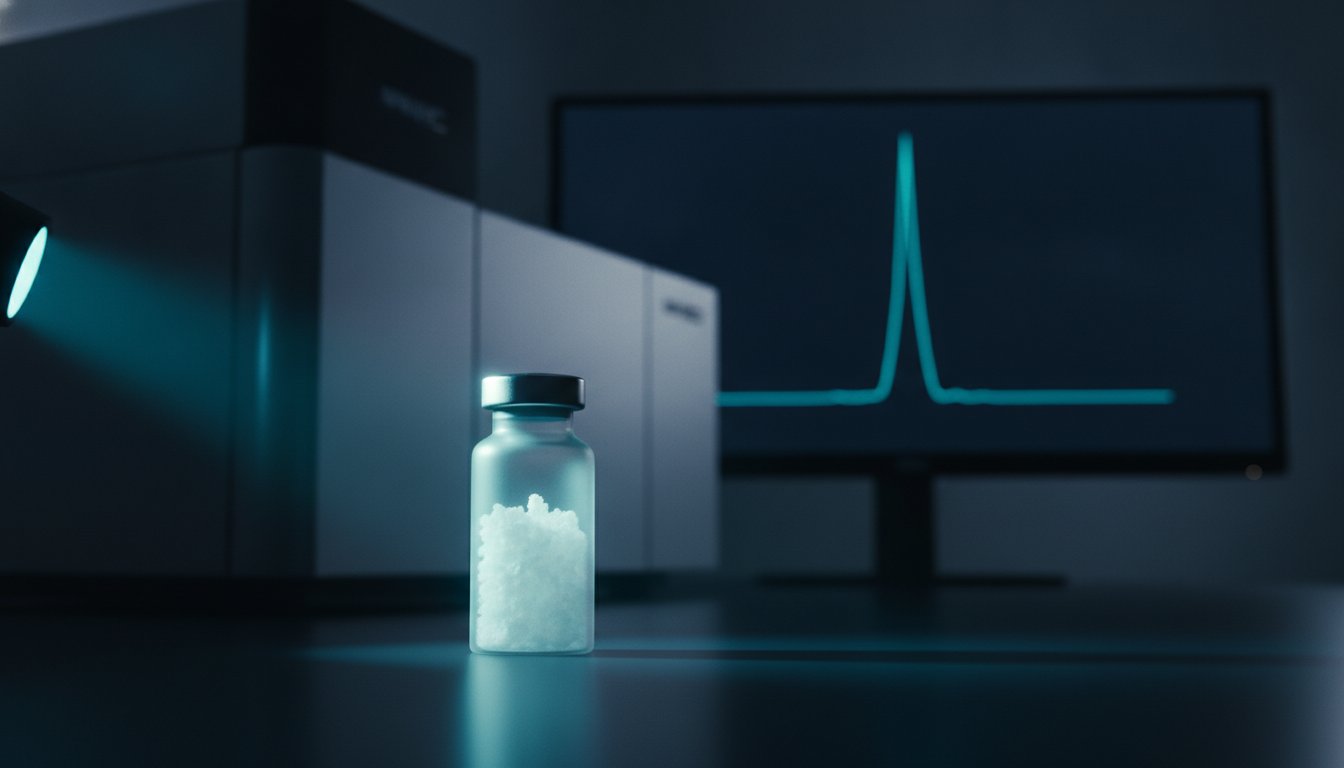
In the fluid landscape of 2026 peptide synthesis, a certificate of analysis is no longer a courtesy; it is the structural anchor of experimental validity. You recognize that batch-to-batch variability and opaque testing reports from generic suppliers can compromise months of meticulous laboratory work. When molecular integrity is the baseline, accepting anything less than absolute transparency is a risk to your data's signal-to-noise ratio. This article provides the technical specifications and verification protocols required to ensure your tirzepatide HPLC verified compounds meet the rigorous ≥99% purity standards demanded by modern analytical frameworks.
We will examine the transition from raw synthesis to mass-spec confirmation. We will also detail the logistics of maintaining molecular integrity during transit. You'll master the protocols for reconstitution and storage that prevent the degradation often seen in substandard fulfillment chains. By establishing a reliable analytical standard, you secure your research against the tide of rising regulatory scrutiny and the complexities of the 2026 market. This is the roadmap for procuring research compounds with verifiable, high-precision data.
Key Takeaways
- Identify the specific reverse-phase HPLC parameters required to accurately profile impurities in synthetic peptide chains.
- Learn to interpret chromatograms by locating the tirzepatide HPLC verified main peak and analyzing retention time data for identity confirmation.
- Differentiate between generic COAs and batch-specific verification to ensure every research compound meets a ≥99% purity threshold.
- Implement aseptic reconstitution and storage protocols designed to preserve molecular integrity in high-precision laboratory environments.
- Understand the impact of US-based shipping and cold-chain logistics on maintaining the stability of research peptides during transit.
The Role of HPLC Verification in Tirzepatide Research
High-Performance Liquid Chromatography (HPLC) serves as the definitive filter in synthetic peptide production. It isn't merely a testing phase; it's a structural requirement for isolating the target molecule from the chaotic wake of the synthesis process. For researchers, utilizing tirzepatide HPLC verified compounds ensures that the observed biological response is attributed solely to the intended sequence. HPLC operates by forcing a pressurized liquid solvent containing the sample through a column filled with adsorbent material. This interaction separates the components with surgical precision, allowing for the quantification of both the primary peptide and any underlying impurities.
Synthetic Tirzepatide requires reverse-phase HPLC (RP-HPLC) for accurate profiling. This specific methodology leverages the hydrophobic properties of the 39-amino-acid chain. Because tirzepatide is a complex molecule, even a single amino acid deletion or a residual protecting group can significantly alter its chemical behavior. RP-HPLC identifies these minute deviations by tracking their unique retention times. This level of scrutiny is what separates "marketing purity" from verifiable analytical data. In preclinical environments, a purity threshold of ≥99% is the anchor that prevents experimental drift and ensures that research data remains reproducible across different batches.
Why Purity Standards Matter for GLP-1/GIP Agonists
The structural complexity of dual-agonist peptides necessitates extreme vigilance. Tirzepatide acts upon both GIP and GLP-1 receptors, a mechanism that requires precise molecular folding. Minor impurities or truncated sequences can interfere with receptor binding assays, leading to competitive inhibition or false-negative results. These impurities also pose a risk of inducing pro-inflammatory responses in research models. Such exogenous variables can obscure metabolic data, making it impossible to discern the peptide's true physiological impact. High-purity standards eliminate these "ghost" variables at the source.
The 2026 Standard for Analytical Release
Modern laboratory protocols have moved beyond basic nitrogen analysis. The 2026 standard for analytical release demands a multi-modal approach to verification. This includes:
- Comprehensive Impurity Profiling: Identifying and quantifying specific related substances rather than reporting a single aggregate purity number.
- Karl Fischer Titration: A precise method for determining water content within lyophilized vials. Excessive moisture is a primary catalyst for peptide hydrolysis and degradation.
- Solubility and Visual Clarity: Establishing a baseline for chemical integrity. A high-quality lyophilized cake must dissolve into a clear, particulate-free solution to confirm successful synthesis and proper storage.
By adhering to these rigorous benchmarks, laboratories can navigate the complexities of peptide research with total confidence in their starting materials. Relying on verified data is the only way to maintain the momentum of high-precision research.
Decoding Tirzepatide HPLC Reports: Purity, Retention, and Peaks
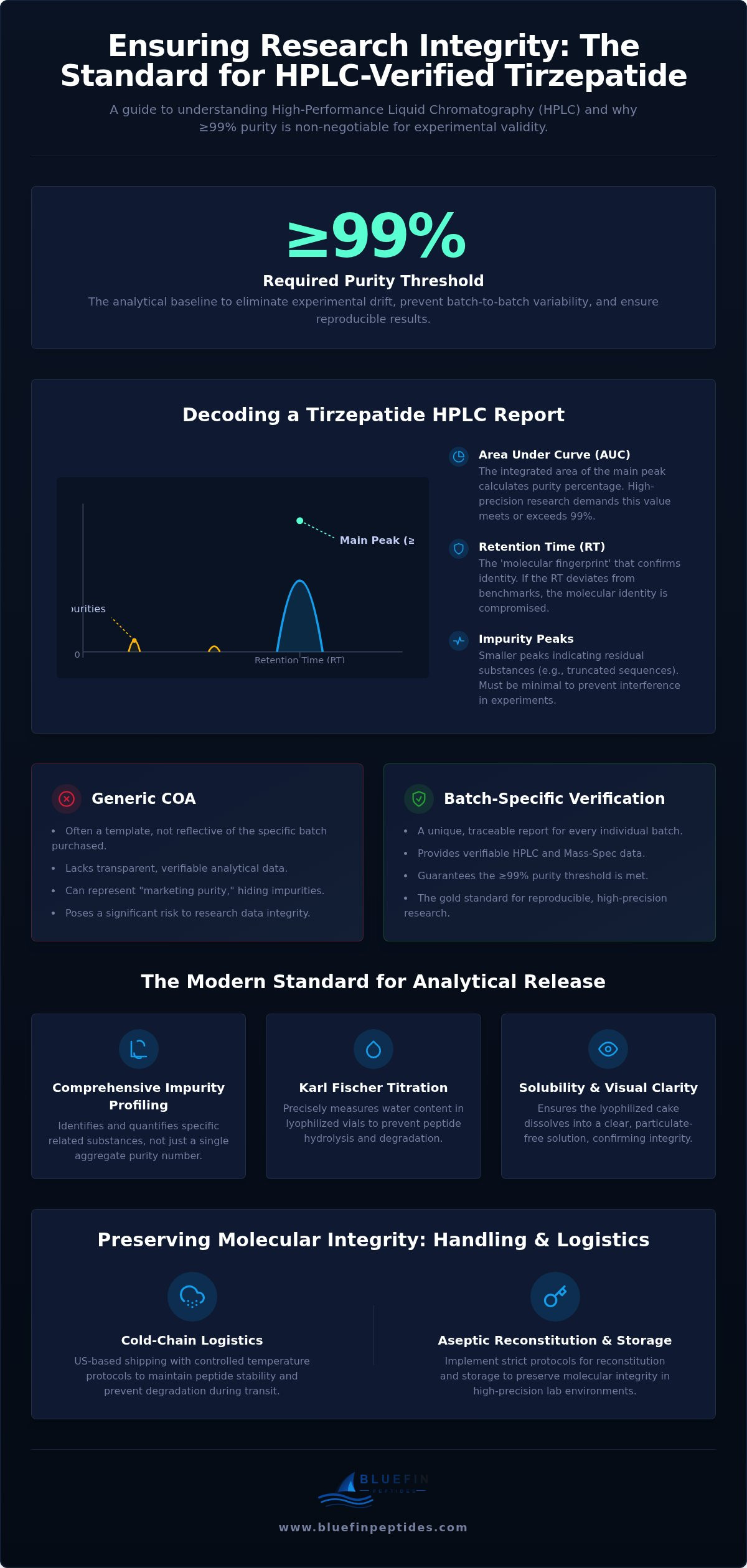
Interpreting a chromatogram is an exercise in pattern recognition and mathematical precision. For a tirzepatide HPLC verified compound, the primary objective is to confirm that the dominant signal aligns with the expected chemical signature. The main peak on the report represents the target peptide, while any smaller, surrounding deviations indicate residual substances or process artifacts. To verify identity, researchers must focus on the Retention Time (RT). This is the temporal fingerprint of the molecule, representing the exact duration it takes for the compound to navigate the column and reach the detector. If the RT deviates from established benchmarks, the molecular identity is compromised.
Quantitative purity is determined by the Area Under the Curve (AUC). By integrating the area of the primary peak and comparing it to the total area of all detected peaks, analysts calculate the purity percentage. High-precision research requires this value to meet or exceed the ≥99% threshold. For a deeper understanding of the chemistry and controls required for this molecule, the FDA Chemistry and Manufacturing Review provides a foundational look at the analytical standards utilized during the pharmaceutical approval process. Detecting secondary peaks is equally vital. These peaks often represent deamidation products or truncated sequences that can skew experimental results if left unquantified.
How to Read a Batch-Specific COA
Every analytical report must be cross-referenced with the specific batch number on the vial to ensure data continuity. The X-axis represents time in minutes, while the Y-axis measures absorbance units, typically in milli-absorbance units (mAU). Understanding these coordinates allows you to visualize the separation efficiency of the run. The reporting threshold is defined as the minimum area percentage at which an impurity peak must be documented and quantified, typically set at 0.05% to ensure comprehensive transparency. Reviewing these details ensures you are working with verified research compounds that meet stringent laboratory requirements.
Common Red Flags in HPLC Reports
Baseline noise acts as the turbulent surface that can obscure deep-seated impurities. If the baseline is not steady, it suggests poor instrument calibration or contaminated mobile phases. You should also examine peak shape. Peak tailing, where the peak stretches toward the right, often indicates column degradation or the presence of related substances with similar hydrophobicities. Peak splitting, or "shouldering," suggests co-elution, where two different molecules exit the column at nearly the same time. Finally, reject any report that relies on blurry or cropped images. A transparent provider will always offer high-resolution, full-scale scans that allow for independent verification of every peak and trough.
Why Batch-Specific Verification Outperforms Generic COAs
Relying on representative Certificates of Analysis (COAs) is a failure of methodology. In the synthesis of complex peptides, "representative" is a euphemism for outdated. A single successful run doesn't guarantee the integrity of subsequent batches. Synthesis is a fluid process. It's subject to environmental variables, reagent purity shifts, and technical drift. A tirzepatide HPLC verified compound must be anchored to its specific batch number. Without this direct link, your research is built on assumptions rather than data. Every synthesis batch must be tested independently to ensure the purity profile hasn't shifted from the original pilot run.
Analytical precision requires a dual-layer approach. While HPLC provides the purity percentage, it cannot definitively confirm molecular identity. Mass Spectrometry (MS) is the essential partner in this process. It verifies the molecular weight, ensuring that the synthesized chain matches the intended sequence. This is particularly critical for verifying the C20 fatty diacid moiety attached to the Lys20 side chain. This specific modification is what defines the peptide's unique pharmacokinetics. A Validated RP-HPLC Method for Tirzepatide allows for the quantification of these components, but MS provides the final confirmation of structural accuracy. Bluefin maintains a commitment to batch-level transparency to eliminate the risks associated with generic data.
HPLC vs. Mass Spectrometry: A Dual-Layer Approach
HPLC answers the question of quantity. It measures how much of the target compound exists relative to impurities. In contrast, Mass Spectrometry answers the question of identity. It confirms the molecule's mass-to-charge ratio. You shouldn't rely on one without the other. Mastering the art of interpreting peptide mass spectrometry data is vital for any researcher. This combination ensures that the peptide isn't just pure, but structurally correct.
Third-Party Verification Protocols
Unbiased data is the only currency that matters in a professional laboratory. Independent laboratories, such as Janoshik, provide a necessary layer of security. They act as a neutral third party, verifying that the manufacturer's claims align with the physical reality of the vial. You can verify the authenticity of these reports by cross-referencing report IDs on the laboratory's official portal. Monoisotopic mass confirms the exact molecular weight of the specific peptide sequence. This verification prevents the use of mislabeled or substandard compounds in high-stakes research models. Trust is replaced by verification.
Reconstitution and Handling of HPLC-Verified Tirzepatide
Precision in synthesis must be matched by precision in handling. Reconstitution represents a critical transition point where the chemical stability of a tirzepatide HPLC verified compound is most vulnerable to environmental stressors. Even the highest purity lyophilized powder can undergo rapid hydrolysis or aggregation if the solvent introduction is handled with negligence. Maintaining molecular integrity requires a disciplined adherence to aseptic technique and mechanical caution. You must treat the reconstitution phase as an extension of the analytical process itself. It is the final safeguard for your data's accuracy.
Aseptic reconstitution begins with the sterilization of the vial stopper and the diluent container using 70% isopropyl alcohol. For most research models, bacteriostatic water or sterile 0.9% sodium chloride is the standard choice. When introducing the diluent, aim the needle toward the glass wall of the vial rather than directly at the lyophilized cake. This prevents mechanical shear stress. Allow the vacuum to pull the liquid in naturally; never force the plunger. Once the solvent is added, gently swirl the vial until the solution is clear. Shaking is prohibited. It introduces air bubbles and can lead to protein denaturation, compromising the results of your peptide reconstitution research.
Calculating concentration is the final step in ensuring experimental accuracy. If a vial contains 10mg of peptide and you add 2mL of diluent, the resulting concentration is 5mg/mL. For high-precision micro-dosing in metabolic research models, these ratios must be verified with volumetric equipment. Errors in this phase negate the advantages of using high-purity starting materials. Secure your experimental baseline by utilizing HPLC-verified research peptides that provide the predictable solubility required for accurate dosing.
Stabilizing the Peptide Chain
Temperature and light exposure are the primary catalysts for peptide degradation. Reconstituted tirzepatide is significantly less stable than its lyophilized counterpart. UV light can trigger side-chain oxidation, while heat accelerates the deamidation of the amino acid sequence. While high-purity peptides exhibit greater resilience against minor fluctuations, they still require a strict protocol within the laboratory. For more on the initial state of the compound, consult our guide on lyophilized peptide storage.
Storage Protocols for 2026 Laboratory Standards
Storage conditions define the longevity of your research materials. Lyophilized vials intended for use within 90 days should be kept at 4°C. For long-term preservation exceeding six months, storage at -20°C or -80°C is the standard requirement. When transitioning a vial from deep-freeze to the benchtop, allow it to reach room temperature before opening to prevent condensation. You must avoid multiple freeze-thaw cycles. These cycles create ice crystals that can physically rupture the peptide's structural conformation, leading to a loss of potency and increased baseline noise in subsequent assays.
Procuring Verified Research Peptides: The Bluefin Standard
Procuring high-purity compounds requires more than a simple transaction; it requires a partnership defined by absolute transparency. In a fluid market where batch-to-batch variability is a constant threat to experimental validity, Bluefin Peptides establishes a structural anchor for your research. We don't ask for blind trust. Instead, we provide the tools for verification. Every vial of tirzepatide HPLC verified peptide we supply is backed by batch-specific documentation that links directly to the physical product in your hand. This "show, don't tell" philosophy ensures that your laboratory work begins on a foundation of chemical certainty. By prioritizing analytical release over marketing claims, we align our operations with the rigorous standards of professional and academic researchers who cannot afford the cost of experimental drift.
Purity is only one half of the equation. Logistics represents the other. International procurement often exposes sensitive peptides to prolonged transit times and unpredictable environmental conditions. These variables compromise molecular integrity before the package even reaches your bench. US-based stocking and fulfillment are critical for maintaining the stability of tirzepatide HPLC verified lyophilized powders. By shortening the distance between the laboratory and the supply source, we minimize the risks associated with temperature fluctuations. Speed isn't just a convenience; it's a functional requirement for quality.
Bluefin Logistics: Speed Meets Precision
Our fulfillment infrastructure is designed to meet the high-stakes requirements of the laboratory environment. We recognize that the window between synthesis and utilization is a factor in molecular stability. To protect your data, we implement the following standards:
- National US Shipping: Rapid delivery ensures that compounds spend the minimum amount of time in transit, preserving the cold-chain integrity of the lyophilized cake.
- Secure, Discrete Packaging: Vials are protected from physical shock and light exposure, ensuring they arrive in a state that matches their original analytical profile.
- Direct Data Access: Batch-specific COAs are readily available, allowing researchers to integrate purity and mass-spec data into their protocols immediately.
Legal and Regulatory Framing
Adherence to strict regulatory boundaries is a non-negotiable aspect of our supply chain. All offerings, including the tirzepatide research peptide, are designated strictly for "Research Use Only" (RUO). This classification is a commitment to ethical supply and professional standards. It ensures that our materials are utilized within the appropriate legal and scientific frameworks intended for laboratory investigation. Bluefin Peptides operates as a disciplined partner for the scientific community, focusing on the "how" of our processes to ensure the "what" of your results. Reliable data doesn't happen by accident; it starts with a reliable source.
Advancing Research Through Analytical Certainty
Analytical rigor is the structural anchor of reproducible metabolic research. You've navigated the complexities of identifying primary peaks, interpreting retention times, and integrating mass spectrometry to confirm molecular identity. These protocols ensure that your starting materials meet the ≥99% purity threshold required for high-precision assays. Establishing a protocol for tirzepatide HPLC verified compounds isn't just about procurement; it's about securing your data against the tide of experimental drift. By prioritizing batch-specific COAs and US-based logistics, you eliminate the variables of degradation and opaque reporting that stall scientific progress.
Bluefin Peptides operates with a commitment to transparency and clinical precision. Every vial is a testament to our "show, don't tell" philosophy, providing the verifiable data points your laboratory demands. Secure the integrity of your next study with compounds that match your professional standards. Procure HPLC-Verified Tirzepatide for Your Research and maintain absolute confidence in your results. Your work deserves a foundation of chemical certainty.
Frequently Asked Questions
What is the significance of HPLC verification for tirzepatide?
HPLC verification ensures the chemical identity and purity of the compound by separating the target molecule from residual reagents and truncated sequences. For research involving tirzepatide HPLC verified standards, this methodology provides the quantitative data necessary to attribute biological effects solely to the intended amino acid chain. It eliminates the risk of synthesis artifacts interfering with your experimental results.
How do I read a tirzepatide HPLC chromatogram?
You read a chromatogram by identifying the primary peak on the Y-axis, which measures absorbance, against the X-axis, representing retention time. The retention time acts as a molecular fingerprint for the peptide. The area under the curve (AUC) represents the relative concentration; high-purity samples display a single, sharp peak with minimal baseline noise or secondary "shouldering" peaks that indicate impurities.
Why is ≥99% purity the standard for research peptides?
The ≥99% purity threshold is the benchmark for minimizing exogenous variables in preclinical models. Lower purity levels introduce unknown impurities that can trigger non-specific pro-inflammatory responses or interfere with GIP and GLP-1 receptor binding assays. Maintaining this standard is a structural requirement for generating reproducible data in high-precision laboratory environments where signal-to-noise ratios are critical.
Can I trust a COA that does not include a mass-spec report?
A Certificate of Analysis (COA) without mass spectrometry is analytically incomplete because HPLC alone cannot definitively confirm molecular weight. While HPLC measures the quantity of the substance relative to impurities, Mass Spectrometry (MS) verifies that the substance is actually the correct molecule. Comprehensive verification requires both layers to ensure the structural integrity of the peptide sequence.
How should HPLC-verified tirzepatide be stored for long-term research?
Long-term storage of tirzepatide HPLC verified vials requires temperatures between -20°C and -80°C in their lyophilized state. Vials must remain sealed to prevent moisture ingress, which catalyzes peptide hydrolysis and degradation. Once you've reconstituted the peptide, it should be used immediately or stored at 4°C for short durations, though stability decreases significantly once the compound is in solution.
What is the difference between HPLC purity and peptide content?
HPLC purity measures the percentage of the target peptide relative to other chemical substances in the sample. In contrast, peptide content indicates the actual weight of the peptide within the vial. A vial might have 99% purity but only 80% peptide content due to residual salts and water. You must account for both metrics when calculating precise concentrations for research dosing.
How does Bluefin Peptides ensure batch-to-batch consistency?
Bluefin Peptides ensures consistency by conducting independent, batch-specific testing for every synthesis run rather than relying on generic, representative reports. We utilize third-party laboratories to verify purity and molecular identity via HPLC and Mass Spectrometry. This disciplined approach provides researchers with verifiable data points for every individual order, effectively eliminating the risks associated with batch-level variability.
Are these tirzepatide research peptides intended for human consumption?
These peptides are strictly for laboratory research and are not intended for human or veterinary consumption. They carry a "Research Use Only" (RUO) designation. Adherence to these legal and professional boundaries is mandatory for all procurement and utilization within scientific and academic institutions. We prioritize ethical supply and the maintenance of clear regulatory boundaries for all our research compounds.
For laboratory research use only. Not for human or veterinary use. This content is educational and does not constitute medical, dosing, or usage guidance.
Browse the BLUEFIN catalog