Mass Spec Confirmed Peptides: The Gold Standard for Laboratory Research Verification

High HPLC purity percentages are often mistaken for definitive proof of molecular integrity. They're not. A 99% purity rating confirms the absence of contaminants but remains silent on the actual identity of the peptide sequence. Relying solely on chromatography is like navigating a deep-sea trench without sonar. When interpreting peptide mass spectrometry data, the focus shifts from quantity to the absolute verification of molecular weight and sequence accuracy. Most researchers understand the frustration of supplier opacity and the catastrophic risk that mislabeled sequences pose to longitudinal data.
Mastering this analytical process transforms raw spectral signals into a non-negotiable anchor for research verification. This article provides a methodical framework for analyzing mass-to-charge ratios and fragmentation patterns to ensure absolute molecular identity. We will examine the documentation standards required for reproducible results and how to leverage 2026 software advancements to achieve clinical precision in your laboratory models. Verification is the only path to security. Precision is the only standard.
Key Takeaways
- Distinguish between purity and identity to ensure your research models utilize the correct molecular sequences rather than just contaminant-free samples.
- Gain proficiency in interpreting peptide mass spectrometry data to identify parent peaks and verify molecular weights against theoretical benchmarks.
- Adopt a dual-verification protocol that combines HPLC chromatography with mass analysis for absolute structural certainty.
- Evaluate batch-specific analytical documentation to maintain high standards of transparency and data reproducibility in longitudinal studies.
- Recognize the technical mechanisms of ionization and mass analysis that allow for the precise identification of complex peptide structures.
Why Molecular Identity Matters: The Role of Mass Spectrometry in Research
Mass spectrometry is the definitive analytical technique for identifying the chemical structure of a compound by measuring its mass-to-charge ratio. While other methods offer a glimpse of a sample's composition, Protein mass spectrometry provides the specific molecular weight required for absolute verification. In the context of laboratory research, interpreting peptide mass spectrometry data is not a luxury; it's a foundational requirement. Without this data, a researcher is operating on blind trust. This trust is often misplaced in an industry where sequence accuracy is frequently assumed rather than proven. Verification is the only path to security. Precision is the only standard.
When a researcher begins interpreting peptide mass spectrometry data, they're looking for the parent peak that matches the theoretical mass of their target sequence. Any deviation suggests a synthesis error or degradation. In high-stakes laboratory environments, these errors aren't just inconveniences. They are systemic failures. A mislabeled sequence can lead to incorrect biological conclusions, wasted funding, and the retraction of published work. Analytical transparency is the only defense against these outcomes.
The Identity-Purity Divergence
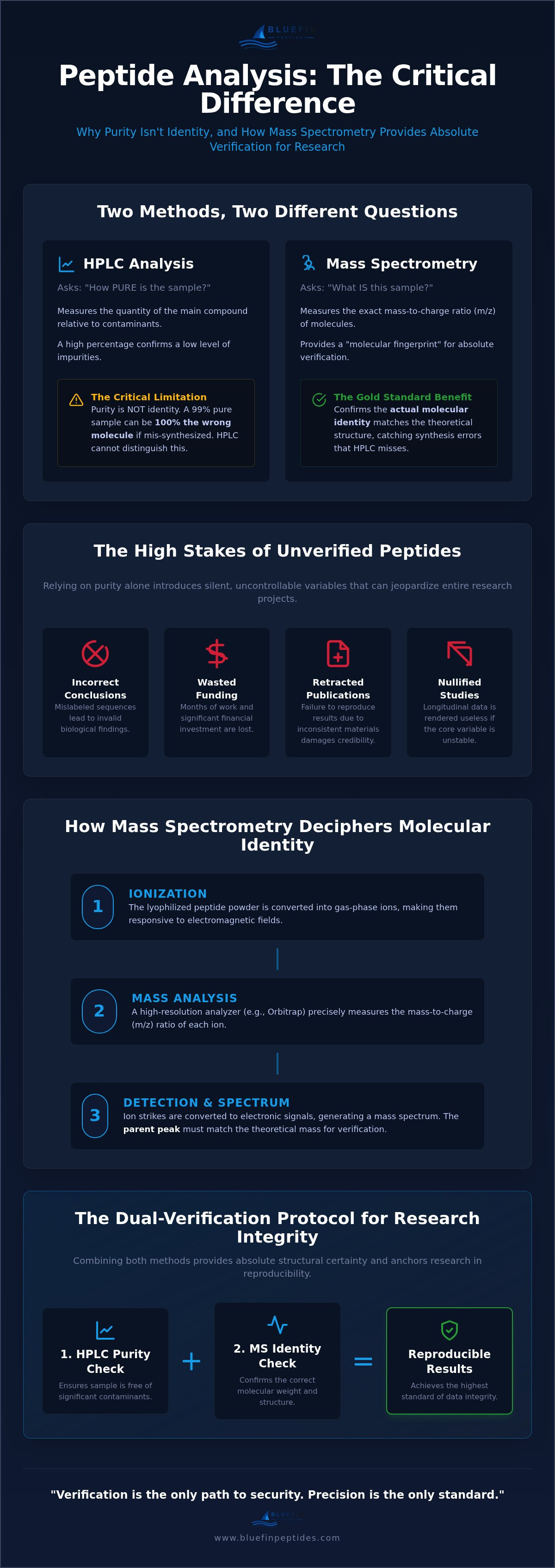
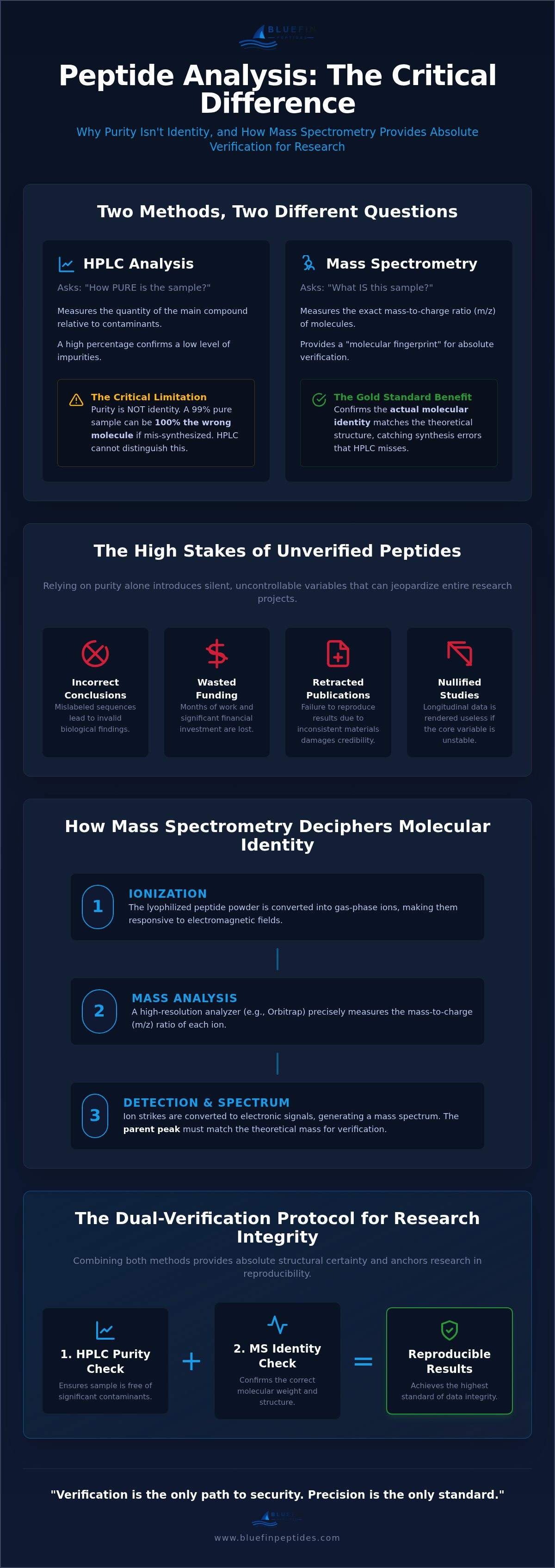
High-performance liquid chromatography (HPLC) is the standard for determining purity. It measures the quantity of the main peak relative to impurities. However, purity is not identity. A sample can be 99% pure and yet consist entirely of the wrong molecular sequence. HPLC lacks the resolution to distinguish between certain isomers or peptides with near-identical hydrophobic profiles. If the sequence is mislabeled at the point of synthesis, chromatography will only confirm that the error is highly concentrated. Mass spectrometry provides the fingerprint needed to catch these discrepancies. It translates chemical matter into a verifiable digital signature.
Anchoring Research in Reproducibility
The integrity of a longitudinal study depends on the stability of its variables. Misidentified research chemicals introduce a silent, uncontrollable variable that can nullify months of data collection. Verification of molecular identity must occur before reconstitution to ensure adherence to research peptide quality standards. Establishing this baseline prevents the catastrophic costs associated with failed peer-reviewed models. Reproducibility isn't a goal. It is a byproduct of rigorous analytical documentation and disciplined procurement. Consistent results require consistent molecules. Mass spectrometry ensures that consistency remains unbroken across multi-phase studies.
The Mechanism of Detection: How Mass Spectrometry Deciphers Peptide Structures
The transition from a lyophilized powder to a digital mass spectrum requires a sophisticated sequence of physical transformations. It begins with ionization. This process converts the solid-state peptide into gas-phase ions, allowing the mass analyzer to manipulate them via electromagnetic fields. High-resolution analyzers, such as the Orbitrap, then measure the mass-to-charge (m/z) ratio with extreme precision. The resulting digital output is what researchers use when interpreting peptide mass spectrometry data to verify that the synthesized molecule aligns with its theoretical blueprint. The molecular ion peak represents the intact peptide. It's the primary anchor point for identity verification, acting as a digital sonar sweep of the molecular structure.
Detection is the final stage where ion strikes are converted into electronic signals. These signals are processed into a spectrum where the x-axis represents the m/z ratio and the y-axis represents intensity. For a researcher, this spectrum is the only objective proof of what's actually inside the vial. Without it, you're navigating the complex currents of biochemical research without a map. Precision in detection ensures that even trace amounts of truncated sequences or synthesis byproducts are visible, allowing for a level of scrutiny that chromatography alone cannot provide.
Soft Ionization for Fragile Peptide Chains
Peptides are delicate. Harsh ionization methods can shatter the amino acid chain before it ever reaches the detector, leading to misleading data. Electrospray Ionization (ESI) is the preferred "soft" technique for large, complex molecules like Tirzepatide or other GLP-1 analogues. ESI functions by applying high voltage to a liquid sample, creating a fine mist of charged droplets. As the solvent evaporates, the peptide molecules enter the gas phase with minimal fragmentation. This method often produces multiple-charged ions ([M+nH]n+), which effectively extends the mass range of the analyzer. This allows for the detection of high-molecular-weight chains with surgical accuracy in a laboratory setting.
Tandem MS/MS and Sequence Verification
Confirming total molecular weight is only the first step. To ensure the sequence hasn't been mislabeled or scrambled, researchers utilize Tandem MS/MS. This involves isolating the parent ion and colliding it with an inert gas to induce controlled fragmentation along the peptide backbone. The resulting b-ions, which extend from the N-terminus, and y-ions, which extend from the C-terminus, provide a detailed map of the amino acid sequence. By reconstructing this fingerprint, a laboratory can verify the integrity of every amide bond. This level of detail is why every batch of verified research peptides from Bluefin undergoes rigorous mass-spec confirmation before fulfillment.
Mass Spectrometry vs. HPLC: A Dual-Verification Framework for Research Integrity
High-performance liquid chromatography (HPLC) and mass spectrometry are often viewed as interchangeable quality checks. They are not. HPLC is a quantitative tool used to determine the concentration of a primary substance relative to its impurities. Mass spectrometry is a qualitative tool used to confirm that the substance is, in fact, the intended molecule. Relying on a single report is like navigating a vessel with only a compass and no depth sounder. For absolute certainty, interpreting peptide mass spectrometry data must be done in conjunction with a purity analysis. This dual-verification framework creates a fail-safe protocol that eliminates the risk of hidden contaminants or misidentified sequences.
Liquid Chromatography-Mass Spectrometry (LC-MS) coupling is the industry gold standard. It allows for the separation of components in a mixture followed by immediate mass identification of each peak. This synergy ensures that even if an impurity co-elutes with the main peptide peak, the mass analyzer will detect the discrepancy in molecular weight. In high-performance laboratory environments, this level of scrutiny is the only acceptable baseline. Data integrity demands it. Precision requires it.
HPLC: Measuring the Degree of Purity
Chromatography functions by passing a liquid sample through a pressurized column. The resulting chromatogram displays various peaks, where the Area Under the Curve (AUC) represents the relative quantity of each detected component. This process is essential for identifying residual solvents, salts, or truncated peptide sequences. For a tirzepatide research peptide, a purity level of ≥99% is required to ensure that experimental observations are the result of the peptide itself rather than chemical noise. HPLC confirms the sample is clean. It does not, however, confirm the sample's identity.
Mass Spectrometry: Confirming the Chemical Formula
While HPLC measures the "how much," mass spectrometry answers the "what." It verifies that the observed mass of the molecule matches the theoretical mass within precise Dalton limits. This is a critical step in interpreting peptide mass spectrometry data, as it allows researchers to identify unintended chemical substitutions or post-translational modifications that HPLC might miss. MS is also a vital tool for monitoring the stability of lyophilized peptide storage. By comparing batch data over time, laboratories can detect subtle molecular degradation or oxidation that compromises structural integrity. Identity is the anchor. Verification is the proof.
Interpreting the Spectrum: A Researcher’s Guide to Reading Mass Spec Reports
Transitioning from theoretical mechanics to practical verification requires a disciplined approach to the analytical report. The mass spectrum is the final gate. When interpreting peptide mass spectrometry data, the primary objective is the identification of the parent peak. This peak represents the intact molecule and should align with the highest intensity signal at the expected mass-to-charge (m/z) ratio. Discrepancies between the theoretical mass and the observed mass must be minimal. In high-resolution environments, this variance is often measured in parts per million, though a deviation of less than 1 Dalton remains a standard threshold for basic identity confirmation. Verification. Precision. Integrity.
A reliable report must also demonstrate a high signal-to-noise ratio. A clean baseline with sharp, distinct peaks indicates a sample free from significant electronic interference or chemical noise. Researchers must cross-reference every report with the specific batch number on the vial. Any administrative disconnect between the analytical data and the physical sample compromises the entire chain of custody. Documentation is not a formality; it is the evidence of molecular truth.
The Anatomy of a Mass Spectrum Graph
The x-axis of the graph represents the m/z ratio, while the y-axis indicates relative abundance, scaled from 0 to 100%. The most abundant ion is termed the base peak. Researchers must also account for isotope clusters. These appear as a series of peaks separated by approximately 1 Dalton, resulting from the natural distribution of Carbon-13 isotopes within the peptide chain. Additionally, be prepared to spot adducts. Common ions like Sodium (Na+) or Potassium (K+) can bind to the peptide during ionization, shifting the observed mass by 23 or 39 Daltons, respectively. These shifts are standard artifacts of the process and do not necessarily indicate a lack of purity.
Red Flags in Analytical Documentation
Scrutinizing the documentation for anomalies is essential for maintaining research standards. The presence of multiple major peaks of similar intensity is a primary red flag, suggesting either significant contamination or advanced peptide degradation. A mass shift greater than 1 Dalton that cannot be explained by common adducts is a critical failure. This often indicates a synthesis error, such as the substitution of an incorrect amino acid. Finally, check for consistency. Inconsistent batch numbers between the HPLC chromatogram and the MS report suggest a failure in laboratory logistics. For researchers requiring absolute certainty, Bluefin provides mass-spec confirmed peptides with batch-specific documentation for every fulfillment.
Bluefin Peptides: Precision Logistics and Verified Analytical Standards
Bluefin Peptides functions as an authoritative laboratory partner rather than a retail vendor. Our methodology is defined by clinical precision. We prioritize the "how" of our processes to ensure the "what" of your results. Every research compound in our inventory undergoes a rigorous dual-verification protocol before it enters our climate-controlled storage. This standard is non-negotiable. It ensures that when you are interpreting peptide mass spectrometry data from our reports, you are viewing an accurate digital fingerprint of the physical substance in your hand. Transparency is our baseline. Verification is our commitment.
Security in research is built on data, not promises. We operate with a show, don't tell philosophy regarding quality. By providing the tools for independent verification, we empower researchers to maintain the highest levels of structural integrity within their models. Our adherence to strict Research Use Only protocols protects the legal and scientific boundaries of your work. Precision. Reliability. Trust.
Batch-Specific COAs for Qualified Researchers
Analytical transparency requires access to the raw data behind every lot. Bluefin provides comprehensive, batch-specific Certificates of Analysis (COA) for every compound we fulfill. These documents are not generic templates. They contain the specific chromatographic profiles and mass spectra for the exact vial you receive. For instance, verifying a retatrutide research peptide before study commencement is essential for establishing a baseline of molecular identity. This level of detail is crucial when interpreting peptide mass spectrometry data to track consistency across multi-phase longitudinal studies. Access to historical batch data allows for precise comparison and tracking of molecular stability over time.
Optimized Logistics and Molecular Stability
The integrity of a peptide is only as stable as the logistics chain that carries it. We maintain a cold chain of data, ensuring that the analytical report remains tethered to the physical compound throughout the fulfillment process. Our US-based stocking strategy prevents the molecular degradation often associated with prolonged international transit and fluctuating temperatures. We recognize the urgency of laboratory environments. Our fulfillment process is fast-paced and direct, designed to provide high-performance support without cutting corners on analytical depth. We manage the logistics so you can focus on the data. Secure mass-spec confirmed peptides for your next laboratory study.
Advancing Laboratory Integrity Through Analytical Transparency
Structural certainty is the non-negotiable anchor of reproducible research. By prioritizing the critical distinction between purity and identity, laboratories eliminate the silent variables that often compromise longitudinal data. Proficiency in interpreting peptide mass spectrometry data ensures that every amino acid sequence aligns with its theoretical blueprint before reconstitution occurs. This analytical rigor transforms unverified chemical matter into a reliable research tool. Verification is the only path to security. Precision is the only standard.
Bluefin Peptides maintains this standard through a disciplined dual-verification protocol. We guarantee ≥99% purity and provide batch-specific COAs with every order to ensure absolute transparency at the lot level. Our domestic US shipping protocols further protect molecular stability by minimizing transit stressors and maintaining the cold chain of data. Precision isn't just a goal; it's a requirement for scientific advancement. Data is the only objective proof of quality.
Procure HPLC-Verified and Mass-Spec Confirmed Research Peptides
Secure the foundation of your next study with unwavering analytical confidence and the security of verified molecular identity.
Frequently Asked Questions
What is the difference between HPLC and Mass Spectrometry for peptides?
HPLC is a quantitative tool that determines the relative concentration of a sample by measuring the area under a chromatographic curve. In contrast, mass spectrometry is a qualitative technique that identifies the specific molecular weight of the substance. While HPLC confirms the sample is free from contaminants, mass spectrometry serves as the anchor for identity verification. Both are required for a complete analytical profile.
Can mass spectrometry determine the exact amino acid sequence of a peptide?
Yes, Tandem MS/MS fragmentation allows for the reconstruction of the amino acid sequence. By colliding the parent ion with an inert gas, the peptide breaks into predictable fragment ions. Analyzing these b-ions and y-ions provides a map of the peptide backbone. This process is essential for interpreting peptide mass spectrometry data to confirm that the N-terminal and C-terminal integrity remains intact.
Why is a mass spec report necessary if the HPLC shows 99% purity?
Purity only indicates the absence of external contaminants. It doesn't prove the molecule is what the label claims. A 99% pure sample could consist entirely of a different peptide with similar hydrophobic properties. Mass spectrometry provides the molecular fingerprint needed to eliminate this risk. It ensures the structural identity of the compound matches the research requirements. Verification is the only path to security.
What does theoretical mass vs. observed mass mean on a COA?
Theoretical mass is the calculated molecular weight based on the peptide's chemical formula and amino acid sequence. Observed mass is the actual value measured by the mass analyzer during testing. On a Certificate of Analysis (COA), these two values should align within a precise margin. A variance of less than 1 Dalton is the standard threshold for confirming molecular identity in most laboratory settings.
How do I know if the mass spec report I received is for my specific batch?
Verification requires matching the batch or lot number printed on the vial directly to the identifier on the analytical report. Every legitimate COA must feature a clear lot number that corresponds to the specific synthesis run. If the documentation lacks a batch number or if it doesn't match the physical sample, the chain of custody for that data is broken. Consistency is the only proof of accuracy.
Are all research peptides sold online mass spec confirmed?
No, many retail vendors provide generic or outdated reports that don't represent the current batch. Procurement from specialized laboratory partners is necessary to ensure each vial is accompanied by its own analytical data. Bluefin Peptides provides batch-specific mass spectrometry and HPLC reports for every fulfillment. This commitment to transparency is a foundational requirement for high-stakes laboratory research. Precision is the only standard.
What are common red flags to look for on a peptide mass spectrometry graph?
Multiple prominent peaks of similar intensity suggest significant contamination or advanced molecular degradation. A mass shift greater than 1 Dalton that can't be attributed to common adducts like Sodium (Na+) indicates a synthesis error. Additionally, a low signal-to-noise ratio complicates the process of interpreting peptide mass spectrometry data, as the baseline noise can obscure critical fragmentation patterns or trace impurities.
Does mass spec confirmation expire over time during storage?
Mass spectrometry confirmation serves as a snapshot of the peptide's integrity at the point of testing. While the molecular identity doesn't expire, the physical state of the compound can change during storage. Factors such as oxidation, deamidation, or improper temperature control can lead to degradation. To maintain the accuracy of the original report, strict adherence to lyophilized peptide storage protocols is required. Data remains valid only when the molecule remains stable.
For laboratory research use only. Not for human or veterinary use. This content is educational and does not constitute medical, dosing, or usage guidance.
Browse the BLUEFIN catalog