Peptide Reconstitution Research: A Comprehensive Laboratory Guide (2026)
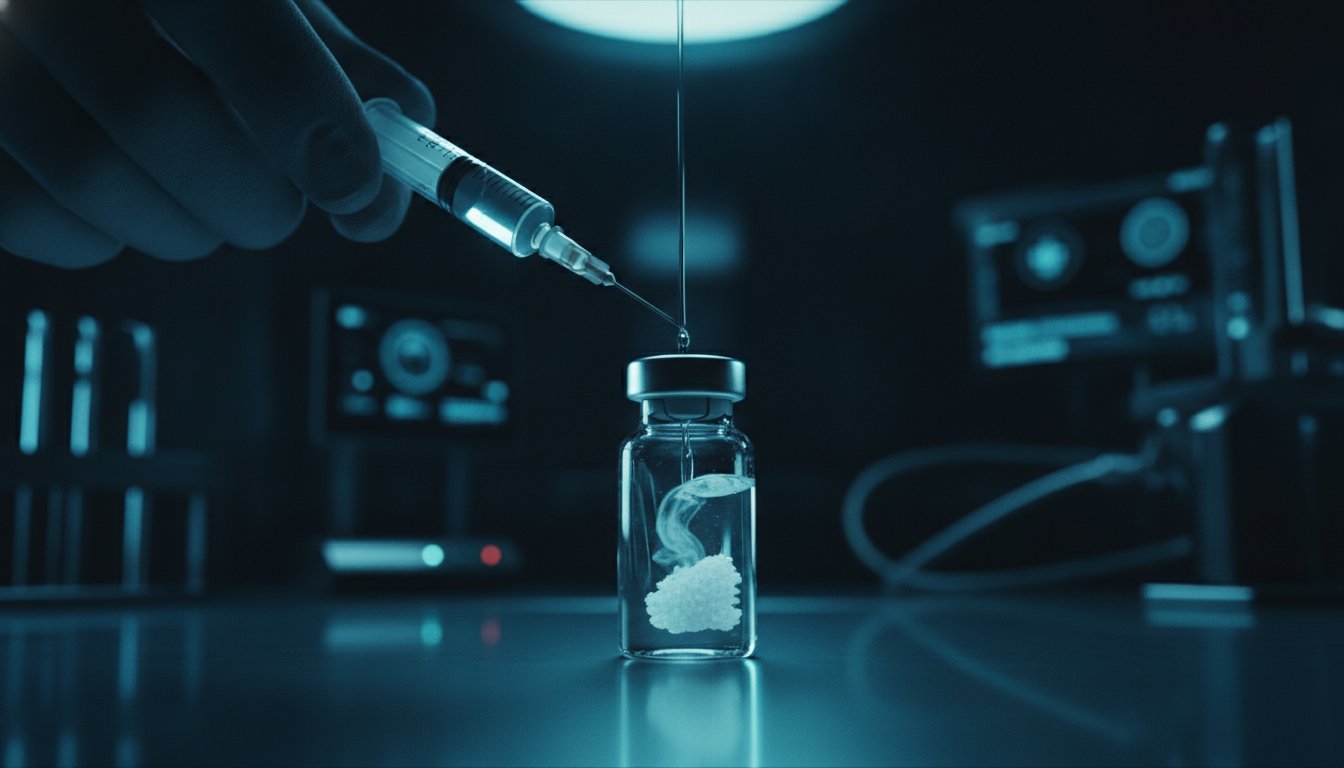
A single error in solvent selection or a momentary lapse in temperature control doesn't just cloud a vial. It permanently denatures the primary sequence. This renders months of laboratory work statistically irrelevant. In the high-precision field of peptide reconstitution research, the solvent is the vessel and the peptide sequence is the map. Precision is the only acceptable standard. Stoic reliability in the lab starts with the realization that molecular integrity is fragile.
You've likely encountered the frustration of irreversible aggregation or the subtle loss of bioactivity caused by improper pH balancing. It's a common hurdle when handling complex lyophilized powders. This laboratory guide provides the rigorous protocols needed to maintain ≥99% purity after dissolution and ensure the long-term stability of your stock solutions. We'll examine the technical requirements for achieving a fully dissolved, clear solution for accurate dosing. We also address the implications of the April 2026 reclassifications, navigating the regulatory currents to ensure your methodologies align with current laboratory standards for compounds like Retatrutide and Tirzepatide.
Key Takeaways
- Master the "like-dissolves-like" principle to select optimal solvents based on specific peptide hydrophobicity and polarity requirements.
- Implement aseptic laboratory protocols for peptide reconstitution research to navigate the delicate phase transition while maintaining molecular integrity.
- Identify early visual indicators of aggregation and apply pH adjustment strategies to rescue solutions approaching their isoelectric point.
- Establish rigorous storage standards for liquid stock solutions to mitigate the accelerated bioactivity decay that begins immediately upon reconstitution.
- Calculate precise solvent volumes to achieve specific mg/mL concentrations, ensuring the ≥99% purity of research compounds remains intact for experimental reproducibility.
Principles of Peptide Reconstitution in Molecular Research
Reconstitution is the critical restoration of a lyophilized peptide to its liquid phase. It's a phase transition where precision dictates the outcome. Within the broader context of Principles of Peptide Reconstitution, this process is less about simple dissolution and more about maintaining the delicate folding of the molecule. It's a chemical navigation task. The transition requires a controlled fluidity. If the solvent is added too aggressively, the resulting shear stress can denature the peptide. This renders the compound useless for high-stakes laboratory analysis.
Research-grade protocols differ significantly from clinical preparation. While clinical settings might prioritize delivery speed or patient convenience, peptide reconstitution research demands absolute preservation of the primary and secondary molecular structures. The goal is experimental reproducibility. Lyophilization acts as a stabilizing anchor in this process. It locks the peptide's secondary structure into a solid matrix; this prevents the kinetic energy of liquid-state molecules from causing premature degradation or unfolding during transit. Without this "freeze-dried" state, enzymatic degradation would compromise the sample before it reached the laboratory bench.
The Anatomy of a Lyophilized Peptide Vial
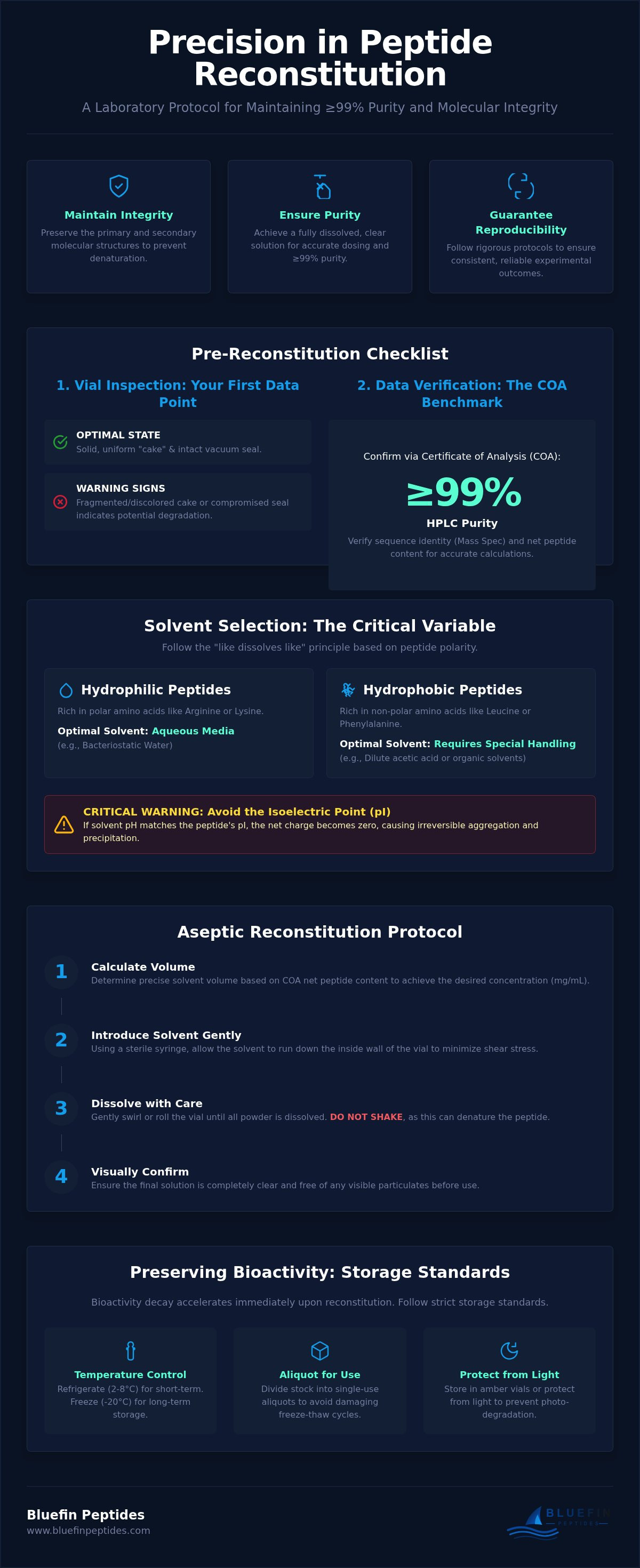
Vial morphology provides immediate data regarding the product's history. A solid, uniform "cake" indicates a high-quality freeze-drying cycle with optimal cryoprotectants. While a loose powder can occur due to physical agitation during shipping, a fragmented or discolored cake may suggest moisture ingress or thermal stress. Vacuum-sealed vials are essential for preventing oxidative degradation. They eliminate atmospheric oxygen, which is the primary driver of decay for sensitive residues like methionine or cysteine. Before opening a Bluefin Peptides vial, researchers should inspect the flip-off cap and the stopper's vacuum seal. A compromised seal is a breach of molecular security.
Verification Before Reconstitution: The COA Benchmark
Data verification must precede the introduction of the first drop of solvent. Every batch requires interpreting peptide mass spectrometry data to confirm the identity of the sequence. HPLC purity levels, specifically those ≥99% provided by Bluefin, aren't just marketing metrics. They are the variables that dictate the precision of your final concentration. Without a batch-specific Certificate of Analysis (COA), calculating solvent volume is mere guesswork. You must confirm the exact molecular weight and net peptide content to achieve a clear, reproducible stock solution. This level of scrutiny is fundamental to modern peptide reconstitution research. It ensures the data gathered is a reflection of the peptide's true bioactivity, not a result of contamination or improper dosing.
Selecting Solvents Based on Peptide Hydrophobicity and pH
Solvent selection is the most critical variable in peptide reconstitution research. It follows the fundamental biochemical principle of "like dissolves like." A peptide's primary sequence dictates its solubility profile. Hydrophilic peptides, rich in polar amino acids like arginine or lysine, dissolve readily in aqueous media. Conversely, hydrophobic sequences containing leucine or phenylalanine require a reduction in solvent surface tension. Navigating these polarities requires a precise analysis of the peptide's net charge at a specific pH. If the solvent pH matches the peptide's isoelectric point (pI), the net charge becomes zero. This often leads to immediate precipitation or irreversible aggregation. It's a chemical dead end.
Stability is as vital as solubility. Extreme pH levels can trigger deamidation, particularly in sequences containing asparagine or glutamine. This chemical degradation alters the molecular weight and destroys bioactivity. For researchers utilizing high-purity compounds, maintaining a stable pH environment is non-negotiable. It ensures the structural integrity of the sample throughout the duration of the study. A disciplined approach to solvent chemistry prevents the loss of valuable research material.
Common Reconstitution Solvents and Their Applications
Bacteriostatic Water (0.9% Benzyl Alcohol) is a standard choice for multi-use research vials. The benzyl alcohol acts as a preservative, inhibiting bacterial growth for approximately 28 days. However, it's not universal. Some sensitive cell cultures or specific assays may react poorly to the preservative. In these cases, Sterile Water for Injection (SWFI) is the preferred alternative, though it lacks antimicrobial properties and must be used or discarded immediately. For highly hydrophobic peptides that resist aqueous dissolution, organic solvents like DMSO or 10% Acetic Acid are necessary. These should be used sparingly to initiate dissolution before slowly diluting with a secondary aqueous buffer to reach the final concentration.
Solvent Compatibility for GLP-1 and GIP Analogues
Modern analogues present unique challenges. When working with tirzepatide research peptide, the presence of a C20 fatty acid diacid side chain increases hydrophobicity. This requires a methodical approach to ensure a clear solution. Retatrutide, with its complex triple-agonist structure, is similarly sensitive to rapid pH shifts. Researchers often encounter unexpected precipitation when using Phosphate-Buffered Saline (PBS). The salts in PBS can interfere with the peptide's ionic bonds, leading to "salting out" effects. Achieving a clear, fully dissolved solution requires a deep understanding of these molecular nuances. For those seeking verified starting materials, choosing HPLC-verified research peptides provides the necessary baseline for reliable solvent testing.
Executing the Reconstitution Protocol: A Step-by-Step Laboratory Guide
Execution is the bridge between theoretical purity and experimental utility. In peptide reconstitution research, the laboratory environment must function as a sterile harbor. Any breach in aseptic technique introduces contaminants that can catalyze enzymatic degradation. Precision begins with temperature calibration. Peptides and solvents must reach room temperature, typically between 20°C and 25°C, before mixing. Cold solvents can reduce solubility and induce thermal shock. Conversely, excessive heat accelerates molecular decay. A successful reconstitution results in a clear, colorless solution. Any opalescence or particulate matter indicates a failure in the protocol or a peptide approaching its isoelectric point. Calculating the precise volume is a matter of basic stoichiometry. To achieve a 5mg/mL concentration in a 10mg vial, exactly 2mL of solvent is required. For a 5mg vial, 1mL of solvent yields the same concentration. These calculations must be verified against the net peptide content listed on the batch-specific COA.
Step 1-3: Preparation and Pressure Equalization
Sanitizing the septum with 70% isopropyl alcohol is the first line of defense against microbial ingress. Allow the surface to air-dry completely to avoid introducing trace propanol into the solution. Vacuum-sealed vials, such as those used for Bluefin's Retatrutide or Tirzepatide, require careful pressure management. Draw air into your syringe equal to the intended solvent volume before piercing the septum. This equalization prevents the solvent from spraying forcefully against the lyophilized cake, which can cause foaming. Introduce the liquid slowly down the interior glass wall. This allows the solvent to gently wash over the powder rather than impacting it directly, preserving the molecular integrity from the first contact.
Step 4-6: Dissolution and Aliquoting
Gentle rotation is the only acceptable method for mixing. Shaking or vortexing creates high-shear environments that can denature the peptide's delicate secondary structure. After the powder appears visually dissolved, allow the vial to rest for 10 minutes. This period of stillness ensures complete molecular hydration and allows micro-bubbles to dissipate. Once the solution is stable, aliquot the stock into smaller, sterile vials. Minimizing freeze-thaw cycles is essential for maintaining the ≥99% purity of your sample. Each thermal transition risks inducing aggregation and reducing the effective concentration. In peptide reconstitution research, these disciplined steps ensure that your results are a reflection of the peptide's true bioactivity rather than a consequence of handling errors.
Managing Solubility Challenges and Peptide Aggregation
Aggregation is the primary failure point in peptide reconstitution research. It represents a thermodynamic trap where molecules prefer self-association over solvent interaction. Identifying these failures early is vital for data integrity. Visual indicators like opalescence, persistent cloudiness, or the presence of macroscopic particulates are clear signals of molecular clumping. These physical states suggest the peptide isn't fully hydrated. This leads to inaccurate dosing and skewed experimental results. Utilizing high-purity materials is the first line of defense. Bluefin Peptides provides compounds with ≥99% HPLC-verified purity. This rigorous standard minimizes the presence of residual synthesis impurities that often act as "seeds" or nucleation sites for irreversible aggregation. Lower purity compounds are inherently more prone to these solubility barriers.
Why Peptides Fail to Dissolve
Solubility failures often stem from isoelectric point (pI) conflicts. When the pH of the solvent matches the pI of the peptide, the net charge of the molecule becomes zero. Without a net charge, electrostatic repulsion vanishes, and the molecules aggregate. Hydrophobic clumping is another frequent hurdle, particularly in sequences with long aliphatic chains. These molecules hide their non-polar regions from the aqueous environment, creating tight, insoluble clusters. The 'salting out' effect occurs when high salt concentrations in buffers like PBS compete for water molecules. This leaves the peptide insufficiently hydrated. Understanding these chemical drivers is the first step in successful navigation.
Advanced Troubleshooting Techniques
The 'Rescue' Protocol involves strategic pH manipulation to restore molecular charge. For basic peptides that resist dissolution, adding a small volume of 10% acetic acid can lower the pH and induce a positive charge. Conversely, acidic peptides often require a drop of 10% ammonium hydroxide to raise the pH and create a negative charge. If these adjustments fail, sonication serves as a last-resort tool. Brief pulses of ultrasonic energy can provide the mechanical force needed to break stubborn hydrophobic bonds. However, this must be monitored closely to prevent heat-induced denaturation. In some complex blends, scavengers or stabilizers are necessary to prevent oxidative cross-linking. If a solution remains cloudy after these interventions, the sample's likely degraded. Move to a fresh vial. Professional laboratory work demands the courage to discard compromised materials. Secure your experimental reproducibility by utilizing HPLC-verified research peptides that meet the highest purity benchmarks.
Preservation of Reconstituted Peptides: Stability and Storage Standards
The transition from a lyophilized cake to a liquid solution is a transition from stability to vulnerability. In the field of peptide reconstitution research, the moment of dissolution initiates a relentless countdown. While lyophilized peptide storage can preserve molecular integrity for years; liquid stocks are susceptible to hydrolysis and oxidation within days or weeks. Light sensitivity adds another layer of risk. UV radiation can catalyze the cleavage of peptide bonds, particularly in aromatic residues. This necessitates the use of amber vials or storage in complete darkness. The freeze-thaw cycle is perhaps the most destructive force. As water expands into ice crystals, it creates mechanical shearing forces that physically tear the peptide's secondary structure. This is why aliquoting into single-use volumes, as discussed in the protocol section, is a non-negotiable standard for maintaining high-purity results.
Short-term vs. Long-term Liquid Stability
Active research phases require refrigeration between 2°C and 8°C. This slows kinetic energy and enzymatic activity without the mechanical risks of freezing. Standard -20°C freezers are often unsuitable for liquid peptides because of frost-free cycles. These cycles cause micro-fluctuations in temperature, leading to repeated partial thawing and refreezing at the molecular level. For long-term liquid preservation, ultra-low temperature freezers (-80°C) are the only reliable option. They lock the solution into a vitrified state, effectively halting the chemical clock. Stoic reliability in the lab depends on choosing the right thermal harbor for your compounds. If -80°C storage isn't available, it's better to keep the peptide in its lyophilized state until the day of the experiment.
Documentation and Laboratory Compliance
Documentation is the final pillar of experimental reproducibility. Labels must be meticulous. Every vial should clearly state the date of reconstitution, the final concentration, the solvent utilized, and the batch ID. Tracking the solution's age is essential. A peptide reconstituted 14 days ago may exhibit different bioactivity than one prepared 24 hours ago. Compliance isn't about paperwork. It's about data integrity. To ensure your peptide reconstitution research begins with a foundation of excellence, adhere to the research peptide quality standards established by Bluefin Peptides. High-purity compounds demand high-purity preservation. By maintaining these rigorous storage standards, you protect the molecular integrity of your samples and the validity of your laboratory data.
Advancing Molecular Precision Through Standardized Protocols
Standardizing your approach to peptide reconstitution research is the only way to ensure experimental reproducibility in an evolving regulatory landscape. By mastering solvent polarities and implementing aseptic pressure equalization, you eliminate the variables that lead to aggregation and denatured sequences. Precise documentation and ultra-low temperature storage preserve the structural integrity you've worked to establish. Quality research depends on the intersection of rigorous methodology and verified starting materials. When you remove the uncertainty of synthesis impurities, your laboratory results become a clear reflection of molecular potential. We provide the tools for this verification, ensuring your study begins with absolute clarity.
Secure HPLC-Verified Peptides for Your Next Study. Our commitment to quality includes ≥99% HPLC Purity Guaranteed, Mass-Spec Confirmation Included for every batch, and Fast Domestic US Shipping to maintain your laboratory momentum. Trust your results to a partner that prioritizes data over marketing. We're ready to support your next breakthrough with the precision your work demands.
Frequently Asked Questions
Is bacteriostatic water the same as reconstitution solution?
No. Bacteriostatic water is a specific solvent containing 0.9% benzyl alcohol to inhibit microbial growth. "Reconstitution solution" is a broad category that includes sterile water, saline, and various organic buffers. Selecting the correct vessel for your peptide depends entirely on the sequence's hydrophobicity and the intended duration of the research phase. Using the wrong medium can lead to immediate precipitation.
Can I shake the vial to speed up the dissolution process?
No. Shaking creates high-shear environments that can permanently denature a peptide's secondary structure. This physical stress causes the molecule to unfold, rendering the compound biologically inactive. Use the gentle rotation technique instead. Allow the solvent to wash over the lyophilized cake and let the vial rest to ensure total molecular hydration without mechanical shearing.
What should I do if my peptide solution remains cloudy after 20 minutes?
Initiate the rescue protocol by adjusting the solution's pH away from the isoelectric point. Cloudiness indicates that the peptide's net charge is near zero, causing molecules to clump. For basic peptides, add a small volume of 10% acetic acid. For acidic sequences, use 10% ammonium hydroxide. This restores electrostatic repulsion and allows the peptide to move back into the liquid phase.
How long can a reconstituted peptide stay at room temperature?
Limit ambient exposure to the absolute minimum required for peptide reconstitution research protocols. Thermal energy accelerates the kinetic decay of peptide bonds. While some stable sequences may survive a few hours, most begin to degrade within 120 minutes of reaching room temperature. Always return stock solutions to refrigeration (2°C to 8°C) immediately after the aliquoting process is complete.
Does the concentration of the solution affect the peptide's stability?
Concentration is a primary variable in molecular stability and aggregation risk. Higher concentrations increase the frequency of molecular collisions, which can lead to irreversible clumping even in optimal solvents. Standard laboratory concentrations between 2 mg/mL and 5 mg/mL typically offer the best balance of stability and dosing accuracy. Highly concentrated stocks often have a significantly shorter shelf life.
Can I mix two different research peptides in the same vial during reconstitution?
No. Co-reconstitution is not a standard laboratory practice because it introduces unpredictable ionic interactions. Different sequences have varying pH requirements and isoelectric points. Mixing them in a single vial can cause one peptide to precipitate the other or lead to cross-linking. Reconstitute each compound in its own sterile harbor to maintain the integrity of your experimental data.
What is the best way to prevent air bubbles when drawing from the vial?
Pressure equalization is the technical standard for bubble prevention. Before drawing the solution, inject a volume of air into the vial equal to the liquid volume you intend to withdraw. This prevents the vacuum from creating turbulence. Invert the vial and ensure the needle tip remains submerged below the fluid line to maintain a steady, bubble-free flow during the draw.
How do I calculate the amount of solvent needed for a 5mg vial to get a 2mg/mL concentration?
Use exactly 2.5 mL of solvent. The calculation is straightforward stoichiometry: divide the total mass (5 mg) by the target concentration (2 mg/mL). This level of mathematical precision is fundamental to peptide reconstitution research. Always verify the net peptide content on your batch COA before final calculations, as the actual mass may vary slightly from the nominal vial size.
For laboratory research use only. Not for human or veterinary use. This content is educational and does not constitute medical, dosing, or usage guidance.
Browse the BLUEFIN catalog