Technical Guide to Peptide Reconstitution Solvents
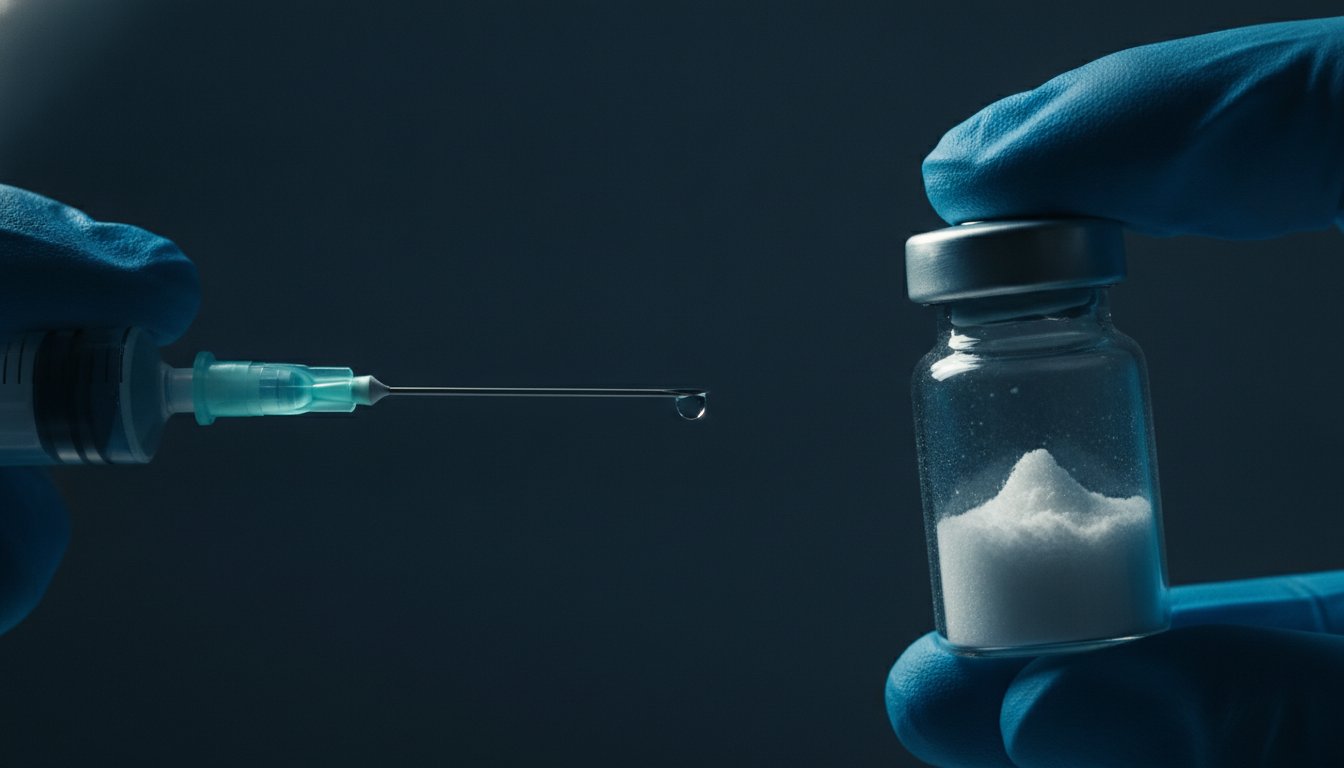
A single error in chemical solvation can render a high-purity lyophilized peptide biologically inert before it ever reaches the assay. While many laboratories treat the process as a standardized formality, the reality is that choosing the right solvent for peptide reconstitution is a high-stakes decision dictated by sequence-specific hydrophobicity and net molecular charge. You've likely witnessed the frustration of a sequence "crashing out" of solution or the subtle loss of bioactivity that occurs when an incorrect pH disrupts delicate hydrogen bonding. It's an avoidable drain on both time and high-value research material.
This technical guide provides the analytical framework necessary to master the biochemical principles of solvent selection. You'll learn how to ensure the structural integrity and solubility of your research peptides, achieving maximum stability for complex GLP-1 and GIP analogues. We'll chart the precise coordinates for maintaining zero contamination and optimal solvation through a rigorous examination of pH adjustment, organic co-solvents, and sterile filtration protocols. From understanding the impact of 2026 HHS reclassifications on research workflows to implementing batch-level documentation, this is your blueprint for laboratory precision.
Key Takeaways
- Identify the biochemical requirements of your specific peptide sequence to prevent premature hydrolysis and preserve the structural integrity of the peptide bond during solvation.
- Establish a clear framework for choosing the right solvent for peptide reconstitution by evaluating the necessity of bacteriostatic preservatives versus sterile, single-use diluents.
- Determine when complex hydrophobic sequences require organic co-solvents like DMSO to ensure complete solubility and prevent compounds from precipitating out of solution.
- Apply rigorous aseptic techniques and precise volume calculation protocols to maintain target molarity and eliminate contamination risks during the reconstitution process.
- Implement standardized storage and temperature management strategies to mitigate the "Clock of Degradation" and maximize the stability of reconstituted research compounds.
The Science of Solubilization: Why Reconstitution Precision Dictates Research Integrity
Peptide reconstitution is the precise transition of a lyophilized solid into a homogenous liquid phase. This isn't a simple dilution; it's a chemical restoration. Peptides are short chains of amino acids that remain highly sensitive to their environment. Lyophilization protects the peptide bond by removing water through sublimation, which prevents premature hydrolysis during storage. However, this protection ends the moment the vial is accessed. If the solvent isn't matched to the sequence, you risk irreversible aggregation or improper secondary structure folding. High-purity research requires high-purity standards. When working with HPLC-verified compounds (≥99%), predictable solubility outcomes depend entirely on choosing the right solvent for peptide reconstitution.
Understanding the Lyophilized State
The freeze-drying process creates a porous, high-surface-area structure known as the "cake." This morphology allows for rapid dissolution when the correct diluent is introduced. You might notice the cake appearance varies between batches. Some appear as a solid plug, while others look like a loose powder. These visual differences are often artifacts of the lyophilization cycle and don't affect the mass-spec confirmation or purity. The vacuum seal within the vial is the primary defense against atmospheric moisture. Breaking this seal prematurely can lead to peptide degradation before the solvent even touches the powder. Maintaining this vacuum until the point of use is a non-negotiable laboratory standard for ensuring compound stability.
Chemical Polarity and Solubility
Solubility follows the "like dissolves like" principle. The interaction between the peptide and the solvent is governed by the amino acid side chains. Polar side chains prefer aqueous environments. Non-polar, hydrophobic side chains require different handling. The net charge of the sequence determines how it interacts with the solvent's dipoles. A critical factor here is the isoelectric point. The isoelectric point (pI) is the specific pH at which a peptide carries no net electrical charge and typically exhibits its lowest solubility. Understanding the pI is essential when choosing the right solvent for peptide reconstitution to avoid "crashing out" the compound. Precision in these early steps ensures the integrity of the entire research project. Using a solvent that pushes the pH away from the pI will generally improve the solubility of the compound in aqueous media.
Primary Aqueous Solvents: Comparing Bacteriostatic Water and Sterile Diluents
Aqueous reconstitution remains the most common methodology for laboratory peptides. The decision process for choosing the right solvent for peptide reconstitution hinges on the balance between microbial suppression and chemical stability. While high-purity water serves as the base, the addition of preservatives or buffers alters the compound's long-term viability and the integrity of the resulting data. Precision in this stage is vital. A failure to account for the solvent's chemical properties can lead to rapid degradation before the research concludes.
Bacteriostatic Water for Multi-Dose Research
Bacteriostatic water is the industry standard for multi-use vials. It contains 0.9% benzyl alcohol, which functions as a bacteriostatic agent by disrupting bacterial cell wall synthesis and metabolic processes. This allows researchers to access the same vial multiple times over a 28-day period when stored at 2°C to 8°C. This antimicrobial protection is indispensable for long-term studies. However, benzyl alcohol is a mild organic solvent. It can occasionally interfere with specific HPLC verified assays by shifting the baseline or interacting with highly sensitive hydrophobic regions of the peptide. Despite this, for compounds like Retatrutide Research Peptide, the protection against contamination usually outweighs the negligible risk of solvent-induced denaturation. The chemical stability provided by the preservative ensures that the peptide remains viable for the duration of the testing cycle.
Sterile Water and Saline Alternatives
Sterile Water (WFI) is devoid of preservatives. It's the preferred choice for single-use applications or in vitro models where benzyl alcohol might induce cytotoxicity. Because it lacks an antimicrobial agent, any peptide reconstituted in WFI must be used immediately or discarded to avoid contamination risks. This solvent is purely for immediate consumption in a controlled assay environment. It's the cleanest option for sensitive cellular models but offers no protection against the rapid proliferation of bacteria once the seal is breached.
Normal Saline (0.9% NaCl) and Phosphate-Buffered Saline (PBS) are utilized when osmotic pressure or pH stability is paramount. PBS is particularly effective at maintaining a physiological pH of 7.4. This prevents the peptide from drifting toward its isoelectric point, a state we previously identified as a primary cause of precipitation. When working with complex sequences like Tirzepatide Research Peptide, maintaining this pH balance can prevent the formation of insoluble aggregates. Researchers should note that unpreserved aqueous solutions facilitate rapid degradation through hydrolysis. Without the stabilizing presence of a buffer or the protection of a bacteriostat, the "clock of degradation" accelerates significantly. Choosing the correct diluent requires a deep understanding of the intended assay's sensitivity and the peptide's inherent chemical vulnerabilities.
Navigating Hydrophobicity: Using DMSO and Organic Solvents for Complex Peptides
Standard aqueous solvents often fail when sequences contain a high percentage of non-polar amino acids. Leucine, Valine, and Phenylalanine create hydrophobic pockets that resist hydration. This resistance causes the lyophilized cake to clump or remain suspended as an insoluble precipitate. Precision in choosing the right solvent for peptide reconstitution requires a sequence analysis before any liquid touches the vial. When hydrophobicity exceeds 50%, organic modifiers become necessary to break these intermolecular forces. These solvents act as a bridge, allowing the peptide to interact with the aqueous environment without aggregating.
The DMSO Protocol for Research Peptides
Dimethyl Sulfoxide (DMSO) is a powerful dipolar aprotic solvent. It disrupts the hydrogen bonding network that leads to peptide aggregation. For complex compounds like the retatrutide research peptide, an initial dissolution in 100% DMSO is often the only way to achieve a clear solution. The "minimal effective volume" strategy is critical here. You should use the smallest amount of DMSO possible to achieve clear solvation before slowly adding the primary aqueous diluent. This stepwise approach prevents the peptide from "crashing out" when it hits the water.
To prevent toxicity in cellular assays, the final concentration of DMSO should remain below 1%. Researchers must calculate this final molarity carefully. High DMSO concentrations can denature proteins or alter cell membrane permeability, which skews data. It's a balance between total solubility and assay sensitivity. If the peptide begins to cloud during aqueous dilution, it indicates the organic concentration has dropped below the threshold required to maintain solvation. In such cases, a higher final percentage of DMSO or a different co-solvent strategy might be required.
PH Adjustment for Solubility Optimization
If DMSO is unsuitable, adjusting the solvent pH can often force a recalcitrant peptide into solution. This method relies on changing the ionization state of the amino acid side chains. For basic peptides, adding 10% Acetic Acid increases the net positive charge. This promotes repulsion between molecules and aids dissolution. Conversely, acidic peptides benefit from 10% Ammonium Bicarbonate to increase the net negative charge. Acetonitrile is another alternative modifier, though it's typically reserved for specific laboratory settings like HPLC mobile phase preparations.
Moving the solvent pH away from the peptide pI triggers dissolution by maximizing the electrostatic repulsion between the molecules. This shift overcomes the van der Waals forces that cause aggregation. Always verify the peptide sequence's net charge at your target pH before proceeding with these aggressive modifiers. Accuracy in these early solvation steps protects the HPLC-verified purity of the compound. Failure to move the pH sufficiently can lead to partial dissolution, resulting in inconsistent concentration across aliquots and compromised research integrity.
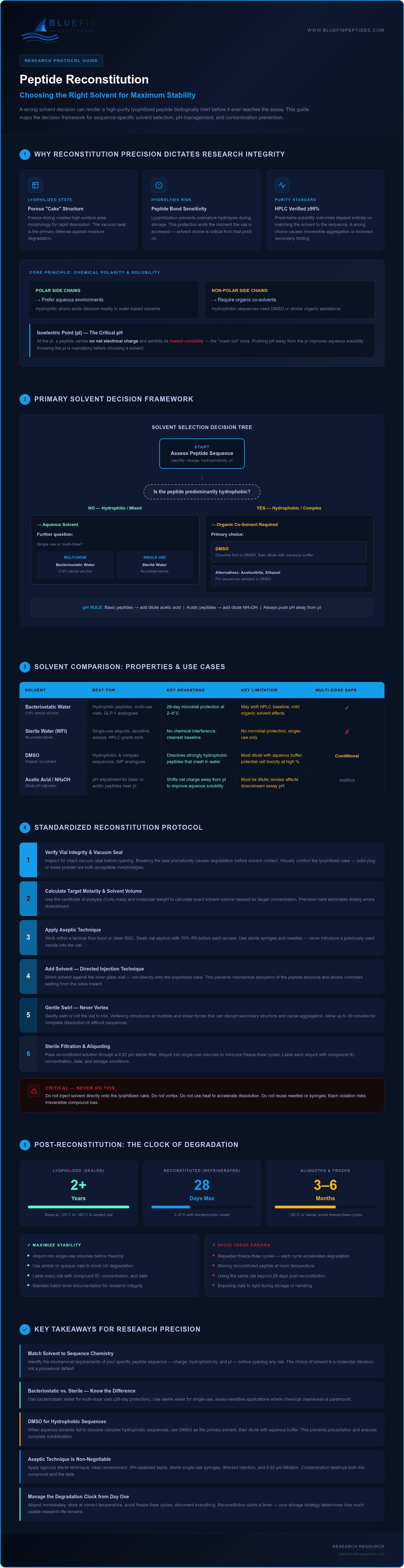
Standardized Laboratory Protocol: A Procedural Guide to Peptide Reconstitution
Choosing the right solvent for peptide reconstitution is a critical prerequisite. However, the physical execution of the solvation process determines the final concentration accuracy and structural integrity of the compound. Laboratory protocols must be rigid. Aseptic technique is mandatory to prevent the introduction of exogenous contaminants during the transition from solid to liquid phase. Environmental controls, including sanitized workstations and sterile implements, provide the necessary security for high-purity research. Every movement should be deliberate.
Calculation of Reconstitution Volumes
Precision begins with the math. The formula for determining the required diluent volume is straightforward: divide the lyophilized mass (mg) by the target concentration (mg/mL). For example, if a researcher requires a concentration of 5mg/mL from a 10mg vial of tirzepatide research peptide, the required volume is exactly 2.0mL.
Researchers must account for displacement volume. The lyophilized powder itself occupies physical space, often between 0.05mL and 0.1mL depending on the mass and excipients used. Additionally, many manufacturers include a slight overfill to ensure the labeled mass is fully recoverable. Ignoring these variables can result in a final molarity that deviates from the calculated target. This deviation potentially skews dose-response data. For the highest accuracy, verify the final volume using calibrated micropipettes after the powder has fully dissolved.
The Reconstitution Sequence
The sequence of operations is designed to mitigate mechanical stress. Most research vials are sealed under a vacuum. The first step involves equalizing this pressure by inserting a sterile needle or slowly introducing the syringe before injecting the solvent. Failure to do so can cause the diluent to be sucked in too rapidly. This creates a high-velocity jet that causes immediate denaturation of the peptide chains.
Once pressure is equalized, use the "Slow Drip" method. Direct the solvent stream down the interior glass wall rather than onto the powder "cake" directly. This allows the liquid to gently wick into the porous structure. After the diluent is added, never shake the vial. Aggressive agitation introduces shear stress that can break delicate bonds and disrupt secondary folding. Instead, use a slow, rhythmic rotation. Roll the vial between your palms until the solution is clear and particulate-free. This ensures the structural integrity of the compound remains intact for downstream applications. To secure HPLC-verified compounds for your next study, source your lyophilized compounds from Bluefin Peptides.
Post-Reconstitution Dynamics: Stability, Storage, and Degradation Mitigation
The transition from a lyophilized solid to a liquid phase initiates the "Clock of Degradation." While lyophilization provides a state of suspended animation, solvation introduces water molecules that facilitate hydrolysis, oxidation, and deamidation. Choosing the right solvent for peptide reconstitution provides the initial stability, but maintaining that integrity requires a rigorous post-reconstitution protocol. Reconstituted compounds are inherently less stable. Their molecular bonds are no longer protected by the porous structure of the freeze-dried cake. They're now subject to the kinetic energy of the liquid environment. Precision in storage is just as critical as precision in solvation.
Temperature management is the primary defense against rapid breakdown. The critical refrigeration range of 2°C to 8°C slows the kinetic motion of the molecules, which reduces the frequency of collisions that lead to aggregation. Researchers must also mitigate chemical threats. Oxidation typically affects sequences containing methionine or cysteine residues, while deamidation often targets asparagine and glutamine. These processes alter the peptide's net charge and secondary structure, effectively rendering the compound useless for high-precision assays.
Short-term vs. Long-term Stability
GLP-1 and GIP analogues exhibit specific stability windows when stored in bacteriostatic water. Under optimal conditions, these sequences remain stable for approximately 28 days. Adherence to research peptide quality standards requires these vials to be stored in light-protected environments. UV exposure can catalyze the breakdown of delicate peptide sequences through photo-oxidation. Researchers must monitor for visual signs of degradation. Turbidity, unexpected color changes, or significant pH shifts indicate that the compound's structural integrity is compromised. These changes often precede a total loss of bioactivity and will skew experimental results.
Advanced Storage Techniques
For multi-week studies, aliquoting is the most effective strategy for mitigating degradation. Repeatedly piercing the septum of a single vial increases the risk of contamination and introduces atmospheric oxygen. By dividing the solution into sterile, low-protein-binding microcentrifuge tubes, researchers can avoid deleterious freeze-thaw cycles. Freezing a reconstituted peptide once is acceptable for long-term storage, but the mechanical stress of repeated crystallization and thawing will denature the chains.
This is particularly vital for complex formulations like the GHK-Cu BPC-157 TB-500 research blend. These blends require absolute temperature consistency to prevent the components from interacting prematurely or precipitating out of the shared solvent. In high-value research, displacing oxygen with an inert gas like Argon or Nitrogen before sealing the vial can further inhibit oxidation. Choosing the right solvent for peptide reconstitution is the first step, but these advanced storage protocols ensure that your HPLC-verified compounds remain viable until the final aliquot is consumed.
Advancing Laboratory Precision through Rigorous Solvation Standards
Mastering the biochemical nuances of solvation is the final safeguard for research integrity. As established, the transition from lyophilized cake to liquid phase is a high-stakes restoration of molecular structure. Precision in choosing the right solvent for peptide reconstitution ensures that your sequence remains biologically active and fully soluble, preventing the costly aggregation that stalls laboratory workflows. By aligning solvent polarity with peptide hydrophobicity and implementing strict temperature controls, you mitigate the inherent risks of hydrolysis and deamidation.
Success in complex assays depends on the underlying purity of your starting material. High-performance research requires verified compounds that meet the most stringent analytical benchmarks. Procure HPLC-Verified Peptides for Your Next Laboratory Study to ensure your data remains untainted by impurities. We provide ≥99% purity guaranteed, supported by batch-specific mass-spec reports and rapid domestic shipping to maintain your research momentum. Maintain your focus on the data. We'll provide the tools for certainty.
Frequently Asked Questions
Is bacteriostatic water the same as reconstitution solution?
Bacteriostatic water is a specific type of reconstitution solution containing 0.9% benzyl alcohol. While the terms are often used interchangeably in laboratory settings, "reconstitution solution" is a broader category that includes sterile water and buffered salines. The inclusion of benzyl alcohol is the defining characteristic of the bacteriostatic variant. It provides necessary antimicrobial protection for multi-use research vials. It's important to verify the specific chemical composition on the manufacturer's label before you begin the solvation process.
Can I use tap water or bottled water to reconstitute peptides?
Tap water and bottled water are unsuitable for laboratory applications. They contain dissolved minerals, organic matter, and microbial contaminants that compromise research integrity. These impurities interact with the peptide's side chains, leading to immediate degradation or unexpected chemical reactions. Only use HPLC-grade sterile water or bacteriostatic diluents. Choosing the right solvent for peptide reconstitution is fundamental to ensuring that your assay results remain verifiable and free from exogenous interference that could skew your data.
What happens if I shake the vial during reconstitution?
Shaking a vial during the solvation process introduces significant mechanical shear stress. This physical force can break the delicate hydrogen bonds that maintain the peptide's secondary and tertiary structures. When these structures are disrupted, the peptide denatures and loses its biological activity. You'll observe a clear solution that is chemically inert. Don't shake the vial; instead, use a rhythmic, horizontal rotation between your palms to encourage dissolution without compromising the structural integrity of the high-purity compound.
Does the reconstituted solution need to be refrigerated immediately?
Immediate refrigeration is mandatory once the lyophilized powder enters the liquid phase. Reconstituted compounds are highly susceptible to enzymatic hydrolysis and thermal degradation. Maintaining a temperature between 2°C and 8°C slows the kinetic energy of the molecules, which preserves the stability of the peptide bond. It's a critical step in degradation mitigation. Leaving a vial at room temperature for extended periods accelerates the breakdown process, resulting in a rapid loss of potency and potential baseline shifts.
How long do peptides remain stable after reconstitution?
Stability duration varies based on the amino acid sequence and the choice of diluent. Most research peptides remain stable for approximately 28 days when reconstituted in bacteriostatic water and stored under refrigeration. If you're using sterile water without preservatives, the stability window is significantly shorter. In these cases, the solution should be used within 24 hours. Factors like light exposure and pH drift also influence the rate at which the compound loses its integrity over time.
Why did my peptide turn cloudy after adding the solvent?
Cloudiness, or turbidity, typically signifies that the peptide has precipitated out of the solution. This often occurs when the solvent's pH is too close to the peptide's isoelectric point, where the net charge is zero. It can also indicate that the sequence is too hydrophobic for a purely aqueous environment. In such instances, choosing the right solvent for peptide reconstitution may require the addition of organic co-solvents like DMSO to achieve a fully homogenous liquid phase.
Can I freeze a peptide after it has been reconstituted?
You can freeze a reconstituted peptide for long-term storage, but you must avoid repeated freeze-thaw cycles. The formation of ice crystals creates mechanical pressure that can shear the peptide chains. If long-term storage is necessary, divide the solution into single-use aliquots using low-protein-binding tubes before the initial freeze. This allows you to thaw only the amount needed for a specific assay, which protects the remaining stock from structural damage and the potency loss associated with temperature fluctuations.
How do I know if my peptide is hydrophobic before choosing a solvent?
Hydrophobicity is determined by the ratio of non-polar amino acids within the sequence. Examine the primary structure for residues such as Leucine, Isoleucine, Valine, and Phenylalanine. If these hydrophobic residues constitute more than 50% of the total sequence, the peptide will likely resist aqueous dissolution. Performing this sequence analysis is a prerequisite for choosing the right solvent for peptide reconstitution. It allows researchers to anticipate solubility challenges and select appropriate organic modifiers or pH buffers before attempting solvation.
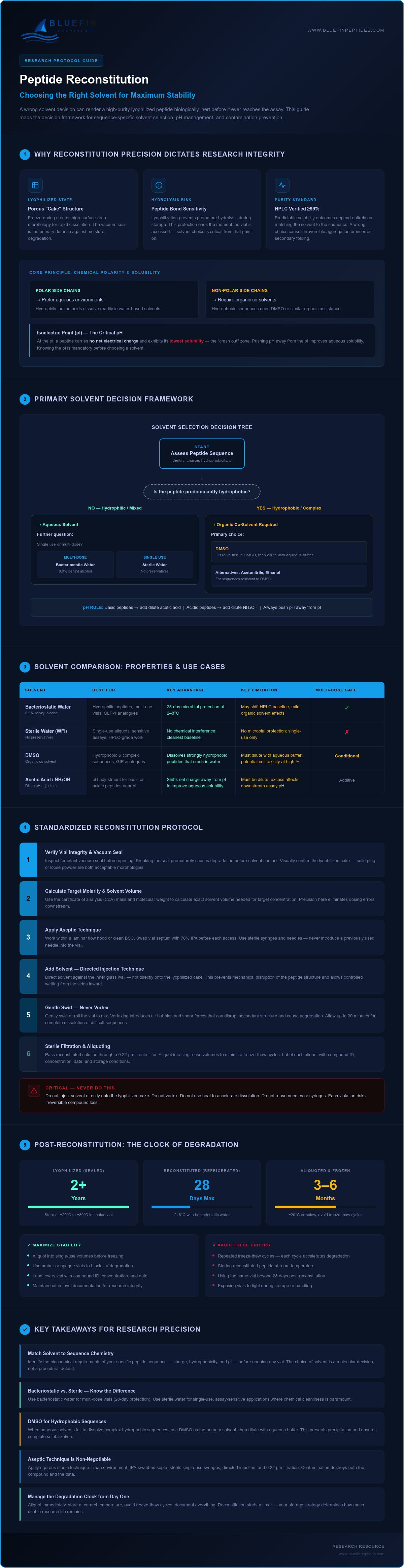
For laboratory research use only. Not for human or veterinary use. This content is educational and does not constitute medical, dosing, or usage guidance.
Browse the BLUEFIN catalog