TB-500 Research Peptide: Molecular Profile and Laboratory Specifications (2026)
The benchmark for synthetic peptide research in 2026 has transitioned from simple procurement to exhaustive molecular verification. Following the FDA's July 2026 PCAC review, the margin for analytical error has vanished. Researchers cannot risk batch inconsistency or the absence of verifiable data. Scientific integrity requires a BPC-157 TB-500 research blend supported by ≥99% HPLC purity and mass spectrometry confirmation to ensure experimental reproducibility.
Reliable data depends on the chemical stability and identity of your reagents. We recognize that inconsistent batch purity from secondary vendors compromises the integrity of high-stakes laboratory environments. This technical analysis provides a comprehensive molecular profile of the TB-500 fragment and establishes strict protocols for laboratory handling and reconstitution. We will examine the signaling mechanisms of these compounds and detail the logistics of securing HPLC-verified standards from US-based facilities. Prepare to navigate the complexities of 2026 research with clinical precision and deep-sea accuracy. Every data point matters when accuracy is the only currency that counts.
Key Takeaways
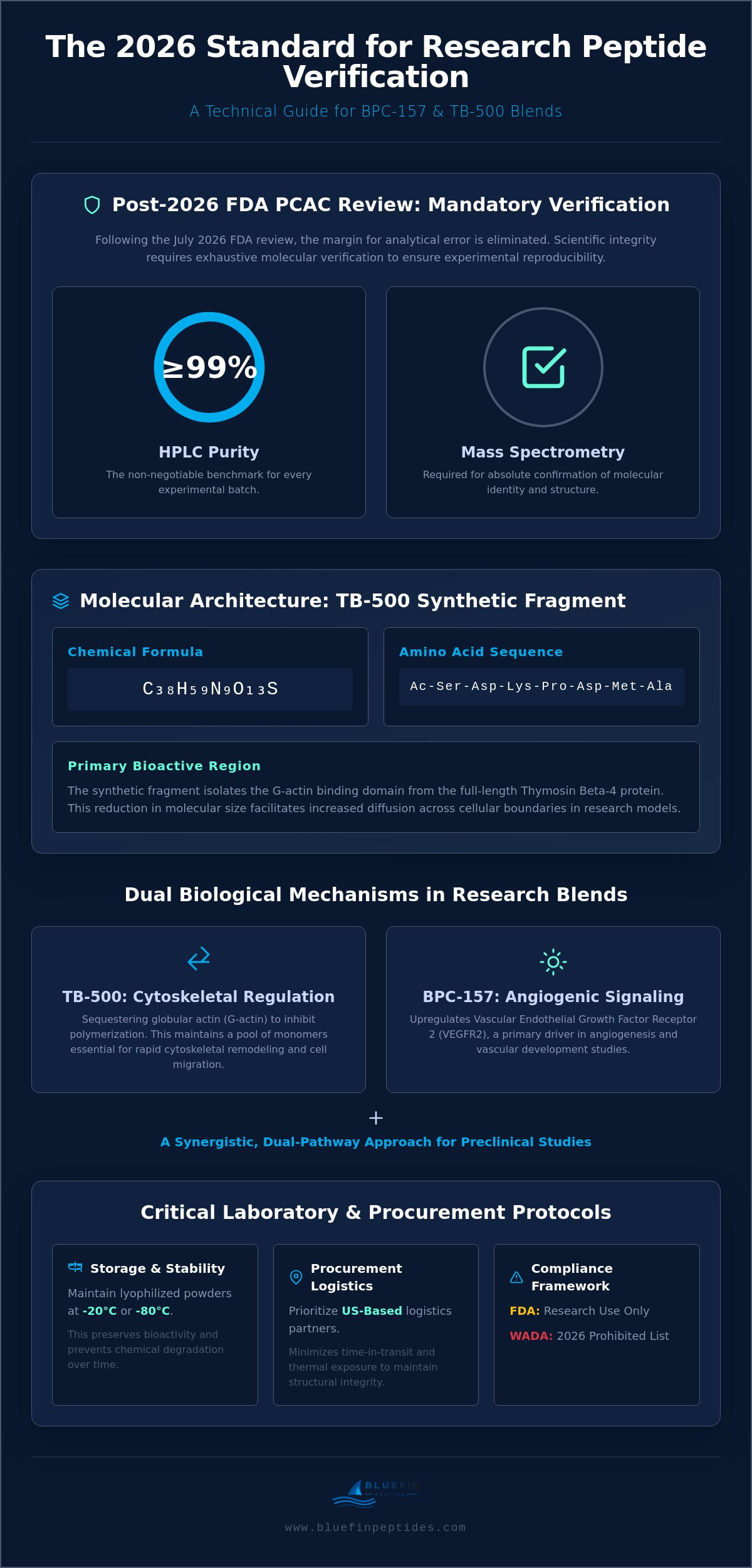
- Analyze the molecular architecture of the TB-500 synthetic fragment. Identify the specific chemical formula C38H59N9O13S to ensure accurate analytical identification in your laboratory.
- Evaluate the biological signaling mechanisms involving actin-sequestering and angiogenesis. These pathways define how the peptide interacts with cellular machinery in research models.
- Verify the analytical standards required for a high-performance BPC-157 TB-500 research blend. Prioritize ≥99% HPLC purity and mass spectrometry identity confirmation for every experimental batch.
- Establish rigorous laboratory protocols for storage and stability. Maintain lyophilized powders at -20°C or -80°C to preserve bioactivity and prevent chemical degradation over time.
- Optimize procurement by selecting US-based logistics partners. Minimizing time-in-transit and thermal exposure is vital for maintaining the structural integrity of sensitive research chemicals.
The Molecular Architecture of TB-500 Research Peptide
The TB-500 research peptide represents a high-precision synthetic fragment derived from the endogenous protein Thymosin Beta-4 (Tβ4). It's specifically an N-terminal acetylated 7-amino acid sequence: Ac-Ser-Asp-Lys-Pro-Asp-Met-Ala. For rigorous analytical identification, researchers must verify the chemical formula C38H59N9O13S. This specific sequence dictates the peptide's behavior in aqueous solutions and its interaction with cellular matrices. TB-500 is a synthesized regenerative signaling peptide used exclusively for laboratory investigation. It's not a pharmaceutical drug. It's a tool for molecular inquiry.
Unlike the full-length 43-amino acid Tβ4 protein, the TB-500 fragment isolates the bioactive region responsible for actin-sequestering. This reduction in molecular size facilitates increased diffusion across cellular boundaries. When utilized in a BPC-157 TB-500 research blend, the synergy between these distinct molecular pathways becomes a focal point for preclinical studies. Accuracy in these models relies entirely on the structural integrity of the synthetic fragment. Batch-to-batch consistency is the only way to ensure reproducible data.
Bioactive Regions and Sequence Homology
The primary mechanism of the TB-500 fragment centers on its G-actin binding domain. This specific region is mirrored in the synthetic fragment to maintain functional homology with endogenous mammalian proteins. Its low molecular weight allows for rapid movement through interstitial spaces. This fluid movement is essential for studying localized cellular migration and cytoskeletal regulation. Verification of this sequence through mass spectrometry ensures that the synthetic analog remains a faithful surrogate for endogenous signaling processes. It behaves with deep-sea precision within experimental environments.
The 2026 Regulatory Landscape for Research Peptides
The current regulatory environment requires absolute transparency. Following the July 2026 FDA Pharmacy Compounding Advisory Committee review, the distinction between research-grade chemicals and compounded pharmaceuticals has been sharply defined. TB-500 remains classified as a "Research Use Only" chemical. It's not approved for human consumption or clinical application. This labeling is a strict requirement for laboratory compliance. Additionally, the World Anti-Doping Agency (WADA) maintains TB-500 on the 2026 Prohibited List as a Growth Factor Modulator. Researchers must adhere to these legal boundaries to maintain institutional standing. Procuring a BPC-157 TB-500 research blend requires a partner that prioritizes documentation over marketing claims. Verification is the only path to security.
Biological Signaling and Cellular Mechanisms in Research Models
The biological efficacy of TB-500 centers on its capacity to sequester globular actin (G-actin). By forming a 1:1 complex with actin monomers, the peptide inhibits their polymerization into filamentous actin (F-actin). This biochemical interaction maintains a critical pool of unpolymerized actin. It provides the necessary raw materials for rapid cytoskeletal remodeling during cell migration. In a BPC-157 TB-500 research blend, this cytoskeletal regulation operates alongside BPC-157's upregulation of VEGFR2. The result is a dual-pathway approach to studying tissue repair. Accuracy in these models requires a deep understanding of TB-500 metabolism and its synthetic analogs.
Signal transduction via the PI3K/Akt pathway is a primary driver of TB-500’s activity in regenerative research. This axis controls cellular survival, proliferation, and motility. Laboratory observations indicate that TB-500 also modulates matrix metalloproteinases (MMPs), specifically MMP-2 and MMP-9. These enzymes are responsible for the controlled degradation of the extracellular matrix. This process is vital. It allows migrating cells to navigate through dense tissue environments. Without this enzymatic activity, cellular movement is significantly impeded. Researchers seeking to maintain the highest analytical standards often utilize HPLC-verified research blends to ensure data reproducibility.
Angiogenesis and Vascular Endothelial Growth Factor (VEGF)
Vascular research models frequently utilize TB-500 to observe endothelial cell behavior. In vitro assays demonstrate a marked increase in endothelial tube formation when the peptide is present. This pro-angiogenic effect is often synergistic with Vascular Endothelial Growth Factor (VEGF) expression. In hypoxic environments, TB-500 appears to stabilize the signaling currents required for new vessel formation. It also influences vascular permeability. This modulation is critical for studying nutrient delivery and waste removal in experimental tissue models. The precision of these observations depends on the chemical purity of the peptide batch.
Cell Migration and Wound Healing Assays
Scratch assays provide a standardized method for evaluating the impact of TB-500 on keratinocyte and fibroblast migration. Data consistently shows accelerated closure rates in treated cultures compared to controls. Beyond simple movement, the peptide influences the quality of the repair. It affects collagen deposition and the resulting fiber orientation within the matrix. Laboratory supernatants also reveal a modulation of inflammatory cytokines. Specifically, researchers monitor changes in IL-6 and TNF-alpha levels. These findings suggest that TB-500 helps regulate the transition from the inflammatory phase to the proliferative phase in cellular repair models. Every observation must be anchored in verified mass-spec data.
Purity Verification: HPLC and Mass Spectrometry Standards
The standard for molecular biology in 2026 is absolute. High-stakes research demands ≥99% purity to ensure that experimental outcomes are the result of the peptide itself rather than synthesis contaminants. Inconsistent batch purity introduces noise into cellular models, rendering data unreproducible and potentially misleading. Verification begins by comparing the synthetic fragment against the established Thymosin Beta-4 Molecular Profile. This baseline allows researchers to confirm that the synthesized 7-amino acid sequence aligns perfectly with its theoretical chemical properties. Precision isn't a goal; it's a prerequisite.
High-Performance Liquid Chromatography (HPLC) is the primary tool for isolating chemical impurities and solvent residues. It separates the components of a sample based on their interaction with a stationary phase, producing a chromatogram where the area under the main peak represents the purity level. For a BPC-157 TB-500 research blend, this process becomes even more critical. The analytical report must clearly distinguish between the two distinct peptide peaks to ensure the ratio is exact. While HPLC confirms purity, Mass Spectrometry (MS) confirms identity. It measures the mass-to-charge ratio of the molecules, verifying the precise molecular mass against the theoretical profile. Without both tests, a Certificate of Analysis (COA) is incomplete.
Identifying Synthesis Byproducts
Peptide synthesis often leaves behind unwanted artifacts. Trifluoroacetic acid (TFA) salts and truncated sequences are common contaminants that can alter the pH of a solution or compete for receptor binding sites. These byproducts act as confounding variables, clouding the results of sensitive assays. The Bluefin standard prioritizes batch-level transparency to navigate these analytical currents. By providing comprehensive documentation, we ensure that researchers aren't forced to guess at the chemical nature of their reagents. We provide the tools for verification so you can focus on the data. Trust is earned through data, not claims.
Batch-Specific Documentation Requirements
Typical analysis often falls short in professional laboratory environments. A common pitfall is the confusion between total vial weight and actual peptide content. Vials often contain bulking agents or residual moisture that inflate the weight without contributing to the bioactive concentration. Researchers must verify the net peptide weight to ensure accurate reconstitution and dosing in their models. For a detailed breakdown of these requirements, consult our Analytical Quality Standards for Research Peptides: A Laboratory Guide. This documentation is essential for maintaining the integrity of a BPC-157 TB-500 research blend across long-term studies. Stability begins with a clear understanding of the starting material.

Laboratory Protocols: Storage, Stability, and Reconstitution
The structural integrity of a BPC-157 TB-500 research blend is highly sensitive to environmental stressors. Lyophilized peptide powders represent the most stable physical state for long-term preservation. Upon arrival, these vials should be stored in a controlled environment to mitigate thermal degradation. For short-term laboratory use, -20°C is generally sufficient. However, for longitudinal studies exceeding six months, -80°C is the professional standard. Maintaining these temperatures prevents the slow hydrolysis of peptide bonds that can occur even in a solid state. Stability isn't a suggestion. It's a requirement for data validity.
Reconstitution requires a methodical approach to preserve the synthetic fragment's bioactivity. Mechanical shear is a common cause of peptide denaturation. When introducing a solvent, the liquid should be aimed at the glass wall of the vial rather than directly onto the lyophilized cake. This allows the solvent to gently submerge the material. Avoid vigorous agitation or vortexing. Instead, use a slow, swirling motion to facilitate dissolution. Once in an aqueous state, the peptide is significantly more vulnerable. Its half-life in sterile water at room temperature is limited, often degrading within hours. Bacteriostatic solutions extend this window, but refrigeration remains mandatory for any reconstituted material.
Reconstitution Calculation and Solvent Selection
Choosing the correct solvent depends on the specific experimental timeline and the nature of the research model. Sterile 0.9% NaCl or bacteriostatic water containing 0.9% benzyl alcohol are the primary choices. For precise concentration management, researchers should utilize a Peptide Blend Reconstitution Calculation: A Laboratory Protocol for 2026. This ensures that the molar ratios of the BPC-157 TB-500 research blend remain consistent across all test arms. Additionally, the storage of the solvent itself must meet specific criteria. For more information, review our guide on Does Reconstitution Solution Need to Be Refrigerated? Laboratory Storage Standards. Proper solvent handling is the first step in navigating the currents of successful research.
Handling and Aliquoting for Reproducibility
Repeated freeze-thaw cycles are detrimental to peptide bond integrity. Each cycle introduces thermal and mechanical stress that can lead to aggregation or fragmentation. To maintain reproducibility, researchers should aliquot the reconstituted blend into single-use volumes. This strategy ensures that each portion of the experiment uses material with an identical thermal history. Visual indicators are useful but shouldn't be the only metric for quality. Cloudiness, precipitation, or any change in clarity often indicates significant degradation or contamination. If the solution isn't crystal clear, the batch integrity is compromised. Researchers who prioritize precision should source high-stability research peptides from partners who understand these logistical requirements.
Procurement of Analytical-Grade TB-500 for Laboratory Studies
Procuring analytical-grade reagents in 2026 requires more than a simple transaction. It requires a partnership anchored in data and transparency. Selecting a domestic research chemical supplier is a tactical decision to safeguard experimental integrity. US-based fulfillment is a necessity. It minimizes time-in-transit and reduces the risk of thermal exposure that can compromise the structural integrity of sensitive fragments. Bluefin Peptides operates with a disciplined approach to high-purity chemical logistics. We prioritize the "how" of our processes to ensure the "what" of your results. Batch-to-batch reproducibility isn't a goal. It's a standard maintained through rigorous internal testing protocols.
The standard for professional research has shifted away from the inconsistent batches provided by secondary vendors. Researchers now demand verifiable HPLC and mass spectrometry documentation for every order. This level of verification is essential when utilizing a BPC-157 TB-500 research blend in longitudinal studies. Any variance in the peptide ratio or purity level introduces confounding variables that can invalidate months of laboratory work. Accuracy is the only currency that matters in a high-stakes environment. We provide the tools for verification so you don't have to rely on blind trust.
Logistical Speed and Deep-Sea Precision
Logistical speed. Analytical depth. These are the twin pillars of professional procurement. Shipping is a variable that researchers must control with precision. A stoic approach to the supply chain involves minimizing the currents of international transit. US-stocked inventory ensures that sensitive compounds aren't subjected to the unpredictable thermal fluctuations of long-haul air freight. Bluefin Peptides balances urgent fulfillment with methodical quality control. We move quickly because we know your timelines are tight. We test thoroughly because we know your data must be perfect. It's a rhythm of urgent precision designed for the 2026 laboratory environment.
Catalog Integration and Research Blends
Synergy drives modern molecular discovery. The BPC-157 TB-500 research blend allows for the simultaneous investigation of distinct but complementary biological pathways. While TB-500 isolates the mechanisms of cytoskeletal movement, BPC-157 provides a window into growth factor receptor signaling. This combination has become a standard reagent for regenerative research models. For laboratories expanding their scope into metabolic signaling or incretin mimetics, we offer comprehensive technical profiles on other standards, such as the Retatrutide Research Peptide: Analytical Specifications and Laboratory Standards. Secure your analytical tools from a partner that understands the high stakes of your work. Precision starts with the reagent. Discovery ends with the data.
Advancing Molecular Discovery with Analytical Precision
The transition to high-precision molecular inquiry in 2026 leaves no room for batch inconsistency or logistical delays. Success in the laboratory is predicated on the chemical identity and structural integrity of your reagents. By prioritizing ≥99% HPLC-verified purity and adhering to rigorous reconstitution protocols, you eliminate the confounding variables that compromise reproducibility. Utilizing a BPC-157 TB-500 research blend allows for a sophisticated investigation of dual signaling pathways, provided the starting material meets the highest analytical standards. Precision isn't just a metric. It's the baseline for every credible discovery.
Secure the foundation of your next study with reagents that mirror the bioactive regions of endogenous proteins. Secure HPLC-Verified TB-500 for Your Laboratory Research. Every batch is supported by mass-spec confirmation and batch-specific COAs. Benefit from the speed of US-stocked inventory and disciplined national shipping from our primary hubs. We provide the tools for verification so you can focus on the breakthrough. Your research deserves the security of professional-grade standards.
Frequently Asked Questions
Is TB-500 the same as Thymosin Beta-4 in research applications?
No. TB-500 is a synthetic 7-amino acid fragment that isolate the bioactive region of the full 43-amino acid Thymosin Beta-4 protein. While it mirrors the N-terminal acetylated sequence, its significantly lower molecular weight facilitates superior diffusion across cellular boundaries in vitro. Researchers utilize this fragment to study localized actin-sequestering without the metabolic overhead of the entire endogenous protein. It's a precision tool for isolating specific signaling currents.
How should I store lyophilized TB-500 research peptide for maximum shelf life?
Store lyophilized vials at -20°C for short-term preservation or -80°C for longitudinal studies exceeding six months. These temperatures effectively halt the slow hydrolysis of peptide bonds and prevent moisture-induced degradation. Vials must remain in a desiccated environment to avoid condensation during retrieval. Maintaining a consistent cold chain is the only way to anchor the structural integrity of the synthetic fragment against environmental stressors.
What is the recommended reconstitution solution for TB-500 in a lab setting?
Sterile 0.9% NaCl or bacteriostatic water containing 0.9% benzyl alcohol are the professional standards for reconstitution. Selection depends on the study's duration. Sterile saline is preferred for immediate, single-use assays to avoid potential solvent interference with cellular membranes. Bacteriostatic water provides necessary antimicrobial properties for multi-day experimental arms. Always allow the solvent to flow gently down the vial wall to minimize mechanical shear during dissolution.
Can TB-500 be stacked with BPC-157 in cellular research models?
Yes. Researchers frequently utilize a BPC-157 TB-500 research blend to investigate the synergistic effects of these distinct pathways on tissue repair. While TB-500 modulates the G-actin sequestering machinery, BPC-157 focuses on the upregulation of VEGFR2 receptors. This dual-mechanism approach allows for a more comprehensive analysis of regenerative signaling in complex cellular models. Accuracy in these studies requires a blend with verified molar ratios and batch-specific documentation.
How do I verify the purity of a TB-500 batch using HPLC reports?
Examine the chromatogram to identify the primary peak relative to the baseline and secondary artifacts. The area under the main peak must represent ≥99% of the total UV absorbance at 214nm or 220nm. Any secondary peaks indicate synthesis byproducts like truncated sequences or residual solvents. Professional HPLC reports provide the analytical depth needed to confirm that the reagent won't introduce confounding variables into your experimental data. Verification is the baseline for trust.
What happens if TB-500 is exposed to room temperature during shipping?
Lyophilized peptides remain stable at room temperature for approximately 7 to 14 days without significant loss of bioactivity. Short-term exposure during domestic transit typically doesn't compromise the peptide's structural integrity. However, prolonged heat exposure can initiate slow chemical degradation. Utilizing US-based logistics hubs minimizes time-in-transit, ensuring the material arrives within the safe window for immediate laboratory storage. We prioritize speed to navigate these thermal risks.
Why is 99% purity critical for TB-500 laboratory studies?
High purity ensures that all observed biological responses are attributable solely to the target peptide fragment. Lower purity batches often contain TFA salts or synthesis artifacts that can alter cellular pH or interfere with receptor binding affinity. These contaminants act as noise in your data, rendering results unreproducible. In high-stakes research, a 1% variance in purity can be the difference between a successful discovery and a failed experiment. Precision is non-negotiable.
Does TB-500 require a specific pH for stability in solution?
Optimal stability occurs within a slightly acidic to neutral range, typically between pH 4.0 and 7.0. When managing a BPC-157 TB-500 research blend, maintaining this pH window is vital for preventing deamidation and peptide bond cleavage. Alkaline environments significantly accelerate the degradation of the amino acid sequence. Researchers must use buffered solutions when necessary to ensure the peptide remains structurally sound throughout the duration of the assay. Stability requires careful navigation of chemical currents.
For laboratory research use only. Not for human or veterinary use. This content is educational and does not constitute medical, dosing, or usage guidance.
Browse the BLUEFIN catalog