Research peptide shipping temperature requirements during transit
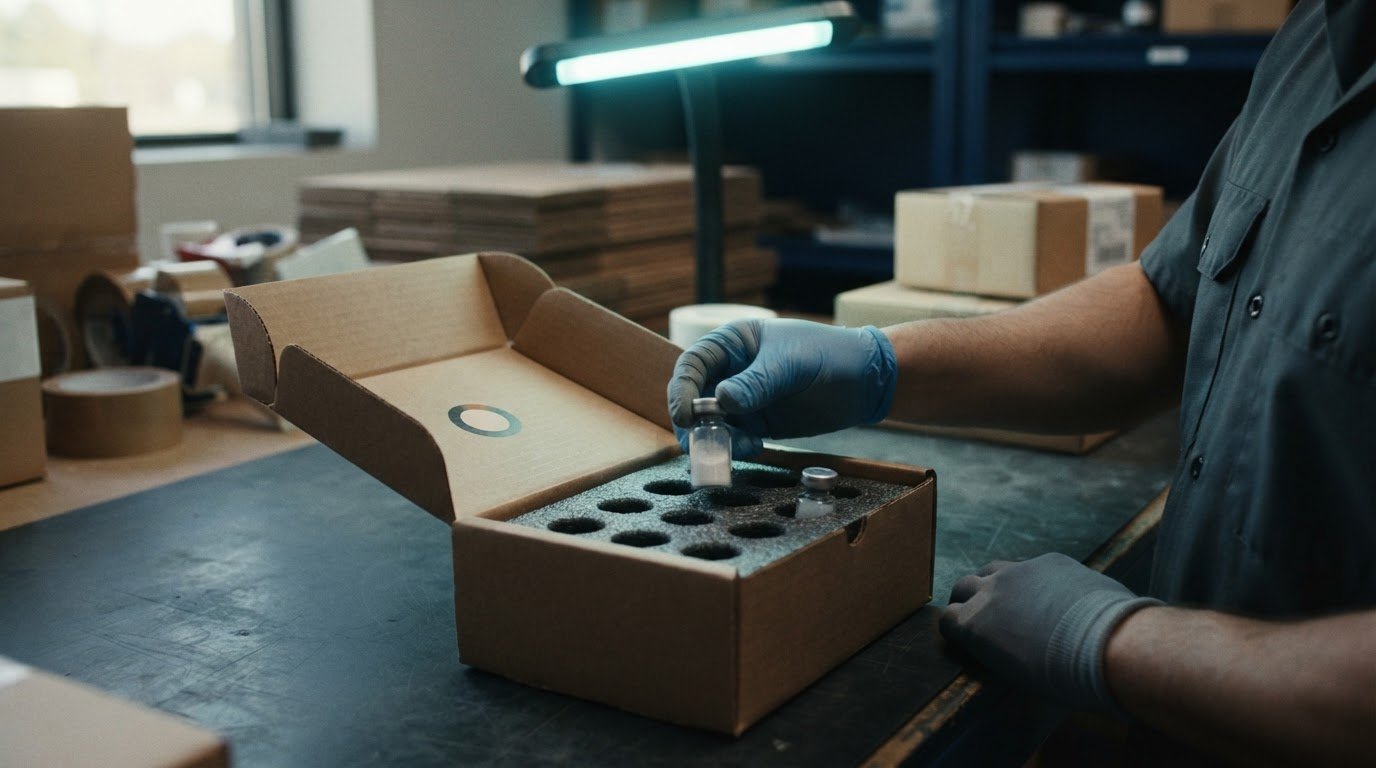
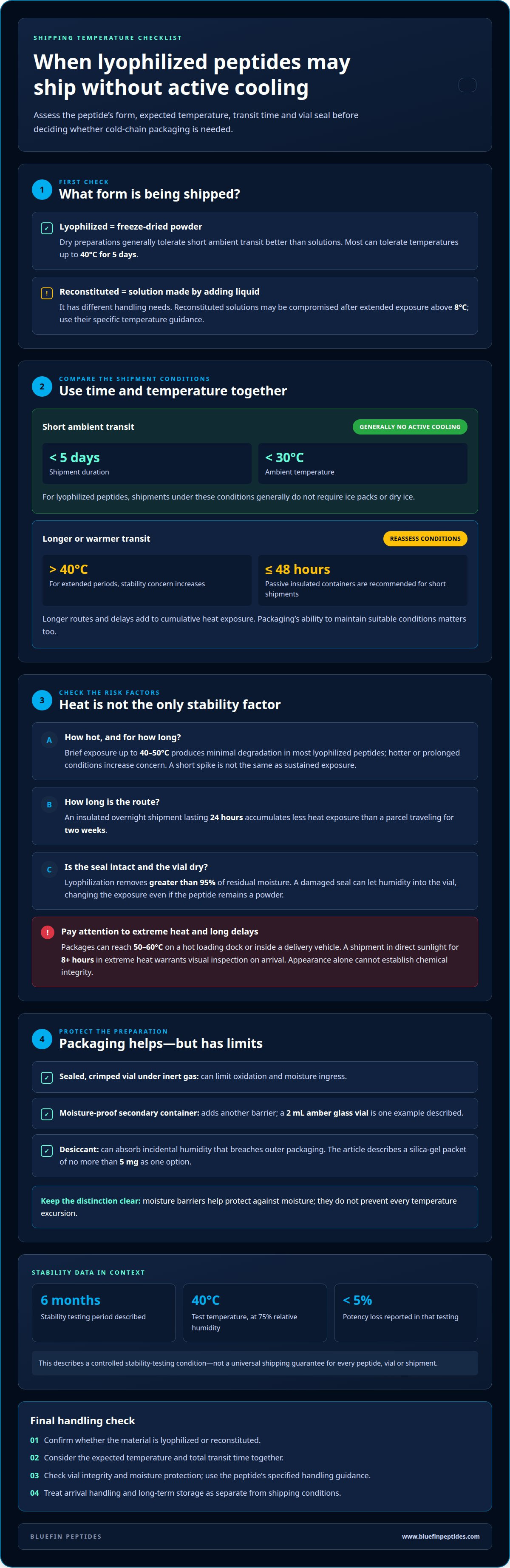
Cold-chain shipping isn’t automatically necessary for a lyophilized peptide. Research peptide shipping temperature requirements depend on the peptide’s physical form, the expected temperature, and transit time: most lyophilized peptides can tolerate temperatures up to 40°C for 5 days, while shipments under 5 days at ambient temperatures below 30°C generally don’t require ice packs or dry ice. Reconstituted solutions need different handling.
Temperature matters, but it is not the only factor. Heat exposure, time in transit and moisture can all affect a peptide’s stability. A short domestic shipment also has a different temperature history from a longer journey.
This guide explains when lyophilized peptides may travel without active cooling, how to interpret recommended temperature ranges, and why storage guidance changes after arrival or reconstitution. It also covers how transit time and temperature excursions inform handling decisions.
Key Takeaways
- Lyophilized peptides may not need active cooling for short ambient transit, but heat exposure and moisture still affect stability.
- Reconstituted solutions have different temperature needs from dry, lyophilized material; the peptide’s physical form matters.
- Transit duration changes the thermal risk, so a short domestic shipment and a longer journey call for different handling considerations.
- Separate shipping conditions from storage conditions: arrival handling and long-term storage are part of preserving peptide stability.
- Use the peptide’s specified temperature range as the guide, rather than assuming one shipping temperature fits every research peptide.
What happens to a peptide that gets too warm during shipping?
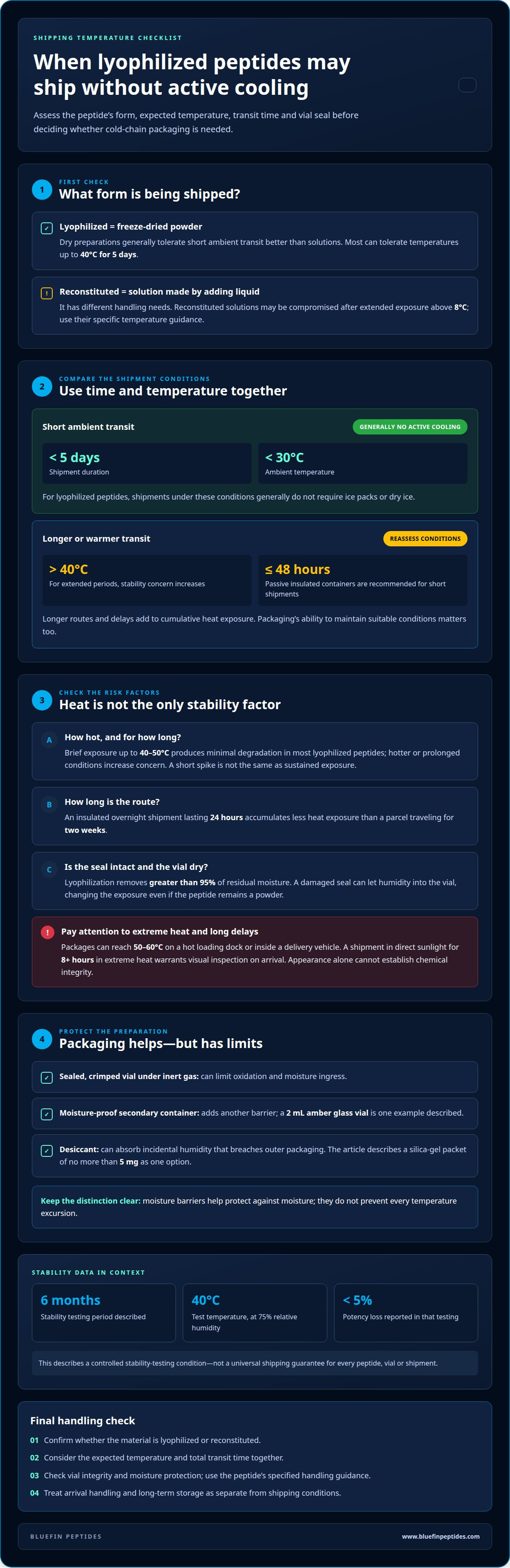
Heat exposure can alter peptide integrity, but temperature alone does not determine the outcome. Duration, moisture, and the peptide’s physical form also matter. Brief exposure up to 40-50°C produces minimal degradation in most lyophilized peptides, while hotter or prolonged conditions increase concern. Packages can reach 50-60°C on a hot loading dock or inside a delivery vehicle. A short temperature spike is not equivalent to sustained exposure.
Transit time changes the cumulative thermal load. An insulated overnight shipment lasting 24 hours experiences less accumulated heat exposure than a parcel traveling for two weeks. In hot Texas, Gulf Coast, and Southwest corridors, package surface temperatures can exceed 50°C during summer. A shipment sitting in direct sunlight for 8+ hours in extreme heat warrants visual inspection on arrival. Inspect the vial and powder for visible changes, while recognizing that appearance alone cannot establish chemical integrity.
Moisture can present a separate stability risk. Lyophilized material is dry, so a compromised seal can allow humidity into the vial. A vial with a failed seal exposed to 70% relative humidity for 24 hours presents a substantial moisture concern. By comparison, an intact lyophilized vial exposed to 45°C for 48 hours would experience less degradation than that moisture-compromised example. Reconstituted material is a different physical form and requires its own handling protocols.
Layered packaging helps keep the vial protected during transit. A sealed, crimped vial under inert gas can limit oxidation and moisture ingress. A moisture-proof secondary container, such as a 2 mL amber glass vial, adds another barrier. Desiccant can absorb incidental humidity that breaches outer packaging. A silica-gel packet of no more than 5 mg is one described option for zip-lock sealing; the secondary polyethylene bag’s stated minimum moisture-barrier rating is 0.1 g/m²/24 h. These measures protect against moisture, not every temperature excursion.
Refrigerated or frozen peptide shipping costs in the United States vary with transit duration, insulation, cooling materials, and the carrier service. The available facts do not support a typical dollar amount. California Assembly Bill 1887 took effect in January 2025, according to the California Legislature; that date concerns the bill, not a measure of peptide stability.
Do lyophilized peptides require cold-chain shipping?
Often, no. Lyophilized peptides may have different temperature requirements from reconstituted solutions during short ambient transit.
For shipments within the United States, customs clearance is not a transit step. Labeling and regulatory obligations depend on the contents and route, and temperature control does not replace them.
Lyophilized and Reconstituted Stability
Lyophilized peptides are freeze-dried preparations, while reconstituted peptides are solutions made by adding liquid. This physical difference matters because drying removes moisture associated with instability, while a solution requires temperature-sensitive handling. A few days of room-temperature transit causes negligible measurable degradation for most lyophilized sequences. Reconstituted solutions, by contrast, may be compromised after extended exposure above 8°C.
Temperature Needs for Lyophilized Peptides
Lyophilized peptides generally tolerate ambient transit better than reconstituted solutions. Most can tolerate temperatures up to 40°C for 5 days, and shipments under 5 days at ambient temperatures below 30°C generally do not require ice packs or dry ice. These conditions help determine whether a shipment needs active cooling. The peptide’s own handling guidance remains the reference for a particular sequence.
Lyophilization removes greater than 95% of residual moisture from a peptide preparation. Below 1% residual moisture is associated with thermal stability during transit. The remaining moisture level and the vial seal therefore influence how a dry preparation responds to ambient conditions. A damaged seal changes the exposure environment, even if the peptide remains in powder form.
Ambient shipping is not equivalent to unlimited heat tolerance. Temperatures above approximately 40°C for extended periods can become a stability concern, even for properly lyophilized, sealed peptides. Transit time matters because temperature exposure accumulates across a shipment. A short domestic route and a prolonged delay create different conditions for the same vial.
Stability data also depend on the conditions tested. Lyophilized peptides regularly pass 6-month stability testing at 40°C and 75% relative humidity with less than 5% potency loss. That result describes a testing condition, not a universal shipping guarantee for every peptide, vial, or shipment. A facility assessing handling should distinguish controlled stability testing from variable transit conditions.
Cold-chain packaging becomes more relevant as ambient temperatures, delays, or route length increase. Passive insulated containers are recommended for short shipments lasting no more than 48 hours. For a longer shipment, the package’s ability to maintain suitable conditions matters alongside the peptide’s dry state. Reconstituted material requires separate temperature controls.
Before planning a shipment, identify whether the material is lyophilized or reconstituted, then apply its recommended handling conditions. For research-use-only peptide options, review the research peptide catalog as part of matching material form to laboratory protocols.
Temperature-controlled peptide storage
Before shipment, store peptides under their specified conditions; after arrival, move lyophilized material to −20°C storage within 30 minutes of inspection. Keep reconstituted solutions under controlled refrigeration, since extended exposure above 8°C can compromise them.
Storage After Receipt
Storage after receipt means transferring a delivered peptide into the appropriate environment before routine laboratory handling. For long-term storage, lyophilized peptides are commonly kept at −20°C. After arrival inspection, move the material to that storage temperature within 30 minutes. This limits the time spent at ambient conditions and establishes a consistent starting point for later work.
Cold-packed vials need a controlled opening sequence. Allow a cold-shipped vial to reach room temperature while sealed before opening to reduce condensation risk. This reduces condensation risk on the vial and its contents. A vial opened while cold can encounter moisture as warmer, humid air contacts its surface. Keep the vial sealed during equilibration.
Storage Before and After Shipment
Storage before and after shipment means maintaining the peptide’s required conditions on either side of transit. Before dispatch, keep lyophilized material sealed and protected from moisture. After receipt, transfer it promptly to the specified storage environment. Uncontrolled handling before dispatch or after delivery can interrupt this continuity.
For reconstituted peptides, temperature control becomes more critical. Treat a solution as potentially compromised if it has exceeded 8°C for an extended period. The specific excursion history matters: time and temperature together shape the exposure, rather than a brief reading alone. Keep storage monitoring continuous, with alerts that identify departures from the intended range.
Excursion thresholds differ by peptide group. For example, BPC-157 has a concern threshold above 40°C for more than 72 hours. GHRH analogues have a concern threshold above 40°C for more than 48 hours. These examples show why one universal threshold cannot describe every sequence or physical form. Apply the relevant handling conditions to the material being stored.
Humidity control also belongs in a laboratory storage protocol. Moisture can enter when a seal is compromised, so retain sealed vials until use and limit unnecessary opening. For a refrigerated carrier, leave a 2-cm air gap around each peptide container to support temperature distribution. Continuous monitoring can expose excursions that a single arrival reading would miss.
Storage records should distinguish lyophilized vials from reconstituted solutions and record relevant temperature excursions. That distinction keeps handling decisions aligned with physical form. A dry vial stored at −20°C follows a different pathway from a solution exposed above 8°C for an extended period.
Transit-time and carrier considerations
Transit time and peak temperature together shape a shipment’s thermal history. Research peptide shipping temperature requirements therefore depend partly on how long the parcel travels and the conditions it encounters.
Ice-pack and dry-ice duration varies with insulation, coolant quantity, ambient conditions, and transit time. There is no universal duration that applies to every package. Data loggers record temperature over time; a shipping logger should record a stable temperature for the first 30 minutes before dispatch, with calibration confirmed within the previous 30 days.
Transit Duration and Peak Temperatures
Transit duration is the time a parcel spends moving through carrier networks, while peak temperature is its highest recorded exposure. Both affect cold-chain performance because a high peak and a long route create different conditions from a brief excursion. Standard domestic peptide shipping timelines are 1-5 days; international transit can span 7-21 days. Route planning should account for potential delays, not only scheduled delivery.
Temperature-sensitive orders benefit from transit services that guarantee delivery within 24-48 hours, paired with packaging designed for the peptide’s specified range. Faster transit reduces the time available for heat exposure, but does not replace suitable insulation or monitoring. Temperature records can distinguish a short peak from sustained warming, which may contribute to hydrolysis or affect purity.
Managing Long Transit Windows
Long transit windows describe routes where delivery takes several days or longer. An international parcel may take 10-14 days, creating a different thermal history from domestic overnight shipping. Temperature-controlled packaging is recommended when transit exceeds 7 days. Cold packs with insulated packaging are recommended when transit exceeds 5 days or summer temperatures above 35°C are anticipated.
When planning transit, allow for possible pauses in sorting or delivery. USPS transit times can exceed cold-chain packaging limits, and FedEx shipments carrying temperature-sensitive peptides still need suitable cold-chain packaging. A carrier name alone does not show that a parcel will stay within its target range.
Cooling Materials and Temperature Duration
Cooling materials absorb heat, but their useful duration depends on package insulation and surrounding conditions. Gel-pack systems rated for 2-8°C or −20°C are generally more practical for international research-peptide shipping than dry ice.
Dry ice maintains approximately −78°C when a frozen state is required. It is not interchangeable with refrigerated gel packs because the target temperature differs. FedEx shipments using dry ice may require hazmat documentation when they exceed applicable weight limits. Packaging must match both the peptide’s temperature needs and the route’s expected duration.
Temperature Indicators and Data Loggers
Temperature indicators show whether a shipment crossed a set threshold, while data loggers capture readings across transit. A logger provides a record of changing conditions rather than a single arrival snapshot. Confirm stable readings for the first 30 minutes before dispatch, and confirm calibration within the previous 30 days.
Real-time tracking and chain-of-custody documentation add route context to temperature records. Active refrigerated shipping units can maintain interior temperatures within ±2°C. Alerts can identify departures from the intended range, while linked shipment records help laboratories interpret excursions alongside delivery timing and handling. These records help apply research peptide shipping temperature requirements to the shipment’s actual transit history.
Recommended temperature ranges for research-use-only peptides
For many research-use-only peptides, recommended shipping temperatures span −20°C to +4°C. The correct target still depends on physical form and the peptide’s specified range.
That range is not a universal setting for every parcel. Shipping containers should remain within the peptide’s specified range, commonly 2°C-8°C. Most research-use-only peptides retain full activity when stored between −20°C and 4°C. These ranges describe different handling recommendations, so temperature planning should follow the material’s own requirements rather than treating all values as interchangeable.
Form matters. Reconstituted peptide solutions should be shipped refrigerated at 2-8°C for transit under 48 hours. A lyophilized, sealed vial has different stability characteristics from a solution, but extended exposure above approximately 40°C can raise degradation concerns. An insulated package helps buffer external temperature swings; it does not make every route or duration suitable for every peptide.
International shipments need particular attention because their transit windows can be longer and less predictable than domestic routes. A package planned for 2-8°C must maintain that range throughout the journey, including handling pauses. Gel-pack systems rated for 2-8°C or −20°C provide different target conditions. Select the system to match the peptide’s specified range, not simply because the shipment needs to remain cold.
Temperature alerts should also match the intended shipping band. The listed alert thresholds are above 4°C or below −20°C. Those thresholds align with a different range than a 2-8°C target, so a monitoring plan should use settings appropriate to the selected temperature range. A logger’s record can help distinguish a brief excursion from sustained exposure, which has different implications for degradation.
A certificate of analysis documents product testing, not necessarily the shipment’s temperature history. Batch-level purity information and transit temperature records answer different questions: one concerns the tested material, the other its conditions in transit. Keep the vial sealed and protected until it reaches the laboratory’s designated storage environment, and retain shipment records with the batch documentation.
For a research-use-only peptide, set the target range first, then align the insulated packaging, coolant, and alert thresholds. Explore research peptide options with those handling requirements in mind.
Bluefin Peptides
Bluefin Peptides offers research peptides for laboratory use, with batch documentation to support product review. Its catalog includes Retatrutide Research Peptide, Tirzepatide Research Peptide, BPC-157 / TB-500 Research Blend, and Ipamorelin / CJC-1295 Research Blend. Each peptide is ≥99% HPLC-verified, with mass-spec confirmation and a batch certificate of analysis. These records provide product-specific information to consider alongside the temperature range and storage protocol established by your laboratory. Turn to Bluefin Peptides when selecting research material and reviewing batch-level documentation for your work. For questions about the catalog or its documentation, contact Bluefin Peptides.
Carry Your Handling Protocol Into the Next Order
A sound approach to research peptide shipping temperature requirements starts with matching handling protocols to the peptide’s form and intended laboratory workflow. Before ordering, define the storage conditions, document acceptable transit conditions and plan how the material will be handled on arrival. This makes product selection and laboratory handling parts of one process.
Bluefin Peptides offers Retatrutide Research Peptide, Tirzepatide Research Peptide, and BPC-157 / TB-500 Research Blend for laboratory use. Batch documentation supports product review alongside your established protocols. Select the material that fits your research needs, then carry the same precision from shipment through storage and use.
Explore research options and connect with Bluefin Peptides to take the next step with clarity and confidence.
Frequently Asked Questions
Should I be concerned about a package left in summer heat?
Consider the exposure time, peak temperature and whether the vial seal remains intact. A parcel left in direct sunlight during extreme heat warrants closer inspection on arrival, especially if the container is damaged or the powder looks different. Appearance cannot establish peptide potency. Keep the vial sealed while assessing the package, and record delivery conditions in the laboratory’s handling documentation.
What degrades a peptide more in transit, cold or heat?
Neither cold nor heat is universally more damaging; the peptide’s specified range and physical form determine the relevant risk. Sustained heat can accelerate degradation, while freezing may be unsuitable for material intended to remain refrigerated. Dry ice can maintain approximately −78°C when a frozen state is required, but that does not make it appropriate for every peptide. Compare the actual temperature history with the intended range.
What temperature should research peptides be kept at during shipping?
Use the peptide’s specified shipping range rather than one temperature for every shipment. A common range is 2°C-8°C, while some shipping guidance spans −20°C to +4°C. Those ranges are not interchangeable. For example, a container set for refrigerated transit should not be treated as suitable for a peptide requiring frozen conditions. The physical form, route, and expected duration also inform packaging choices.
What temperature range should research peptides be shipped at?
Many research-use-only peptides are shipped in containers intended to maintain −20°C to +4°C, while a specified range is commonly 2°C-8°C. For reconstituted solutions, refrigerated shipping at 2-8°C applies to transit under 48 hours. These figures describe different conditions, not a single universal target. Set monitoring alerts to correspond with the selected range, so the record reflects the actual handling requirement.
Which research peptides require frozen, refrigerated, or ambient shipping?
Shipping needs depend on peptide form and the product’s handling specification, not just its name. Lyophilized material may tolerate ambient transit under suitable conditions, while reconstituted solutions require refrigerated handling. Frozen shipping applies when the required state is frozen, with dry ice maintaining approximately −78°C. Don’t infer a specific temperature category for a named sequence from its identity alone; use its stated handling range.
How should peptides be packaged for cold-chain shipping?
Use insulated packaging with cooling materials matched to the target range, and keep the vial sealed against moisture ingress. A temperature logger can document conditions throughout transit; active refrigerated units can maintain interior temperatures within ±2°C. Package layout matters too: leave a 2-cm air gap around each container in a refrigerated carrier. These measures help manage temperature distribution and create a useful shipment record.
What shipping temperature excursions can damage peptide stability?
Risk depends on how far the temperature moves beyond range and how long the excursion lasts. For example, the listed concern threshold for BPC-157 is above 40°C for more than 72 hours; reconstituted solutions warrant concern after extended exposure above 8°C. These are distinct situations, not universal limits for every peptide. Interpret an excursion against the specific material and its physical form.
What are USPS, UPS, and FedEx rules for shipping dry ice or temperature-sensitive materials?
Carrier handling depends on the service and shipment details. FedEx shipments using dry ice may require hazmat documentation above applicable weight limits, and temperature-sensitive shipments need suitable cold-chain packaging. USPS transit times can exceed cold-chain packaging limits. For UPS, do not assume the same dry-ice terms apply as for another carrier. Separate carrier acceptance and documentation requirements from the peptide’s temperature range.
For laboratory research use only. Not for human or veterinary use. This content is educational and does not constitute medical, dosing, or usage guidance.
Browse the BLUEFIN catalog