Research Peptide Blends Explained: Analytical Standards and Synergistic Rationale

Manual multi-analyte stacking is a precision-killer in the laboratory. While the theoretical synergy of specific sequences is well-documented, the physical execution of combining lyophilized powders often results in ratio drift and unintended chemical interactions. This guide offers research peptide blends explained through a lens of analytical chemistry, moving beyond surface-level claims to address the core requirements of high-fidelity research.
You likely recognize the frustration of deciphering complex HPLC reports where overlapping peaks mask potential impurities. Establishing a reliable baseline for co-formulated research requires more than just trust; it demands a deep understanding of mass-spec confirmation and stoichiometric accuracy. We will analyze the scientific rationale for pairings such as Ipamorelin and CJC-1295, provide a standardized protocol for the reconstitution of multi-peptide vials, and identify the markers of ≥99% purity in US-sourced analytical standards. This technical overview ensures your laboratory maintains the clinical precision and batch-level transparency necessary for verifiable results. We prioritize the depth of data over the convenience of the blend.
Key Takeaways
- Distinguish between manual stacking and precision co-formulation to ensure stoichiometric accuracy in laboratory environments.
- Understand the research peptide blends explained through the mechanics of pathway cross-talk and synergistic receptor activation.
- Develop the analytical proficiency required to interpret multi-peak HPLC reports and verify individual peptide ratios within a single vial.
- Establish standardized protocols for the reconstitution of co-lyophilized powders to mitigate solubility variances and maintain molecular stability.
- Identify high-purity procurement standards by prioritizing US-based suppliers that provide batch-specific COAs and mass-spec confirmation.
What are Research Peptide Blends? Defining Co-Formulated Compounds
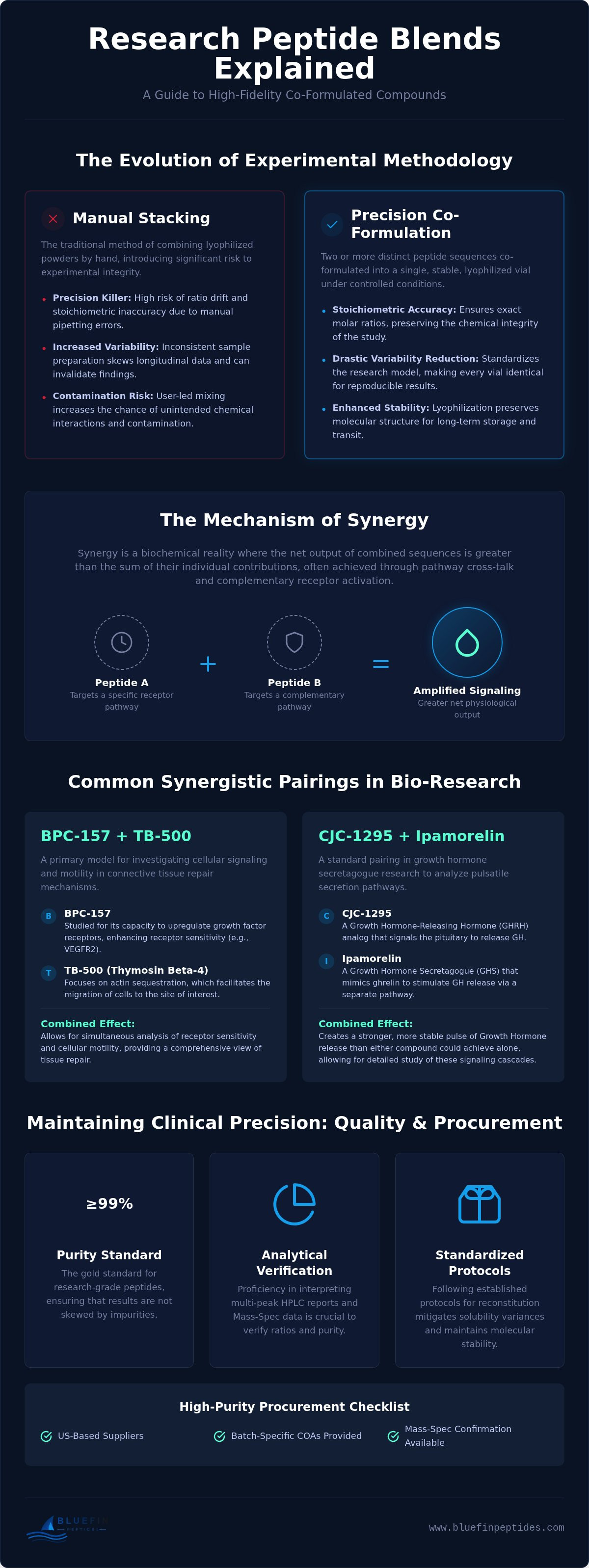
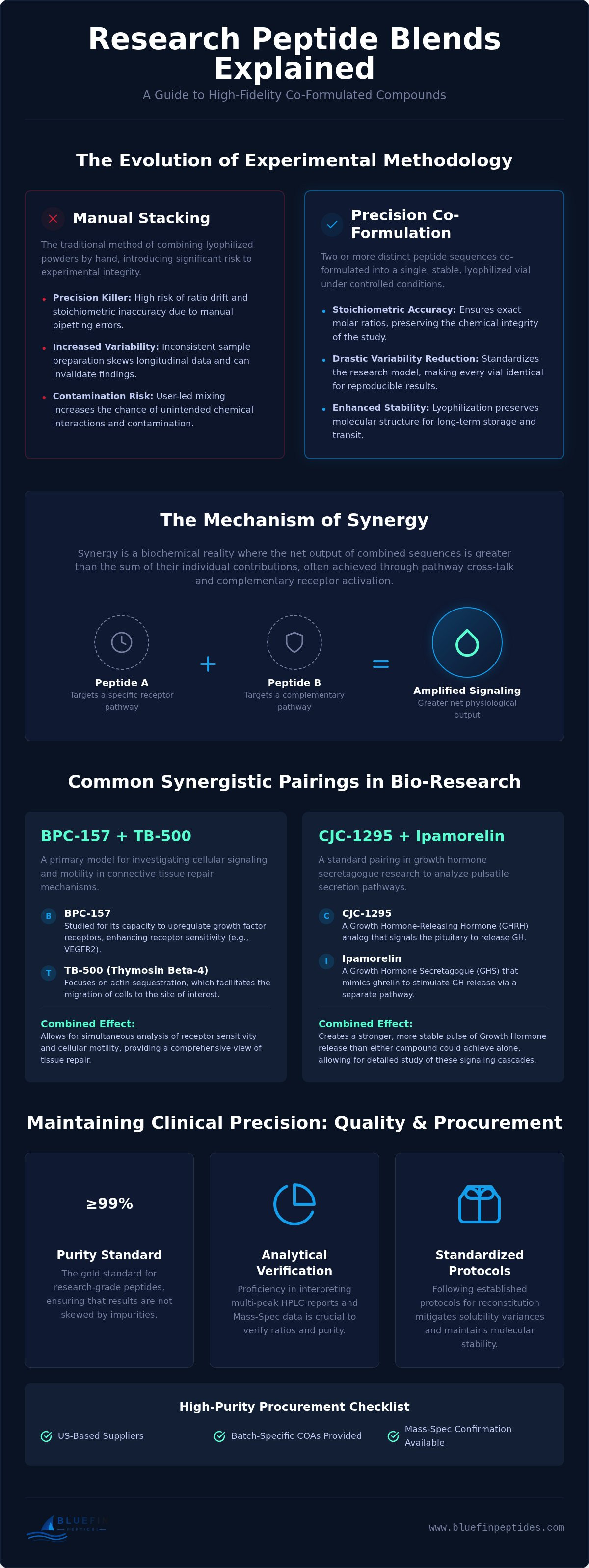
A research peptide blend consists of two or more distinct peptide sequences co-formulated into a single lyophilized vial. This is the foundation of research peptide blends explained for the modern laboratory. The transition from manual "stacking" to precision-manufactured co-formulations represents an evolution in experimental methodology. It replaces the inherent risks of user-led mixing with a controlled, high-purity environment. This shift ensures that the chemical integrity of the study is preserved from the moment of synthesis to the point of reconstitution.
The primary objective of these blends is the drastic reduction of experimental variability. By ensuring exact molar ratios across all study samples, researchers eliminate the drift often associated with manual reagent preparation. Lyophilized powders remain the gold standard for maintaining long-term stability. This freeze-drying process removes moisture while preserving the molecular structure, ensuring that the chemical signature of each sequence remains stable during transit and storage. High-purity manufacturing relies on advanced chemical peptide synthesis to produce individual sequences that meet or exceed ≥99% purity before they are accurately weighed and combined.
The Rationale for Pre-Formulated Research Stacks
Precision. Reliability. Efficiency. These are the core advantages of pre-formulated stacks. Manual pipetting is a frequent source of error in high-throughput laboratory environments. Even minor deviations in reagent volume can skew longitudinal data and invalidate findings. Pre-formulated blends standardize the research model, ensuring that every vial in a multi-vial study is identical to the last. This simplification of inventory management allows researchers to maintain a steady momentum in their data acquisition without the logistical burden of multi-component tracking or potential contamination during manual mixing.
Common Peptide Blend Categories in Bio-Research
Different research models require specific chemical synergies to yield actionable data. In tissue repair and recovery studies, the BPC-157 and TB-500 synergy is frequently investigated for its effects on cellular migration. Growth hormone secretagogue research often centers on Ipamorelin and CJC-1295 pairings, which are utilized to analyze pulsatile secretion pathways. More complex studies utilize multi-peptide formulations, such as GHK-Cu, BPC-157, and TB-500 blends, to observe metabolic interactions across multiple biological systems. These research peptide blends explained in this context are designed to provide a consistent, HPLC-verified baseline for complex multi-analyte investigations.
The Mechanism of Synergy: Why Certain Peptides are Paired
Synergy is not a marketing term; it's a biochemical reality where the net physiological output of two sequences is greater than their individual contributions. In the context of research peptide blends explained, this phenomenon is often the result of pathway cross-talk. By targeting distinct but complementary receptors within a single physiological system, researchers can observe amplified signaling cascades. Achieving this requires rigorous adherence to USP Peptide Reference Standards to ensure that each component maintains its structural integrity and intended molarity. Precision is paramount. A deviation in a 1:1 or 5:5 mg ratio can fundamentally alter the experimental outcome, making reproducible synergistic data impossible to obtain without pharmaceutical-grade accuracy.
Case Study: BPC-157 and TB-500 Interaction
The BPC-157 TB-500 research blend serves as a primary model for investigating cellular signaling in connective tissue. BPC-157 is frequently studied for its capacity to upregulate growth factor receptors, particularly VEGFR2. In contrast, TB-500 (Thymosin Beta-4) focuses on actin sequestration, facilitating the migration of cells to the site of interest. When co-formulated, these sequences allow for the simultaneous analysis of receptor sensitivity and cellular motility. This dual-pathway approach provides a more comprehensive view of tissue repair mechanisms than individual peptide analysis could ever achieve.
Growth Hormone Secretagogue Synergies: CJC-1295 & Ipamorelin
Research into pulsatile secretion often utilizes the ipamorelin CJC-1295 research blend USA to observe dual-action stimulation. This pairing combines a GHRH analogue (CJC-1295) with a Ghrelin mimetic (Ipamorelin). While CJC-1295 initiates the signal for production, Ipamorelin targets the ghrelin receptor to suppress somatostatin, the primary inhibitor of the target pulse. Managing the half-life differences between these co-formulated secretagogues is critical for longitudinal studies. Researchers must account for the metabolic stability of each sequence to ensure consistent laboratory observations. For those requiring verified ratios, selecting a high-purity source is the only way to guarantee analytical continuity.
Analytical Complexity: Interpreting HPLC Reports for Multi-Peptide Blends
Analyzing a single-analyte vial is straightforward. You identify one primary peak, calculate the area, and determine purity. However, multi-peptide chromatography introduces significant analytical layers. When dealing with research peptide blends explained in a laboratory setting, the expectation is a multi-peak chromatogram. Each peptide sequence possesses unique hydrophobic properties, meaning they will elute from the column at different retention times. This fundamental principle of research peptide blends explained ensures that each constituent can be isolated and quantified. If a Certificate of Analysis (COA) for a co-formulated product displays only a single peak, it indicates either a failure in the chromatographic method or a mislabeled product. Neither is acceptable for high-fidelity research.
Mass Spectrometry (MS) acts as the secondary layer of verification. While HPLC determines the purity by separating components, MS confirms the molecular weight of each constituent. This ensures the peaks identified in the HPLC run are indeed the correct sequences. Determining aggregate purity requires calculating the purity of each individual component; the blend is only as reliable as its weakest link. We prioritize mass-spec confirmation for all batches to eliminate identity ambiguity.
Reading the Chromatogram: Peak Resolution and Integration
In a multi-analyte run, baseline resolution is the critical metric. This refers to the complete separation of peaks, where the signal returns to the baseline before the next peptide elutes. Without this separation, accurate integration is impossible. Integration is the calculation of the area under each peak to determine relative abundance. If peaks overlap, the reported ratio of peptides like BPC-157 to TB-500 becomes an estimate rather than a precise measurement. This ambiguity introduces variability that compromises experimental reproducibility.
Verifying Batch-Specific COAs
A robust research peptide quality standards report must include individual HPLC traces and MS data for every batch. Generic or outdated reports are insufficient. Red flags in blend COAs include single-peak reports for multi-peptide products or purity levels that aggregate multiple peaks into one value. Each individual component within the blend must meet the ≥99% purity threshold independently. This level of transparency allows researchers to confirm that the pre-formulated ratios are accurate and that no degradation products or synthesis byproducts are present in the final lyophilized powder. Verification is a non-negotiable prerequisite for laboratory safety and data integrity.
Laboratory Protocols: Reconstitution and Stability of Research Blends
Reconstitution is the most volatile phase in the handling of co-formulated compounds. When we consider research peptide blends explained for the laboratory, we must focus on the delicate balance of aqueous solubility. Peptides within a single vial often possess divergent hydrophobic profiles. This means one sequence may achieve rapid dissolution while the other remains in a suspended crystalline state. Rushing this transition through aggressive mechanical force is a common error. It causes mechanical shear, a process that physically degrades the peptide chains and renders the molar concentration inaccurate. Patience is an analytical requirement.
Addressing solubility variances requires a methodical approach. If one peptide dissolves faster than its counterpart, the technician must wait for the entire solution to clear before proceeding. The molecular integrity of the blend depends on this uniform suspension. Temperature sensitivity is equally critical. Maintaining a strict "cold chain" for blended compounds prevents the thermal degradation of peptide bonds. While lyophilized powders are stable, their reconstituted counterparts are highly fragile and demand immediate refrigeration to maintain their analytical profile.
Reconstitution Best Practices for Blends
Standardized protocols begin with the selection of an appropriate diluent. Bacteriostatic water, containing 0.9% benzyl alcohol, is typically preferred for multi-vial studies to inhibit microbial growth. The "gentle swirl" technique is non-negotiable. Shaking the vial introduces air bubbles and mechanical stress that can fracture the peptide sequences. Allow for a 5 to 10 minute equilibration period. This pause allows the solution to reach thermal and chemical equilibrium, ensuring that both peptides are fully and safely integrated into the liquid medium. Precision in this stage preserves the stoichiometric accuracy intended during the manufacturing process.
Long-Term Stability and Degradation Mitigation
Stability is a function of temperature and physical state. Lyophilized powders are resilient when stored in a deep-freeze environment between -20°C and -80°C. Once reconstituted, the window of stability narrows significantly. The solution should be kept at 2°C to 8°C and used within a strictly defined timeframe. Repeated freeze-thaw cycles are catastrophic for multi-peptide stability, as the resulting thermal expansion and contraction can snap peptide bonds. Identifying signs of degradation is vital. Cloudiness, precipitation, or any deviation from a crystal-clear appearance indicates chemical breakdown. Maintain the integrity of your longitudinal studies by utilizing USA-stocked research peptide blends that undergo rigorous batch-specific verification.
Procurement Standards: Navigating the US Research Peptide Market
Procurement represents the final, critical variable in the experimental chain. For research peptide blends explained to be practically applicable, the logistical framework must mirror the precision of the chemical synthesis. Sourcing from US-stocked suppliers isn't just a matter of convenience; it's a safeguard for research continuity. International transit introduces uncontrolled variables, including temperature fluctuations and prolonged customs delays, which can jeopardize the molecular stability of co-lyophilized vials. High-purity standards, such as those found in retatrutide research peptide and other advanced analogues, set the industry benchmark for what an analytical standard should be. These standards demand that every milligram is accounted for through rigorous, batch-specific documentation.
Evaluating supplier transparency requires moving beyond generic marketing claims. Verification is the only currency in a professional laboratory environment. A supplier's adherence to legal compliance is equally vital; products must be strictly designated for laboratory research use only. This clear boundary ensures that the focus remains on the chemical nature of the offerings rather than consumer-facing fluff. When research peptide blends explained are integrated into a study, the researcher must have absolute confidence in the provenance and purity of the reagents.
Logistical Efficiency and Research Timelines
Laboratory schedules are often built around tight windows of observation. Domestic fulfillment minimizes the window of exposure to environmental stressors during transit. We view inventory management with maritime-level precision, ensuring that the flow of reagents to your laboratory is fluid and uninterrupted. Fast fulfillment isn't a luxury; it's a requirement for maintaining the momentum of longitudinal studies. By eliminating the friction of global logistics, researchers can focus on data acquisition rather than supply chain volatility. A reliable supplier acts as a high-performance laboratory partner, prioritizing the "how" of the process to secure the "what" of the results.
The Bluefin Standard: Verification and Velocity
Trust is replaced by verification. Our commitment to ≥99% purity across all research-grade peptide blends is backed by direct access to batch-specific HPLC and Mass-Spec documentation for every lot. We don't rely on generic claims or outdated reports. Every vial is a verifiable data point. Secure procurement is reserved for qualified researchers and institutional laboratories, ensuring that all compounds are strictly designated for laboratory research use only. This disciplined approach to distribution mirrors our adherence to strict testing protocols. It's a standard built on velocity and objective data, providing the tools for verification rather than asking for blind trust. This ensures that the research peptide blends explained in your documentation match the compounds delivered to your bench.
Advancing Analytical Precision in Multi-Peptide Research
The transition from theoretical synergy to laboratory execution requires an unwavering commitment to analytical verification. We've analyzed research peptide blends explained through the lens of stoichiometric accuracy, highlighting their role in providing a superior baseline for longitudinal studies. Purity isn't a static claim. It's a verifiable data point established through multi-peak HPLC resolution and mass-spec identity confirmation. By standardizing the ratio of co-lyophilized compounds, researchers eliminate the drift that often compromises complex signaling models.
Maintaining this integrity requires a logistics partner focused on the physical state and chemical nature of the reagents. Domestic stocking and rapid fulfillment are essential to preserve the molecular stability of these delicate sequences. We provide the documentation necessary to treat every vial as a high-fidelity analytical standard. Our focus on methodology ensures that your results remain consistent from the first batch to the last.
Procure HPLC-Verified Research Peptide Blends from Bluefin Peptides to secure ≥99% purity backed by batch-specific Mass-Spec confirmation and US-based logistics for rapid laboratory fulfillment. Establish a new benchmark for your research today.
Frequently Asked Questions
What is the primary advantage of using a peptide blend over single peptides?
The primary advantage is the elimination of pipetting errors and the standardization of stoichiometric ratios across multi-vial longitudinal studies. When research peptide blends explained are utilized, the technician avoids the incremental drift associated with manual reagent preparation. This ensures that every sample in a high-performance laboratory environment remains identical. It streamlines inventory management while providing a fixed baseline for observing synergistic effects between complementary sequences without the risk of cross-contamination during manual mixing.
How do I read an HPLC report for a vial containing two different peptides?
An HPLC report for a multi-peptide vial must display distinct, isolated peaks for each constituent sequence. Each peptide elutes at a specific retention time based on its unique hydrophobic signature. Technicians should verify "baseline resolution," where the signal returns to the baseline between peaks. If the report shows only a single peak for a co-formulated product, it indicates a failure in the chromatographic separation or a critical error in the product's chemical identity.
Are peptide blends less stable than individual peptide vials?
Lyophilized blends maintain the same level of long-term stability as individual peptides when stored at -20°C to -80°C. The freeze-drying process effectively halts chemical degradation by removing moisture. Once reconstituted, the solution's stability is governed by the most fragile peptide in the pairing. While co-formulation doesn't inherently decrease shelf life, the aqueous environment allows for potential aggregation or precipitation if the "cold chain" isn't strictly maintained throughout the study duration.
Can I customize the ratio of peptides in a pre-formulated blend?
Pre-formulated blends are manufactured with fixed molar ratios, such as 1:1 or 5:5 mg, to ensure maximum reproducibility. Customizing these ratios within a single vial isn't possible once the lyophilization process is complete. Researchers requiring specific, non-standard ratios must revert to manual stacking, though this reintroduces the pipetting variability that research peptide blends explained are designed to solve. Precision-manufactured blends prioritize consistency over the flexibility of user-led, manual adjustments.
What diluent should be used for reconstituting a multi-peptide research blend?
Bacteriostatic water containing 0.9% benzyl alcohol is the standard diluent for reconstituting multi-peptide research blends. This choice is critical for longitudinal studies where a single vial may be sampled over several days. The antimicrobial agent inhibits microbial growth, preserving the molecular integrity of the sequences. Sterile saline is an alternative for specific metabolic studies; however, it lacks the preservative qualities necessary for maintaining a sterile environment in multi-use laboratory vials.
Why is mass spectrometry necessary for verifying a peptide blend?
Mass spectrometry is the only definitive method for confirming the identity of each peptide in a multi-analyte blend. While HPLC separates peaks based on retention times, it can't independently verify the molecular weight of the eluting compounds. MS provides a precise chemical fingerprint for each constituent. This dual-layer verification is a non-negotiable requirement for high-purity research, ensuring that the peaks identified on the chromatogram correspond exactly to the intended sequences.
Is it possible for peptides in a blend to react with each other in the vial?
In their lyophilized state, peptides are chemically inert and can't react with one another. The absence of a liquid medium prevents molecular movement and interaction. Once reconstituted, the risk of direct chemical reaction between peptides is minimal, but physical interactions like aggregation or precipitation can occur. These effects are typically driven by concentration levels or shifts in the solution's pH. Maintaining a crystal-clear appearance after the gentle swirl technique is a primary indicator of successful integration.
How should I store a reconstituted peptide blend for short-term research use?
Reconstituted blends must be stored at 2°C to 8°C in a temperature-controlled refrigeration unit. They should be shielded from light and used within a strictly defined experimental window to avoid proteolytic degradation. Repeated freeze-thaw cycles must be avoided, as the resulting mechanical stress can fracture the delicate peptide chains. For short-term research use, the solution's analytical profile is best preserved by minimizing the time the vial spends at room temperature during the sampling process.
For laboratory research use only. Not for human or veterinary use. This content is educational and does not constitute medical, dosing, or usage guidance.
Browse the BLUEFIN catalog