Peptide synthesis or pre-made peptides for research
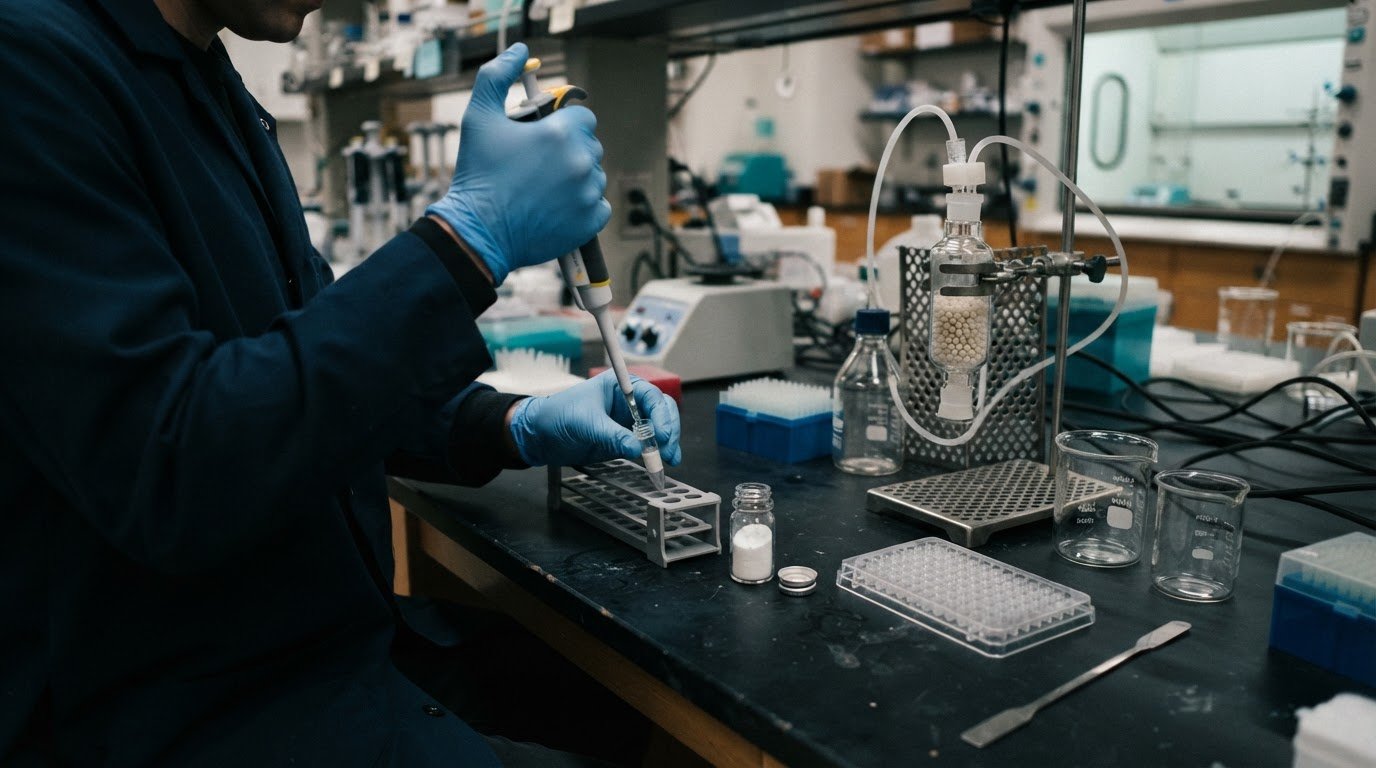
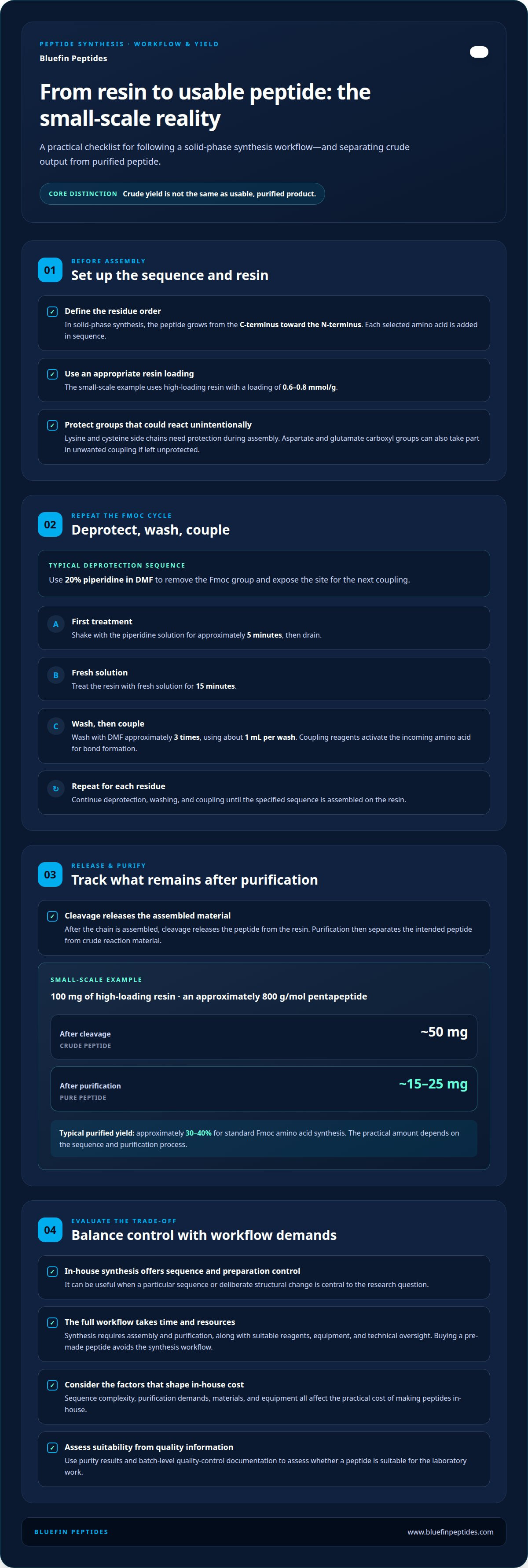
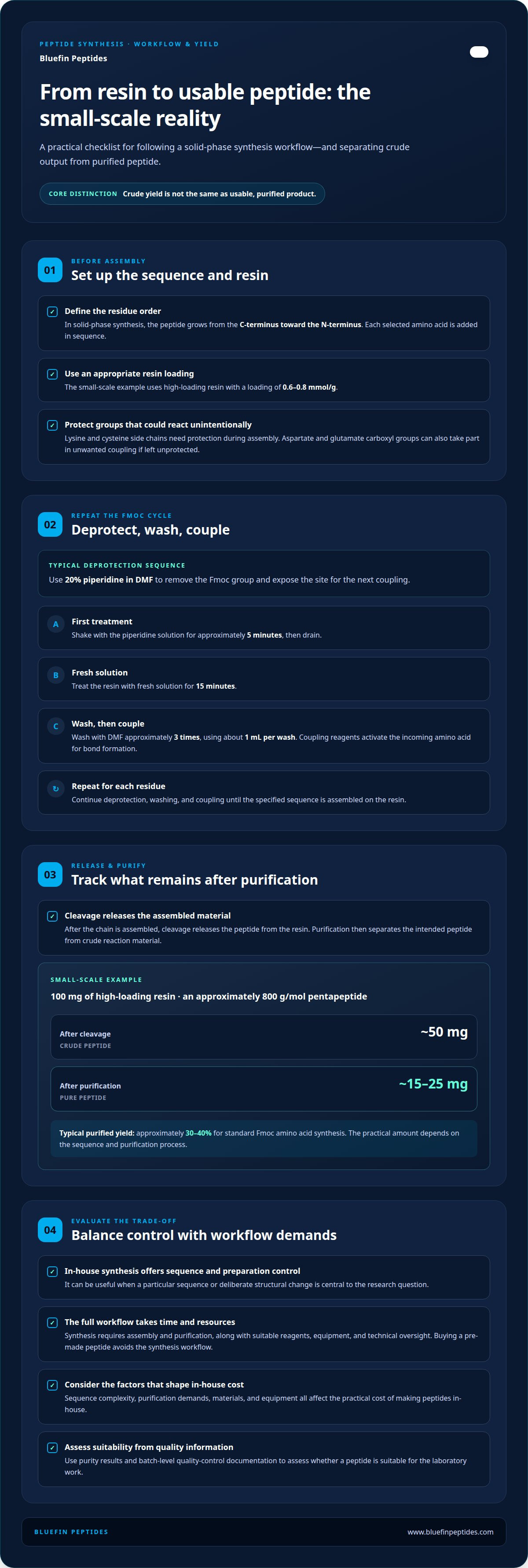
Peptide synthesis versus buying pre-made peptides comes down to control, time, and the amount of purified material your experiment needs. Chemical synthesis assembles amino acids into a specified sequence, then removes protecting groups and purifies the peptide. In a small-scale example using 100 mg of high-loading resin to make an approximately 800 g/mol pentapeptide, cleavage yields about 50 mg of crude peptide, while purification produces about 15-25 mg of pure peptide.
That gap matters: crude output is not the same as usable, purified product. For standard Fmoc amino acid synthesis, the typical yield after purification is approximately 30-40%, but the practical amount depends on the sequence and the purification process. Buying a pre-made peptide avoids the synthesis workflow, while making it in-house can offer greater control over the sequence and preparation.
This comparison explains how solid-phase synthesis works, what small-scale yields mean in practice, and which factors shape the cost trade-off without relying on unsupported price estimates. It gives you a practical basis for deciding whether the work, equipment, and purification demands of synthesis fit your research needs.
Key Takeaways
- In-house synthesis offers control over peptide sequence and preparation, but requires synthesis and purification steps.
- Separate crude yield from purified output when estimating how much usable peptide a small-scale synthesis will produce.
- Sequence complexity, purification demands, materials, and equipment all affect the practical cost of making peptides in-house.
- Compare the full synthesis workflow with the time needed to obtain a pre-made peptide for your research schedule.
- Use purity results and batch-level quality-control documentation to assess whether a peptide is suitable for your laboratory work.
Advantages of chemical synthesis
Chemical synthesis gives researchers direct control over a peptide’s amino acid sequence. The method links selected amino acids in a defined order, so the target structure is planned before assembly. For example, a laboratory designing a short peptide can specify each residue rather than selecting only from available pre-made sequences. The standard set contains 20 proteinogenic amino acids, providing a broad foundation for sequence design. Synthesis is useful when the research question depends on a particular sequence or a deliberate structural change.
That control extends to modifications. A synthesis plan can protect reactive groups during assembly, then remove the protecting groups during workup. Lysine and cysteine side chains need protection to limit unintended reactions. Aspartate and glutamate carboxyl groups can also take part in unwanted coupling if left unprotected. Planning these steps helps direct coupling toward the intended backbone rather than competing sites on the molecule.
Solid-phase peptide synthesis supports this staged approach. The peptide grows from the C-terminus toward the N-terminus while attached to an insoluble polymer resin. Each cycle adds a selected residue, while protecting groups control which amino acid functions can react. Coupling reagents activate amino acids for bond formation. This stepwise workflow makes the sequence traceable: a synthesis record can identify each residue added and the chemistry used.
- Sequence control: choose the residue order for a defined experimental target, rather than adapting the study to a stocked sequence.
- Reaction control: protect groups such as lysine’s amino group and cysteine’s side chain during assembly.
- Process visibility: track coupling and deprotection cycles as the chain extends from its C-terminus.
- Solubility troubleshooting: sonication at an elevated temperature of up to 50 °C for up to 30 minutes may help dissolve a peptide.
These advantages matter most when sequence specificity outweighs convenience. A custom sequence or a design with a particular residue arrangement may be difficult to source as a ready-made material. Chemical assembly gives researchers control over that design, while purification separates the intended peptide from synthesis-related impurities. The trade-off is operational: every coupling and cleanup step requires suitable reagents, equipment, and technical oversight.
Synthesis can also support work on peptide-based drug candidates. According to the U.S. Government Publishing Office, the simplest peptide products may qualify for the 505(j) generic-drug pathway if they contain the same active ingredient as the innovator product. This regulatory pathway is distinct from research synthesis, but it illustrates why defined composition matters in peptide development.
In short, chemical synthesis offers design control, staged assembly, and a clear route for introducing selected residues. A short pentapeptide with an approximate molecular weight of 800 g/mol provides a practical example for planning and evaluating a synthesis. The method is most compelling when the required sequence is central to the experiment and the laboratory can manage assembly and purification.
Chemical peptide synthesis
In solid-phase peptide synthesis, the target chain is assembled on an insoluble resin. Assembly proceeds from the C-terminus toward the N-terminus. For a standard Fmoc workflow, the resin-bound chain is extended through repeated deprotection and coupling cycles. The resin holds the growing peptide during these reactions, then cleavage releases the assembled material. The method’s sequence of cycles makes each residue addition a distinct stage in the process.
At each cycle, the Fmoc group temporarily protects the amino group. Piperidine removes that group, exposing the site for the next coupling. A typical deprotection sequence uses 20% piperidine in DMF: shake for approximately 5 minutes, drain, then treat the resin with fresh solution for 15 minutes. After deprotection, wash the resin with DMF approximately three times, using about 1 mL per wash. The exposed amino group is then ready for coupling.
- Prepare the resin: a small-scale example uses high-loading resin with a loading of 0.6-0.8 mmol/g.
- Deprotect the chain: remove the Fmoc group with piperidine, then wash away the solution and residual reagents.
- Couple the next residue: coupling reagents activate the incoming amino acid and enable bond formation.
- Repeat the cycle: continue deprotection, washing, and coupling until the specified sequence is assembled.
- Release and purify: cleave the peptide from the resin, then separate the target from crude reaction material.
Protecting groups prevent competing reactions during coupling. Lysine and cysteine side-chain functions stay protected while the backbone grows. Aspartate and glutamate carboxyl groups also need control because unprotected groups can take part in unintended coupling. The choice of protecting group determines how it is removed. Piperidine cleaves Fmoc, while catalytic hydrogenation with hydrogen and palladium cleaves the Z amino protecting group.
Small-scale synthesis needs a yield estimate that distinguishes crude material from purified peptide. For a 100 mg resin scale using high-loading resin and an approximately 800 g/mol pentapeptide, cleavage produces approximately 50 mg of crude peptide. After purification, the example yields approximately 15-25 mg of pure peptide. Standard Fmoc amino acid synthesis typically gives approximately 30-40% yield after purification. These figures show why crude mass alone does not predict usable output.
Monitoring provides a practical checkpoint during assembly. The Kaiser test is a qualitative colorimetric test for free amines, helping assess whether coupling has completed. A 10 mL syringe setup is used for syntheses up to 200 micromole scale. Test cleavage can assess the resin-bound peptide before full cleavage; the test solution is collected after approximately 30 minutes. Full cleavage uses gentle agitation in cleavage cocktail for approximately 2 hours.
After cleavage, approximately 1 mL of cold ether can precipitate crude peptide. Ether used for precipitation is kept at −20 °C for more than 2 hours. The supernatant should also be examined, because some peptide may remain soluble in diethyl ether. These recovery and purification stages are essential parts of the synthesis workflow, not optional finishing steps.
Factors that affect synthesis costs
The cost comparison depends on how much purified peptide your experiment can use, not just the cost of starting materials. For example, a synthesis may produce a large crude mass but still require substantial purification before the target is usable. A pre-made option bundles production and purification into a supplied material, while in-house work spreads costs across reagents, equipment, labor, and analytical steps. Compare equivalent quantities and specifications.
Sequence design is a major cost driver. Each added residue requires another coupling and deprotection cycle, so longer sequences need more cycles and create more opportunities for incomplete coupling. Sequences with reactive residues such as lysine or cysteine may also require additional protecting groups and process steps. Unusual modifications or difficult sequence regions can call for further method development. These factors affect reagent use and the effort required to obtain the intended product.
Scale changes the calculation. Resin, amino acid derivatives, coupling reagents, and solvents are consumed during assembly, while the required amount of purified product determines how much material must enter the process. High-loading resin can provide a different starting capacity from lower-loading resin, but resin capacity alone does not determine usable output. Include purification losses and analytical checks in the estimate.
- Sequence length and composition: more coupling cycles mean more reagent use; protected lysine or cysteine can add handling steps.
- Target scale: the amount required determines resin and reagent demand, while excess synthesis may be needed to account for downstream losses.
- Purification burden: sequences that are harder to separate from by-products can require more chromatography and analysis.
- Laboratory infrastructure: an established SPPS setup spreads equipment costs across projects; a new setup adds equipment, training, and maintenance needs.
- Quality requirements: analytical methods and documentation add work, but help establish identity and purity for the intended research use.
Purification can be a major cost factor. Crude material contains the target alongside residual reagents and synthesis-related by-products. Separating these components takes suitable purification methods and time from trained personnel. A sequence that is difficult to separate may need additional optimization. Estimating costs from amino acid quantities alone therefore overlooks a substantial part of the workflow.
For an in-house estimate, group expenses by stage: synthesis materials, instrument use, labor, purification, and quality control. Divide the total by the expected amount of purified peptide, not the crude output. For a pre-made comparison, match the specified sequence, purity evidence, and usable quantity. This like-for-like method avoids treating unlike materials as equivalent.
There is no universal cost winner. A laboratory with established solid-phase synthesis capability may spread setup costs across repeated projects. A one-off sequence can have a different cost balance because method development and purification are concentrated in a single request. The decision between peptide synthesis and buying pre-made should follow the project’s required sequence, purified quantity, and available laboratory capacity, not a simple comparison of raw materials.
How long does custom peptide synthesis take versus buying pre-made peptides?
Custom synthesis involves more stages before a peptide reaches the experiment bench. A laboratory must define the sequence, assemble it, remove protecting groups, purify the product, and complete quality checks. Each stage can affect the schedule. A pre-made peptide that is already stocked skips custom assembly and purification, making procurement and delivery the main timing factors.
Sequence length is one scheduling factor in Fmoc solid-phase peptide synthesis. Each residue requires another coupling cycle, with deprotection and washing between additions. A short sequence therefore involves fewer assembly cycles than a longer one. Reactive side chains, such as those in lysine or cysteine, also need protection during assembly, adding process considerations to the synthesis plan.
Reagent behavior can affect workflow efficiency. For automated Fmoc-SPPS, Fmoc amino acid derivatives should dissolve rapidly in DMF or NMP. Poor dissolution can interrupt a planned coupling sequence and require troubleshooting. The completed peptide’s solubility also matters during downstream handling. A sequence that is difficult to dissolve or purify can extend the work after chain assembly, even when synthesis proceeds as planned.
Purification and analysis are separate schedule components, not instant extensions of synthesis. After cleavage, crude material must be separated from unwanted components. The purification method and the peptide’s behavior during separation determine how much work is required. Analytical review then establishes whether the material meets the project’s specifications. If the results prompt further purification or process adjustments, the schedule extends beyond the initial assembly plan.
- Custom synthesis: allow for sequence design, assembly cycles, cleavage, purification, and analytical review.
- Pre-made material: if the required sequence is in stock, the timeline mainly involves order processing, shipment, and laboratory receipt.
- Existing inventory: compare the exact sequence and required specifications; a related peptide is not an equivalent substitute.
- Project readiness: account for sample intake, internal documentation, and any laboratory procedures required before use.
For example, a project requiring a defined sequence that is not stocked must allow time for custom production and downstream purification. A project using an available peptide that matches the specifications can skip those production stages. The practical advantage depends on whether the ready-made material matches the intended sequence and research requirements.
Plan backward from when the experiment needs to start, then identify which steps are already complete. For custom work, map sequence approval, synthesis, purification, and analytical release. For pre-made material, account for purchasing and delivery, followed by the laboratory’s own receipt procedures. This comparison separates production time from shipping time and prevents crude synthesis completion from being mistaken for purified material ready for use.
What purity and quality-control documentation should buyers look for in peptides?
Purity and identity answer different questions. A purity result estimates how much of the tested sample corresponds to the main peptide-related component. Identity testing evaluates whether the material matches the intended molecular target. For a research peptide, a high purity figure alone does not establish identity, so review both results and the methods used to obtain them.
High-performance liquid chromatography, or HPLC, separates components in a sample and supports a reported purity value. A stated ≥99% HPLC-verified purity gives a numerical purity claim, but it should be read alongside the batch documentation. HPLC results describe the tested sample under the method used. They do not, by themselves, provide the same type of confirmation as mass spectrometry.
Mass spectrometry provides a separate identity check by measuring molecular mass. Read the result alongside the peptide name and batch identifier, rather than treating a spectrum as a stand-alone quality statement. For example, a report linking a mass-spec result to the vial’s batch provides a clearer connection between the test result and the material than a generic method description.
A certificate of analysis, or COA, should connect results to a specific batch. Useful documentation names the peptide, identifies the batch, reports measured purity, and presents analytical evidence supporting identity and quality. A COA without a batch reference offers less traceability because it cannot clearly link the displayed results to the material received.
- Purity: identify the method, reported value, and batch the result represents.
- Identity: look for mass-spec confirmation linked to the named peptide.
- Traceability: match the COA’s batch identifier to the product label and accompanying records.
- Consistency: confirm that the peptide name and stated specifications align across the documentation.
Batch-level records matter because test results apply to the analyzed sample or batch, not automatically to every batch sold under the same peptide name. A batch COA is therefore more informative than a general statement about a product category. Read the analytical methods and results together: the method explains how the value was obtained, while the result shows what the test found.
For research peptides, available quality documentation includes ≥99% HPLC-verified purity, mass-spec confirmation, and batch COAs. These records provide complementary information: HPLC supports the purity assessment, mass spectrometry supports identity, and the COA links results to a batch. To review research peptide options with this documentation, explore available research peptides.
Without batch-linked purity and identity records, buyers may be unable to confirm that a peptide matches its intended target or that the test results apply to the material received. A purity figure or generic COA alone provides limited assurance because it may not establish identity or traceability to a specific batch.
Bluefin Peptides
Bluefin Peptides offers research peptides for laboratories choosing ready-made material instead of conducting synthesis in-house. Its catalog includes Retatrutide Research Peptide, Tirzepatide Research Peptide, and research blends. Products are ≥99% HPLC-verified, with mass-spec confirmation and batch COAs, giving researchers quality documentation to consider alongside sequence requirements and expected purified yield.
A pre-made option can suit a study when a catalog peptide matches the research plan and the laboratory wants to avoid assembly and purification work. Bluefin Peptides offers research peptides stocked in the United States and shipped after ordering. Review the available options against your study’s requirements, then use the COA lookup to review batch documentation and access the research catalog through Researcher Access.
Set the next experiment in motion
Choose the route that fits the question your experiment needs to answer. If a suitable research peptide with the required sequence is available, buying pre-made can keep laboratory effort focused on the study itself. If the design calls for a specific sequence that cannot be sourced in that form, synthesis may offer the needed control. The decision between peptide synthesis and buying pre-made is ultimately a research-design choice: define the material your protocol requires, then align procurement with that requirement.
Bluefin Peptides offers Retatrutide Research Peptide, Tirzepatide Research Peptide, and BPC-157 / TB-500 Research Blend for laboratory research. Consider whether one of these catalog offerings matches your planned work, then review its product information and batch documentation as part of your selection process.
For a direct next step, contact Bluefin Peptides about research peptide options. A clear material choice gives your next study a defined starting point.
Frequently Asked Questions
How are peptides made in the lab?
Peptides are made by joining amino acids in a defined sequence, commonly through solid-phase peptide synthesis. The chain grows while attached to a resin, with repeated cycles adding selected residues. After assembly, the peptide is cleaved from the resin and purified. Researchers can monitor coupling during production, then use analytical testing to assess the finished material’s identity and purity before using it in an experiment.
What is the difference between custom peptide synthesis and buying pre-made peptides?
Custom synthesis produces a peptide to a requested sequence or design, while a pre-made peptide comes from an existing catalog. For a project requiring a particular residue arrangement or modification, custom production offers more design control. If a catalog item matches the experiment’s sequence and specifications, buying pre-made avoids arranging custom assembly. The key question is whether the available material fits the study, not simply how it was obtained.
How much does custom peptide synthesis cost compared with pre-made peptides?
There is no single cost relationship that applies to every sequence and order. In-house or custom production involves materials, labor, equipment, purification, and quality-control work. A pre-made peptide combines production and supply in a ready-to-procure item. For a useful comparison, calculate the full synthesis workflow against the amount of purified material needed, then compare it with an equivalent quantity and specification of the catalog peptide.
What factors affect peptide synthesis price, including sequence length and modifications?
Sequence length affects the number of amino acid addition cycles, while modifications may require specialized building blocks or additional processing. Reactive residues can need protection during assembly, and difficult purification can add separation and analytical work. Scale also changes material requirements. A practical estimate starts with the exact sequence and requested modifications, then accounts for synthesis, purification, and quality-control requirements.
When is custom peptide synthesis more cost-effective than purchasing a catalog peptide?
Custom synthesis may be more cost-effective when an experiment needs a sequence or modification unavailable as a suitable catalog peptide, particularly when that defined material supports repeated research. The comparison should include method development, production, purification, and testing, not just raw reagent use. For a one-off experiment with a matching catalog option, pre-made material may avoid those setup steps and reduce laboratory workload.
What U.S. laws and regulations apply to buying custom or pre-made peptides?
The 505(j) generic-drug pathway may apply to the simplest peptide products if they contain the same active ingredient as the innovator product. This pathway is distinct from research synthesis.
For laboratory research use only. Not for human or veterinary use. This content is educational and does not constitute medical, dosing, or usage guidance.
Browse the BLUEFIN catalog