Peptide Solubility: Variables, Evidence, and Decisions
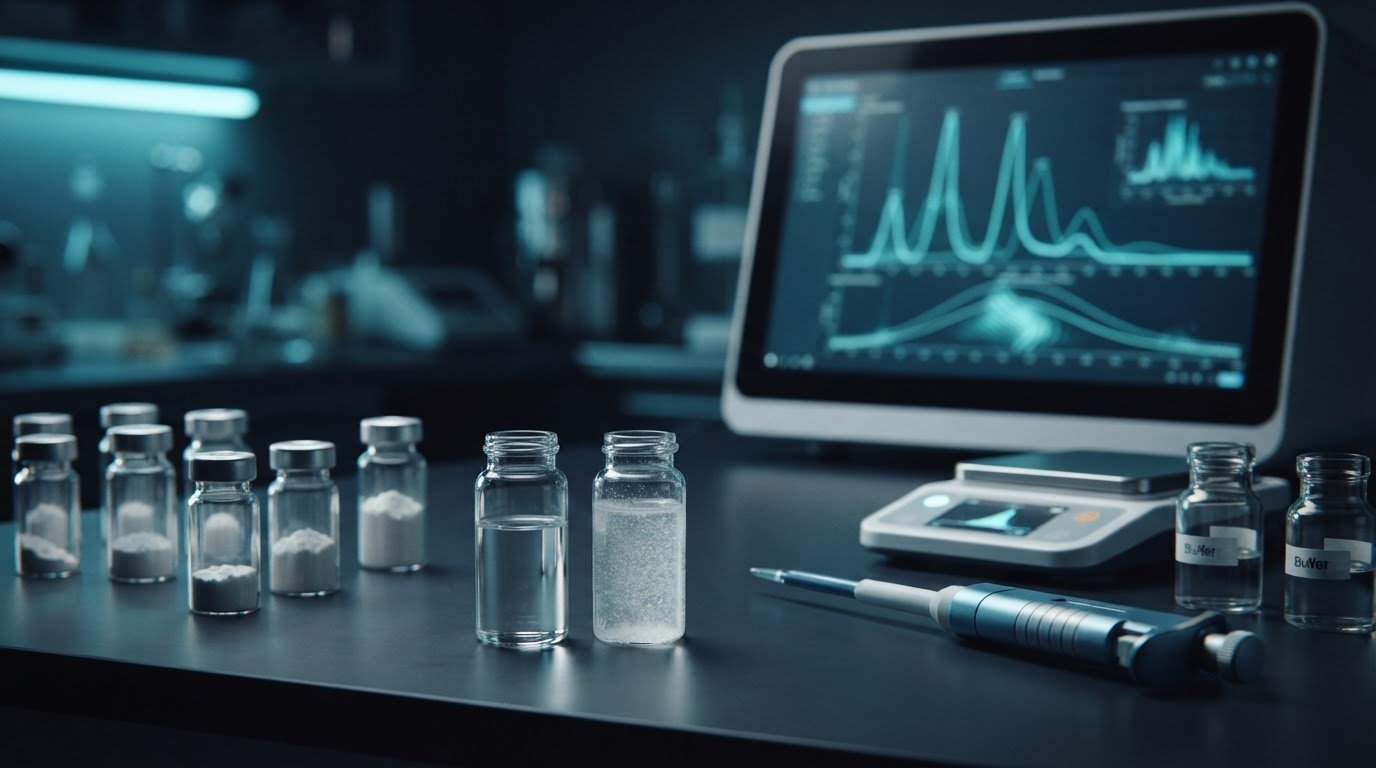
The same peptide can dissolve in one buffer and remain cloudy in another. Neither observation alone explains what is happening. This peptide solubility guide for researchers treats solubility as specific to the sequence and conditions, not as a universal solvent recipe.
When a sample behaves inconsistently, it is tempting to look for one reliable fix. But dissolution, equilibrium solubility, and aggregation are distinct phenomena, and confusing them can lead to misleading conclusions. This guide explains how sequence features such as charge and hydrophobicity interact with pH, ionic strength, concentration, temperature, solvent, and handling.
You’ll learn how to compare candidate conditions systematically, record observations so experiments are easier to reproduce, and interpret a clear or cloudy sample with appropriate caution. The article also explains what analytical documentation can and cannot tell you: batch-specific HPLC and mass-spectrometry results support assessment of purity and identity, but do not predict how a peptide will behave in a particular formulation. The aim is a documented, evidence-led approach to evaluating research samples.
Key Takeaways
- Define the endpoint you need to assess. Dissolution, visible clarity, and sustained solubility are not interchangeable observations.
- Use sequence, charge, and hydrophobicity to guide comparisons, then assess the peptide under the solution conditions relevant to your experiment.
- This peptide solubility guide for researchers outlines a controlled workflow for comparing candidate conditions and documenting observations.
- Change conditions systematically and record details such as pH, concentration, solvent, temperature, and handling to make results easier to interpret and reproduce.
- Use HPLC and mass-spectrometry documentation as evidence about purity and identity, not as a prediction of solubility in a specific buffer.
What Peptide Solubility Means in a Research Setting
A peptide’s solubility is not a fixed label that applies in every experiment. The IUPAC Gold Book definition of solubility relates solubility to a saturated solution and a specified solvent. In practice, a reported value is meaningful only alongside its conditions, including the peptide identity, medium composition, temperature, and measurement method.
Peptide solubility is the amount of a specified peptide that can remain in a defined medium at equilibrium under stated conditions, including temperature and solution composition. This condition-specific definition is a useful anchor for any peptide solubility guide for researchers. It prevents results in one buffer from being mistaken for a universal property of a sequence.
Solubility, Dissolution, and Aggregation Are Different Observations
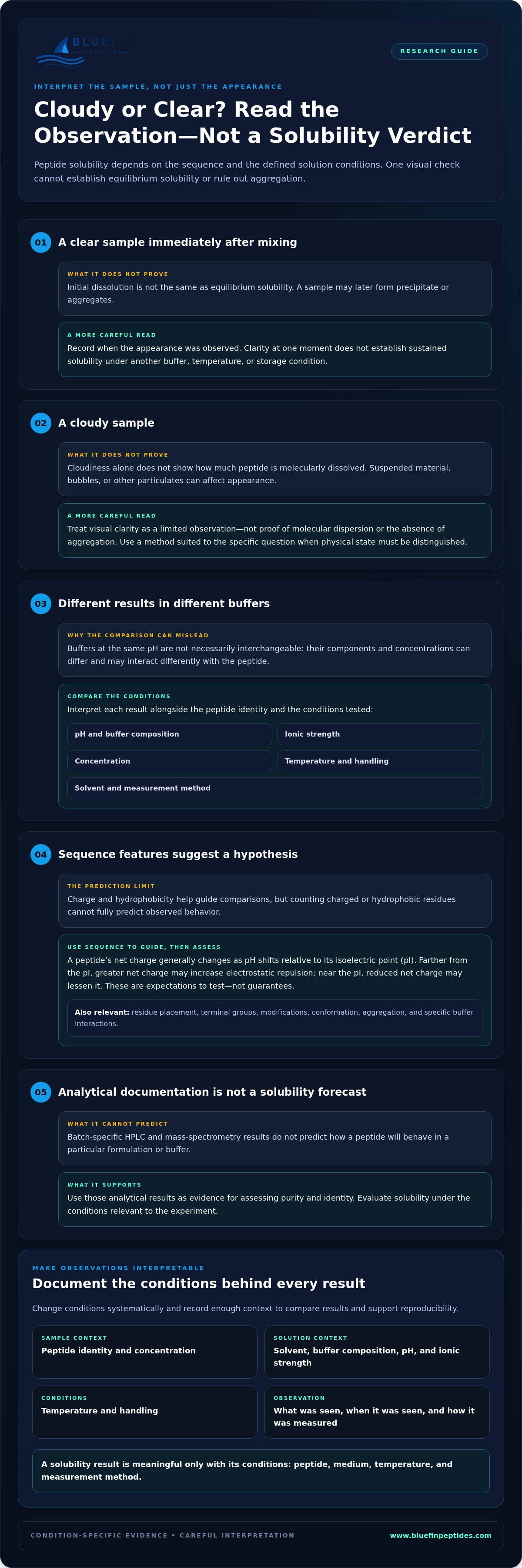
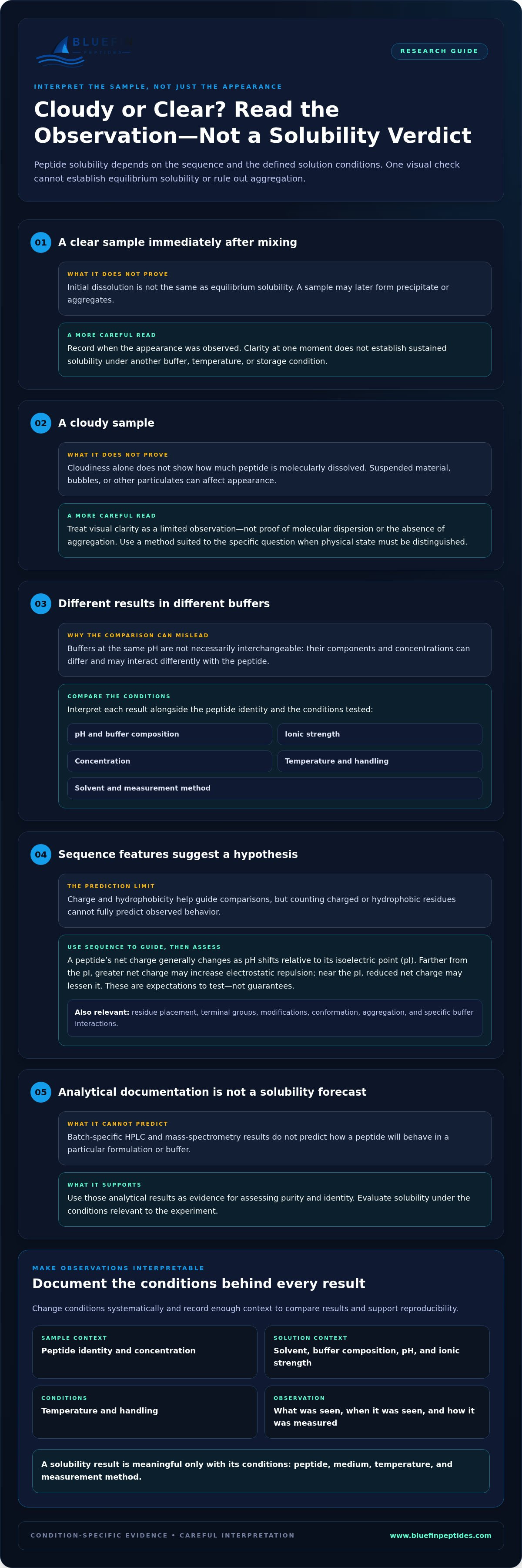
Dissolution is the process by which material enters a solvent; solubility describes an equilibrium-related limit under defined conditions. A sample may initially appear to dissolve, then form precipitate or aggregates over time. Conversely, a cloudy sample may contain suspended material without showing how much peptide is molecularly dissolved.
Visual clarity is a limited observation, not proof of molecular dispersion or the absence of aggregation. Small particles and soluble assemblies may not be visible, while bubbles or other particulates can make a sample look cloudy. Record appearance and when it was observed, but do not treat either as a complete account of the sample’s physical state. If the research question requires distinguishing dissolved peptide from other forms, use an analytical method suited to that question.
Why Researchers Need Condition-Specific Solubility Information
Solubility information supports assay design. The medium used to prepare a sample can affect the amount available in solution and may also interact with assay components. If concentration or physical state varies between preparations, observed differences may reflect handling or formulation conditions rather than the variable under investigation. Reproducibility depends on recording those conditions clearly.
Peptide identity matters because sequence and structure influence interactions with the surrounding medium. The overview of peptides describes peptides as chains of amino acids; changes in sequence can change their chemical properties. Medium composition and temperature also shape those interactions. Concentration matters because conditions that appear workable at a lower concentration may not behave the same at a higher one. The measurement method matters too: visual inspection, turbidity, and analytical separation do not answer identical questions.
For example, clarity immediately after mixing in one buffer does not establish sustained solubility in a different buffer, at a different temperature, or after storage. Nor should findings for one peptide automatically be applied to another, even if their sequences are related. All materials and examples discussed in this article concern qualified laboratory research, not clinical or consumer use. The practical standard is precise documentation: identify what was tested, the conditions used, and what the observation can support.
How Sequence and Solution Conditions Shape Peptide Solubility
Solubility emerges from the interaction between a peptide’s sequence and its surrounding solution. Nonpolar residues can favor association with one another rather than contact with water, while charged or polar residues can support interactions with aqueous media. The position of residues in the sequence and how their properties combine matter too. Simply counting hydrophobic or charged amino acids cannot fully predict observed behavior.
Peptide solubility depends on the peptide’s sequence and the defined solution conditions, including pH, buffer composition, ionic strength, temperature, and concentration. Sequence-based estimates can help form hypotheses, but measured behavior remains essential under the conditions relevant to a particular experiment.
Sequence Properties and the Isoelectric Point
The isoelectric point, or pI, is the pH at which a molecule has zero average net charge. The IUPAC Gold Book definition provides this chemical reference point. A peptide’s net charge generally changes as pH shifts relative to its pI, but that does not establish a universal solubility outcome. Residue placement, terminal groups, modifications, and interactions among charged groups also matter.
Farther from the pI, greater net charge may increase electrostatic repulsion between peptide molecules and, in some systems, reduce self-association. Near the pI, reduced net charge may lessen that repulsion. These are expectations to test, not guarantees: aggregation, conformation, and specific buffer interactions can change the result. Use predicted charge and hydrophobicity to select candidate conditions, not as substitutes for measurement.
PH, Buffer, Ionic Strength, and Other Conditions
pH describes acidity, while buffer composition determines how that pH is maintained and which other chemical species are present. Two buffers at the same pH are not interchangeable: their components may differ in charge, concentration, or interaction with the peptide. Ionic strength can screen electrostatic interactions, and counterions associated with charged groups may influence observed behavior. The direction and magnitude of these effects depend on the peptide and the full formulation.
Temperature can alter molecular motion and association; concentration can shift the balance between dispersed molecules and intermolecular contacts. Record both, along with pH, buffer identity, and counterion where known. When comparing conditions, change one factor at a time where practical so the result is easier to interpret.
Keep analytical evidence separate from formulation behavior. HPLC and mass spectrometry address aspects of purity and identity; they do not establish solubility in a particular buffer. The analytical quality standards guide explains this distinction. Bluefin Peptides offers research-use peptides with batch-specific analytical documentation for qualified laboratory research. Review research peptide materials as part of a documented evaluation.
How to Compare Solubility Strategies Without Assuming a Universal Recipe
Compare candidate approaches by what they change and whether that change fits the research question. Adjusting pH can alter ionization and net charge; adding a cosolvent changes the solvent environment and peptide-solvent interactions. Aqueous buffers provide a relevant test medium when the assay itself uses one, but buffer composition can also influence observed behavior. No category is a default winner. The peptide and intended assay determine what is worth evaluating.
Compare Candidate Conditions by Purpose and Constraint
Use a comparison matrix to make trade-offs explicit before testing. Treat each peptide-specific choice as a hypothesis that needs experimental verification. Include assay compatibility, downstream detection, and material constraints, such as whether the assay tolerates a buffer component or cosolvent. The table identifies questions to assess, not a ranked recipe.
| Strategy | Primary rationale | Limitations to consider | Assay and material constraints |
|---|---|---|---|
| Aqueous buffer | Tests behavior in a water-based medium relevant to many assay designs. | Buffer identity, pH, and ionic strength may each affect the result; clarity alone is not a solubility measurement. | Check compatibility with assay chemistry, detection, and downstream handling. |
| pH adjustment | Changes ionization and may alter peptide charge and intermolecular interactions. | Effects depend on sequence and conditions; a pH shift can also affect stability or assay performance. | Consider assay pH requirements, buffer capacity, and whether detection is sensitive to the altered conditions. |
| Compatible cosolvent | Changes the solvent environment and may help assess behavior when aqueous conditions are inadequate. | Compatibility and effects are peptide- and assay-specific; the cosolvent can become a confounding variable. | Assess tolerance in the assay, downstream detection, and any material or handling constraints. |
Keep the comparison tied to the experimental endpoint. A condition that supports sample preparation may not suit the final assay, and apparent clarity does not establish compatibility or sustained solubility. Evaluate the selected condition in the relevant analytical or assay system before interpreting results.
Use Peptide-Specific Evidence, Not Generic Solvent Rules
A published condition for a different peptide can help generate a candidate, but it is not a guarantee that the condition will transfer. Sequence, modifications, counterion, concentration, buffer composition, and measurement endpoint can all differ. Record which details match your system and which do not, then test the candidate under controlled conditions.
Analytical specifications for retatrutide provide sequence-specific analytical context, not evidence of behavior in a particular solvent. Neither a peptide’s name nor a purity percentage predicts its solubility. A peptide solubility guide for researchers should keep these evidence types separate: analytical identity and purity inform sample characterization, while solubility requires condition-specific evaluation. For qualified laboratory research, explore research-use peptide materials alongside the documentation relevant to the sample.
A Research Workflow for Evaluating and Troubleshooting Solubility
A useful workflow turns an unclear result into testable observations. Keep comparisons aligned with the research question, and change conditions in a way that helps identify what influenced the outcome. The steps below are a decision framework, not a validated laboratory protocol; follow methods appropriate to the sample and assay.
- 1. Define the endpoint. Specify what counts as a relevant result, such as a measured soluble fraction or compatibility with a particular assay. Do not use “dissolved” as an undefined pass-or-fail criterion.
- 2. Review the sample. Record peptide identity and available sequence or modification information. Note the lot, since comparisons across lots can introduce another variable.
- 3. Select candidate conditions. Choose conditions relevant to the experimental medium and compare them with a clear rationale. Keep key factors constant; where practical, vary one factor at a time to make initial troubleshooting easier to interpret.
- 4. Observe at defined points. Record appearance and timing separately from any instrumental measurement or assay result. Use the same observation conditions across comparisons.
- 5. Document and reassess. Compare records before assigning a cause. If the result remains unclear, select a follow-up measurement suited to the question rather than relying on appearance alone.
One-variable-at-a-time comparisons can help isolate a factor during focused troubleshooting, but they may miss interactions between factors. The NIST/SEMATECH e-Handbook of Statistical Methods discusses experimental designs for evaluating factors and interactions. For a broader study, choose a design that can answer the research question without assuming a single-factor comparison captures every effect.
Record Conditions and Observations Consistently
Reproducible solubility observations require a record of the conditions under which they were made. For each comparison, capture peptide identity and lot, medium and buffer composition, pH, temperature, concentration, and observation time. Note any handling details that differed between samples. Missing conditions can make a clear-looking result difficult to reproduce or interpret.
Keep visual appearance distinct from measurement. Note clarity, visible particles, or precipitation as observations, then separately identify the method used to assess the sample and the assay outcome. Visual inspection cannot establish molecular dispersion or rule out aggregation by itself.
Interpret Unexpected Cloudiness or Inconsistent Results
Cloudiness is a finding, not a diagnosis. It may reflect suspended material, precipitate, bubbles, or other causes; appearance alone cannot confirm aggregation or degradation. Before assigning an explanation, compare condition records and consider whether buffer components or other formulation variables could affect the assay or detection method.
Use method-specific follow-up evidence to support claims about physical state or chemical change. For instance, an assay response that shifts alongside visible cloudiness does not prove aggregation caused the shift. The measurement must be suitable for distinguishing the possibilities relevant to the research question. Consistent records provide a clear basis for deciding what to investigate next.
Bluefin Peptides offers research-use peptides and blends for qualified laboratory research and documented sample evaluation.
How Analytical Documentation Supports Peptide Solubility Decisions
Analytical records and solubility testing answer different questions. High-performance liquid chromatography (HPLC) separates components in a sample, and its chromatographic profile can support an assessment of purity. Mass spectrometry measures mass-to-charge ratios to help characterize molecular mass and support identity confirmation. Neither result, by itself, shows how much peptide will remain dissolved in a specific buffer or perform in a particular assay.
This distinction matters for procurement and experimental interpretation. A high-purity result does not guarantee a clear solution, prevent aggregation, or predict compatibility with a study medium. Solubility depends on the peptide and the conditions being evaluated. A certificate of analysis (COA) documents specified analytical results for a batch; it is not a substitute for an experiment-specific assessment.
What Purity and Identity Records Can and Cannot Show
Read each record according to the method it reports. An HPLC result supports review of chromatographic purity under the stated method, while mass-spectrometry data support assessment of expected mass and identity. These measurements provide useful evidence about a sample’s analytical characteristics, but they do not directly measure equilibrium solubility or behavior after preparation in a chosen medium.
A COA should be interpreted within its stated scope. It can support batch review and traceability, but it cannot establish that the same peptide will behave identically across buffers, concentrations, temperatures, or assay conditions. Keep analytical claims and formulation observations separate in research records.
Apply Documentation to Research Procurement
Batch-specific documentation helps researchers connect a material to its reported analytical results, supporting procurement review and a traceable record of what entered an experiment. Compare the document with the material and batch being evaluated, then record its details alongside your own preparation conditions and measurements. This creates a clearer evidence trail without treating supplier data as a prediction of experimental performance.
Bluefin Peptides’ research-use peptides are at least 99% HPLC-verified, have mass-spectrometry confirmation, and include batch-specific certificates of analysis. These records support analytical review; they do not establish solubility in every formulation. Use documentation to characterize the batch, then evaluate behavior under the defined conditions of the study.
Bluefin Peptides’ products are exclusively for qualified research use, not human, veterinary, or consumer use. Review the relevant research-use peptide documentation as one part of a condition-specific evaluation.
Carry a Clear Solubility Record Into Your Next Study
Make your next step operational: define the observation your study needs before preparing a sample, then record the conditions and measurement method alongside the result. A consistent record gives your team a stronger basis for comparing future experiments and deciding which variables deserve closer evaluation. It also helps prevent an early visual impression from becoming an unsupported conclusion.
Use this peptide solubility guide for researchers as a framework for building that decision trail, not as a universal formulation recipe. Pair condition-specific testing with batch documentation, keeping each source of evidence within its proper scope. Bluefin Peptides provides research-use peptide documentation for qualified laboratory research; review the records relevant to your research materials as you plan your evaluation.
Review Bluefin Peptides’ research-use peptide documentation and take the next step with a methodical, evidence-led approach. Clear questions and well-kept records make results easier to interpret.
Frequently Asked Questions
Is peptide solubility the same as peptide stability?
No. Solubility concerns how much peptide is present in solution under defined conditions; stability concerns whether the peptide retains its chemical or structural integrity over time under those conditions. A sample can be soluble but degrade, or remain chemically intact while precipitating. For example, a change in assay signal after storage could reflect degradation, precipitation, or another effect. Distinguish these possibilities with measurements suited to each question.
Can a clear peptide solution guarantee that the peptide is fully dispersed?
No. A solution can look clear while containing assemblies or particles too small to see, and visual inspection cannot establish molecular-level dispersion. Clarity also says nothing by itself about whether the peptide remains uniformly distributed over time. If dispersion matters to an experiment, define an appropriate measurement and sampling point, and check whether the method detects the physical forms relevant to your study.
Does an HPLC purity result predict peptide solubility?
No. An HPLC purity result describes the sample’s chromatographic profile under the method used; it does not predict how the peptide will behave in your experimental medium. Two samples with similar reported purity can respond differently to a buffer or assay. Use purity data to support sample characterization, then evaluate the specific material under the conditions of interest. Purity evidence and solubility evidence answer separate questions.
Does the counterion affect the apparent solubility of a peptide?
It can. A counterion contributes to the chemical form of a charged peptide and may influence interactions with the surrounding medium, so apparent behavior can differ between preparations. The effect cannot be predicted from the counterion name alone; peptide sequence, pH, ionic strength, and other formulation details also matter. If comparing materials, record the stated counterion where available and keep other conditions consistent before interpreting a difference.
Can one solvent system work for every research peptide?
No single solvent system can be assumed to work for every research peptide. Sequences differ in charge, hydrophobicity, and other properties, while assays impose their own compatibility limits. A solvent that produces a usable sample for one study may interfere with another study’s detection or downstream analysis. Treat prior conditions as candidate starting points only, and assess the chosen system against the peptide and intended experimental endpoint.
Does a certificate of analysis specify a peptide’s solubility?
Only if solubility was specifically tested and reported with defined conditions and a method. A certificate of analysis documents the tests it contains, such as identity or purity results; those results do not establish solubility in every buffer or assay. Review the document’s test scope and conditions. If solubility data are not included, evaluate the peptide in the formulation relevant to your research rather than inferring behavior from unrelated results.
For laboratory research use only. Not for human or veterinary use. This content is educational and does not constitute medical, dosing, or usage guidance.
Browse the BLUEFIN catalog