Peptide Research Lab Notebook Standards: Practical Guide

A peptide result is only as reviewable as the record connecting it to the material, method, and raw evidence. Clear lab notebook standards for peptide research help prevent a familiar problem: a result is recorded, but the sample identity, batch, analytical evidence, or experimental context is incomplete. A notebook should let another researcher follow the work without guessing what happened.
Consistent documentation matters, especially when methods change or an experiment departs from plan. The goal isn’t to turn every entry into paperwork. It’s to preserve enough context to interpret and reproduce the work. This guide provides a repeatable entry structure for capturing peptide identity and batch details, procedures, observations, deviations, and links to raw data. It also explains how to document corrections and reviews, and how to distinguish broadly useful practices from requirements set by a particular institution, study, or electronic record system. The result is a traceable workflow that keeps materials, methods, and conclusions connected.
Key Takeaways
- Use lab notebook standards for peptide research to connect each conclusion to identifiable materials, documented methods, observations, and supporting evidence.
- Link peptide identifiers and batch details to the relevant certificate of analysis, while keeping source documents distinct from the notebook entry.
- Record work chronologically, including deviations, failed runs, and follow-up decisions, so the experimental history remains clear.
- Choose paper or electronic records based on workflow needs, and establish appropriate access, backup, retention, and change-history controls.
- Pilot a concise template with representative records, then refine fields and review practices before adopting it across the laboratory.
Lab Notebook Standards for Peptide Research: What a Complete Record Must Establish
A laboratory notebook preserves the context of a study, the actions performed, the observations made, and the evidence supporting the interpretation. Strong lab notebook standards for peptide research let a reader trace how a conclusion arose instead of finding a result detached from the work that produced it. Complete records support reconstruction and review, but they cannot guarantee reproducibility on their own. Suitable methods, materials, training, and experimental design matter too.
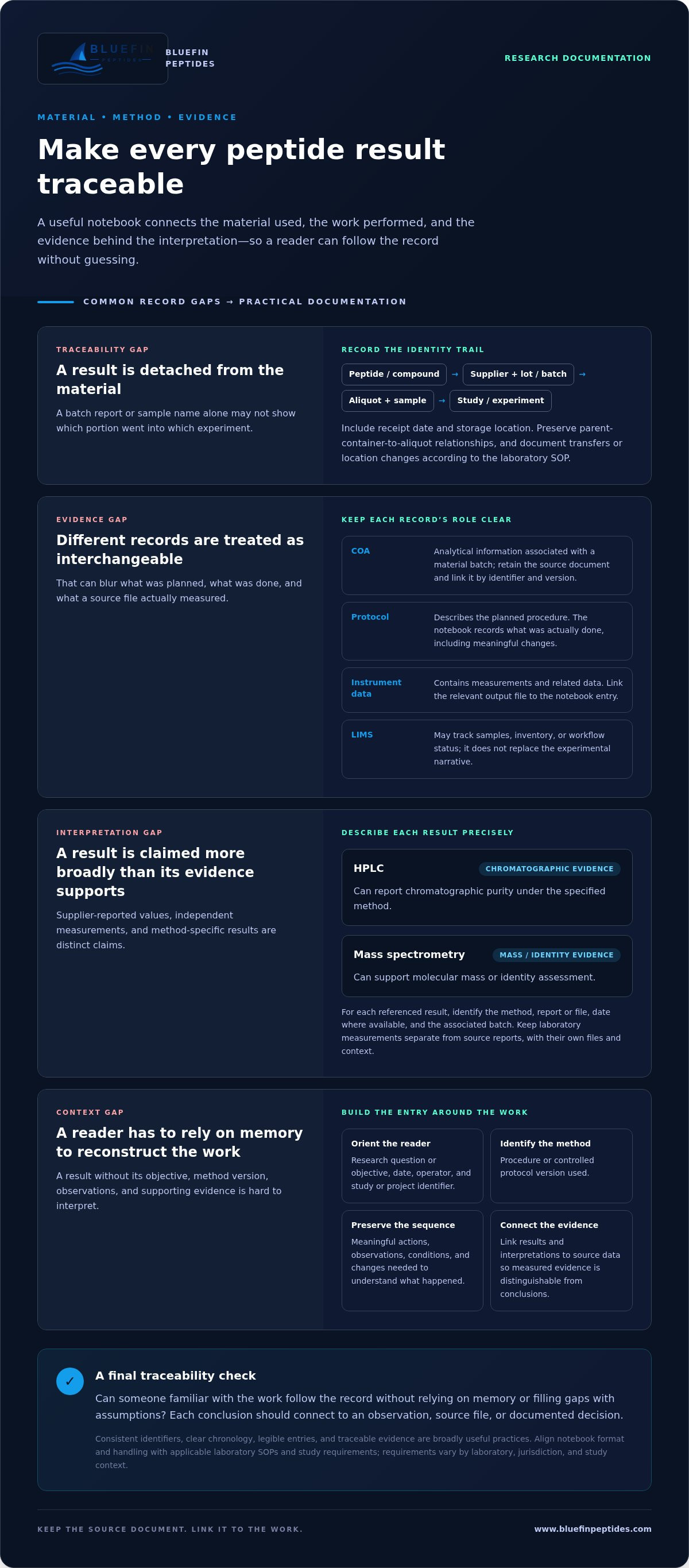
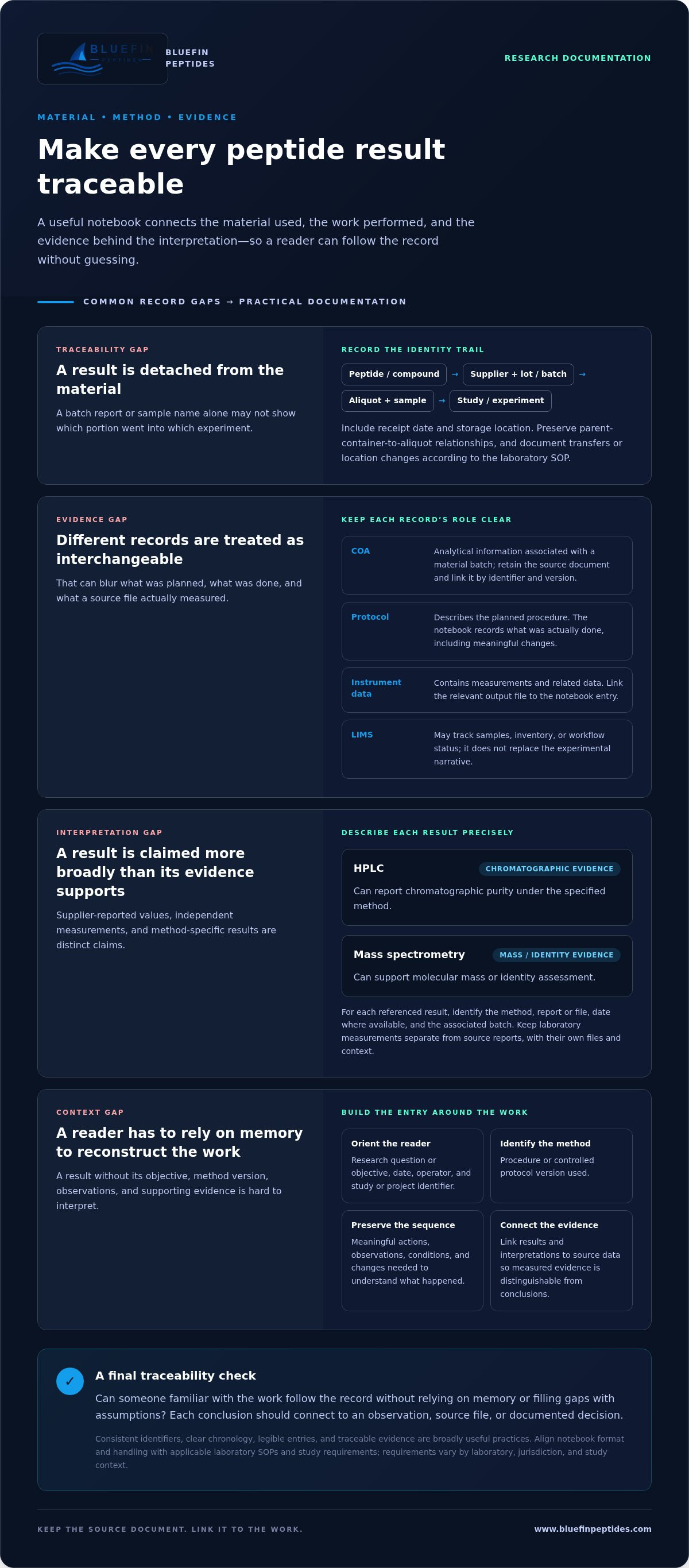
Keep the notebook’s role distinct from related records. A certificate of analysis (COA) documents analytical information associated with a material batch. Instrument output contains measurements and related data. A protocol describes the planned procedure; the notebook records what was actually done. A laboratory information management system may track samples, inventory, or workflow status. Link the entry to relevant source records, but don’t use it as a replacement for them or imply they contain the full experimental narrative.
What makes a peptide research notebook entry complete?
Begin with enough context to orient a reader: the research question or objective, date, operator, and study or project identifier. Identify the procedure or controlled protocol version used. Record meaningful actions and observations in sequence, including conditions or changes needed to understand what happened. Link results and interpretations to source data, such as instrument files or associated records, so a reviewer can distinguish measured evidence from the researcher’s conclusion.
Use a practical test: could someone familiar with the work follow the record without relying on memory or filling gaps with assumptions? If a statement can’t be traced to an observation, source file, or documented decision, its basis may be unclear.
Notebook standards versus laboratory policy
Consistent identifiers, clear chronology, legible entries, and traceable evidence are broadly useful practices, but they don’t replace local requirements. Applicable institutional SOPs and regulatory obligations depend on the laboratory, jurisdiction, and study context. Good Laboratory Practice (GLP) describes a quality system for managing research conduct and records. Whether GLP applies to a particular study depends on its governing context.
Use the notebook as a reliable working record, and align its format and handling with applicable SOPs and study requirements. Don’t assume that a template, paper book, or electronic system satisfies every funder, institution, or regulated study. Refer jurisdiction- or study-specific questions to the responsible institutional or regulatory specialist. The standard is twofold: preserve a clear account of the work and follow the rules that govern it.
Documenting Peptide Identity, Batch, and Analytical Evidence
Material traceability starts with a clear link between the peptide received, the portion used, and the experiment in which it was used. Assign consistent identifiers to the compound, supplier, lot or batch, aliquot, sample, and study. Record the receipt date and storage location, and document transfers or location changes according to the laboratory’s SOP. Storage conditions and handling requirements vary by material and facility, so follow the applicable procedure rather than assuming one set of conditions fits every situation.
Reference the source document by identifier and version, such as a supplier record or batch-specific certificate of analysis (COA). Don’t copy conclusions that the source doesn’t support. A supplier-reported purity value, an independent laboratory measurement, and a result from a particular analytical method are distinct claims. Identify whose result it is, which material batch it concerns, and where the supporting report is filed.
Linking analytical evidence to the material used
For each referenced result, record enough information to locate and interpret its source: the method, report or file identifier, date where available, and explicit batch association. If a sample is an aliquot from a parent container, preserve that relationship in the identifier trail. This helps prevent a report for one lot or sample from being mistaken for evidence about another.
HPLC and mass spectrometry provide different forms of analytical evidence. An HPLC result can report chromatographic purity under the specified method; mass spectrometry can support molecular mass or identity assessment. Describe each result only as broadly as its method and report justify. Keep the original COA or analytical report linked to the notebook entry, and record any laboratory measurements separately with their own files and context. For further context on interpreting these records, see analytical quality standards for research peptides.
A COA documents a batch, but it doesn’t replace experimental records showing how that material was handled and used. Connect the batch evidence to the actual sample and experiment in the notebook, while retaining the source document as supporting evidence. This traceable approach is central to lab notebook standards for peptide research.
For foundational guidance on permanence, contemporaneous entries, and corrections, consult the University of Wisconsin-Madison resource on how to keep an accurate, up-to-date laboratory notebook. Researchers seeking research-use-only peptide materials can review peptide research materials alongside the batch documentation relevant to their work.
Recording Peptide Methods, Observations, Deviations, and Results
A useful experimental entry follows the work in the order it happened: identify the materials and samples, cite the method or protocol version, record actions and observations as they occur, then document results and decisions. Add dates, personnel, and equipment identifiers where applicable. This sequence gives a reviewer a clear route from the planned method to the actual run and its evidence.
Building a reconstructable experimental record
Record enough method context to distinguish the procedure used from other versions, including the protocol reference and revision. Note the relevant sample and equipment identifiers so the entry can be connected to the correct materials and instrument records. Cross-reference raw instrument files and analysis outputs using stable filenames or repository identifiers. A link should lead to the source evidence, not just a summary.
If the work departs from the planned or approved procedure, document what changed, when it changed, and why. Include any review or authorization required by the laboratory’s SOP or study requirements. Preserve the original sequence of events: use the approved correction process rather than silently replacing an entry. Apply the same principle to failed runs and unexpected observations. Record what happened, relevant conditions, the immediate response, and any follow-up decision. A failed run is part of the experimental history, not a blank to remove.
Documenting results without overstating conclusions
Separate direct observations from interpretation. For example, record an instrument output or observed event as evidence, then label the explanation or proposed meaning separately. Include units, calculation methods, exclusions, and relevant uncertainty with reported results. If data are excluded, identify them and document why. Note unresolved limitations rather than smoothing them out of the record.
An interpretable result needs traceable method context and linked source data. A value separated from its method, sample identity, calculations, and original file is difficult to assess. Lab notebook standards for peptide research should make the path from observation to conclusion visible, including decisions that affect how results are reported.
Keep conclusions proportionate to the evidence. A single analytical measurement may support a narrow statement about that measurement under its method conditions; it doesn’t, by itself, establish broader biological or clinical claims. Record what the data show, identify the limits of the method or dataset, and distinguish findings from hypotheses that require further investigation.
Paper or Electronic Notebook: Choosing a Traceable Documentation Workflow
Neither paper nor electronic format is inherently more rigorous. The stronger choice is the one that lets your laboratory create attributable entries, preserve changes, retrieve records, and retain them under its procedures. Compare each option against access control, searchability, evidence links, retention needs, and how researchers actually document work. Format alone doesn’t establish compliance or make a record reviewable.
When a paper notebook can support consistent records
Paper can work well when entries are legible, dated, attributable, and connected to referenced attachments. Use a bound or otherwise controlled format if laboratory policy specifies it. Record information in the approved manner, and make corrections as transparent amendments that preserve the original entry and show who made the change and when, as required by local procedure. Store notebooks and attachments securely, with retention and access governed by the laboratory’s SOP.
Paper records can be simple to use at the bench, but searching across notebooks and connecting detached instrument files may require deliberate indexing. A consistent identifier scheme and clear attachment references help keep records navigable alongside the experiment.
Electronic notebook controls researchers should document
Electronic notebooks can make records easier to search, link, and share, but those advantages depend on controls. Evaluate whether each user has an individual account, access is appropriately limited, changes remain visible in an audit history, and records can be backed up and exported in a usable form. A shared login or undocumented file replacement can weaken attribution and obscure a record’s history.
Before adopting an electronic workflow, check institutional rules for signatures, retention, system validation, and approval. Requirements depend on the study and applicable policy; an electronic tool doesn’t automatically satisfy them. For records subject to FDA requirements, determine with qualified institutional staff whether 21 CFR Part 11 applies and what controls are expected. Build the workflow around those decisions, not the software’s feature list.
Regardless of format, preserve the link between a material’s batch documentation and the sample used in a study. The retatrutide analytical specifications and laboratory standards guide offers related context for batch-linked records. These practices support lab notebook standards for peptide research by making evidence traceable without treating any one format as a universal solution.
Review research-use-only peptide materials and their available documentation at Bluefin Peptides.
Implementing Peptide Research Notebook Standards Without Adding Unnecessary Friction
A practical rollout improves traceability without creating duplicate paperwork. Before adding fields, map the laboratory’s existing SOPs, sample identifiers, inventory records, and data repositories. A new notebook template should connect these systems, not create a parallel record researchers must maintain by hand. This alignment is central to effective lab notebook standards for peptide research.
A practical sequence for introducing a notebook template
Build the workflow in stages. Define essential entry fields, establish consistent naming conventions for studies and samples, specify how attachments and source data are referenced, and assign responsibility for review. Then test the draft template against representative records, including a routine run, a deviation, and an incomplete or failed run. Use a fictional example to train users before rollout. Revise fields that create confusion or capture information already maintained reliably elsewhere.
Keep the process lean. Each required field should help identify, interpret, review, or retrieve the work. Document the template version and how changes will be introduced so researchers don’t unknowingly use conflicting formats.
Keeping records reviewable throughout the study lifecycle
Set review frequency, responsibility, and record-retention practices according to approved institutional procedures. Periodic checks can catch missing links, inconsistent identifiers, unclear corrections, or references that no longer lead to source data. Review should verify connections among notebook entries, material records, batch-specific certificates of analysis (COAs), and raw-data references. It should not replace the original entry or silently rewrite the experimental history.
Batch COAs are useful source documents for material traceability. For example, a researcher can reference the COA identifier and relevant batch in the material record, then link that record to the samples and study entries where the peptide was used. The COA supports the documentation trail; the notebook still records the experiment itself. Bluefin Peptides provides batch-specific COAs for researchers to retain and connect to their own records.
Start small. Link carefully. Review consistently. A workflow that fits existing laboratory practice is more likely to keep records interpretable from study start through retention. Explore research-use peptide documentation from Bluefin Peptides.
Make Traceability Part of Every Peptide Study
Reliable records connect the material used to the method performed, the observations recorded, and the evidence behind each conclusion. Strong lab notebook standards for peptide research also preserve the experimental history: document deviations and unsuccessful runs, distinguish observations from interpretations, and keep supporting data retrievable.
Choose a paper or electronic workflow that fits laboratory procedures, then pilot its fields and identifiers against representative records. Review entries and links during the study, not only at the end. Batch-specific analytical documents can support material traceability, but they don’t replace the notebook’s record of how a sample was used.
Bluefin Peptides offers high-purity research peptides that are at least 99% HPLC-verified, with mass-spectrometry confirmation and batch COAs. Researchers can retain and connect this documentation to their own records. Products are sold exclusively to qualified researchers and aren’t intended for human, veterinary, or consumer use.
Apply a consistent, reviewable workflow to your next study, and review Bluefin Peptides research-use peptides and batch documentation. Clear records give future readers a stronger trail to follow.
Frequently Asked Questions
What should a peptide research lab notebook include?
A peptide research lab notebook should capture the study context and enough detail to understand what was done and why. Record the objective, project identifier, date, operator, peptide identity, supplier and batch identifiers, sample references, and method or protocol version. Add chronological actions, direct observations, results, deviations, and follow-up decisions. Link conclusions to relevant source data, such as instrument files, and note where those files are retained.
Are there universal regulatory standards for peptide research notebooks?
No single notebook format or set of fields applies universally to every peptide research study. General practices, such as clear attribution, traceable evidence, and transparent corrections, support review, but binding requirements can depend on study type, institution, funding conditions, jurisdiction, and applicable regulation. Check approved laboratory SOPs and study-specific procedures before setting a workflow. Refer unclear requirements to the responsible institutional or regulatory specialist.
How should researchers document a peptide batch in a lab notebook?
Connect the compound identifier and supplier to the lot or batch, receipt record, and the study’s sample identifiers. Reference the COA by its identifier and retain or link the source document so its batch association can be checked. Record relevant storage or location events according to laboratory SOPs. If material is divided into aliquots, use identifiers that preserve the connection to the original batch and make each aliquot traceable.
What is the difference between a lab notebook and a certificate of analysis?
A lab notebook records experimental activity and context, including materials used, methods followed, observations, deviations, and results. A certificate of analysis (COA) reports specified analytical information associated with a material batch. The COA can support material traceability, but it doesn’t document how a researcher handled or used the material in an experiment. Reference and retain the relevant COA alongside the notebook record rather than treating it as a substitute.
Can an electronic lab notebook replace a paper notebook?
An electronic lab notebook can replace a paper record only when the laboratory’s approved workflow and applicable study requirements permit it. Format alone doesn’t establish compliance or record integrity. Evaluate whether the system supports individual user access, visible change history, reliable backup, usable export, and appropriate retention. Review institutional policy for signatures, system approval, and any validation expectations before migrating records or making an electronic notebook the official record.
How should corrections or deviations be recorded in a research notebook?
Record corrections as transparent, attributable amendments that preserve the original entry. Follow the laboratory SOP for showing who made the change, when it was made, and any required explanation. For a deviation, document what differed from the planned procedure, when it occurred, the reason, and any required review or follow-up. Don’t silently overwrite, erase, or omit the original record, including when a run fails or produces an unexpected observation.
How long should peptide research lab notebooks be retained?
Retention periods depend on institutional policy, study obligations, funding conditions, and applicable requirements; there isn’t one period that fits every research record. Check the approved retention schedule and any study-specific procedures before disposing of notebooks, attachments, or linked electronic data. Confirm that the schedule covers supporting records such as COAs and raw-data references. If requirements conflict or remain unclear, seek guidance from the responsible records or compliance specialist before disposal.
For laboratory research use only. Not for human or veterinary use. This content is educational and does not constitute medical, dosing, or usage guidance.
Browse the BLUEFIN catalog