Peptide Research Guide: Identity, Handling, and Safety
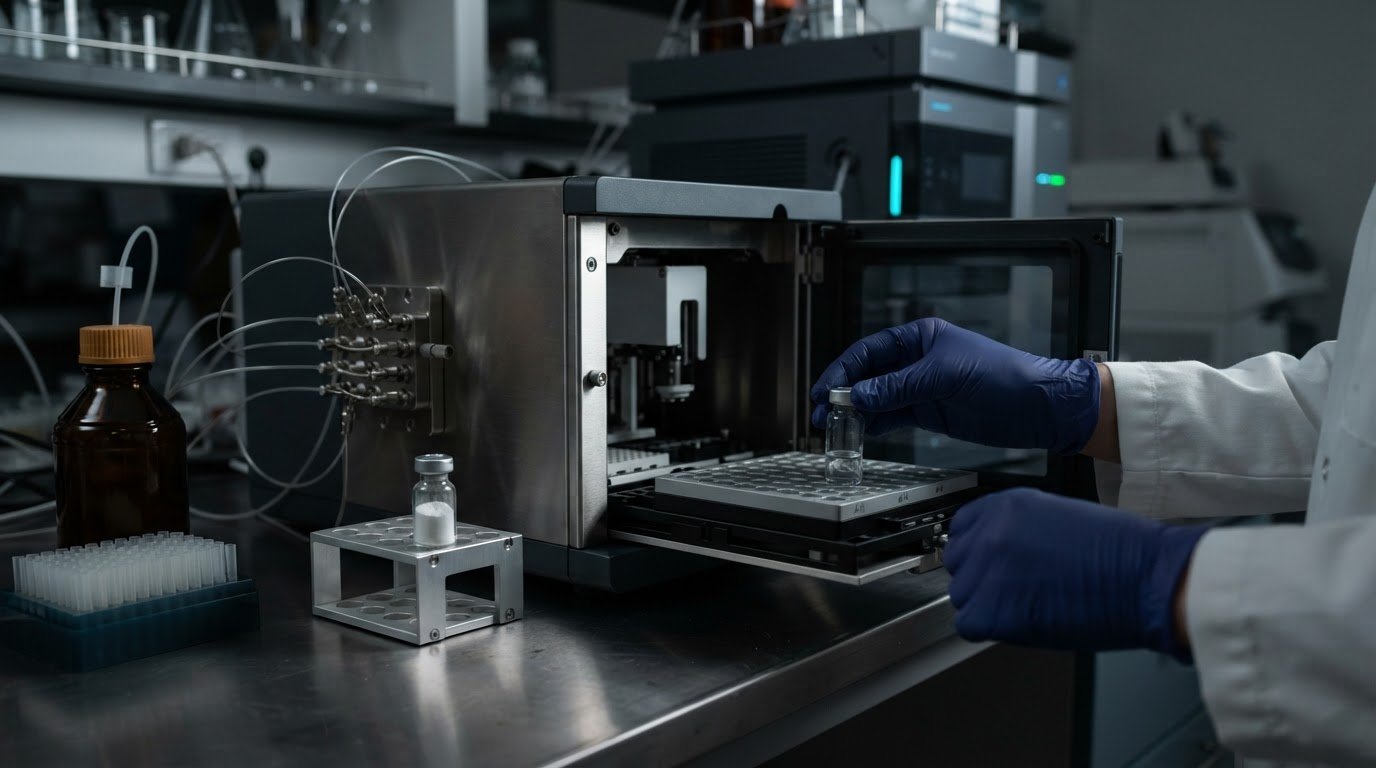
Peptide research depends on knowing what a sample contains and how it is handled. Peptides typically consist of 2 to 50 amino acids, and this guide to peptide research for beginners explains how researchers examine these molecules and their properties. Identity and purity testing help establish what is in a sample before it is used in an experiment.
Knowing a peptide’s name is only the starting point. Its sequence, sample quality, storage conditions, and intended research use all affect how it can be studied and how results should be interpreted.
This guide to peptide research for beginners covers peptide structure, emerging therapeutic research, and how HPLC and mass spectrometry can help assess identity. It also explains practical handling and storage principles, and why safety information must match a specific product and its intended use. The key is to distinguish laboratory research from medical treatment, preserve sample integrity, and interpret findings carefully.
Key Takeaways
- Understand how peptide structure shapes the questions researchers can investigate.
- Learn why identity, purity, and content testing are distinct parts of evaluating a sample.
- Recognize how handling and storage practices help preserve peptide integrity.
- See why administration methods and safety considerations depend on the specific product and its intended use.
- Explore current research directions while keeping laboratory research distinct from medical treatment.
Administration methods and injection safety
Administration depends on the formulation and research context. Peptides may be supplied as liquids, tablets, pens, prefilled syringes, or single-dose vials. Some require reconstitution; others are ready for their intended process. Subcutaneous injection is common, while certain peptides are available orally or topically. Oral peptides can degrade during digestion, affecting absorption, so these routes are not interchangeable. A hormone study, including one involving growth hormone, must follow its approved protocol, not assumptions based on insulin use or supplement directions.
Peptides are chains of amino acids, typically containing 2 to 50 residues. Individual amino acids are the building blocks; a peptide links several together. Proteins are generally longer, more complex chains that fold into functional structures. Small-molecule compounds are chemically distinct and are not amino-acid chains. This difference affects how researchers characterize a sample and design experiments; it does not establish safety or suitability for administration.
Preparation requirements depend on the specific formulation. The diluent, concentration, route, storage conditions, and discard date can vary. A vial that requires reconstitution may call for its specified diluent, alcohol swabs, a new sterile syringe, and a sharps container. Do not assume every vial needs reconstitution. For human treatment, follow the exact directions for the prescribed product. Never derive a dose from another peptide or transfer instructions between products.
Technique also requires product-specific training. A patient should ask a pharmacist or clinician to demonstrate preparation, syringe reading, injection technique, site rotation, and sharps disposal. Subcutaneous products may use 29-31G needles, with an injection angle of 45-90 degrees depending on tissue depth. These figures are not a universal protocol. Syringe-unit measurements depend on vial strength and the volume of water used, so an uncertain calculation needs pharmacy clarification.
Follow the product’s storage instructions for temperature, light, first use, and discard timing. Reconstituted or premixed injectable peptides should last at least a month when stored appropriately; injectable products are often stored around 4°C. These are not substitutes for the formulation’s label directions. Temperature damage, visible unexpected particles, or an unreadable label are reasons to pause use and contact the dispensing pharmacy. Record storage conditions as part of sample traceability.
In the United States, drug compounding requirements discussed here fall under Section 503A of the Federal Food, Drug, and Cosmetic Act, according to the U.S. House Office of the Law Revision Counsel. That legal context concerns compounding, not a laboratory research protocol. Research preparation and patient treatment have different purposes and controls. Keep those processes distinct in records and handling procedures.
For a peptide experiment, use a documented sequence:
- Define the research question, sample identity, and intended endpoint.
- Record the formulation, batch identifier, and relevant storage conditions.
- Follow the approved protocol for preparation, including the specified diluent when required.
- Document concentrations, controls, equipment, and deviations before starting the assay.
- Log observations and results with dates, sample identifiers, and handling notes.
For prescribed treatment, keep a dose log with the date, time, amount, injection site, and symptoms. Breathing trouble, facial swelling, fainting, or another severe reaction warrants urgent care. A clear record can help distinguish handling issues from treatment effects.
Peptide identity, purity, and content testing
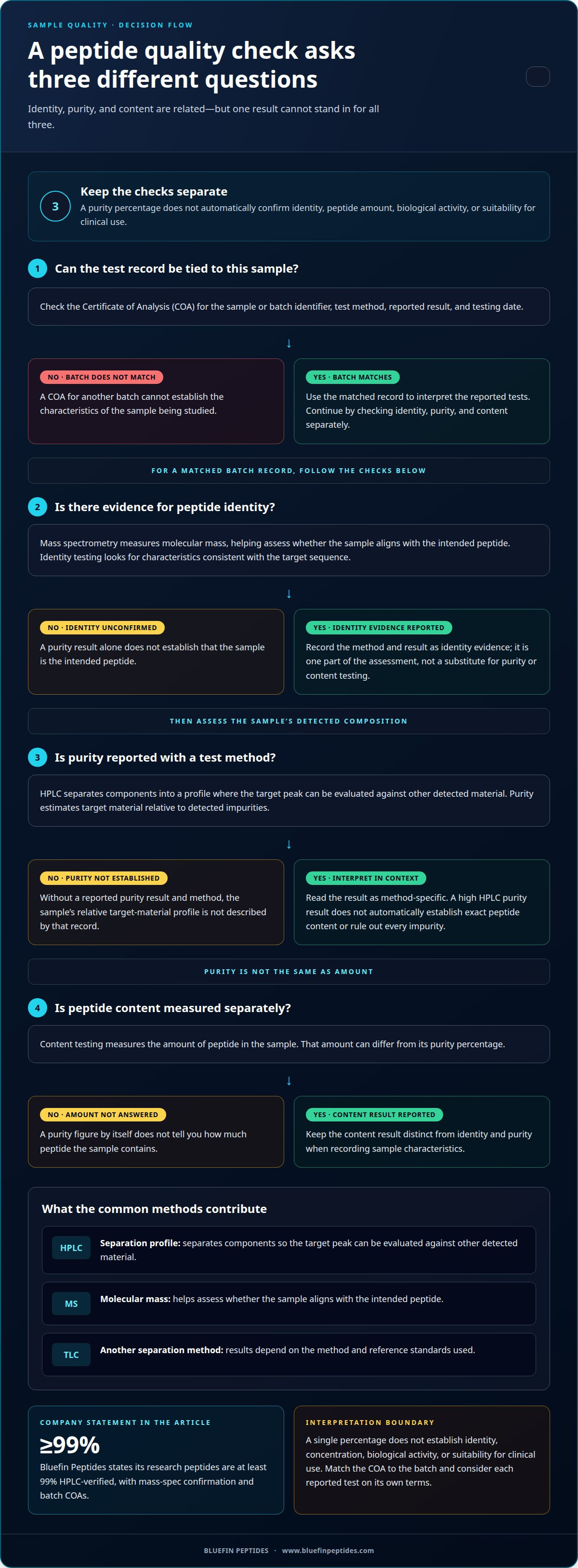
A useful peptide quality assessment asks three separate questions: Is this the intended peptide? What proportion of the sample is target material? How much peptide does the sample contain? These measures are related but not interchangeable. Identity testing looks for characteristics consistent with the target sequence. Purity testing estimates target material relative to detected impurities. Content testing measures the amount of peptide in the sample, which can differ from its purity percentage.
Laboratories may use thin-layer chromatography (TLC), high-performance liquid chromatography (HPLC), and mass spectrometry to assess identity, purity, and content. HPLC separates components into a profile where the target peak can be evaluated against other detected material. Mass spectrometry measures molecular mass, helping assess whether a sample aligns with the intended peptide. TLC provides another separation method, though results depend on the method and reference standards used.
A Certificate of Analysis (COA) records testing associated with a batch. Useful fields include the sample or batch identifier, test method, reported result, and testing date. Match the identifier on the COA to the batch being studied; a document for another batch cannot establish that sample’s characteristics. A purity figure alone also does not prove identity, concentration, biological activity, or suitability for clinical use.
For example, a high HPLC purity result describes the relative profile detected by that method. It does not automatically establish the peptide’s exact content or rule out every impurity. Mass-spec confirmation adds an identity check, while batch documentation connects reported results to a specific lot. Together, these measures provide more context than a single percentage. Bluefin Peptides states that its research peptides are at least 99% HPLC-verified, with mass-spec confirmation and batch COAs.
Keep sample testing distinct from clinical baseline testing. Before therapy, health conditions, current medicines, allergies, pregnancy plans, and sport rules can affect decisions. Growth hormone medicines may call for review of IGF-1 and glucose. GLP-1 medicines require attention to gastrointestinal effects, hydration, glucose-lowering medicines, and product-specific warnings. Semaglutide is a peptide medicine example, but sample QC does not determine whether treatment is appropriate.
For research interpretation, record the batch identifier, method, and result alongside each experiment. This traceable record helps distinguish sample variation from changes in experimental conditions. It also prevents an HPLC purity result from being mistaken for a clinical outcome, receptor response, muscle growth, or evidence of therapeutic effectiveness. Those conclusions require different evidence and study designs.
To explore research samples with batch-level documentation, browse research peptide options and use the associated COA as part of sample traceability.
Potential therapeutic peptide research directions
Therapeutic peptide research examines how peptide structure relates to biological activity and potential clinical uses. Current research directions include metabolic signaling, antimicrobial activity, tissue repair, and modifications intended to enhance stability.
Peptide Types and Potential Uses
Peptide types are grouped by structure, biological target, or research purpose, helping researchers frame testable questions. GLP-1 is a naturally occurring peptide hormone involved in appetite and blood sugar regulation. Medicines such as Mounjaro and Wegovy mimic GLP-1 activity, slow stomach emptying, improve insulin response, and reduce hunger signals. These mechanisms make metabolic signaling a prominent research direction.
Retatrutide is an investigational multi-receptor agonist peptide studied for potential weight-loss effects. Its research context differs from an approved prescription medicine; investigational status does not establish clinical suitability. Antimicrobial peptides form part of the body’s defence system and help protect against bacteria, viruses, and fungi. Research also examines GHK-Cu, a naturally occurring copper-binding peptide associated with tissue repair and skin regeneration, and BPC-157, studied mainly in animals for possible repair and inflammation effects.
Modifications to a peptide’s N-terminus, side chain, or C-terminus can affect its stability, functionality, and biological activity. Collagen peptides are studied for possible support of skin elasticity and hydration through consumption or topical application. These examples show why a proposed use should be tied to the specific peptide structure and evidence, not generalized across the entire class.
Potential Benefits and Side Effects
Potential benefits are research hypotheses about measurable biological effects, not guaranteed outcomes for an individual. For example, GLP-1 receptor agonists are studied for weight and glucose changes, while antimicrobial peptides are investigated for defensive activity. Evidence also varies by compound: human evidence for Epitalon and similar peptides promoted for ageing pathways or growth hormone release is limited. BPC-157 research has focused mainly on animals, so those findings do not establish human benefit.
Safety findings matter alongside proposed benefits. Reported potential effects include water retention, joint stiffness, fatigue, and localized injection-site reactions. Misuse can disrupt hormone balance or immune function. The FDA identifies growth hormone releasing peptide-2, growth hormone releasing peptide-6, ipamorelin acetate, and kisspeptin-10 as peptides that may pose significant immunogenicity risk. That risk concerns immune response, not proof that every exposure causes harm.
Monitoring must match the peptide and its intended clinical context. Growth hormone medicines may call for review of IGF-1 and glucose. GLP-1 medicines require attention to gastrointestinal effects, hydration, glucose-lowering medicines, and product-specific warnings. Health conditions, medicines, allergies, pregnancy plans, and sport rules can affect treatment decisions. Prescription status and research use are distinct; laboratory findings alone do not establish a suitable therapy or justify self-administration.
Peptide handling, solubilization, and storage
Good handling practices help preserve peptide stability, integrity, and function throughout an experiment. Storage practices aim to limit risks such as moisture absorption and oxidation. Start by reviewing the sample label and batch record, then document the material’s condition before opening it. Record whether the sample is dry or already in solution, since solubilization and subsequent storage depend on the formulation.
Solubilization is the process of dissolving a peptide in a suitable liquid for a defined research procedure. Peptides differ in sequence and chemical properties, so their behavior in solution can vary. The appropriate diluent and concentration depend on the formulation and experimental method. Do not assume water or another familiar solvent is suitable for every peptide. An unsuitable choice can affect dissolution and whether the preparation fits the planned assay.
Use the product’s preparation and storage instructions as the controlling reference. A vial that requires reconstitution needs its specified diluent; a ready-to-use liquid has its own directions. Record the diluent, preparation date, concentration, and batch identifier in the experiment log. These details help researchers interpret results and trace changes to preparation variables instead of mistaking them for biological effects.
Limit unnecessary exposure to air and moisture while handling samples. Close containers promptly after removing the required material, and keep labels legible. Keep each label linked to its batch record through preparation and analysis. If a sample’s identity, condition, or storage history becomes unclear, its role in an experiment is difficult to interpret. Traceability is part of the method, not an administrative afterthought.
Storage conditions should match the peptide’s formulation and its specific instructions. Temperature, light exposure, first-use timing, and discard timing can vary. Do not transfer conditions from one peptide to another, even when both are studied in the same laboratory. Record relevant storage events, including movement between storage locations, so the sample’s handling history remains visible alongside assay data.
Keep laboratory storage separate from treatment decisions. A peptide investigated for weight loss, such as an investigational compound, is not thereby a licensed medicine or supplement. Research handling directions do not establish directions for human use. For prescribed therapy, follow the licensed clinician’s instructions and the specific medicine’s labeling. Separate workflows help prevent a laboratory protocol from being mistaken for clinical guidance.
For reproducible results, link each sample’s identity, preparation, and storage records to the experimental endpoint. If a study measures weight change, for example, record the sample and assay conditions alongside that endpoint. Consistent documentation helps researchers assess whether differences reflect the peptide, procedure, or handling conditions, without treating weight loss as proof of a particular mechanism.
What equipment and supplies are needed for beginner peptide research?
Equipment choices depend on the research question, peptide form, and planned assay. A basic setup needs tools for accurate measurement, controlled preparation, sample identification, and recordkeeping. Before selecting supplies, define the experimental endpoint and identify the protocol’s material requirements. An assay using a peptide solution has different handling needs from one examining a dry sample.
Common preparation tools include calibrated pipettes, compatible tips, labeled tubes, and a rack to keep samples upright. A balance supports weighing solid materials when the protocol requires it. A pH meter can help characterize solutions when acidity matters to the method. Each tool has a distinct purpose: a pipette measures liquid volume, while a balance measures mass. Neither result alone establishes peptide identity or biological activity.
Sample control is just as important. Use labels that connect each tube to its sample identifier, batch, preparation details, and experiment record. Choose a marker that withstands the storage conditions in use. A laboratory notebook or electronic record can capture dates, solution composition, equipment used, and deviations. For example, noting a change in pipette or preparation step helps explain differences between assay runs.
Personal protective equipment should match the laboratory’s safety procedures and the materials being handled. Common examples include gloves, protective eyewear, and a laboratory coat. Keep work surfaces organized, use containers suited to the protocol, and separate sample handling from food and personal items. Use a sharps container only in workflows that generate sharps; it is not a general peptide storage container.
Some projects also require analytical instruments. HPLC can separate sample components, while mass spectrometry can support molecular-mass assessment. These instruments require validated methods and trained operators; they do not replace routine preparation tools. A beginner project can instead use an established assay with appropriate controls, provided the method answers the research question.
Storage supplies depend on the material’s form and instructions. Some materials may require a suitable freezer or refrigerator, while light-protective containers may be important for light-sensitive compounds. Follow the peptide’s stated requirements instead of applying one temperature to every sample. Record storage conditions and sample movement to keep the handling history traceable.
Build the equipment list from the protocol, not from a generic shopping checklist. Confirm that measurement tools suit the required range, containers suit the solvent, and records preserve sample identity. Research materials must remain distinct from medicines intended for patient treatment. To select a sample for a defined laboratory study, explore research peptide options and plan the required equipment around its documented form and experimental use.
Bluefin Peptides
Bluefin Peptides is a practical next step for researchers seeking peptide samples for laboratory work. Its catalog includes Retatrutide Research Peptide, Tirzepatide Research Peptide, BPC-157 / TB-500 Research Blend, and Ipamorelin / CJC-1295 Research Blend. These offerings provide sample options across distinct research areas, while the study design, handling protocol, and interpretation remain the researcher’s responsibility.
Turn to Bluefin Peptides when your research question and protocol point to one of these peptide categories. Keep research materials separate from medicines intended for patient treatment, and use product-specific documentation when planning laboratory handling. For questions about research peptide offerings, contact Bluefin Peptides.
Turn a research question into a defined next step
Before selecting a sample, narrow your research question. Define the variable you intend to examine, the assay that can measure it, and the controls needed to interpret the result. This creates a clear path from sample selection to analysis, without treating an experimental finding as proof of a clinical effect.
A guide to peptide research for beginners is most useful when it supports a disciplined study plan. State the research purpose clearly, link each sample to its documentation, and separate laboratory work from medical treatment decisions. This framework helps make experimental evidence interpretable rather than inviting unsupported conclusions.
For laboratory research, Bluefin Peptides offers Retatrutide Research Peptide, Tirzepatide Research Peptide, and BPC-157 / TB-500 Research Blend. Choose only a sample that fits the research question and protocol. Contact Bluefin Peptides to discuss research peptide offerings and take the next step with a defined study objective.
Careful questions support stronger research. Start with one clear objective and build from there.
Frequently Asked Questions
What exactly are peptides?
Peptides are short chains of amino acids connected by chemical bonds. They typically contain 2 to 50 amino acids, and their sequence helps determine how they interact with biological systems. For example, a peptide hormone can participate in signaling between cells. Researchers study defined sequences and responses to understand a specific biological question. A peptide’s classification alone does not establish its effectiveness or suitability as a treatment.
What Is Peptide Modification?
Peptide modification means changing a peptide’s chemical structure, such as at its N-terminus, side chain, or C-terminus. Researchers investigate these changes because they can affect stability, functionality, or biological activity. For example, a study might compare a modified peptide with an unmodified reference under the same assay conditions. Recording the exact sequence and modification helps distinguish structural effects from differences in sample preparation or experimental design.
Which Peptides Do Beginners Most Often Encounter?
Introductory discussions often feature GLP-1, antimicrobial peptides, GHK-Cu, BPC-157, and investigational retatrutide. These examples represent different research directions, including metabolic signaling, antimicrobial activity, and tissue repair. Their evidence and status differ, so they should not be treated as interchangeable. For instance, retatrutide is investigational, while GLP-1 medicines are prescription drugs. Start by identifying the specific compound and the research question attached to it.
What are peptides, and how do they work in biological research?
In biological research, peptides are studied as molecules that may interact with defined targets and influence measurable processes. GLP-1, for example, is a naturally occurring peptide hormone involved in appetite and blood sugar regulation. Researchers can frame experiments around a target, a measurable response, and suitable controls. A receptor-related result describes an experimental observation; it does not, by itself, prove a clinical benefit or establish how a person should use a peptide.
How do you choose a reputable peptide supplier and verify purity?
Look for batch-linked documentation that identifies the sample and reports the analytical methods and results. HPLC can assess a sample’s purity profile, while mass spectrometry can support identity assessment; these tests answer related but different questions. Bluefin Peptides reports ≥99% HPLC verification, mass-spec confirmation, and batch COAs for its research peptides. Match the batch identifier on the documentation to the material under consideration, and interpret each result within its stated method.
How should research peptides be stored and handled safely?
Follow the storage and handling instructions for the specific peptide and formulation instead of applying one rule to every sample. Keep the sample’s identity linked to its container and experiment record, including preparation details and relevant storage conditions. A sample with an unreadable label or unclear history cannot be reliably traced through an experiment. For laboratory work, follow the procedures established for the workspace and the material.
What safety risks and disposal rules apply to research peptides?
Research peptides are not instructions for personal treatment. Misuse can disrupt hormone balance or immune function, and reported effects include fatigue, joint stiffness, and localized injection-site reactions. When work involves sharps, use a designated sharps container and follow the laboratory’s applicable disposal procedure. Match waste handling to the material and the facility’s safety process. A research label is not evidence of approval for human use.
Where can beginners find reliable peptide research protocols and training?
Use a protocol suited to the peptide, research question, and assay, and document deviations rather than silently changing steps. A laboratory supervisor can explain local procedures and instrument operation. Prescribed treatment requires different preparation and injection training: a pharmacist or clinician can demonstrate the product-specific process, syringe reading, injection technique, site rotation, and sharps disposal. A guide to peptide research for beginners can orient you, but it cannot replace hands-on training for a specific procedure.
For laboratory research use only. Not for human or veterinary use. This content is educational and does not constitute medical, dosing, or usage guidance.
Browse the BLUEFIN catalog