Peptide Purity Testing Methods: What Each Test Can, and Cannot, Tell You

A peptide can produce a high HPLC purity result and still be the wrong peptide. That distinction is central to evaluating peptide purity testing methods: chromatography estimates the target peak’s share of detected peak area, while mass spectrometry can support identity by measuring molecular mass. Neither result answers every quality question on its own, and chromatographic purity is not the same as total peptide content.
A COA’s headline percentage may look decisive, but its meaning depends on the method, the batch tested, and the question the result is intended to answer. HPLC and mass spectrometry provide different, complementary evidence. A result from one method should not be treated as proof of what only another method can assess.
This article compares the main analytical methods used to assess peptide purity, identity, and sample composition. It explains how to read batch-specific documentation, compare COAs without overstating their claims, and select complementary tests based on a defined research-quality question. The goal is clear evidence, not a single number asked to do every job.
Key Takeaways
- Choose peptide purity testing methods according to the question: separation profile, identity, content, or another defined attribute.
- Interpret HPLC or UPLC results in light of peak area, possible co-elution, and differences in detector response.
- Use complementary methods only when their documented scope adds evidence relevant to the sample and research question.
- Assess a COA by confirming the batch identity, reviewing the method and reported result, and noting what the documentation does not establish.
- Compare batch records methodically rather than treating a single purity figure as a complete measure of sample composition.
What Does Peptide Purity Testing Measure, and What Does It Leave Unanswered?
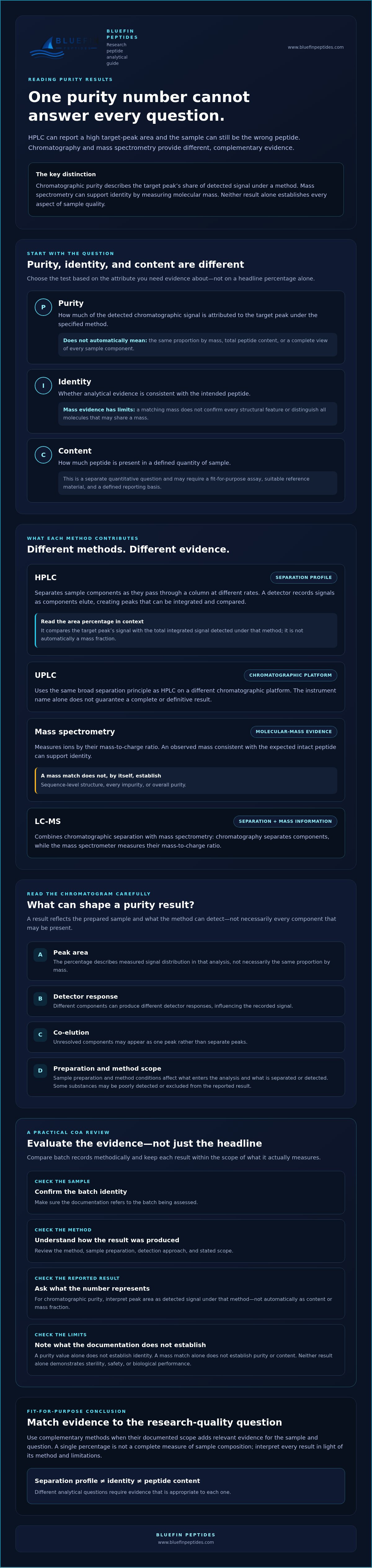
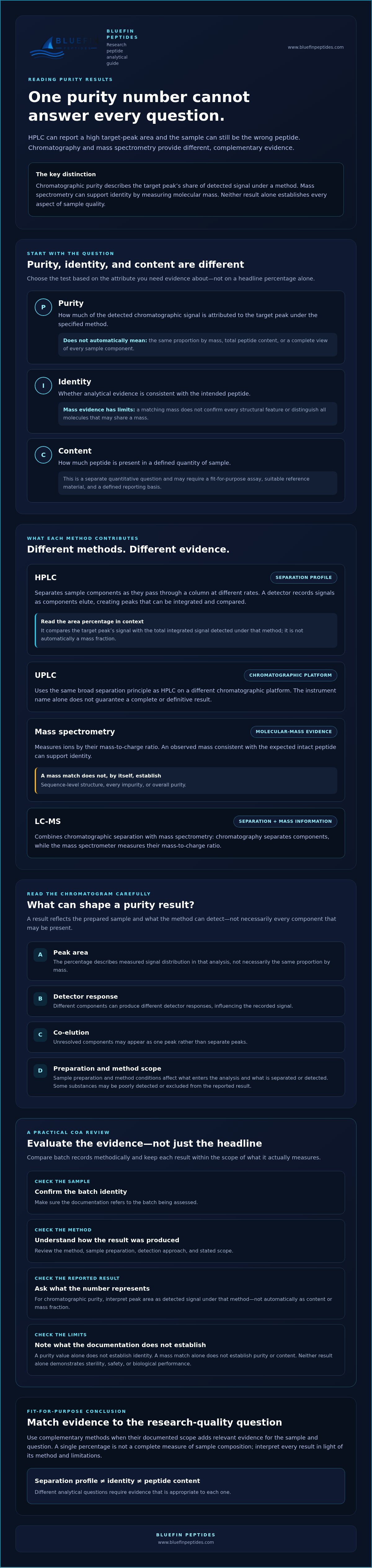
Peptide purity is the proportion of detected sample signal attributed to the target peptide under a specified analytical method. Identity is evidence that the analyte is consistent with the intended molecule, while content is the amount of peptide in a defined quantity of sample. This distinction matters because a chromatographic purity percentage is not automatically a measure of concentration, total mass, or the amount of peptide in a vial.
Purity, identity, and content are different analytical questions
In a chromatographic assay, the reported area percentage commonly compares the integrated signal for the target peak with the combined signal from detected peaks. It describes the distribution of measured signal in that analysis, not necessarily the same proportion by mass. Compounds can produce different detector responses, and components that co-elute may not appear as separate peaks. The separation principles behind High-performance liquid chromatography (HPLC) help explain why the result depends on the method and its conditions.
Identity asks whether analytical evidence is consistent with the intended peptide. Mass spectrometry can measure molecular mass and support that assessment, but a matching mass alone does not confirm every structural feature or distinguish all molecules that may share a mass. Content is a separate quantitative question. Determining how much target peptide is present in a sample may require a fit-for-purpose assay, suitable reference material, and a defined basis for reporting the result.
Why one result cannot establish every aspect of sample quality
A result reflects what the method can detect in the prepared sample. Sample preparation can affect what enters the analysis, method conditions influence separation, and detector response affects the signal recorded for each component. Some substances may be poorly detected or excluded from the reported result. A high chromatographic area percentage therefore describes the detected profile within that method’s scope, not every possible component or quality attribute.
Interpret each result within its limits. A purity value does not establish identity on its own, and a mass match does not establish purity or content. Neither result alone demonstrates sterility, safety, or biological performance. For a broader framework for interpreting quality terminology, see the analytical quality standards guide.
The practical value of peptide purity testing methods comes from matching the evidence to the question. Before comparing results, check the method, sample preparation, detection approach, and stated scope. A number is meaningful only within that analytical context.
How HPLC, UPLC, and LC-MS Assess Peptide Purity and Identity
These peptide purity testing methods answer related but distinct questions. HPLC and UPLC separate components so their signals can be measured; mass spectrometry adds mass-to-charge information that can support identification. The value of each result depends on the method, sample preparation, and reporting scope, not simply the instrument name.
HPLC and UPLC: separation and relative chromatographic purity
In reversed-phase chromatography, components move through a column at different rates because they interact differently with the stationary phase and liquid mobile phase. The time a component takes to pass through the column is its retention time. A detector records signals as components elute, producing a chromatogram with peaks that can be integrated and compared.
A reported peak-area percentage expresses the target peak’s signal relative to the total integrated signal under that method. It is not automatically a mass fraction. Different components may produce different detector responses, and unresolved co-elution can cause multiple substances to appear as one peak. The risk depends on the separation and conditions used. UPLC applies the same broad separation principle using a different chromatographic platform; neither HPLC nor UPLC guarantees a complete or definitive result by itself.
Mass spectrometry: molecular-mass evidence and identity support
LC-MS combines chromatographic separation with mass spectrometry. The chromatography separates components, while the mass spectrometer measures ions according to their mass-to-charge ratio. An observed mass consistent with the expected intact peptide supports identity, but it does not by itself establish sequence-level structure, reveal every impurity, or quantify overall purity. Results also depend on which compounds ionize and are captured under the acquisition method.
| Method | Primary question answered | Key limitation |
|---|---|---|
| Reversed-phase HPLC | What detected components separate, and what is the target peak’s relative area? | Co-elution and unequal detector response can affect interpretation. |
| UPLC | How does the sample separate under the specified chromatographic conditions? | Platform choice alone does not establish identity or total peptide content. |
| LC-MS | What mass-to-charge evidence accompanies separated components? | An expected intact mass is not a complete purity or sequence assessment. |
Read chromatograms and mass data as complementary evidence, not interchangeable verdicts. Qualified researchers comparing research-use peptide options can review product information at Bluefin Peptides.
Which Complementary Peptide Testing Methods Answer Different Questions?
More tests do not automatically mean stronger evidence. The useful combination depends on the uncertainty to resolve: amino acid composition, sequence-related features, structural characteristics, or a separate sample attribute. Complementary peptide purity testing methods should add information the primary assay cannot provide, with each method’s applicability and validation established for the analyte and intended measurement.
Orthogonal methods for composition and structural characterization
Amino acid analysis can help characterize amino acid composition and, with an appropriate quantitative approach, support peptide content assessment. It generally involves breaking the peptide into constituent amino acids, so it does not preserve sequence order. Results can also depend on hydrolysis conditions, recovery, and how individual amino acids are measured. It is therefore not a direct substitute for a chromatographic purity profile.
Peptide mapping examines fragments generated from a peptide, often after controlled enzymatic or chemical digestion. A suitably designed map can provide sequence-related evidence by comparing observed fragments with expected ones. Its usefulness depends on digestion, separation, detection, and interpretation. A map should not be treated as a complete assessment of every impurity unless the method was designed and validated for that purpose.
Nuclear magnetic resonance (NMR) can provide complementary information about molecular structure and chemical environment. It may be appropriate when the research question concerns structural features that mass or chromatographic data do not resolve. NMR is not a default replacement for chromatography, and its suitability depends on the sample, question, and analytical setup.
Additional tests address attributes beyond chromatographic purity
Some measurements characterize material that a chromatographic purity percentage does not describe. Treat them as separate attributes, not as alternate purity scores:
- Water content: determines the amount of water in the tested material, which can affect interpretation of mass-based content.
- Counterion identity: checks which associated ion is present, where relevant to the peptide’s form or specification.
- Residual solvents: assesses specified solvent residues using an appropriate method.
- Endotoxin or microbiological testing: addresses those attributes only when relevant to the laboratory specification; neither is established by a chromatographic purity result.
Before interpreting any result, verify that the method applies to the analyte and that its documented scope, sample preparation, and validation support the stated conclusion. A test for water cannot establish sequence identity; a sequence-oriented method does not automatically quantify total peptide content. Select evidence with purpose, then keep each conclusion within the boundaries of what was measured.
How to Evaluate a Peptide Purity Result and Batch COA
A certificate of analysis (COA) is useful when its reported results can be traced to the material being evaluated and interpreted within the methods’ scope. Review the evidence in sequence: confirm the batch, identify the method, examine the reported result and its basis, then note what the document does not establish.
A practical sequence for reviewing reported analytical evidence
- Confirm the material and batch. Check that the COA identifies the peptide or research blend and that its batch identifier matches the material under evaluation. If the connection between document and sample is unclear, the result cannot be confidently assigned to that batch.
- Identify the method. Determine which analytical method produced the purity result. Look for the stated reporting basis, such as a chromatographic peak-area percentage, and avoid comparing figures without knowing what each represents.
- Review identity evidence separately. Check whether mass-spectrometry confirmation is reported in addition to chromatographic purity. A purity result and a mass-related identity result answer different questions; one should not be used to imply the other.
- Note the limits. Record which attributes the COA reports and which remain outside its stated scope. Do not fill gaps in documentation with assumptions.
For a compound-specific example of how analytical specifications and laboratory standards are framed, consult the retatrutide analytical specifications guide.
Questions a COA cannot answer without additional evidence
A COA’s conclusions are bounded by its tests. A chromatographic purity percentage does not, by itself, establish sterility, safety, biological activity, or suitability for human use. Nor should a high value be treated as proof that every potential contaminant was measured. The document supports only the results and attributes it actually reports.
Compare percentages cautiously. Before treating two values as comparable, check whether they come from meaningfully similar methods and use the same reporting basis. Differences in separation, detection, or calculation can make headline numbers appear comparable when they are not.
COA checklist: Treat the batch, method, and reported result as documented evidence. Treat sterility, safety, activity, and any unreported attribute as unestablished unless supported by separate evidence.
Detailed chromatogram reading requires attention to peak integration and method conditions, so it is best handled separately from this document-level review. For qualified research use, review Bluefin Peptides research peptide information alongside the batch-specific documentation for the material being considered.
Fit-for-Purpose Testing for Research Peptides
Begin with the analytical question, not a list of available tests. Is the goal to examine a separation profile, support molecular identity, estimate peptide content, or assess another defined attribute? The right evidence is the evidence whose documented scope addresses that question. A longer test list is not automatically more informative if its results do not resolve the uncertainty under study.
Select methods to match the question
- For a separation profile: Select a suitable chromatographic method and review its output, reporting basis, and known limitations.
- For molecular-mass identity support: Consider mass spectrometry alongside appropriate separation evidence. Confirm that the method and reported data support the intended conclusion.
- For content or another attribute: Define the quantity or characteristic to measure, then verify that the selected method is appropriate for that analyte and purpose.
Complementary peptide purity testing methods are useful when each contributes distinct, relevant evidence. For example, chromatography can show how detected components separate, while mass spectrometry can provide mass-related identity evidence. Neither should be stretched beyond its documented scope. If the research question concerns a separate attribute, specify it and assess whether an additional method is justified.
Keep batch documentation traceable
Record the material and batch identifier, analytical method, reported result and its basis, and any known limitations. This creates a traceable record that can be compared with study-specific requirements and helps prevent results from becoming detached from the sample they describe. When reviewing supplier documentation, confirm that claims correspond to the specific batch and that the evidence is described clearly enough to evaluate.
Supplier-stated testing is one input to laboratory assessment, not a substitute for a study-specific protocol or evidence of research outcomes. Bluefin Peptides states that its research-use products are at least 99% HPLC-verified, with mass-spectrometry confirmation and batch-specific certificates of analysis. These are supplier claims. Qualified researchers should check current product information and applicable batch documentation, including the scope of the evidence provided.
Set acceptance criteria and any additional testing needs according to the research question and laboratory protocol. Keep conclusions aligned with what was actually measured. Qualified researchers can review Bluefin Peptides research-use documentation as one source of batch and analytical information.
Choose Evidence That Matches the Research Question
Reliable interpretation starts with a defined question. Chromatography describes the detected separation profile, while mass spectrometry offers mass-related evidence that can support identity. Neither result alone establishes total peptide content or every attribute of a sample.
Use peptide purity testing methods according to their documented scope, and add complementary analyses only when they address a relevant uncertainty. When reviewing a COA, confirm that the tested material and batch are clearly identified, check how each result was produced, and note what the document does not establish. Purity percentages are most useful when their methods and reporting bases are understood.
Bluefin Peptides states that its research-use products are at least 99% HPLC-verified, receive mass-spectrometry confirmation, and have batch-specific COAs available. These are supplier-stated claims; review current product and batch documentation to confirm the details relevant to your work. Products are intended exclusively for qualified research use, not human, veterinary, or consumer use.
For qualified research use, review Bluefin Peptides research-use documentation alongside your laboratory’s requirements. A clear question and appropriately scoped evidence provide a stronger foundation for research decisions.
Frequently Asked Questions
Is HPLC enough to confirm peptide purity?
HPLC can estimate chromatographic purity, but it does not establish every quality attribute. Among peptide purity testing methods, it reports the relative signal of detected components under specified conditions; it may not quantify absolute peptide content, confirm molecular identity, or reveal unresolved or poorly detected components. Review the method and reporting basis, then consider separate identity evidence, such as mass spectrometry, if the research question requires it.
Can mass spectrometry measure peptide purity?
Mass spectrometry provides mass-related evidence that can support molecular identity and help characterize detected species, but it is not automatically a standalone purity measurement. Ionization, sample composition, and analytical setup influence which species are detected and how they appear. Read the findings alongside separation data and the method’s stated scope. An expected mass supports an identity assessment; it does not prove the sample contains no impurities.
What is the difference between peptide purity and peptide content?
Purity usually describes the relative proportion of detected components under a defined analytical method, while content concerns how much peptide is present in a sample. A chromatographic area percentage should not automatically be read as total peptide mass or concentration. Check the report’s measurement basis, units, and method. If the research question requires an amount or concentration, determine whether a separate, suitable content assay is needed.
How do HPLC and LC-MS differ for peptide testing?
HPLC separates sample components and can support a chromatographic purity estimate. LC-MS combines chromatographic separation with mass-spectrometry information, adding mass-related evidence about detected analytes. The methods therefore address related but distinct questions. Neither label alone guarantees complete characterization or a particular level of validation. Review the specific method, reported output, sample context, and stated limitations before deciding what the results support.
What happens if a peptide COA reports high purity but no mass spectrometry?
The COA may document chromatographic evidence without separately reporting mass-related identity confirmation. That gap does not prove the material is incorrect, but identity remains a separate question. Check that the batch identifier matches the material, then review the method and reporting basis. Consider whether other identity evidence is available and whether the documentation answers the research question. Do not treat a high purity percentage as a substitute for identity data.
Can two peptide purity percentages be compared directly?
Not reliably unless the methods and reporting bases are meaningfully comparable. Chromatographic conditions, detectors, sample preparation, and peak-integration choices can affect the reported percentage. Confirm that both results refer to comparable materials and clarify what each percentage represents. Check identity evidence separately, too. If method details are missing or differ substantially, treat the values as method-specific results rather than using them to rank samples directly.
How much testing does a research peptide need?
There is no universal test panel for every laboratory question. First define the evidence needed, such as a separation profile, identity support, peptide content, or another specified attribute. Select methods with documented scope that address those needs, and add complementary analysis when it resolves a meaningful uncertainty. Record the batch, methods, results, and limitations. Verify supplier testing claims against current batch documentation and your laboratory’s requirements.
For laboratory research use only. Not for human or veterinary use. This content is educational and does not constitute medical, dosing, or usage guidance.
Browse the BLUEFIN catalog