Peptide Dosage for Cell Culture: Researcher's Guide

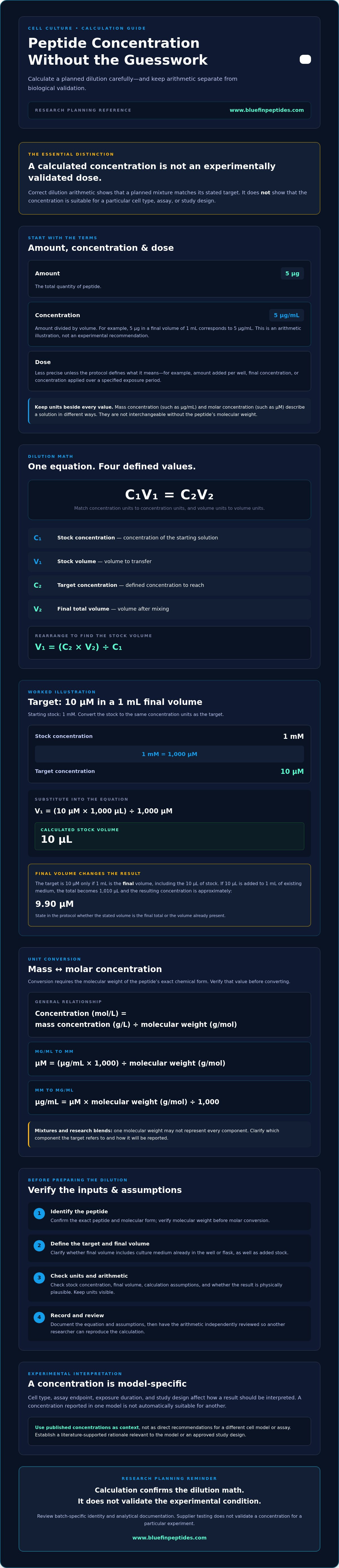
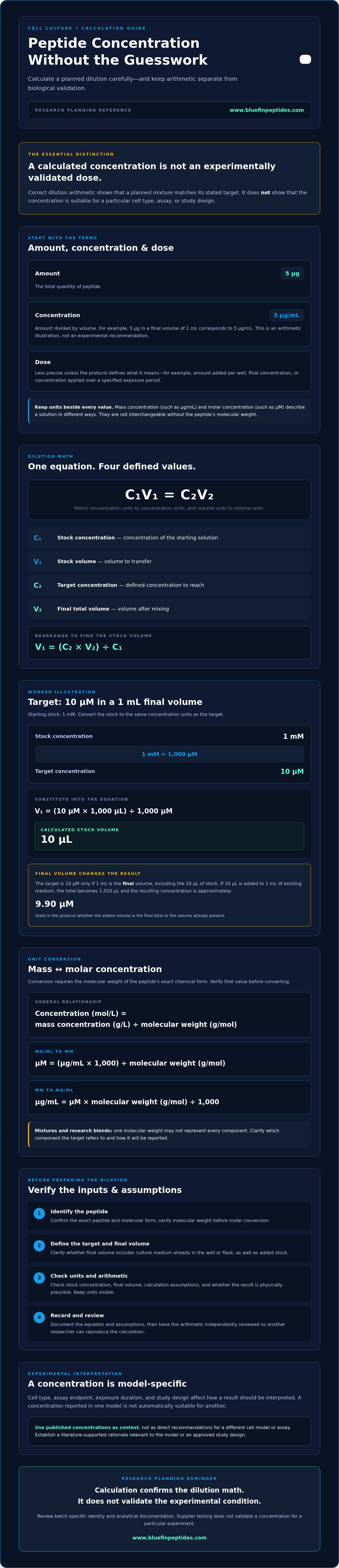
A calculated peptide concentration is not an experimentally validated dose. That distinction matters when calculating peptide dosage for cell culture: a correct dilution does not show that the concentration is suitable for a particular cell type or assay.
It’s easy to confuse mass concentration with molar concentration, or to use an incorrect molecular weight, stock concentration, or final volume. This guide explains how to calculate a dilution from a defined experimental target, convert units carefully, and record the assumptions and units another researcher needs to reproduce the calculation.
You’ll see how stock concentration and final volume determine the amount to add, and why peptide purity and peptide content are not interchangeable when interpreting vial mass. We’ll also cover details to verify, including molecular weight, batch documentation, solvent compatibility, and experimental conditions. The calculation is a starting point for a documented protocol, not a universal dose or evidence of experimental validation.
Key Takeaways
- For calculating peptide dosage for cell culture, start with a defined target concentration and final culture volume. Use C1V1 = C2V2 to determine the stock volume required.
- Choose mass-based or molar reporting to suit the experiment, and verify molecular weight before converting between units.
- Treat published concentrations as context, not as direct recommendations for a different cell model or assay.
- Before preparing a dilution, check the units, stock concentration, final volume, and calculation assumptions. Document the equation and have the arithmetic independently reviewed.
- Review batch-specific identity and analytical documentation as part of research planning. Supplier testing does not validate a concentration for a particular experiment.
What does peptide dosage mean in cell culture?
In a cell-culture protocol, an experimental concentration states how much peptide is present in a defined final volume of culture medium. It may be reported by mass, such as µg/mL, or by amount of substance, such as µM. These units describe the same solution in different ways, but they are not interchangeable without the peptide’s molecular weight. Molar concentration expresses the amount of substance per volume, typically in mol/L.
Working definition: Concentration arithmetic specifies the quantity of peptide per volume. Biological validation requires evidence that the chosen condition is appropriate for the cell model, assay, and study design.
Dose, concentration, and amount are not interchangeable
Amount is the total quantity of peptide, for example, 5 µg. Concentration is that amount divided by volume: 5 µg in a final volume of 1 mL corresponds to 5 µg/mL. This is an arithmetic illustration only, not an experimental recommendation. Dose is less precise unless the protocol defines what it means, such as the amount added per well, the final concentration, or a concentration applied over a specified exposure period.
Keep units beside every value and carry them through each calculation. A value without units cannot reliably distinguish mass from amount of substance or volume. Even the same concentration can mean different things across experiments because cell type, assay endpoint, exposure duration, and study design affect how a result should be interpreted. A concentration reported in one model is not automatically suitable for another.
What information should be established before calculating?
First, identify the exact peptide and molecular form being studied. Confirm its molecular weight from an appropriate, verified source before converting a mass-based concentration to a molar one. For a peptide mixture or research blend, a single molecular weight may not represent all components. Clarify which component the target concentration refers to and how it will be reported.
Next, define the intended final concentration and final treatment volume. Specify whether that volume includes the culture medium already in the well or flask, as well as any added stock solution. This distinction affects the concentration ultimately present in the culture.
Finally, establish why the experimental condition was selected. Use a literature-supported rationale relevant to the model or an approved study design. Do not treat a calculated value as evidence of biological activity or suitability. When calculating peptide dosage for cell culture, the arithmetic can confirm that a planned dilution matches its stated target. It cannot determine whether that target is meaningful for the experiment.
How to calculate peptide concentration and prepare a dilution
For a defined stock and target, use the dilution equation C1V1 = C2V2. The equation works when the concentration units match each other and the volume units match each other.
Here, C1 is the stock concentration, V1 is the stock volume to transfer, C2 is the target concentration, and V2 is the final total volume after mixing. Rearrange the equation to find the stock volume: V1 = (C2 × V2) / C1. Keep units visible throughout the calculation, then check that the result is physically plausible before preparing the dilution.
Use the dilution equation for a defined stock and final volume
Illustration only, not an experimental recommendation: To calculate a 10 µM target in a 1 mL final volume from a 1 mM stock, first convert 1 mM to 1,000 µM. Then:
V1 = (10 µM × 1,000 µL) / 1,000 µM = 10 µL
This gives 10 µM only if 1 mL is the final volume, including the 10 µL of stock. If instead 10 µL is added to 1 mL of existing medium, the total is 1,010 µL and the resulting concentration is approximately 9.90 µM. State which convention you used in the protocol. That volume distinction can matter when calculating peptide dosage for cell culture.
Convert between mass concentration and molar concentration
Molar conversion requires the molecular weight for the peptide’s exact chemical form. The relationship is:
Concentration (mol/L) = mass concentration (g/L) ÷ molecular weight (g/mol)
For a concentration in µg/mL, the equivalent shortcut is µM = (µg/mL × 1,000) ÷ molecular weight (g/mol). The reverse is µg/mL = µM × molecular weight (g/mol) ÷ 1,000. These relationships depend on consistent units. Confirm the source and chemical form before using a molecular weight.
Check whether the stated molecular weight includes a salt or counterion, and whether the mass basis accounts for water or other non-peptide content. For a blend, each component may have a different molecular weight, so one molar value may not describe the mixture. Record the conversion basis and assumptions alongside the result.
Before planning a dilution, researchers can review available identity and batch documentation for research-use peptides, including the relevant certificate of analysis. Review research peptide documentation as one input to planning, not as evidence that a calculated concentration is validated for a particular cell model or assay.
Which concentration and calculation approach fits the experiment?
Choose the concentration unit that makes the experimental question easiest to interpret and the source data easiest to verify. Mass-based reporting describes peptide mass per volume; molar reporting describes amount of substance per volume. Neither unit establishes whether a condition is biologically appropriate. Base the choice on the study rationale, available molecular-weight information, and reporting conventions in relevant literature.
Mass concentration or molar concentration?
Use mass units when the source method or assay reports mass per volume, or when the calculation inputs are defined on that basis. Molar units can support comparisons across compounds when their molecular weights are known and the chemical forms are comparable. Reporting both may help readers, but only when the molecular-weight source and conversion basis are documented. Otherwise, a second unit can create false precision.
| Reporting approach | Useful when | Key limitation |
|---|---|---|
| Mass concentration, such as µg/mL | The source method or study reports peptide mass per volume. | Does not directly compare molecular amounts across peptides with different molecular weights. |
| Molar concentration, such as µM | Molecular amount is useful for comparing compounds with verified molecular weights. | Depends on the correct molecular form and conversion inputs. |
| Both units | Conversion inputs and calculation basis are available and recorded. | Can mislead if assumptions or molecular-weight details are omitted. |
Any values used to demonstrate unit formats in this table are illustrative only, not experimental recommendations. For a mixture, confirm whether each component can be expressed meaningfully on a molar basis. A single value may not represent the whole blend.
How should literature values inform a cell-culture plan?
A published concentration describes a specific experiment, not an automatic instruction for another one. Before comparing studies, check peptide identity and formulation, cell model, assay endpoint, and exposure period. Differences in any of these can change how a reported condition should be interpreted. Record what matches your planned system and what does not.
When calculating peptide dosage for cell culture, distinguish a single-condition calculation from the design of an experimental concentration series. The equation can determine the amount needed to prepare a defined condition. It cannot select the conditions or establish their biological relevance. A series should follow a literature-supported rationale or approved study design, without assuming that values from another paper transfer directly.
Label exploratory conditions as a pilot design, not a validated condition. Document the rationale, uncertainties, source studies, and differences in model or formulation. This record helps prevent arithmetic from being mistaken for biological validation.
How to check the math and document a reproducible calculation
A calculation is reproducible only when another researcher can trace its inputs, units, and assumptions. Before using a result, check the arithmetic independently and compare peptide-specific details with source documentation. Keep intermediate values unrounded in the record, then note any rounding applied to the final transfer volume.
What should a calculation record include?
Build a clear record that connects the planned concentration to the material and preparation method. Include:
- Peptide identifier, batch or lot, and chemical form.
- Molecular weight and its source, plus the relevant certificate of analysis reference.
- Stock preparation assumptions, including the amount used and the final stock volume.
- The dilution equation, substituted values, units, unrounded intermediate results, and date.
- Final culture volume, including whether added stock and other solutions are counted.
- Experimental rationale and controls, as specified in the approved laboratory plan.
For calculating peptide dosage for cell culture, preserving this calculation trail helps distinguish a checked arithmetic result from an assumption that still needs review.
What errors should researchers check before use?
Run a deliberate unit check before substituting values. Confirm conversions such as mg to µg and mL to µL, and make sure concentration and volume units are consistent in the equation. Recheck the stock concentration and establish whether the stated final volume includes all added solutions. A mismatch in volume assumptions changes the calculated final concentration.
Verify the peptide identifier, molecular form, and any molecular-weight or content basis against the relevant source documents. If the certificate, label, and calculation inputs do not agree, pause and resolve the discrepancy rather than choosing one value without justification. Where possible, have a second person independently recalculate the result.
Analytical identity or purity evidence does not establish biological activity or validate a concentration for a specific cell assay. HPLC purity describes a chromatographic purity result. It does not by itself confirm the amount of peptide content in a weighed sample or prove experimental performance. Bluefin Peptides describes its research-use peptides as ≥99% HPLC-verified, with mass-spectrometry confirmation and batch-specific certificates of analysis. Review the relevant batch documents as procurement and planning information, not as validation of an experimental condition.
For qualified research use, review Bluefin Peptides research documentation and confirm the relevant batch certificate before relying on lot-specific details.
How Bluefin Peptides documentation can support research planning
Supplier documentation can help researchers verify the material they are considering before recording inputs or planning a calculation. It is one part of research planning, not evidence that a peptide will produce a particular effect or that a concentration is suitable for a cell type or assay. Experimental conditions still require a literature-supported rationale or an approved study design.
What analytical documents can and cannot establish
Bluefin Peptides describes its research peptides as ≥99% HPLC-verified, with mass-spectrometry confirmation and batch-specific certificates of analysis (COAs). HPLC and mass spectrometry provide analytical information to review alongside the batch record. Confirm that documents correspond to the specific material under consideration, and check the reported identity and analytical results before using peptide-specific details in a calculation.
These records have defined limits. An analytical result does not independently demonstrate biological activity, cell-culture efficacy, or an appropriate experimental concentration. A reported purity value also should not be treated as a direct measurement of the peptide amount in a weighed sample unless the documentation specifically establishes that basis. For additional context on evaluating analytical evidence, see the research peptide quality standards guide.
Research procurement and responsible next steps
Before calculating peptide dosage for cell culture, qualified researchers can use batch-specific records to check that the compound identity and relevant analytical information align with the planned research material. If a batch document is missing, unclear, or inconsistent with other available information, resolve the discrepancy before relying on it as a calculation input. Record the document reference and assumptions in the study notes so the source of each value remains traceable.
- Match the COA to the batch under consideration.
- Verify the compound identity and chemical form against the research plan.
- Use documented inputs for calculations, and keep experimental justification separate from supplier analytical results.
Bluefin Peptides supplies peptides for qualified research use only, not human, veterinary, or consumer applications. Researchers can review Bluefin Peptides research products and available documentation as one step in procurement planning. Product documentation can support verification; it does not validate a concentration for a specific experiment.
Make Every Concentration Traceable
Reliable cell-culture planning starts with a defined target, consistent units, and a clear final volume. The dilution equation calculates how much stock is needed, but it cannot establish whether that concentration is biologically appropriate. Treat the result as arithmetic, then evaluate the experimental condition against relevant literature and the approved study design.
For reproducibility, record the peptide’s identity and chemical form, molecular-weight source, stock assumptions, equation, units, and final culture volume. Have the calculation independently checked, and keep analytical evidence distinct from assay-specific validation.
Before planning with a research peptide, review the relevant batch documentation. Bluefin Peptides describes its research peptides as ≥99% HPLC-verified, with mass-spectrometry confirmation and batch-specific certificates of analysis. These records support material review, not claims of experimental efficacy. For qualified research use, review research peptides and available batch documentation.
With careful calculations and a complete record, calculating peptide dosage for cell culture becomes a transparent, reproducible step in a scientifically reasoned experiment. Keep assumptions visible and inputs verified, and place confidence in the calculation rather than unsupported conclusions.
Frequently Asked Questions
How do you calculate peptide concentration for cell culture?
Calculate concentration by dividing the peptide amount by the final culture volume, or use C1V1 = C2V2 to determine a stock dilution. Keep concentration and volume units consistent, and define whether final volume includes the added stock. For calculating peptide dosage for cell culture, the result is a mathematical target, not proof that the concentration is appropriate for a particular cell model or assay.
How do you convert peptide mass concentration to micromolar?
Divide the mass concentration in µg/mL by the peptide’s molecular weight in g/mol, then multiply by 1,000 to obtain µM. The symbolic conversion is µM = (µg/mL × 1,000) ÷ molecular weight (g/mol). Verify the molecular weight for the exact chemical form and document its source. Salts, counterions, or the stated mass basis can affect which molecular weight is appropriate.
What does C1V1 = C2V2 mean?
C1V1 = C2V2 expresses the relationship between the amount of solute in a stock and in a diluted solution. C1 is stock concentration, V1 is stock volume used, C2 is target concentration, and V2 is final total volume. Match concentration units to each other and volume units to each other. The calculated target alone does not establish biological suitability.
Is there a standard peptide concentration for cell culture?
No single concentration applies universally across peptides, cell types, assays, or exposure conditions. An experimental range must be justified for the specific research question through relevant literature or an approved study design. Published values are useful context, not automatic instructions for another model. Treat an exploratory concentration series as a pilot unless it has been validated for the same relevant conditions.
How do you calculate the volume of stock to add to culture medium?
Rearrange the dilution equation to calculate stock volume: V1 = (C2 × V2) ÷ C1. Use consistent units for both concentrations and both volumes. Define V2 as the final total volume, including stock and other added solutions. If stock is added to an existing volume of medium, account for the resulting total volume before interpreting the final concentration.
Does an HPLC purity percentage tell me what concentration to use?
No. An HPLC purity result describes an analytical measurement; it does not identify an appropriate cell-culture concentration or demonstrate biological activity. It also should not automatically be treated as the peptide mass fraction in a weighed sample. Review the relevant batch documentation, including identity information and the stated analytical basis, then select experimental conditions using a research rationale. Bluefin Peptides describes its research peptides as ≥99% HPLC-verified, with mass-spectrometry confirmation and batch-specific COAs.
For laboratory research use only. Not for human or veterinary use. This content is educational and does not constitute medical, dosing, or usage guidance.
Browse the BLUEFIN catalog