Peptide Concentration Calculation for In Vitro Studies
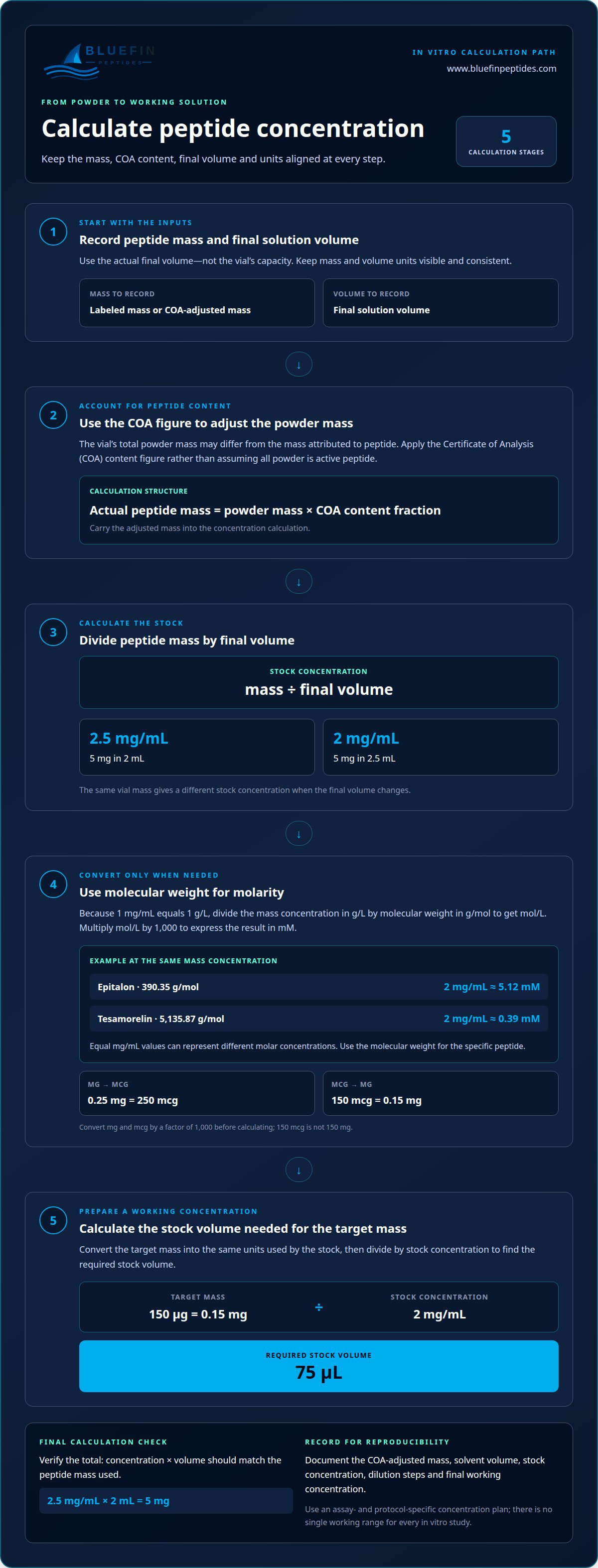
The diluent volume is only half the calculation. Accurate peptide concentration calculation for in vitro studies uses the peptide’s actual mass, adjusted for the Certificate of Analysis content figure, divided by the final solution volume. For example, 5 mg in 2 mL gives 2.5 mg/mL before any content adjustment.
The arithmetic is straightforward, but the inputs must match. A vial’s labeled mass and its peptide-content percentage can differ. Using the COA figure helps calculate the peptide in the powder instead of treating its full mass as active peptide.
This guide covers stock concentration, COA-based mass adjustment, and dilution to a working concentration. It also explains how to convert between mass and molar concentration when molecular weight is available, keeping units visible at each step. The result is a reproducible calculation path for preparing in vitro solutions, not a substitute for a study-specific protocol.
Key Takeaways
- Calculate stock concentration from peptide mass and final solution volume, keeping units consistent throughout.
- Use molecular weight to convert a mass concentration into molarity; equal mg/mL values can represent different molar concentrations for different peptides.
- Apply the Certificate of Analysis peptide-content figure to estimate actual peptide mass instead of assuming the vial’s full powder mass is peptide.
- Use the dilution equation to determine the stock volume and diluent needed for a target working concentration.
- Choose stock and working concentrations that support practical, accurate pipetting for your experimental setup.
How do I calculate peptide concentration?
There is no single concentration range for all in vitro studies: the working range depends on the assay, target, and experimental design. A peptide concentration calculation for in vitro studies starts with peptide mass and solution volume, then uses molecular weight when molarity is needed.
Mass Concentration to Molarity
Mass concentration to molarity conversion expresses peptide concentration as moles per liter rather than mass per volume. Divide concentration in mg/mL by molecular weight in g/mol, then multiply by 1,000 to obtain mM. For example, 2 mg/mL of Epitalon at 390.35 g/mol is about 5.12 mM. This conversion accounts for the number of peptide molecules represented by a given mass.
Equal mass concentrations can represent different molar concentrations. At 2 mg/mL, Tesamorelin, with a molecular weight of 5,135.87 g/mol, is about 0.39 mM, while Epitalon is about 5.12 mM. The difference comes from molecular weight, not mass concentration. Record both units when comparing peptides by mass and molecule count in a laboratory protocol.
Molecular Weight and Concentration Units
Molecular weight provides the conversion factor between mass concentration and molarity. Convert mg/mL to g/L, then divide by molecular weight in g/mol to obtain mol/L. Multiply mol/L by 1,000 to express the result in mM. Because 1 mg/mL equals 1 g/L, the mass-concentration conversion preserves the numeric value.
For example, 5 mg of Selank in 1 mL equals 5 mg/mL, or 5 g/L. Dividing by its molecular weight of 751.88 g/mol gives 0.00665 mol/L, equivalent to 6.65 mM. Use the molecular weight for the specific peptide; values cannot be interchanged. Preserve intermediate precision and round only the final result to suit the protocol.
Milligrams and Micrograms
Milligram-to-microgram conversion changes the mass unit by a factor of 1,000. Multiply mg by 1,000 to obtain mcg, or divide mcg by 1,000 to obtain mg. For example, 0.25 mg equals 250 mcg, and 150 mcg equals 0.15 mg. Apply this conversion before using mass in a concentration calculation.
A second peptide concentration calculation for in vitro studies should keep units visible at every step. A target of 150 mcg is not 150 mg; confusing them changes the calculated mass by a factor of 1,000. Record values as, for example, 2 mg/mL or 100 mcg/mL. U-100 insulin syringe units measure volume: 100 units equals 1 mL, and one unit equals 0.01 mL.
Stock concentration from peptide mass and diluent volume
Stock concentration is peptide mass divided by final solution volume. To calculate reconstitution, start with those inputs, then adjust for the target concentration or molarity.
Mass and Solvent Volume Inputs
Vial mass and reconstitution solvent volume are the starting inputs for stock concentration. Divide peptide mass by the final volume, using matching mass and volume units. For example, a 5 mg vial reconstituted in 2 mL produces 2.5 mg/mL. If the same vial uses 2.5 mL, the result is 2 mg/mL.
Use the actual final solution volume in the calculation, not an assumed volume based on vial capacity. Record whether the stated mass is the labeled amount or a COA-adjusted peptide mass. A target mass of 150 µg from a 2 mg/mL stock requires 75 µL. Convert 150 µg to 0.15 mg before dividing by 2 mg/mL.
Stock Solution Volume Calculations
Stock volume calculations determine the solvent volume needed for a desired concentration or molarity. For a mass-based stock, divide peptide mass by target concentration: 10 mg in 1 mL gives 10 mg/mL. For molar stock preparation, use volume in liters equal to peptide mass in grams divided by target molarity and molecular weight.
For example, 8.24 mg of actual peptide with a molecular weight of 1,500 Da requires 1.09 mL for a 5 mM stock. A 5 mg sample in 2.5 mL instead gives 2 mg/mL. For an aliquot calculation, 0.25 mg from a 2.5 mg/mL stock occupies 0.10 mL. These calculations describe laboratory solution preparation, not animal dose selection or injection instructions.
Choose an in vitro dose-response range based on the assay’s research question, target, and protocol. Plan a series of concentrations, then calculate each dilution from the prepared stock rather than relying on one universal range.
Calculation Errors and Checks
Calculation checks catch unit mismatches, incorrect volumes, and missed content adjustments. Confirm that mass and concentration use matching units, and verify the result by multiplying concentration by volume. For 2.5 mg/mL across 2 mL, the calculated total is 5 mg. Keep intermediate values unrounded, then round the reported result to suitable precision.
Common errors include using vial capacity instead of diluent volume, confusing µg with mg, and treating all powder mass as peptide. Compare your calculation with the vial mass and COA content figure. For molarity, verify the molecular weight and convert mg/mL to g/L before dividing.
For aliquots, divide the reconstituted solution into single-use portions to reduce repeated handling. Store reconstituted solution at 2-8°C and use it within the COA timeframe. General expected stability ranges are 1-3 months for single-use aliquots at −20°C and 6-12 months at −80°C. Gently swirl the vial until dissolved rather than shaking it.
Include a solvent control with the same solvent concentration as the treated samples. This helps distinguish solvent effects from peptide-related observations. Record the stock concentration, solvent volume, dilution steps, and final working concentration for every control and treatment condition.
Using peptide-content figures from a Certificate of Analysis
Peptide content is the fraction of a powder’s measured mass attributed to peptide. Use the Certificate of Analysis (COA) content percentage to calculate peptide mass before determining stock concentration.
Convert the percentage to a decimal, then multiply it by the vial’s labeled mass. A 10 mg vial at 82.4% peptide content contains 8.24 mg of actual peptide: 10 mg × 0.824. This adjusted mass, rather than the full powder mass, is the numerator for a peptide-specific concentration calculation.
For example, dissolving that 8.24 mg of peptide in 2.5 mL gives 3.296 mg/mL. Using the labeled 10 mg instead would produce 4 mg/mL, overstating the peptide concentration. Keep the COA percentage, vial mass, diluent volume, and calculation together in the laboratory protocol so the result can be reconstructed.
COA content can also exceed or fall below the vial’s label value. For a 10 mg vial, a measured mass of 10.6 mg corresponds to 106% net content; 9.4 mg corresponds to 94%. Apply each figure as a decimal multiplier, respectively 1.06 or 0.94, rather than treating either as a purity claim.
Counterions and residual moisture contribute to the physical powder mass without representing peptide mass. Acetate- or TFA-salt lyophilisates typically assay at 70-90% peptide content, while counter-ion and residual moisture typically account for 5-20% of powder mass. These ranges explain why labeled powder mass alone may not represent the amount of peptide available for a calculation.
COA reporting should guide the mass adjustment used in the protocol. A batch analysis reported average peptide content of 80.3% ± 8.7%, illustrating variation between preparations; do not substitute an average for the batch-specific COA figure. The stated content is the relevant input for that vial’s calculation.
Use this sequence for each batch: locate the peptide-content percentage, convert it to a decimal, multiply by labeled mass, then divide by the final solution volume. If the COA reports 82.4% for a 10 mg vial, the calculated peptide mass is 8.24 mg. Carry that adjusted value into subsequent stock and dilution calculations, and record the percentage alongside the result.
Diluting stock to a working concentration
Calculate stock concentration by dividing peptide mass by final volume. Use C₁V₁ = C₂V₂ to calculate dilution volumes. For serial dilutions, transfer a measured portion of one solution into diluent, then repeat from each new concentration.
Working Concentration Dilutions
A working concentration is the diluted stock concentration prepared for a specific assay. The equation C₁V₁ = C₂V₂ relates starting concentration and volume to target concentration and final volume. For a 2 mg/mL stock and a 0.25 mg/mL target at 2 mL final volume, calculate V₁ = (0.25 × 2) ÷ 2. The required stock volume is 0.25 mL.
Add diluent until the final volume reaches 2 mL, rather than adding 2 mL of diluent to the stock. That distinction changes the final concentration. For molar solutions, keep both concentrations in the same unit before applying the equation. A 5 mM stock diluted 1:50 yields 100 µM, since 5 mM equals 5,000 µM.
Serial Dilutions for Cell Studies
A serial dilution creates a concentration series by repeatedly diluting the preceding solution. A fourfold series starting at 2 mg/mL produces 0.5 mg/mL, then 0.125 mg/mL, then 0.031 mg/mL. Each step uses one part of the current solution and three parts diluent, preserving the fourfold relationship.
For a direct 100 µM preparation from a 5 mM stock, combine 2 µL stock with 98 µL buffer for 100 µL total. This is a 1:50 dilution. Record the stock concentration, transfer volume, diluent volume, and resulting concentration at each step. The powder mass is not the working concentration; it first becomes a stock through reconstitution.
Plan the dilution sequence around the assay’s target concentrations and final well volume. If each well receives a fixed treatment volume, account for that transfer when calculating the final concentration. Keep solvent concentration consistent across treatment and control wells so solvent exposure does not vary with peptide concentration. Document each intermediate solution and dilution step in the protocol.
Choose a stock strength that produces pipette transfers within the instrument’s rated range. Many air-displacement pipettes lose accuracy below about 10% of that range. A 2 µL transfer may therefore require suitable pipette capacity and technique. Prepare a larger intermediate dilution when the required transfer is too small, then calculate its concentration before proceeding.
Check each step independently with C₁V₁ = C₂V₂. For a fourfold dilution, divide the starting concentration by four, then verify the transferred volume against the final volume. Label every tube with its concentration and dilution step to reduce mix-ups between successive solutions.
Peptide solution concentration calculation
Peptide solution concentration is the amount of peptide per solution volume. Calculate it from mass and volume, or estimate it from ultraviolet absorbance if the peptide’s extinction coefficient is available. These methods use different inputs, so record the method and units to keep each concentration value interpretable in the laboratory.
For a mass-based calculation, divide peptide mass by final solution volume. For example, 10 mg in 2 mL gives 5 mg/mL. To calculate the volume containing a target mass, divide that mass by the concentration: at 5 mg/mL, 0.5 mg occupies 0.1 mL. Keep numerator and denominator units aligned. A result in mg/mL describes mass per volume, not molecule count.
Absorbance-based concentration uses the Beer-Lambert relationship, A = εlc. Here, A is measured absorbance, ε is the molar extinction coefficient, l is the cuvette path length, and c is molar concentration. Rearrange the equation to c = A/(εl). This method requires a suitable wavelength and an extinction coefficient derived from the peptide’s sequence.
For a peptide containing one tyrosine and one tryptophan residue, the estimated extinction coefficient at 280 nm is 6,970 M⁻¹cm⁻¹. A sample absorbance of 0.35 in a 1 cm cuvette gives approximately 50.2 µM: 0.35 divided by 6,970. The estimate depends on the sequence and path length. Use the coefficient that matches the peptide rather than applying one value universally.
At this wavelength, estimated extinction coefficients vary by aromatic residue, so use values appropriate to the peptide sequence. Add the relevant residue contributions to estimate the peptide coefficient. Phenylalanine absorbs negligibly at this wavelength, with an extinction coefficient below 200 M⁻¹cm⁻¹. A peptide’s residue composition therefore affects the absorbance-based calculation.
Use mass and volume when those are the defined inputs; use absorbance when sequence-based optical estimation fits the protocol. Compare results only after confirming that their units and assumptions match. For a molar comparison, convert mass concentration using molecular weight. The practical distinction is that mg/mL tracks peptide mass, while µM tracks the number of molecules in solution.
Bluefin Peptides: Retatrutide Research Peptide
Bluefin Peptides offers Retatrutide Research Peptide for laboratory research workflows requiring a defined peptide input. Its catalog also includes Tirzepatide Research Peptide and research blends, giving laboratories options to align material selection with their study design.
Concentration calculations depend on the batch’s measured content and the preparation volume. Bluefin Peptides provides batch Certificates of Analysis with HPLC verification and mass-spectrometry confirmation, supporting review of product documentation alongside laboratory calculations. Use the relevant batch information to determine peptide mass and record stock concentration in a protocol.
For research teams sourcing peptide material for a planned in vitro workflow, Bluefin Peptides is a natural next step after defining the required compound and calculation method. Contact Bluefin Peptides to discuss its research peptide offerings.
Carry Your Calculations Into the Next Study
A peptide concentration calculation for in vitro studies is most useful when its assumptions are documented alongside the experiment. Carry forward the batch record, preparation details, and concentration units so future work can be interpreted on the same basis. Clear records also help distinguish changes in experimental conditions from changes in the peptide material or preparation.
As you plan upcoming laboratory work, match material selection to the research question and the protocol. Bluefin Peptides offers Retatrutide Research Peptide, Tirzepatide Research Peptide, and BPC-157 / TB-500 Research Blend for research use. Review the available offerings in relation to your study’s requirements and documentation workflow.
For the next step, contact Bluefin Peptides about research peptide offerings. A disciplined preparation record and a well-defined study plan provide a strong foundation for the work ahead.
Frequently Asked Questions
How do I convert mg/mL to molarity?
Divide the mass concentration in mg/mL by molecular weight in g/mol, then multiply by 1,000 to get mM. For example, a 2.5 mg/mL solution of a peptide with a molecular weight of 1,419.55 g/mol is approximately 1.76 mM. To express that result in µM, multiply mM by 1,000. Keep the molecular-weight units and concentration units consistent.
How do I work out the volume for a given amount?
Divide the target peptide mass by the solution concentration, after converting both masses to matching units. For example, 0.5 mg at 10 mg/mL occupies 0.05 mL, or 50 µL. Check the result by multiplying the calculated volume by the concentration; it should return the target mass. Distinguish the aliquot volume from the final volume of a dilution.
How do you calculate peptide concentration from peptide mass and molecular weight?
First, divide peptide mass in grams by molecular weight in g/mol to obtain moles. Then divide the moles by solution volume in liters to obtain molarity. For a stock prepared from powder, use the peptide mass applicable to the calculation, including any COA content adjustment. Record the mass, molecular weight, volume, and resulting units together so the calculation can be reproduced.
How do you convert peptide concentration between mg/mL, mM, and µM?
Convert mg/mL to mM by multiplying by 1,000 and dividing by molecular weight in g/mol. Convert mM to µM by multiplying by 1,000; reverse that step by dividing by 1,000. For example, 5 mM equals 5,000 µM. To convert molarity back to mass concentration, multiply mM by molecular weight and divide by 1,000.
How do you account for peptide purity and counterion content in concentration calculations?
Use the COA’s peptide-content percentage to adjust powder mass when calculating peptide-specific concentration. Multiply the labeled mass by the percentage expressed as a decimal, then use that adjusted mass in the calculation. Counterions and residual moisture contribute to powder mass but are not peptide mass. Keep peptide content distinct from an HPLC purity result, and record which COA figure informs your calculation.
How do you reconstitute lyophilized peptides for in vitro experiments?
Use the solvent and volume specified for the experimental protocol, then add solvent to the lyophilized powder and gently swirl until dissolved. Avoid shaking the vial. Record the solvent, volume, batch information, and resulting stock concentration. Store reconstituted solution at 2-8°C and follow the timeframe specified on its COA. Those preparation and storage details help maintain a traceable record for each experiment.
For laboratory research use only. Not for human or veterinary use. This content is educational and does not constitute medical, dosing, or usage guidance.
Browse the BLUEFIN catalog