Long-Term Storage Protocols for Research Peptides: Stability and Preservation
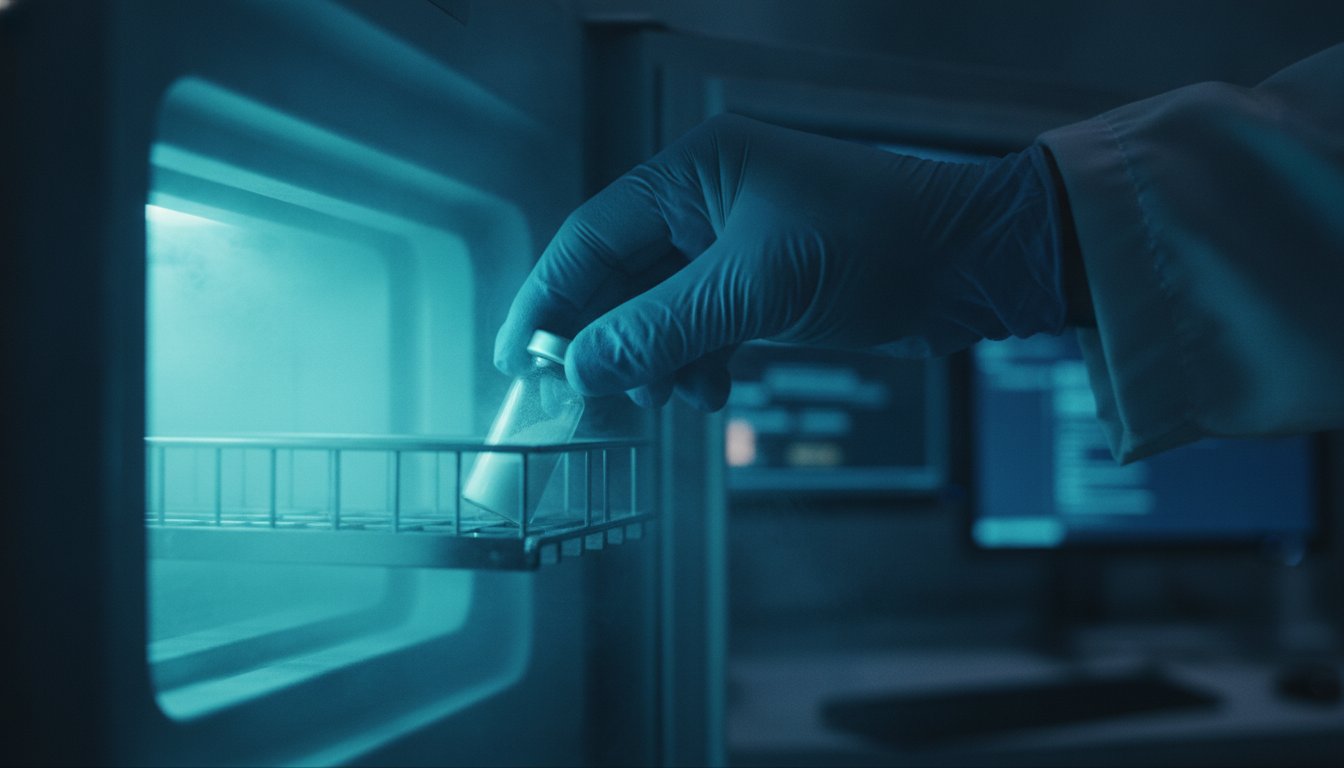
A research peptide is not a static asset. It is a volatile chemical system in a state of constant thermodynamic decline. For the disciplined researcher, the difference between a successful assay and a failed experiment often rests on the precision of your long-term storage protocols for research peptides. Even a minor breach in thermal stability or a microscopic ingress of atmospheric moisture can trigger irreversible hydrolysis, effectively liquefying your investment before it ever reaches the bench.
We understand that inconsistent results are the enemy of scientific progress. You require absolute certainty that your lyophilized compounds maintain their analytical integrity from the moment they arrive from our US-based facility until the final aliquot is reconstituted. This article provides the rigorous, validated SOPs necessary to anchor your research in stability. You'll master the specific requirements for -20°C and -80°C preservation, learn to mitigate oxidation risks, and ensure your HPLC-verified purity remains uncompromised over extended durations. We examine the exact methodology for handling vacuum-sealed vials to prevent contamination and preserve the bioactivity of your high-purity sequences.
Key Takeaways
- Identify the primary biochemical pathways of peptide degradation, including hydrolysis and sequence cleavage, to prevent premature loss of bioactivity.
- Execute precise long-term storage protocols for research peptides using a tiered thermal strategy that scales from -20°C for annual storage to -80°C for multi-year preservation.
- Minimize moisture-induced instability through aliquoting and strict adherence to the 7–14 day stability window for reconstituted research chemicals.
- Deploy advanced shielding techniques like inert gas blanketing and Argon displacement to isolate sensitive compounds from oxidative atmospheric conditions.
- Establish a rigorous T=0 analytical baseline using HPLC and mass-spectrometry to ensure that storage success is built on a foundation of high-purity lyophilized material.
Mechanisms of Peptide Degradation in Laboratory Environments
Peptide stability isn't a passive state. It's the active maintenance of a molecule's primary sequence and secondary structure over time. To understand why these compounds fail, one must first understand what peptides are: precise chains of amino acids linked by amide bonds that are susceptible to a variety of environmental pressures. Stability is the anchor of analytical integrity. Without rigorous long-term storage protocols for research peptides, these molecules drift toward thermodynamic equilibrium, resulting in a total loss of bioactivity before the first assay is even conducted.
Hydrolysis represents the most persistent chemical threat in the laboratory. It involves the cleavage of peptide bonds, a process often mediated by residual moisture and subtle pH fluctuations. Even in a lyophilized state, microscopic water ingress can catalyze this breakdown. Physical aggregation is equally destructive. Hydrophobic sequences often lose bioactivity through non-covalent bonding, where individual molecules clump together. This creates insoluble masses that render the compound analytically useless and technically unviable for precise research models.
Sequence-Specific Vulnerabilities: Cys, Met, and Trp
Certain amino acid residues act as inherent weak points in the molecular chain. Cysteine (Cys) residues are notoriously prone to disulfide bridge formation when exposed to oxidative environments. This leads to unintended cross-linking that alters the peptide's intended fold. Methionine (Met) is similarly vulnerable, frequently oxidizing to methionine sulfoxide. This specific chemical shift often disrupts receptor binding sites, effectively "blunting" the peptide's biological utility. Tryptophan (Trp) presents a different risk profile. It's highly sensitive to light. Photo-oxidation of Trp residues occurs rapidly if vials aren't shielded, creating degradation products that contaminate HPLC profiles and skew data results.
Deamidation and Racemization Pathways
Chemical degradation doesn't always require external oxygen. Deamidation primarily targets Asparagine (Asn) and Glutamine (Gln) residues, particularly when a peptide is transitioned to an aqueous state. When pH levels rise above 8.0, the formation of isoaspartate accelerates. This fundamentally alters the peptide's charge and backbone structure. Temperature dictates the rate of another silent failure: racemization. This process converts L-amino acids into their D-isomer counterparts. While the sequence appears identical on paper, the change in chirality usually eliminates the biological function. Implementing strict long-term storage protocols for research peptides is the only way to arrest these kinetic processes and ensure that the compound you analyze is the compound you purchased.
Primary Storage Protocols for Lyophilized Research Peptides
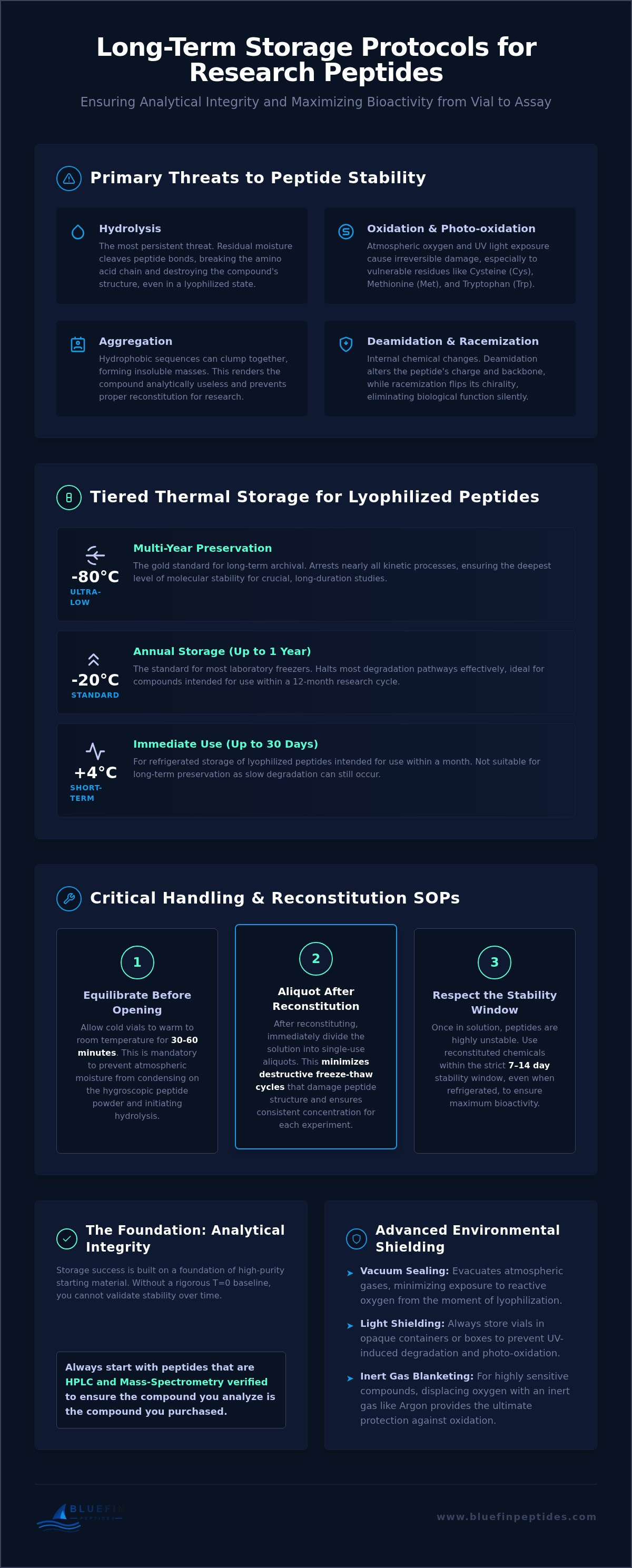
The lyophilized state is the non-negotiable baseline for preservation. By removing the aqueous environment, we halt the primary engine of degradation. For effective long-term storage protocols for research peptides, temperature management follows a strict hierarchy based on the intended duration of the study. Store vials at 4°C for immediate use within 30 days. Maintain -20°C for durations up to one year. Utilize -80°C for multi-year preservation to ensure the deepest level of molecular stability. UV exposure is a critical failure point. Always store vials in light-shielded containers to prevent ultraviolet-induced sequence cleavage.
Vacuum sealing serves as the final layer of defense. By evacuating atmospheric gases, we minimize the reactive potential of oxygen. This vacuum-sealed environment, combined with high-purity lyophilization, ensures the peptide remains in a state of suspended animation. Researchers looking to secure their analytical data should start with high-purity vacuum-sealed compounds to ensure the longest possible shelf life before reconstitution.
The Moisture Equilibration Protocol
Opening a cold vial in a warm laboratory environment is a common cause of experimental failure. It triggers immediate condensation on the hygroscopic peptide powder. This microscopic moisture ingress initiates hydrolysis and ruins the lyophilized cake. A mandatory 30–60 minute warm-up period is required to bring the vial to ambient temperature before the seal is breached. In high-humidity environments, utilize the Desiccator Method. Transfer the cold vial directly into a desiccator chamber and allow temperature equilibration within the dry environment. Open the vial only once thermal parity is achieved to keep the powder dry and stable.
Vial Selection and Integrity Verification
Material choice dictates long-term stability. Borosilicate glass is the industry standard for its low thermal expansion and chemical resistance. Polypropylene, while common, carries risks of chemical leaching and higher gas permeability over extended durations. Use teflon-lined caps to provide a chemically inert seal that resists the corrosive nature of certain solvents. For more on these standards, refer to the Peptide Handling, dissolution & Storage guidelines provided by the NIBSC.
Integrity is verified through visual inspection. A healthy lyophilized cake should appear as a solid, uniform structure. If the cake appears collapsed, shrunken, or melted, it indicates moisture ingress or a thermal breach. These vials should be subjected to HPLC verification before use to confirm they still meet the ≥99% purity standard required for rigorous long-term storage protocols for research peptides. Consistency in the physical state of the offering is the first sign of a reliable storage process.
Managing Reconstituted Peptides: Aliquoting and Stability Limits
Reconstitution represents the most volatile phase in the lifecycle of a research compound. Transitioning a peptide from a stable lyophilized state to an aqueous solution initiates an immediate decline in molecular stability. While long-term storage protocols for research peptides focus on the solid state, the management of liquid solutions requires even tighter tolerances. Most reconstituted research peptides maintain analytical integrity for only 7–14 days when stored at 4°C. Beyond this window, the risk of hydrolysis and microbial proliferation increases significantly. Researchers should utilize sterile, bacteriostatic solutions to inhibit bacterial growth within laboratory models. For specific solvent ratios and concentration guidance, consult our reconstitution protocols for tirzepatide vials.
The Aliquoting Strategy for Multi-Phase Studies
Repeated freeze-thaw cycles are destructive. The mechanical stress of ice crystal formation during slow cooling can lead to irreversible peptide denaturation, effectively shearing the delicate sequence bonds. To prevent this, implement a strict aliquoting protocol. Once the initial vial is reconstituted, divide the solution immediately into single-use experimental volumes. These aliquots should be flash-frozen using liquid nitrogen or dry ice. This rapid transition to a solid state prevents the growth of large, damaging ice crystals. By using single-use vials, you ensure that the remaining stock is never exposed to thermal fluctuations, preserving the bioactivity required for consistent results across multi-phase studies.
PH Optimization for Solution Stability
The electrochemical environment of the solvent dictates the rate of chemical degradation. Most GLP-1 analogues, including Retatrutide and Tirzepatide, possess a "Safe Zone" for stability between pH 5.0 and 7.0. Deviating into highly acidic or basic ranges catalyzes rapid deamidation and hydrolysis. This shift fundamentally alters the peptide's primary sequence. To maintain this balance, utilize buffered solutions such as Phosphate-Buffered Saline (PBS). These buffers resist pH drift and provide a stable environment that mimics physiological conditions. Integrating these steps into your long-term storage protocols for research peptides ensures that the transition from storage to active research doesn't compromise your HPLC-verified purity.
Advanced Environmental Control: Light, Moisture, and Inert Gas Blanketing
Standard refrigeration is merely the first tier of preservation. For sequences prone to oxidative degradation, inert gas blanketing represents the elite standard in long-term storage protocols for research peptides. While nitrogen is a common laboratory choice, argon offers superior protection. Argon’s higher density allows it to sink, creating a stable, fluid-like shield over the lyophilized cake that effectively displaces lighter atmospheric oxygen. This displacement is critical for maintaining the structural integrity of sulfur-bearing residues over multi-year durations.
Secondary containment provides an additional layer of security against the ingress of moisture. Placing vials inside larger, desiccated jars creates a micro-environment that resists external humidity fluctuations. Within these storage units, utilize humidity indicator cards to monitor moisture levels in real-time. These cards provide a visual verification of the storage unit's performance, ensuring that the desiccant remains active and the hermetic seal is intact. This "defense in depth" strategy is essential for protecting expensive research assets from atmospheric contamination.
Implementing an Inert Gas Purge
Executing a precise purge requires a manifold-based system or a controlled glove-box environment. The objective is to introduce the inert gas at a low flow rate to displace reactive oxygen without disturbing the delicate structure of the lyophilized powder. Once the atmospheric air is replaced, the vials must be sealed immediately with teflon-lined caps to ensure a hermetic environment. This process is essential for high-purity research chemicals intended for long-term analytical studies. Researchers can source vacuum-sealed research peptides to establish a professional baseline for these advanced protocols.
Light Mitigation and UV Protection
Light-induced degradation is a silent threat to molecular integrity. Peptides containing aromatic amino acids, such as Tryptophan, Tyrosine, and Phenylalanine, are particularly vulnerable to UV-induced sequence cleavage. Exposure to laboratory fluorescent lighting during handling can initiate photo-oxidation, leading to contamination in HPLC profiles and skewed data. Use amber vials or opaque secondary storage containers for all research blends to provide a permanent shield against the light spectrum. This protective layer is a non-negotiable component of long-term storage protocols for research peptides, ensuring that the primary sequence remains unchanged from procurement to analysis.
Ensuring Analytical Integrity from Procurement to Long-Term Storage
Storage success is fundamentally limited by the initial purity of the research chemical. Impurities act as catalysts for degradation. A compound arriving at 95% purity will degrade significantly faster than one at ≥99% due to the presence of truncated sequences or residual solvents that facilitate chemical breakdown. Establishing a T=0 baseline through HPLC and mass-spec reports is the first step in rigorous long-term storage protocols for research peptides. This documentation ensures that any subsequent analytical drift is quantifiable rather than an unknown variable of procurement.
Logistics play a decisive role in preservation. Extended transit times from overseas suppliers expose vials to uncontrolled temperature excursions. Bluefin utilizes US-based logistics to minimize this "transit stress," ensuring that the maritime precision of our fulfillment process maintains the cold chain. The Retatrutide research peptide serves as an ideal model for this high-stability chain; its complex sequence requires the absolute absence of thermal spikes during transit to preserve its structural integrity before it ever enters your laboratory's long-term inventory.
Interpreting Batch-Specific COAs for Stability Data
A Certificate of Analysis (COA) is a roadmap for stability. Researchers must identify the residual moisture content; high levels accelerate hydrolysis even at -20°C. The choice of salt, whether acetate or Trifluoroacetic acid (TFA), also dictates long-term behavior. TFA salts are generally more stable for storage but can be more cytotoxic in certain cell models. For any sequence held in inventory longer than 24 months, we encourage performing a "verification HPLC" to confirm that the primary sequence remains within 1% of its original T=0 value. This ensures your long-term storage protocols for research peptides are actually performing as intended.
The Bluefin Advantage: Precision Lyophilization
Our commitment to ≥99% purity provides a critical safeguard against autocatalytic degradation. We utilize industrial-grade lyophilization to ensure residual water content is typically below 5%, effectively locking the peptide in its bioactive state. This precision is especially vital for multi-peptide systems. Researchers conducting complex stability studies should explore the Ipamorelin CJC-1295 research blend, where the interaction between two distinct sequences demands the highest level of initial purity and moisture control to ensure consistent experimental outcomes over time. High-purity foundations are the only way to anchor your results in fact.
Securing the Analytical Future of Your Research
The integrity of your experimental data is inseparable from the physical state of your compounds. Stability is an active discipline. It requires a transition from the passive refrigeration of vials to a rigorous methodology involving thermal hierarchy, light shielding, and the strategic use of inert gas. By implementing these long-term storage protocols for research peptides, you eliminate the variables of degradation and ensure that your T=0 analytical baseline remains consistent over months or years. Your findings are only as reliable as the stability of your underlying sequences.
Success in the laboratory begins with the procurement of high-purity, vacuum-sealed foundations. Bluefin provides the security you need through ≥99% HPLC-verified purity and batch-specific COA documentation for every sequence. Our US-based domestic shipping ensures that your compounds arrive with minimal transit stress, ready for immediate integration into your preservation workflow. Anchor your research in analytical certainty and maintain the highest standards of precision in every study.
Procure HPLC-Verified Research Peptides for Your Laboratory
Frequently Asked Questions
Can research peptides be stored in a standard household freezer?
Standard household freezers are generally unsuitable for the most rigorous long-term storage protocols for research peptides. These units utilize automatic defrost cycles that cause significant temperature fluctuations. Such cycles induce repeated thermal stress on the lyophilized cake. For preservation exceeding six months, a dedicated laboratory-grade freezer set to a constant -20°C or -80°C is required to maintain the sequence integrity and prevent premature degradation of the compound. Consistency is the anchor of professional research.
How long do lyophilized peptides remain stable at room temperature during shipping?
Lyophilized peptides are robust enough to withstand ambient temperatures for 7 to 14 days during transit. Bluefin utilizes the maritime precision of US-based logistics to minimize this transit duration, ensuring the compound remains well within its stability window. While short-term exposure to room temperature doesn't immediately compromise a vacuum-sealed vial, immediate transfer to cold storage upon arrival is mandatory. This halts the kinetic energy that drives molecular breakdown and preserves the analytical integrity of the sequence.
What are the visible signs that a research peptide has degraded?
Visible degradation often manifests as a physical change in the lyophilized cake. A healthy product appears as a uniform, white plug. If the cake appears shrunken, yellowed, or has a melted translucent appearance, it indicates moisture ingress or a thermal breach. In reconstituted solutions, persistent cloudiness or the presence of insoluble particulates suggests significant peptide aggregation. Such vials should be subjected to HPLC verification to confirm they still meet the ≥99% purity standard required for rigorous study.
Is it better to store peptides in glass or plastic vials for long-term use?
Borosilicate glass is the superior choice for long-term preservation. It offers high chemical resistance and low gas permeability. While polypropylene vials are acceptable for short-term aliquoting and multi-phase studies, they present a higher risk of chemical leaching and atmospheric gas ingress over extended durations. For multi-year storage, the inert nature of glass, combined with a teflon-lined seal, provides the most stable environment for maintaining high-purity research sequences. Secure storage remains the foundation of data.
Does the presence of a BPC-157 / TB-500 Research Blend affect individual peptide stability?
The presence of a BPC-157 / TB-500 Research Blend doesn't inherently destabilize the individual sequences when stored in a lyophilized state. Each peptide maintains its own thermodynamic profile within the vacuum-sealed environment. However, once reconstituted, the different degradation rates of each sequence must be considered. Maintaining a neutral pH and utilizing aliquoting strategies is essential to ensure that both components of the blend remain analytically viable for the duration of the experiment. Precision remains paramount.
Should I use a desiccator for all peptide handling procedures?
Utilizing a desiccator is a critical step in professional long-term storage protocols for research peptides. It's particularly essential during the moisture equilibration phase. Opening a cold vial in a humid laboratory environment triggers immediate condensation on the hygroscopic powder. By allowing the vial to reach ambient temperature inside a desiccator, you ensure that the internal environment remains dry. This prevents the microscopic moisture ingress that catalyzes hydrolysis and ruins the structural integrity of the lyophilized cake.
What is the impact of light exposure on reconstituted peptide solutions?
Reconstituted peptides are significantly more vulnerable to light-induced degradation than their lyophilized counterparts. UV exposure catalyzes the photo-oxidation of aromatic amino acids, leading to rapid sequence cleavage. This process is often accelerated by the aqueous environment. Always use opaque secondary containment or amber vials for solutions. Even short-term exposure to intense laboratory fluorescent lighting can skew analytical results by altering the chemical structure of the peptide in solution. Shielding the compound ensures experimental accuracy.
How does residual TFA (Trifluoroacetic acid) affect long-term storage outcomes?
Residual Trifluoroacetic acid (TFA) acts as a counter-ion and affects both the solubility and the electrochemical stability of the peptide. While necessary for HPLC purification, high levels of residual TFA can lower the local pH within the vial. This acidic micro-environment may accelerate certain degradation pathways like deamidation over extended periods. Researchers should consult the batch-specific COA to identify the salt content and adjust their buffered reconstitution solutions accordingly to maintain optimal stability and sequence integrity.
For laboratory research use only. Not for human or veterinary use. This content is educational and does not constitute medical, dosing, or usage guidance.
Browse the BLUEFIN catalog