Justifying Peptide Purchases and Costs in a Research Grant

Justifying a peptide purchase for a research grant starts with a traceable quantity calculation and evidence that the specified material fits the study. Estimate the amount needed per run, multiply it by the planned runs, and account separately for controls, calibration, and repeat analyses. Support the cost estimate with supplier quotations that match the peptide specification, quantity, quality documentation, and delivery requirements.
A low reagent estimate can look incomplete if it lacks an experimental basis or evidence used to assess the material. Peptide documentation matters: batch records with HPLC purity data and mass spectrometry identification help connect the requested reagent to the work described in the proposal.
This article explains how to build a defensible estimate, present peptide specifications and documentation, and address reviewer concerns about quantities or apparent discrepancies. It also covers the budget details that make a request easier to evaluate, keeping the scientific need and proposed expenditure clear and aligned.
Key Takeaways
- Build reagent estimates from the quantity needed per run, planned runs, and separately accounted controls, calibration, and repeat analyses.
- Compare quotations against consistent peptide specifications, quantities, quality records, and delivery requirements.
- Use batch-level documentation, including purity data and identity testing, to connect the requested material to the proposed experiments.
- Explain unusual quantities and reconcile differences between the experimental plan, budget, and supporting documents.
- Keep the scientific rationale, cost estimate, and supporting records aligned so reviewers can follow the basis for the request.
What evidence should support reagent cost estimates in a grant application?
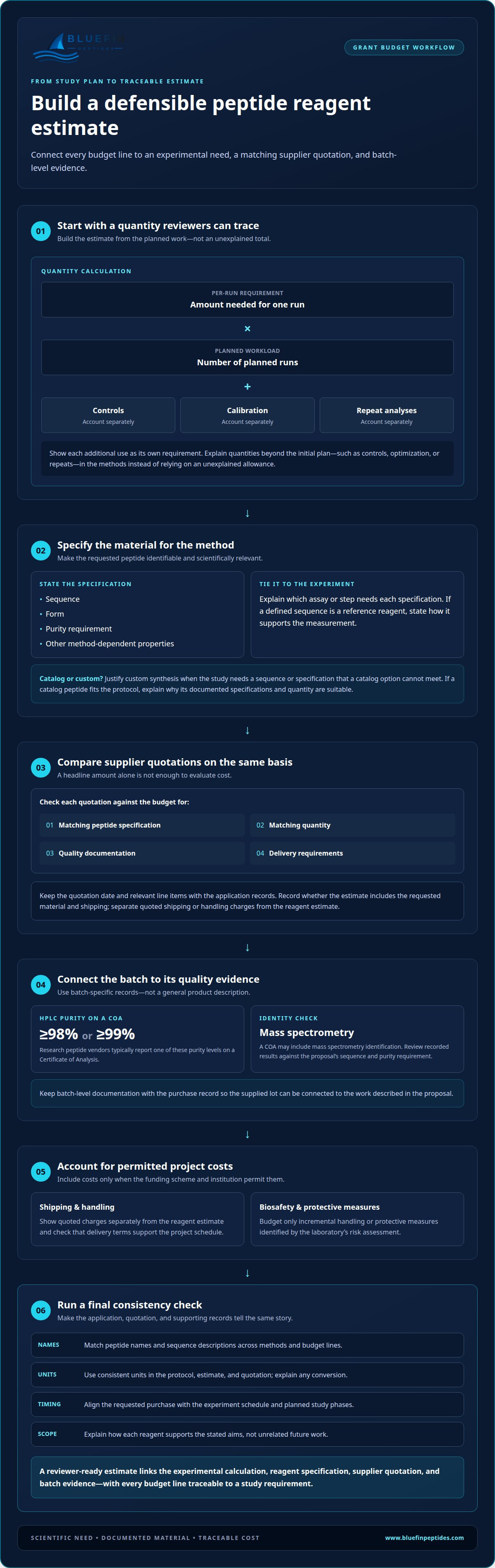
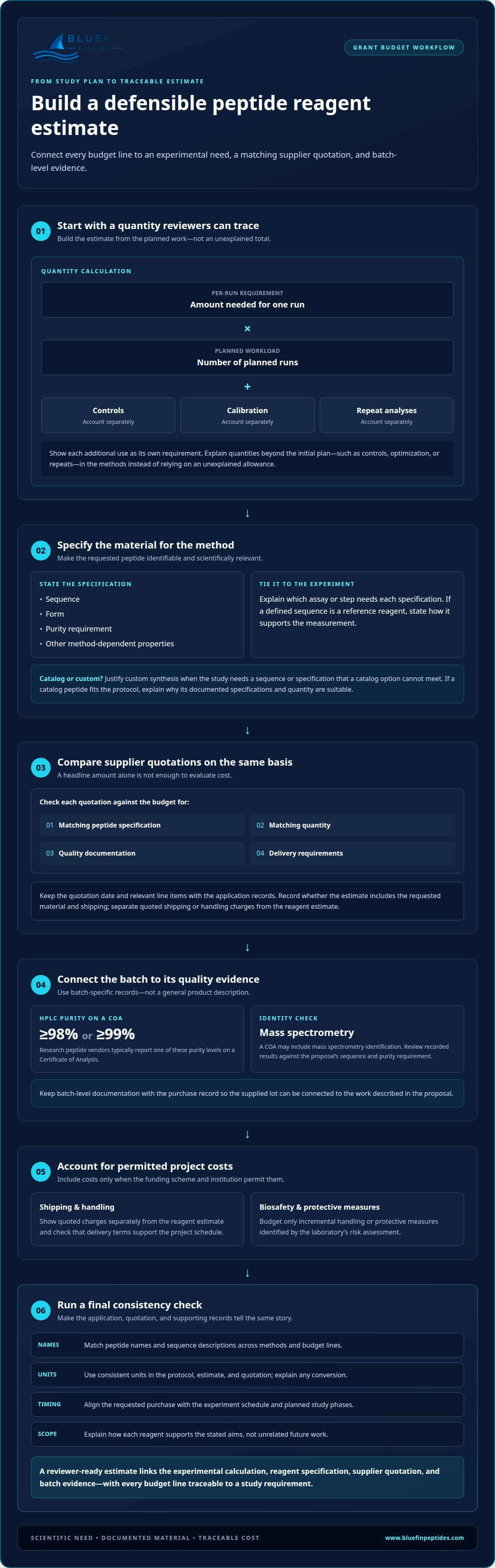
A defensible reagent estimate connects the experimental plan to a traceable quantity and supplier quotation. Start with the amount required for one run, then multiply it by the planned number of runs. Add separate quantities for controls, calibration, and repeat analyses. For example, if a protocol requires distinct control and calibration samples, show those needs separately rather than folding them into an unexplained total. This makes the calculation auditable.
Describe the peptide specification alongside its quantity: sequence, form, purity requirement, and any other property the method depends on. Tie each specification to the intended assay or experimental step. If the protocol uses a defined sequence as a reference reagent, explain how that sequence supports the measurement. Reviewers can then assess whether the requested material and amount match the proposed work.
A supplier quotation should identify the same specification, quantity, quality documentation, and delivery requirements used in the budget. Compare quotations on that common basis, not by the headline amount alone. Record whether the estimate includes the requested material and shipping, and keep the quotation date and relevant line items with the application records. These details show how the estimate was constructed without relying on an unsupported market average.
For custom peptide synthesis versus purchasing a catalog peptide, justify custom synthesis when the study requires a sequence or specification the catalog option cannot meet. If a catalog peptide fits the protocol, explain why its documented specifications and quantity are suitable.
Certificates of Analysis (COAs) connect a supplied batch to stated quality results. Research peptide vendors typically report HPLC purity of at least 98% or 99% on a COA. A COA may also include mass spectrometry identification; review the recorded results against the sequence and purity requirement in the proposal. Keep batch-specific documentation with the purchase record, rather than treating a general product description as evidence for a particular lot.
Check that the quotation, product specification, COA information, and delivery terms align, and resolve mismatches in sequence, quantity, or stated purity before finalizing the estimate. A research peptide supply chain can include synthesis, purification, testing, packaging, and shipment. Identify the records accompanying the material and explain how the planned delivery supports the project schedule.
Include biosafety, handling, and shipping costs when they are project costs permitted by the funding scheme and institution. Separate quoted shipping or handling charges from the reagent estimate, and budget only incremental handling or protective measures identified by the laboratory’s risk assessment.
In the United States, pharmaceutical-grade peptide manufacturing follows FDA cGMP regulations for finished pharmaceuticals under 21 CFR Part 211, according to the U.S. National Archives and Records Administration, Office of the Federal Register. This distinction helps define the material category being discussed; it does not make pharmaceutical-grade manufacturing a default requirement for every research reagent when working with partners like Bluefin Peptides.
A clear justification for a peptide purchase for a research grant aligns the experimental calculation, reagent specification, quotation, and batch evidence. Present those records together, with each budget line traceable to a study requirement.
Common reviewer concerns and application discrepancies
Reviewers look for a coherent connection between the scientific aims, methods, and requested resources. A mismatch can weaken that connection. For example, an application may describe testing one peptide sequence but budget for a different sequence or form. Resolve inconsistencies across the project narrative, methods, budget, and supporting records. Use the same reagent name and specification throughout so the intended experiment remains clear.
Quantity requests attract scrutiny when they exceed the experimental plan. If a proposal describes a small pilot but budgets material for extensive testing, explain the additional work directly. It may involve controls, optimization, or repeat analyses, but each use should appear in the methods. Avoid unexplained allowances. Reviewers should be able to trace every requested amount to a defined experimental purpose.
Another concern is a budget line without enough detail to evaluate. A single entry labeled “peptide reagents” obscures the planned material and its role. Separate distinct reagents and state how each supports a specific aim. For instance, identify which sequence serves as the experimental reagent and which serves as a control. This helps reviewers assess scientific relevance without inferring the protocol.
Check the application for discrepancies before submission. Compare these elements side by side:
- Names: Match peptide names and sequence descriptions across methods and budget lines.
- Units: Use consistent units in the protocol, estimate, and quotation; explain any conversion.
- Timing: Align the requested purchase with the experiment schedule and planned study phases.
- Scope: Explain why a requested reagent supports the stated aims, not unrelated future work.
Reviewers may also question a sudden change in specifications between the methods and supporting documents. For example, a proposal might describe a high-purity reagent while its attached estimate describes a different grade. Clarify the scientific reason for the selected specification, then make the supporting record consistent. Avoid broad quality claims when the application names a more precise requirement.
Application discrepancies can arise from revisions, copied text, or separate contributors preparing the budget and methods. Arrange a final review across those components. Check that the project’s reagent names, roles, quantities, and timing tell the same story. If a change is necessary, update every affected section and explain its experimental rationale where reviewers assess the request.
Keep the rationale direct. State the concern, identify the relevant experiment, and show how the requested resource addresses it. For peptide-based projects, research peptide options can help frame the material category being considered. The application itself should still establish the scientific need and maintain consistency between its methods and budget.
Characteristics of legitimate research peptides
Assess a research peptide through verifiable identity and batch records, not its label alone. The sequence, stated amount, purity result, and intended laboratory use should align across product information and batch documentation. A Certificate of Analysis (COA) with HPLC purity data and mass spectrometry identification gives reviewers evidence to compare with the proposal’s specifications. These records support evaluation; they do not, by themselves, establish suitability for every experiment.
Check what the stated purity figure measures. Research peptide vendors typically report HPLC purity of at least 98% or 99% on a COA. HPLC purity describes the measured proportion of the target peak relative to detected peaks under the stated method. It does not establish that a vial contains the labeled quantity. Review identity and quantity as separate attributes, and avoid treating one result as proof of the other.
Label accuracy illustrates why batch-level evidence matters. Use this example to distinguish declared content from verified content, not to assume that every vial differs. For a grant application, describe the quantity basis used in the estimate and retain records identifying the purchased batch.
Documentation should also make the supply chain traceable. Match the product name and sequence to the COA, then connect the batch identifier to the purchase record and receiving documentation. If the supplier provides HPLC and mass spectrometry results, review them against the proposed experimental specification. A missing or inconsistent identifier can make it difficult to show that the paperwork corresponds to the material used.
Keep research-grade material distinct from pharmaceutical-grade products. In the United States, pharmaceutical-grade injectable peptides must pass the Bacterial Endotoxins Test under USP <85> before release. That requirement describes pharmaceutical-grade injectable peptides, not a blanket criterion for every laboratory reagent. The proposal should state the grade and tests relevant to its intended work, without implying that research-use documentation establishes pharmaceutical release status.
Sequence length also matters when describing regulatory categories. The stated distinction classifies peptides with more than 40 amino acids as biologics, while peptides with fewer than 40 amino acids remain drugs. Avoid using this distinction as a substitute for describing the actual reagent or its intended laboratory use. For a public-facing application, precise wording helps reviewers distinguish research materials from products represented for therapeutic use.
- Match the sequence and batch identifier across product records, COA, and purchase documentation.
- Read HPLC purity and mass spectrometry identification as separate evidence points.
- State the intended research use and the specification that the experiment requires.
Peptide documentation and laboratory-research use
In a laboratory, purchase records are useful when they remain connected to the experiment. A defined record trail links the ordered material, its receipt, and its use in the study.
Purchase Documentation
Purchase documentation connects an order to the material received and the supplier’s batch information. Retain the purchase order, invoice, product specification, Certificate of Analysis, and receiving record together. For example, a receiving entry can record the product name and batch identifier, then point to the matching COA. This lets the research team trace which material entered a particular experiment.
Keep the supplier’s documentation in a controlled project folder with consistent file names. A useful naming pattern includes the reagent name, batch identifier, and document type. If a COA reports HPLC purity and mass spectrometry identification, preserve it alongside the corresponding batch record. The goal is a retrievable chain of evidence, not a collection of detached files.
Research Expense Justification
Research expense justification explains how a purchase supports a defined aim and method. Link the reagent to a protocol step, such as testing a specified peptide in an assay, and connect that step to the grant’s stated objective. This gives reviewers a clear scientific basis for the expense rather than leaving them to infer the reagent’s role from its name.
For example, a project record can connect the budget line to the protocol section, planned experiment, and resulting data file. If the method changes, document the revised reagent role and update the project records. This alignment helps show that the expense serves the approved research scope rather than an unrelated activity.
At receipt, record the date, package identifier, and condition observed by laboratory staff. Store the supplier’s batch documents with that entry. When the reagent is assigned to an experiment, record the project code and protocol version. These links help distinguish material used in separate studies, even when the same peptide name appears in multiple records.
During laboratory use, connect each experiment record to the relevant batch and protocol. A notebook entry can identify the reagent, batch, experimental purpose, and file containing the resulting data. If a run is repeated, record the reason and connect the repeat to the same study aim. This sequence supports later interpretation of results and clarifies how the purchased material was used.
Keep supplier evidence distinct from experimental records. A COA documents supplier-reported batch information; a laboratory notebook records how researchers used the material. Neither replaces the other. For instance, a COA cannot establish which batch was used in a specific assay unless the experiment record identifies it.
A well-maintained file structure also supports closeout and audit preparation. Organize records by grant, reagent, and experiment, then preserve links between the budget entry and laboratory documentation. This makes the purchase rationale visible from proposal through data collection, without relying on memory or disconnected paperwork.
What documentation supports peptide purchase as a necessary research expense
A strong expense file connects the proposed peptide to a defined research aim, experimental method, and budget line. The key is traceability: each record should show why the material is needed, how the estimate was developed, and where the expense sits within the project. Reviewers can then assess scientific necessity and budget relevance without reconstructing the rationale from scattered documents.
Start with the project narrative and protocol. Identify the aim that requires the peptide, the experiment that uses it, and the resulting measurement or analysis. For example, if an assay compares responses to a specified sequence, describe the sequence’s role in that comparison. Connect the narrative to the protocol section and corresponding budget entry, using consistent reagent names across all records.
A resource calculation should show how the request follows from the study design. Link the planned runs and experimental conditions to the quantity requested. Keep the calculation with the budget worksheet, and note assumptions that affect it, such as control groups or planned repeat analyses. This lets reviewers follow the rationale from experimental design to requested amount instead of seeing an isolated figure.
Organize supporting records so each answers a distinct question:
- Scientific need: The aims and protocol identify the experiment requiring the peptide.
- Specification: The product description records the sequence and relevant material requirements.
- Cost basis: The quotation and budget worksheet support the estimated purchase and related charges.
- Receipt and use: Purchase and laboratory records connect the received material to project activity.
Keep the quotation aligned with the budget version submitted. If a revised estimate changes the material, quantity, or delivery requirement, update the related calculation and explanation. For example, a switch from one sequence to another should appear in both the method and budget rationale. A dated revision note can clarify which estimate supports the application and prevent an earlier document from appearing inconsistent.
Separate direct research costs from broader institutional expenses according to the funding scheme and the institution’s accounting treatment. For a U.S. proposal, show the peptide as a project expense only when the work plan explains its role. Describe shipping or handling separately when the application requires it. Do not bury ancillary charges in a reagent total if that obscures the estimate’s basis.
Before submission, conduct a cross-document review. Compare the aims, protocol, budget, quotation, and purchase rationale for matching names, specifications, quantities, and timing. Confirm that each requested item supports the proposed work and that every budget line has an experimental purpose. This final review turns supporting documents into a coherent record of necessity.
For research planning, review research peptide options that can be evaluated against the project’s written specifications and documentation needs.
Bluefin Peptides: Retatrutide Research Peptide
Bluefin Peptides offers Retatrutide Research Peptide for laboratory use, with batch documentation that can support a project’s purchasing records. Its peptides are ≥99% HPLC-verified, with mass spectrometry confirmation and batch Certificates of Analysis. These records can help research teams assess material documentation alongside their own experimental specifications.
Turn to this offering when Retatrutide matches the sequence and material requirements established in your protocol. Bluefin Peptides also offers Tirzepatide Research Peptide, BPC-157 / TB-500 Research Blend, and Ipamorelin / CJC-1295 Research Blend. Evaluate any option against the grant’s scientific rationale and budget documentation; the proposal remains responsible for showing how the reagent supports the planned work.
Visit www.bluefinpeptides.com to review the research peptide offerings.
Make the Next Grant Cycle Easier to Prepare
Build a durable purchasing record into the laboratory’s research workflow, rather than leaving it until submission week. When planning a new experiment, connect reagent decisions to the protocol and project records immediately. This gives the team a clearer starting point when future applications require an updated rationale or revised scope.
Consistent internal records also help researchers distinguish a scientific change from an administrative discrepancy. If an aim or method evolves, document the reason and align affected project materials before the next budget review. This keeps the decision trail readable for colleagues who may inherit the work and supports a more efficient approach to justifying a peptide purchase for a research grant.
For research peptide sourcing aligned with laboratory documentation needs, contact Bluefin Peptides. A well-prepared record and a clearly defined research plan give your next proposal a strong foundation.
Frequently Asked Questions
How to justify peptide purchases in a research grant budget?
Justifying a peptide purchase for a research grant starts with linking each sequence and quantity to a named experiment, objective, and planned use period. Explain why the peptide is necessary, how the requested amount follows the protocol, and why synthesis or specified modifications are required. Tie the amount to experimental groups, replicates, and controls, then state the basis for the estimate and how unused material will be managed.
What information should a peptide vendor quote include for a grant application?
Ask the vendor quote to identify the peptide sequence, modifications, quantity, synthesis specifications, and any stated validation or quality-control documentation. It should also show the quoted amount, shipping or other charges, and the date or validity period so the estimate is traceable. Bluefin Peptides provides a research catalog and COA lookup through Researcher Access. Use available batch documentation as supporting evidence, and obtain a formal quote separately if needed.
What are NIH rules for budgeting peptides and laboratory supplies in grant applications?
NIH has no peptide-specific budget category. Classify the purchase according to the applicable application instructions and your institution’s accounting policy. Requested costs must meet federal cost principles, including being allowable, allocable to the project, and reasonable. Explain how the peptide supports the proposed work, and follow the funding opportunity’s budget format. Do not assume every application uses the same level of budget detail.
How do you write a grant budget justification for peptide synthesis and validation?
Describe synthesis and validation as distinct cost elements when the quote separates them, then connect each to a study need. For example, explain why a modified sequence is needed for the assay and why identity or purity testing is required before use. Identify the requested quantity and how it maps to planned experiments, controls, and repeats. Refer to the vendor’s stated methods and documentation without presenting a test as a grant requirement unless the funding instructions say so.
For laboratory research use only. Not for human or veterinary use. This content is educational and does not constitute medical, dosing, or usage guidance.
Browse the BLUEFIN catalog