How to Verify a Peptide Supplier's Authenticity Through Lab Tests
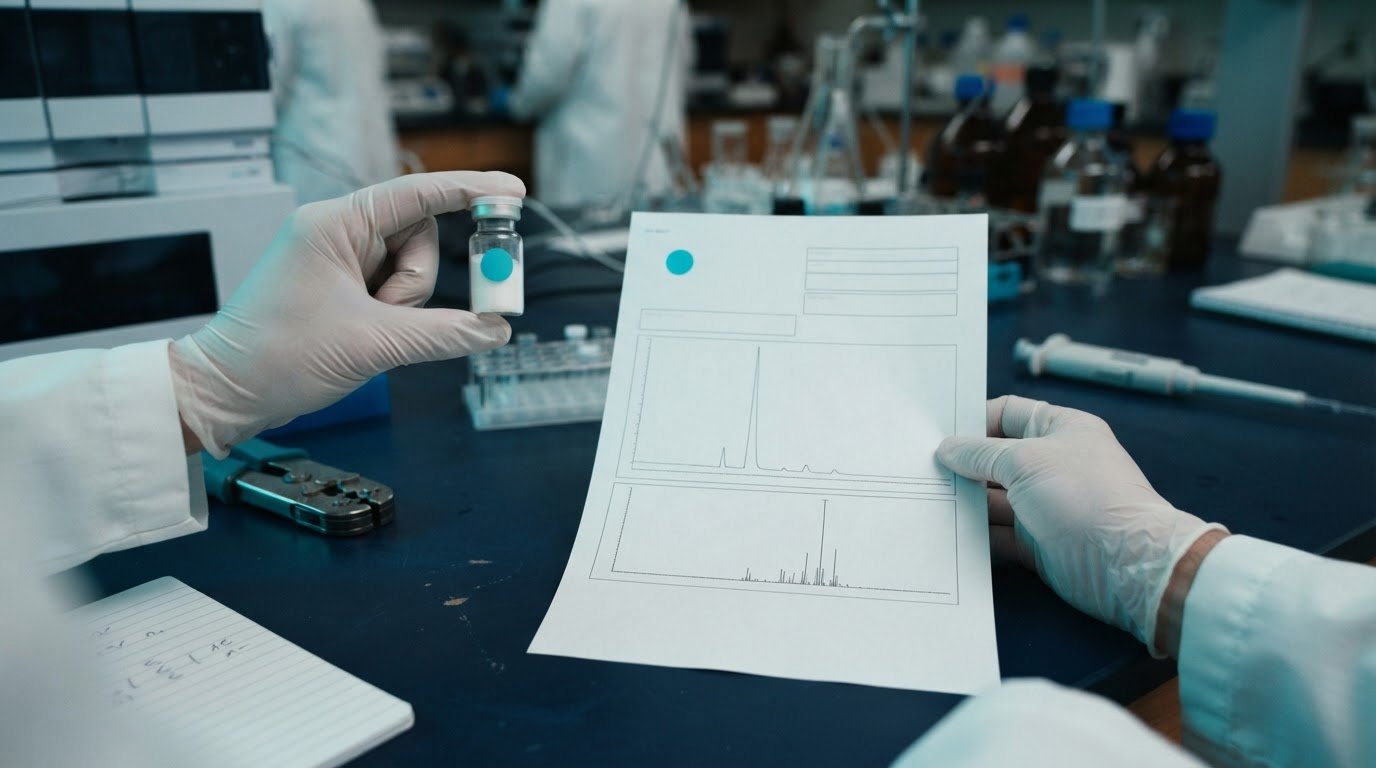
A polished Certificate of Analysis can still leave the central question unanswered. Without an analysis date or lot number, it cannot show that the material currently offered matches the tested batch. Verifying a peptide supplier's authenticity starts with a dated report tied to the specific lot, supported by results that identify the peptide and assess its purity.
That distinction matters: a document can look complete yet offer little evidence about the vial in question. Look for a clear link between the supplier’s claims, the batch on the label, and the laboratory data. This guide explains how to assess a COA and compare its details with the peptide and lot being offered.
You’ll also learn what HPLC purity results can show, how mass spectrometry supports peptide identity, and where each method has limits. The focus is a practical verification process: follow the batch trail, interpret results carefully, and separate documented evidence from claims the data cannot establish.
Key Takeaways
- Match the COA’s lot number to the vial and look for a dated report tied to the batch being offered.
- Read HPLC results as evidence about purity, and mass spectrometry results as evidence about peptide identity.
- Compare the supplier’s product and batch claims with the laboratory report, including its methods and issuing laboratory.
- Look for independent laboratory analysis; ISO 17025 accreditation is a positive indicator, according to the International Organization for Standardization.
- Use a step-by-step verification workflow to separate what test results demonstrate from what they cannot establish.
What is the difference between HPLC and mass-spectrometry testing for research peptides?
Use mass spectrometry to assess peptide identity and HPLC to assess purity: the methods answer different questions. To assess a supplier’s identity, address, and contact information, compare those details across its business records and product documents. Note any inconsistencies that weaken traceability.
-
Check Mass-Spectrometry Identity Evidence
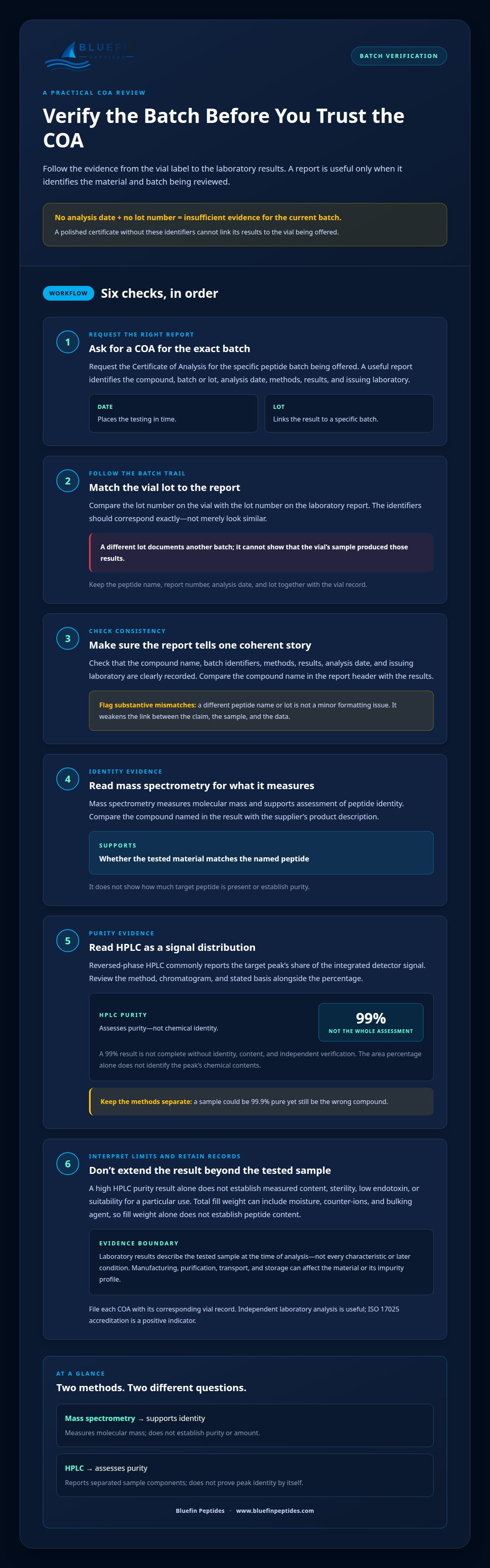
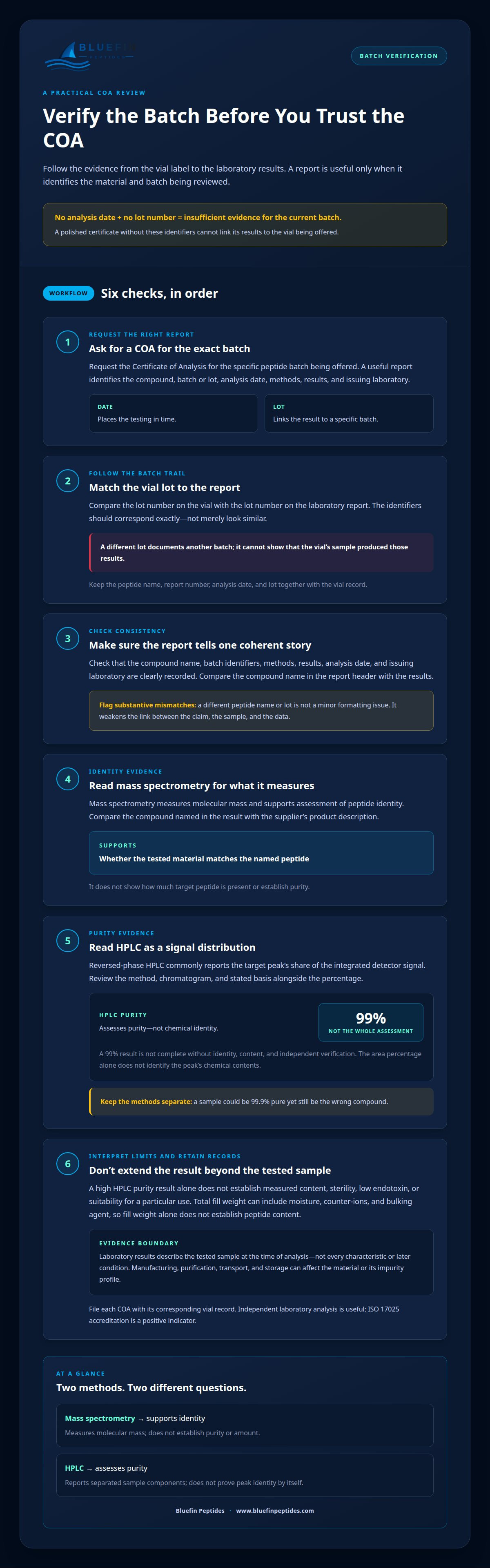
Review the mass-spectrometry result for evidence that the tested material matches the named research peptide. The result supports identity by measuring molecular mass; it does not show how much target peptide is present or establish purity. A sample could be 99.9% pure yet still be the wrong compound, so do not treat a high purity figure as identity confirmation.
Compare the compound named in the report with the supplier’s product description. A mismatch between the named peptide and the identity result is a material discrepancy, not a minor formatting issue. Keep identity evidence separate from purity evidence in your quality-control review.
-
Assess HPLC Purity and Peptide Content
Read the HPLC result as a measure of separated sample components, not proof of identity. Reversed-phase HPLC commonly reports the target peak’s share of the integrated detector signal. That area percentage describes the chromatogram’s signal distribution; by itself, it does not identify the peak’s chemical contents.
Review the method, chromatogram, and stated basis alongside the percentage. A 99% HPLC result is not a complete assessment without identity, content, and independent verification. Purity also differs from net peptide quantity: total fill weight can include moisture, counter-ions, and bulking agent. Therefore, a vial’s fill weight alone does not establish its peptide content.
- Separate the questions. Record what each method establishes: mass spectrometry supports identity, while HPLC assesses purity. A COA containing both provides distinct evidence about those two properties. Neither result substitutes for the other in supplier quality control.
- Consider limits and handling. A high HPLC purity result alone does not establish measured content, sterility, low endotoxin, or suitability for a particular use. Manufacturing and purification shape the impurity profile, while transport and storage can affect material after testing. Treat laboratory results as evidence about the tested sample at the time of analysis, not proof of every characteristic or later condition.
Can I trust a Certificate of Analysis that does not have a date or lot number?
No. An undated certificate without a lot number cannot link its results to the vial being sold. Treat it as insufficient evidence for the current batch, then follow these steps before relying on a report.
-
Request a Batch-Specific Certificate
Request the Certificate of Analysis for the exact peptide batch before purchase. A useful report identifies the compound, batch or lot, analysis date, methods, results, and issuing laboratory. Without a date, you cannot place the testing in time; without a batch identifier, you cannot link the analysis to a specific sample.
Compare the report date with the stock being offered. A COA from 2022 does not establish the quality of a batch sold in 2026. A report can remain genuine yet still describe older material. Do not treat a certificate for one batch as evidence for a different batch, even when the peptide name matches.
-
Match Vial Lots to Laboratory Reports
Match the lot number on the vial to the number on the laboratory report. The identifiers should correspond exactly, not merely look similar. If the certificate lists a different lot, it documents another batch and cannot show that the vial’s sample produced those results.
Record the vial’s lot number and matching report in your laboratory notebook. This creates a traceable record for later batch-to-batch comparisons. Keep the peptide name, report number, date, and lot together; separating these details can make a valid result difficult to associate with its sample.
- Inspect report completeness. Check that the certificate names the peptide and issuing laboratory and records the analysis date, methods, and results. Look for identity and peptide purity findings, along with any contaminant results included in the analysis. A report missing these details offers less information for judging what the laboratory tested and found.
Review the compound name across the certificate header and results. A mismatch between the named peptide and its reported identity is a substantive inconsistency. Batch-specific documentation should identify the same compound and lot throughout, rather than combining results or identifiers from separate records.
- Keep each batch distinct. File each COA with its corresponding vial record rather than reusing a previous batch’s report. Comparing reports over time can help assess consistency, but one batch’s results do not transfer to another. Each certificate is evidence for the sample and batch it identifies.
For research peptides, the clearest record joins the vial, lot number, analysis date, and laboratory report. If you are reviewing available research peptide batch documentation, use the same batch-matching standard before drawing conclusions about peptide purity.
Comparing supplier listings with laboratory-hosted results
Compare the supplier’s listing with the laboratory report for the same compound and tested batch. Assess analytical evidence, laboratory credentials, and claims about legal status as separate checks.
- Compare the supplier listing with the report’s compound name, results, and sample details. Check that the product described matches the material tested; a mismatch between the certificate’s header and identity result is a reason to reject the purchase. A report applies only to the items tested, not automatically to every vial or batch.
Research-use-only peptides are distinct from FDA-approved medicines. A research-use-only designation does not establish FDA approval, and these peptides cannot legally be used in human compounding under the FDA’s position.
-
Verify Reports With the Issuing Laboratory
Contact the laboratory named on the report using contact information obtained independently. Ask it to authenticate the report number and confirm its results. Compare its response with the supplier’s document, including the compound and tested batch. A supplier’s in-house analysis is first-party testing, not independent testing, because the supplier has a commercial interest in the result.
-
Review Laboratory Credentials and Accreditation Scope
Check the issuing laboratory’s credentials and whether its accreditation scope covers the relevant analytical work. The International Organization for Standardization identifies ISO 17025 accreditation as a positive indicator when assessing a laboratory that issued a peptide analysis report. Accreditation is a laboratory credential, not proof that every report or tested sample represents all stock.
Distinguish laboratory independence from accreditation. A laboratory owned or controlled by the supplier remains first-party, regardless of who paid for testing. An independent laboratory analyzes a submitted batch sample; its report applies to that sample and the work performed.
- Separate price from analytical evidence. Peptide supplier prices vary, and this section offers no valid like-for-like price benchmark. An unusually low price alone does not prove a listing is false; compare the stated compound, batch documentation, and laboratory results instead of treating price as a test result.
A Certificate of Analysis also does not establish whether a compound may lawfully be imported into the buyer’s location. FDA registration or authorization is a separate claim: a COA proves neither status. Assess such claims against relevant FDA records, and do not treat registration as proof that a product is an FDA-approved medicine.
- Keep the boundaries clear. Unverified supplier claims leave uncertainty about compound identity, tested-sample results, and the link between a report and the offered material. Do not infer legal import status or suitability for a particular use from a laboratory certificate; these are separate from analytical identity and purity.
HPLC purity testing
Interpret an HPLC result alongside its method, chromatogram, and stated specification. A percentage is useful only when you understand what the analysis counts.
-
Interpret Purity Percentages
Read the reported percentage with its analytical method and basis. HPLC separates sample components and quantifies the main peptide peak relative to other detected peaks. A result of 98% indicates approximately 2% impurities within the stated measurement basis. It does not establish which impurities are present or whether the tested compound is the intended peptide.
Inspect the chromatogram and specification rather than relying on a summary figure alone. For example, 98.4% purity corresponds to 1.6% of the sample attributed to impurities under that analysis. The result describes peptide-related species detected by the method, not every possible property of the material.
-
Compare Purity Claims With Grade Thresholds
Compare the supplier’s claim with the specification required by your research protocol. Research-grade purity does not have one universal definition. Listed benchmarks range from a 95% minimum to at least 99%; some guidance describes results below 98% as generally substandard. These figures are reference points, not a substitute for the method and application criteria.
Use the certificate’s stated threshold to assess whether the tested result meets its specification. Pharmaceutical-grade peptides typically exceed 98% purity, but that label alone does not establish suitability for a particular use. A “research grade” description also does not guarantee a universal purity level.
- Review the method and evidence. Check whether the report includes a chromatogram, an analytical method, and a clear specification. HPLC area percentage represents the integrated detector signal, so compare like with like across reports. A 99.2% result from one stated method should not automatically be treated as equivalent to a result using another method or basis.
Also assess whether testing is independent. Third-party testing can provide an independent analysis of a batch sample, while supplier-controlled laboratory testing remains first-party. Neither label changes what HPLC measures: the report’s sample, method, and result still define the evidence.
- Flag unsupported certainty. Treat a claim of 100% HPLC purity cautiously; such a result is described as unrealistic for solid-phase peptide synthesis. A rounded figure may obscure the report’s actual measurement or presentation. Use the underlying analysis rather than promotional wording to decide whether the result meets your research specification.
Finally, keep purity separate from identity, content, sterility, and endotoxin results. A high HPLC percentage alone does not establish those properties. In quality control, record the tested batch, method, chromatogram, and reported percentage together, then assess each result against the protocol’s defined requirements.
Supplier quality verification workflow
In the United States, assess a supplier’s business identity by comparing its name, address, and contact details across product listings and documents. Then evaluate the batch evidence separately. A repeatable process for verifying a peptide supplier's authenticity helps keep these checks consistent across purchasing decisions.
-
Verify the Supplier’s Business Legitimacy
Compare the supplier’s stated business name and address across its product listing, invoice, and testing documents. Check that the contact information identifies the same business, not unrelated entities. Record differences and resolve them before treating the documents as one traceable supplier record.
Consistent business details are an initial screen, not proof of peptide identity or purity. A coherent profile cannot replace batch evidence or analytical results. Verifying a peptide supplier's authenticity means keeping business identity distinct from evidence about the material itself.
-
Ask About Testing, Storage, and Shipping
Ask which tests support purity and identity claims, and whether mass spectrometry and HPLC results apply to the offered lot. Ask how the material is stored before shipment and which storage conditions are specified for receipt. Compare the answers with the product documentation and tested sample.
Ask how shipping and handling address the material’s condition after testing. For stability claims, look for information tied to specified storage conditions. Keep responses with the relevant batch record so the stated handling details remain connected to the material under review.
- Build a batch record. Link the product name, lot number, COA, analysis date, and issuing laboratory in one record. Confirm that the report identifies the same compound as the listing. Keep mass-spectrometry identity evidence separate from HPLC purity measurements; they address different analytical questions.
Use the record to compare batches over time. Results for an earlier lot do not establish the quality of a newly offered batch, even when the supplier and product name are unchanged.
- Review the full testing picture. Compare supplier claims with the analytical document, including its methods and reported results. Check that the report identifies the laboratory and tested sample. A record showing only passing results may reflect limited testing or selective publication, so assess completeness as well as outcomes.
Repeat this review whenever the offered lot changes. Consistent documentation lets your laboratory track whether reported methods and claims remain aligned across its records, rather than assuming one batch represents another.
- Decide from aligned evidence. Assess business identity, batch traceability, laboratory results, and handling information as separate elements of quality control. Verifying a peptide supplier's authenticity is more systematic when each claim connects to a document and each document to the offered lot. For a documented research peptide, review Bluefin Peptides’ research peptide offerings.
Bluefin Peptides
Bluefin Peptides offers research peptides and blends supported by batch-level documentation. Its catalog includes Retatrutide Research Peptide, Tirzepatide Research Peptide, and research blends. Products are ≥99% HPLC-verified, with mass-spectrometry confirmation and batch Certificates of Analysis. These records give researchers documented information to assess alongside the compound, lot, and testing method.
Turn to Bluefin Peptides when your laboratory is evaluating research materials and needs clear quality documentation as part of its review. A COA supports assessment; it does not replace your own protocol-specific evaluation or establish suitability for a particular use. For questions about Bluefin Peptides’ research offerings and documentation, contact Bluefin Peptides.
Build Verification Into Your Research Process
Make supplier review part of your laboratory’s routine, not a last-minute response to an unexpected result. Define documentation requirements before ordering, record why you accepted a material, and preserve those records with the relevant research data. A consistent process for verifying a peptide supplier’s authenticity helps your team apply the same criteria to future purchasing decisions and maintain a clear audit trail.
Use your laboratory’s research purpose and internal quality controls to decide which evidence matters most. Keep acceptance criteria practical: documentation should support the specific material and work, while conclusions should stay within what the evidence establishes. This discipline makes the next review easier to reproduce and explain.
Bluefin Peptides provides research peptide offerings with batch documentation for laboratory evaluation. Explore Bluefin Peptides’ research peptide offerings as you plan your next sourcing decision. A careful, repeatable process gives your team a stronger foundation for confident research.
Frequently Asked Questions
From Synthesis to Storage: Which Records Matter?
Keep a traceable record from batch production through laboratory handling and storage. For each sample, retain its batch identifier, synthesis or manufacturing record, purification details, analytical reports, and storage-condition logs. Record transfers between locations or containers so the sample’s history remains clear. If results change after storage, these records help distinguish an initial batch difference from a later handling or stability issue.
How do I check whether a COA is genuine?
Verify the report with the issuing laboratory using contact details you obtained independently. Provide the report identifier and ask whether the laboratory issued it and whether the recorded results match. Check that the report identifies the laboratory, analysis date, method, and tested material. A supplier-provided logo or signature alone does not establish authenticity; confirmation from the named laboratory provides a separate verification point.
Is 99% purity a meaningful claim on its own?
No. A 99% purity figure needs context, including the analytical method, measurement basis, and the identity evidence for the compound. For example, a high HPLC area percentage describes detector signal distribution; it does not independently establish the peptide’s identity or net content. Evaluate the figure against the research protocol’s specification, then consider whether the report addresses the properties your work requires.
What Is Third-Party Validation in Peptide Research?
Third-party validation means an independent laboratory analyzes a batch sample, with tests selected to assess properties such as identity, purity, content, or contaminants. Independence depends on laboratory control, not simply who pays the invoice. A supplier-owned or supplier-controlled laboratory performs first-party testing. Remember that an independent report describes the items tested; it does not automatically represent every vial in a shipment.
What are the clearest warning signs?
Watch for missing batch identifiers, undated results, or a compound name that conflicts with the identity finding. Documentation showing only passing results without enough context to understand what was tested is another concern. A report that cannot be authenticated by its named laboratory offers limited assurance. Treat these as evidence gaps to assess, rather than relying on polished presentation or broad quality language.
What is a Certificate of Analysis for a laboratory peptide?
A Certificate of Analysis is a laboratory document reporting analytical findings for an identified sample or batch. It commonly records the compound, batch information, analysis date, methods, results, and issuing laboratory. Researchers use it to evaluate documented characteristics against their own protocol. It is not a complete account of every product attribute, and its findings should not be extended beyond the material and tests described.
Why do legitimate research peptide suppliers charge more than unverified sources?
Price alone cannot establish whether a supplier is legitimate or whether a peptide meets a laboratory’s requirements. Costs may reflect differences in production, purification, testing, documentation, handling, and shipping, but a higher price does not prove better quality. Compare the evidence behind each offer instead: batch-level analytical records, identifiable testing, and traceable product information provide more relevant grounds for evaluation.
How do I verify a peptide’s certificate of analysis and batch number with an independent lab?
Contact the laboratory named on the certificate through independently obtained contact details. Give its staff the report identifier, compound name, and vial batch number, then ask whether the report matches their records. Keep the laboratory’s response with the corresponding sample record. The laboratory can authenticate its report, but its findings apply to the submitted sample, not automatically to other vials or batches.
For laboratory research use only. Not for human or veterinary use. This content is educational and does not constitute medical, dosing, or usage guidance.
Browse the BLUEFIN catalog