How to Read a Peptide Certificate and Assess Its Test Results

A high HPLC purity result does not prove how much peptide is in a vial or that the vial’s batch was tested. To understand how to read a peptide certificate of analysis, distinguish chromatographic purity, the relative area of detected peaks, from peptide content, the fraction of the powder’s mass that is peptide. Then match the report’s lot or batch number to the vial. A generic certificate cannot establish results for a specific batch.
A certificate should provide clear evidence about the material being reviewed. Read each result in context rather than treating one high percentage as proof of identity, quantity, and overall quality.
This guide explains how to review a report step by step: match batch details, interpret HPLC purity and peptide content, assess mass-spectrometry identity results, and understand what additional testing can and cannot show. It also explains how to tell a batch-specific report from a generic example.
Key Takeaways
- Read HPLC purity as chromatographic peak-area information, not as a direct measurement of peptide mass in the vial.
- Compare mass-spectrometry results with the expected molecular mass, and interpret identity evidence alongside purity results.
- Match the compound name, lot or batch number, sample identifier, and report date to the material being assessed.
- Use ISO/IEC 17025:2017 accreditation as a useful signal of independently assessed laboratory competence, according to the International Organization for Standardization.
- Assess whether endotoxin and other testing are relevant to the intended research application, rather than assuming every certificate covers the same tests.
Confirming peptide identity with mass spectrometry
Use mass-spectrometry results to assess whether the tested material’s observed mass agrees with its expected molecular mass. In the United States, a Certificate of Analysis is not permission to use a research-only product in people or animals.
-
Check Mass Spectrometry Identity Results
Compare the report’s observed mass with the theoretical mass for the named peptide. Mass spectrometry, including electrospray ionization or MALDI-TOF, supports identity by measuring molecular mass; it does not establish purity. For peptides under 5 kDa, the guide says the values should agree within approximately 1 Da. One page recommends a difference no greater than ±0.5 Da for reliable identity confirmation.
-
Separate Identity From Purity And Quantity
Read identity, purity, and quantity as separate results. Identity asks whether the measured molecular mass aligns with the intended peptide. Purity describes the proportion of detected chromatographic material attributed to the main component. Quantity concerns how much peptide is present. A sample can show high purity yet still be the wrong molecule, so review mass results alongside purity data rather than treating either as a substitute for the other.
-
Identify The Compound And CAS Number
Match the compound name and CAS Registry Number across the report and associated material details. For example, the worked example identifies LY3298176 with CAS Registry Number 2023788-19-2 and reports observed and theoretical mass of 4813.5 Da. Treat a mismatch in name or identifier as a reason to pause interpretation; matching identifiers help tie the result to the intended compound, not to another peptide.
- Inspect any reported mass difference before interpreting the result. A peptide mass 16 Da higher than theoretical may indicate oxidation; a result 18 Da lower may indicate dehydration. A 1 Da difference may indicate deamidation. These shifts are clues, not standalone diagnoses, so read them with the method and compound details. Check that the report identifies the batch number tested, because identity data from another batch do not establish the identity of the material in hand.
Review laboratory competence information as a separate quality signal. According to the International Organization for Standardization, ISO/IEC 17025:2017 accreditation is useful evidence that a testing laboratory’s competence has been independently assessed. Accreditation does not change what mass spectrometry measures. Use it alongside the report’s method, result, compound identifier, and batch details when assessing the evidence.
What is the difference between HPLC purity and net peptide content?
Read the HPLC percentage and peptide mass as separate measurements in the COA. A chromatogram describes detected components under a stated method; it does not directly show how much peptide powder is in the vial.
-
Interpret HPLC Chromatograms
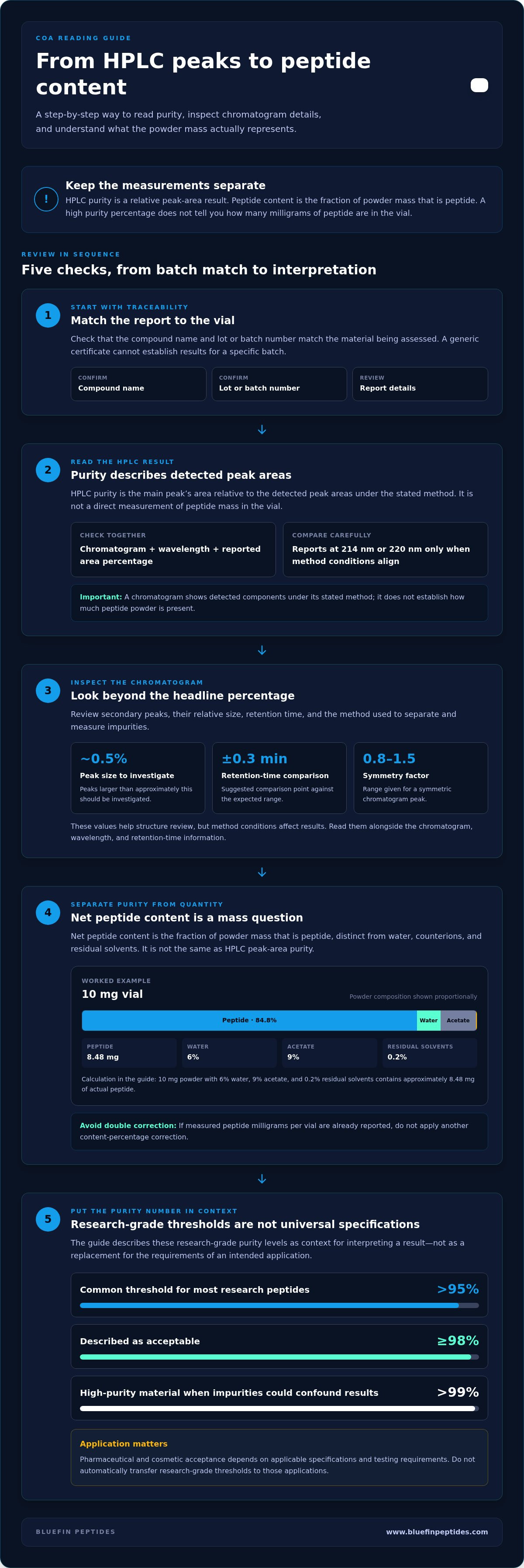
Inspect the chromatogram, wavelength, and reported area percentage together. HPLC purity is the main peak’s area relative to detected peak areas, under the stated method conditions. A report may show peptide purity at 214 nm or 220 nm, so compare results only when method conditions align. Note secondary peaks, their relative size, and whether the document reports retention time. A retention time within ±0.3 minutes of the expected range is suggested as a comparison point.
-
Review Impurities And Testing Methods
Identify every visible impurity peak and the method used to separate and measure it. Peaks larger than approximately 0.5% should be investigated, rather than hidden by the headline purity percentage. A symmetry factor of 0.8-1.5 is given as an acceptable range for a symmetric chromatogram peak. These values help structure review, but method conditions affect the result; use the reported wavelength, retention time, and chromatogram to understand what was measured.
- Separate chromatographic purity from net peptide content before interpreting a vial label. Purity is an area percentage of detected peaks. Net peptide content is the fraction of powder mass that is peptide, distinct from water, counterions, and residual solvents. For example, a 10 mg vial containing 6% water, 9% acetate, and 0.2% residual solvents has approximately 8.48 mg of actual peptide in the guide’s calculation. If measured peptide milligrams per vial are already reported, don’t apply another content-percentage correction.
- Use research-grade purity thresholds as context, not as a substitute for the intended application’s specification. The guide identifies >95% as a common threshold for most research peptides, ≥98% as acceptable, and >99% as high-purity material when impurities could confound results. Pharmaceutical and cosmetic acceptance depends on their applicable specifications and testing requirements; research-grade thresholds should not be transferred automatically.
To assess ISO/IEC 17025 accreditation, compare the laboratory’s name and documented accreditation scope with the testing performed. The International Organization for Standardization identifies ISO/IEC 17025:2017 accreditation as a useful signal of independently assessed laboratory competence. For traceability, retain the COA, method details, measured results, and batch number together. When comparing research materials, review research peptide documentation alongside each batch’s stated results.
Should a COA include endotoxin or bioburden testing?
A peptide COA typically identifies the compound and batch, gives a report date, and presents test methods and results. Depending on the tests performed, it may also report water, counterion, endotoxin, bioburden, or residual solvents.
- Match each reported test to the material’s intended research use. Endotoxin results may be expressed in EU/mg or EU per vial, so confirm the unit before comparing values. The guide lists less than 5 EU/mg as a typical research-grade threshold, less than 10 EU/mg as acceptable for cell culture, and below 1 EU/mg for in vivo peptide use. These are use-specific reference points, not interchangeable specifications.
- Read endotoxin and bioburden as distinct tests, not synonyms. Endotoxin testing measures bacterial endotoxin; a bioburden test assesses microbial contamination. Neither result can stand in for the other. First identify the intended application, then check which test was conducted, the stated method, and the reported result. If endotoxin testing is missing, record it as not reported rather than assuming a low result from a purity percentage.
- Review the report’s additional composition results. Water content may be measured by Karl Fischer titration, while counterion and residual-solvent results address other components of the sample. The guide gives less than 0.5% as a residual-solvent reference and points to ICH Q3C. A COA may report trifluoroacetate (TFA) content separately; the worked example gives 6.1%. These measurements add detail beyond chromatographic purity.
- Check the method and units beside each numerical result. For endotoxin, compare EU/mg with EU per vial only after accounting for the stated basis, since they describe different quantities. For water, counterion, and solvent results, note whether the values are percentages or another unit. A blank field means no result is reported. It does not establish that the result is zero, below a threshold, or covered by another assay.
- Decide whether the listed test panel answers the question your experiment poses. A COA reports only the tests it names, and its findings apply to the stated sample and batch. For example, a document showing HPLC purity without endotoxin data cannot establish an endotoxin level. Treat each result as evidence for its specific measurement, and record which tests fall outside the report’s stated scope.
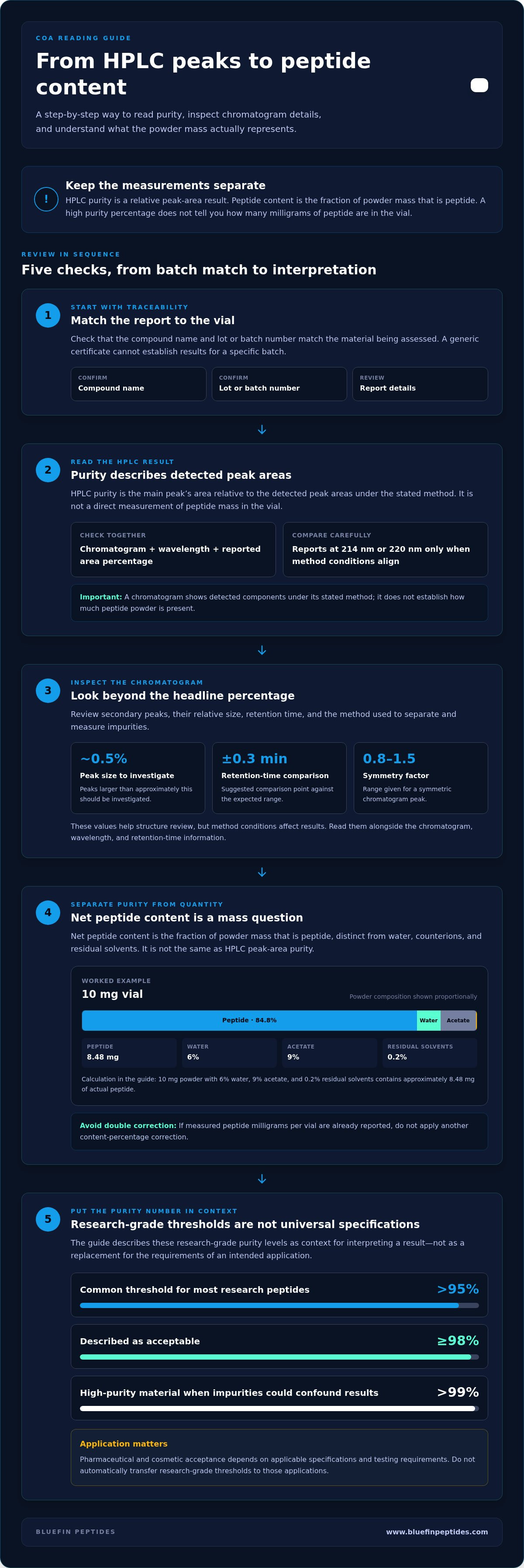
Matching a COA to the material and batch
Start with the identifiers that link the Certificate of Analysis to the material. A test result matters only when the compound name, batch details, sample identifier, and report date align.
- Compare the vial’s lot or batch number with the COA character by character. They must match exactly. Check letters, digits, hyphens, and leading zeros; even a near match is a mismatch. Do not substitute an order reference or report number for the lot number. This direct comparison is a practical first step in how to read a peptide certificate of analysis for a specific vial.
- Match the compound name on the container to the name on the report. Read the full name, including any stated peptide sequence or blend components, rather than relying on a shortened label. If the COA names one material but the vial identifies another, the document does not establish results for that vial. Record both names together.
- Locate the sample identifier and determine how it relates to the vial’s batch number. A laboratory sample ID may differ from a manufacturer’s lot code, so compare the document’s identifiers and any stated relationship between them. Do not assume an unrelated number is a match. Record the sample identifier beside the lot number to keep the path from received material to tested sample traceable.
- Read the report date alongside the batch and sample details. It tells you when the analysis was reported, but it does not replace a matching lot number. Check that the date belongs to the COA for the material under review, then keep it with the identifier record. If the document lists several dates, distinguish the analysis date from any separate issue or print date.
- Check the full set of identifiers before interpreting individual results: compound name, lot or batch number, sample identifier, and report date. Each field has a specific role. The batch number ties the vial to the lot; the sample identifier connects that lot to the laboratory sample; the date locates the reported analysis. A missing field does not prove a match, so do not infer it from another identifier. This sequence provides a repeatable approach to how to read a peptide certificate of analysis across batches.
- Keep a simple comparison record for each material received. Transcribe the vial label and COA identifiers exactly, then note whether each field matches. This creates a clear record for reviewing results such as mass spectrometry or HPLC findings. It also helps prevent results from being carried over accidentally when multiple compounds or batches are handled in the same laboratory workflow.
Distinguishing batch-specific reports from generic certificates
- Confirm that the document reports results for the lot you received. A peptide COA is a lot-specific record, so data from another batch do not establish test results for your material. Compare the report’s lot number with the vial label, then check that the compound name and sample details correspond. A familiar compound name or expected HPLC purity percentage alone cannot link a generic document to the actual batch.
- Look for labels that indicate a template rather than a completed analysis. A report marked “sample,” “example,” or “not a valid lab report” cannot establish that the shipped batch was tested. Similarly, a product specification sheet may describe expected characteristics, but it does not document observed results for a particular lot. Distinguish these general descriptions from laboratory data tied to the material received.
- Review the report for batch-level evidence, including a lot or batch number, sample identifier, testing laboratory, and reported results. In a 2022 audit of peptide COAs from 47 suppliers, 23% lacked essential data elements such as batch numbers or mass-spectrometry spectra. This finding makes the distinction practical: if the document lacks a batch identifier, you cannot match its results reliably to the vial.
- Trace any reissued certificate to its testing source. A reseller that reissues a COA should identify the testing laboratory and refer to the original manufacturer’s certificate. Compare the referenced report’s compound and lot information with the reissued document and vial. If the documents show different identifiers or results, they are not consistent records for one batch. Keep the original reference and reissued copy together for traceability.
- Assess the results only after confirming the report is batch-specific. HPLC purity, identity findings, and other reported tests describe the tested sample, not every batch of the same research peptide. A generic percentage may state an expected specification, while a batch report records measured findings. Keep that distinction clear when reviewing a COA: specific, traceable results help assess the vial; general claims do not replace them.
- Use a simple decision rule: if the report’s lot number does not match the vial, or the document is labeled as an example, do not treat it as proof that your batch was tested. For materials with batch documentation, review available peptide records as part of your assessment.
Bluefin Peptides: Retatrutide Research Peptide
Bluefin Peptides offers Retatrutide Research Peptide for laboratory research use, with batch documentation to support review of the material. Its peptides are ≥99% HPLC-verified, with mass-spectrometry confirmation and batch COAs. Apply the same checks outlined above: compare the COA’s batch identifier with the vial, then review the reported identity and purity results. The certificate documents testing; it does not authorize use in people or animals.
For researchers selecting material for a laboratory project, Bluefin Peptides also offers Tirzepatide Research Peptide and research blends. Review the relevant product and its batch documentation as part of your assessment.
Visit Bluefin Peptides to explore its research peptide offerings.
Carry Your COA Review Into the Next Research Decision
Make this review a consistent part of laboratory recordkeeping. A clear record helps your team connect material selection with experimental planning and interpret results in light of the specific research conditions used. Keep the criteria visible in your workflow so future decisions rely on documented evidence rather than assumptions.
A careful approach to how to read a peptide certificate of analysis supports more deliberate material selection. Bluefin Peptides offers Retatrutide Research Peptide, Tirzepatide Research Peptide, and BPC-157 / TB-500 Research Blend for laboratory research use. Review these offerings in light of your research requirements and the documentation relevant to your work.
Contact Bluefin Peptides to discuss research peptide options. A disciplined review process gives your next decision a clearer foundation.
Frequently Asked Questions
How do I confirm a COA belongs to the specific vial I have?
Compare the vial’s lot number with the lot or batch identifier on the COA, character by character. Then check that the compound name and any sample identifier correspond to that material. For example, a matching peptide name with a different lot number does not link the report to your vial. Keep the vial label and matching document identifiers together for later review.
How do I know if a COA is real or fake?
No single visual feature proves that a COA is authentic. Check whether it names a testing laboratory, reports identifiable results, and refers to a specific batch rather than presenting a generic example. A document marked “sample,” “example,” or “not a valid lab report” does not establish that a purchased batch was tested. If a reseller reissues a COA, the report should identify the laboratory and refer to the original manufacturer’s certificate.
How do I read a CoA for chemicals or research reagents?
First identify the reagent, its batch, and the report’s stated testing methods. Then interpret each result according to its unit and method, rather than comparing unlike measurements. For example, an assay percentage and a water-content percentage describe different properties. Record which tests were performed and treat blank fields as not reported. A COA supports assessment only of the material, batch, and tests it identifies.
How often should I verify my supplier’s COA with independent testing?
For a new supplier, the guide recommends independently verifying the first 3 batches. For an established supplier, it describes spot-checking 1 in 10 batches or every 3 months, whichever comes first. For GMP- or in vivo-grade peptides, it recommends independent verification of 1 in 5 batches. These are suggested verification schedules; apply the approach that fits your study’s risk and material requirements.
How recent should the COA testing date be?
Prefer COA testing dated within the last 12 months. An analysis date older than 6 months is a reason for review, while a manufacturing date older than 12 months is flagged as outdated unless retest data are provided. Check which date the document shows: analysis, manufacture, and report issue dates refer to different events. A recent report also cannot document changes after testing during later storage or shipping.
If a field like molecular formula or CAS number is missing from the COA, what should I assume?
Treat the field as not reported; do not infer a molecular formula or CAS number from the product name or another document. A missing identifier does not establish the material’s identity. Use the identifiers and test results the COA actually presents, and note the omission in your records. When reported for the relevant material, mass-spectrometry data can support identity assessment.
What Is a Certificate of Analysis (COA)?
A Certificate of Analysis reports analytical results for an identified material or batch. It typically records the compound or reagent, batch details, tests performed, methods, and measured results. Its scope is limited to the listed tests and the sample represented by the report. A COA does not establish the outcome of unlisted tests or account for changes that may occur after testing.
What are endotoxin units (EU/mg) on a COA?
EU/mg means endotoxin units per milligram of tested material. It expresses the reported endotoxin result relative to the sample’s mass, not as a purity percentage or peptide-content measurement. Check that the COA reports EU/mg, not EU per vial, before comparing results. These units use different bases. The result applies to the stated sample and test, so interpret it alongside the method and intended research use.
For laboratory research use only. Not for human or veterinary use. This content is educational and does not constitute medical, dosing, or usage guidance.
Browse the BLUEFIN catalog