How to Qualify Domestic and International Peptide Sources
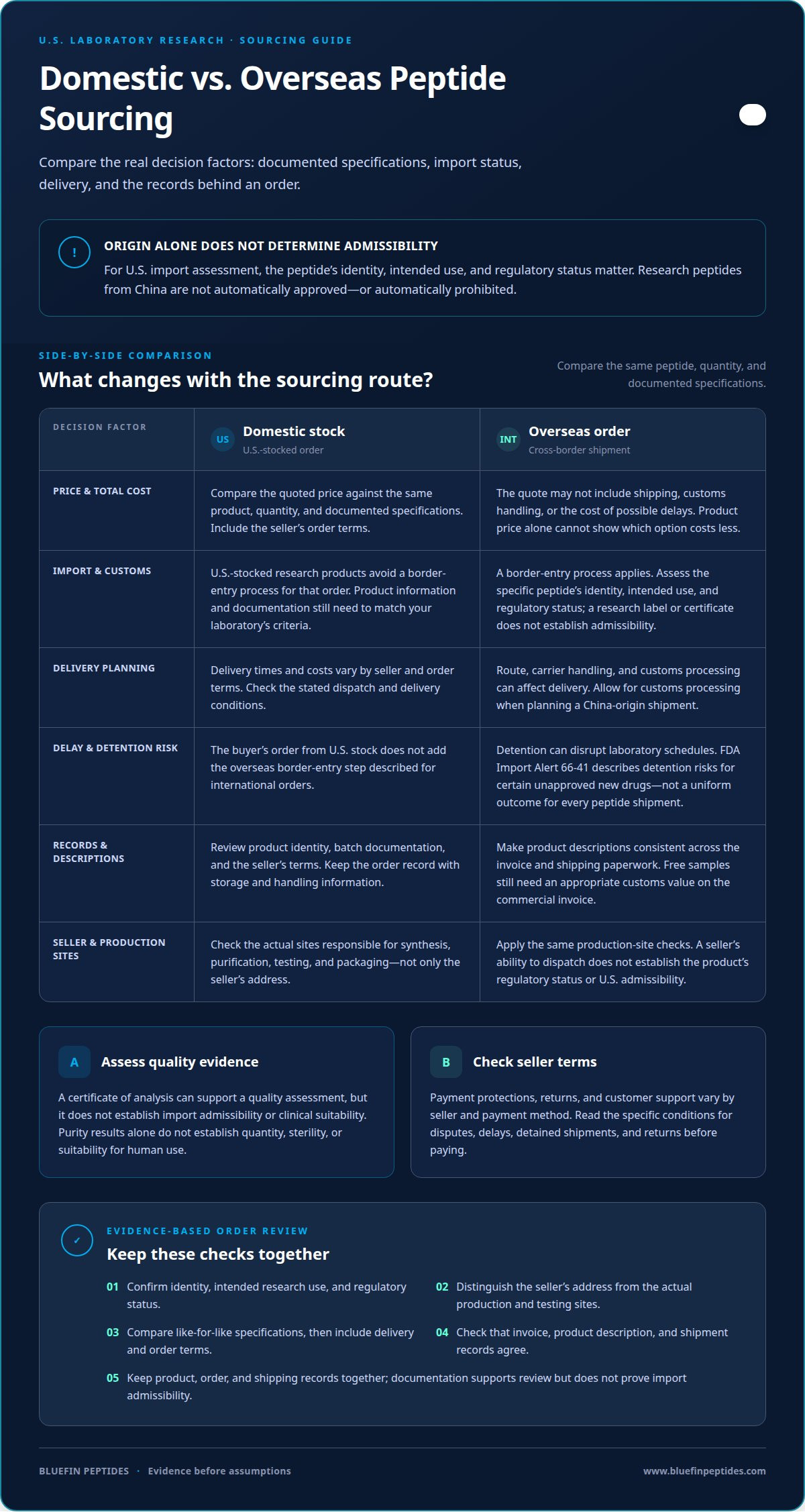
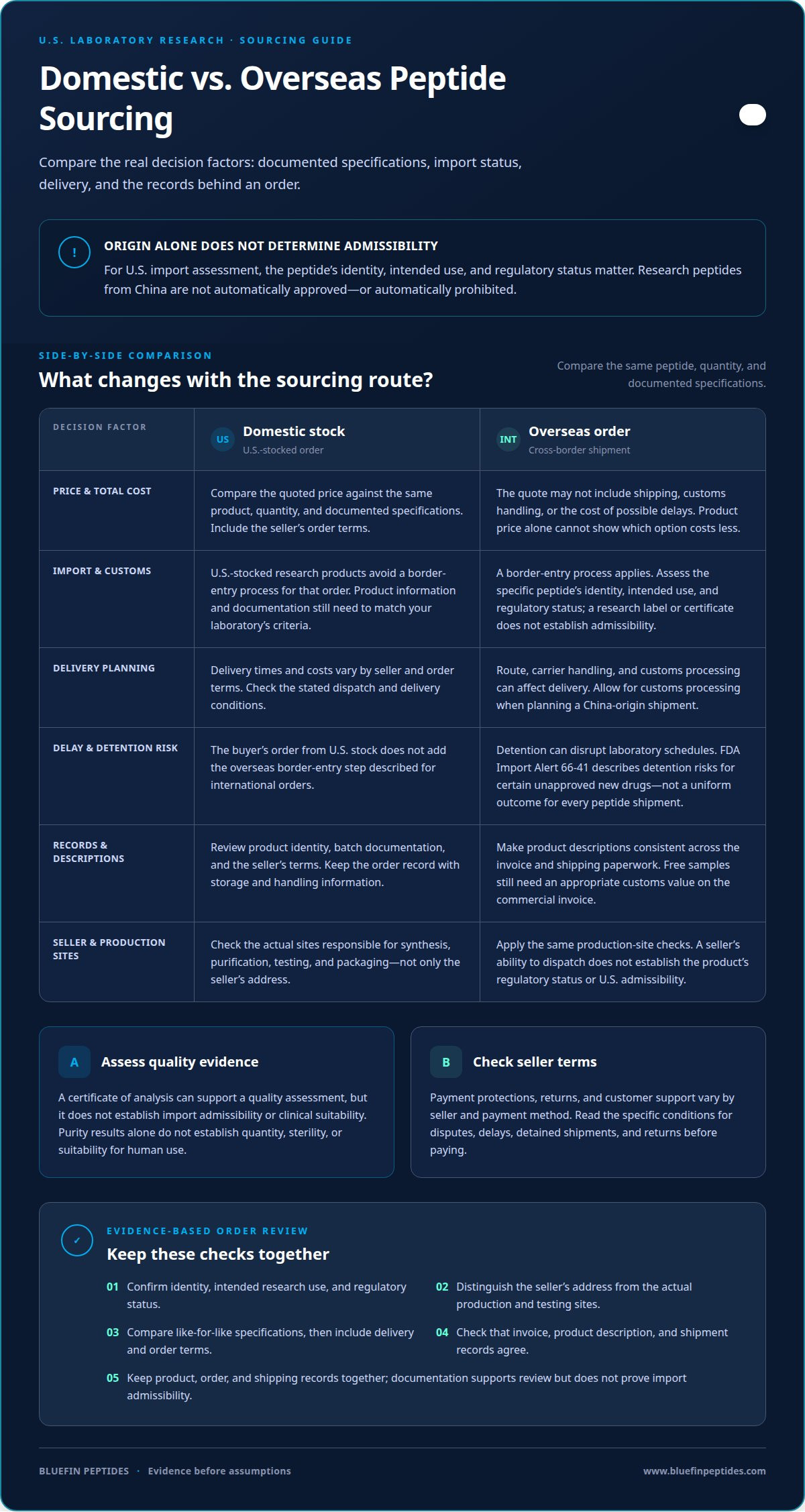
A supplier’s location alone does not determine whether a peptide can enter the United States. Import admissibility depends on the peptide’s identity, intended use, and regulatory status, so research peptides from China are not automatically approved. The domestic vs international peptide sourcing decision starts with these factors, not geography.
It is reasonable to weigh documentation, manufacturing transparency, and shipping risks alongside origin. A certificate of analysis can support a quality assessment, but it does not establish import admissibility or clinical suitability.
This guide explains how to assess U.S. import considerations, distinguish a seller’s address from the production site, and evaluate manufacturer qualifications and batch documentation. It also covers where domestic sourcing can simplify logistics, where international sourcing may add regulatory and transport considerations, and how to assess a source using evidence rather than claims. The aim is a clear, defensible sourcing decision for laboratory research.
Key Takeaways
- Assess import eligibility by the peptide’s identity, intended use, and regulatory status rather than assuming all research peptides face the same rules.
- Separate the seller’s address from the actual sites responsible for synthesis, purification, testing, and packaging.
- Use batch documentation to assess product quality, while recognizing that purity results alone do not establish quantity, sterility, or suitability for human use.
- Review destination-country restrictions before traveling with peptides, since import rules vary and some countries impose specific requirements.
- For U.S.-stocked research peptides, compare Bluefin Peptides’ batch-level documentation and product information with your laboratory’s sourcing criteria.
Can you legally import peptides from China?
Importing a peptide from China is not automatically lawful or prohibited. U.S. admissibility depends on the peptide’s identity, intended use, and regulatory status.
-
Compare Domestic and Overseas Prices
Compare the same peptide, quantity, and documented specifications before weighing prices. Overseas quotes may exclude shipping, customs handling, or possible delays, so the initial product price alone does not show which option costs less. Prices vary by supplier and order terms, with no reliable universal domestic-versus-overseas comparison. Include delivery charges and the seller’s payment, return, and support terms in your evaluation.
-
Check Import Duties and Requirements
Establish the peptide’s identity, intended use, and regulatory status before arranging a U.S. import. These factors affect whether a shipment is admissible; Chinese research peptides are not approved as a class. No single duty amount applies to every peptide shipment based only on its country of origin. Confirm the customs treatment for the specific product and shipment rather than assuming a general rate.
FDA Import Alert 66-41 describes detention risks for unapproved new drugs entering the United States. A certificate or research label does not by itself establish that a shipment can enter. Free samples also require an appropriate customs value on the commercial invoice. Accurate product descriptions and declared values matter; do not treat a sample as having no customs value.
-
Assess Customs Detention Risks
Evaluate the possibility of detention before choosing an international order. FDA Import Alert 66-41 identifies a risk for certain unapproved new drugs, but it does not mean every peptide shipment receives the same treatment. The peptide’s identity, stated purpose, and regulatory status remain central to the assessment. A shipment held at customs can disrupt laboratory schedules, even when the order’s product documentation appears complete.
- Compare shipping expectations with the seller’s stated dispatch and delivery terms. Domestic and international delivery times vary by route, carrier handling, and customs processing, so no single timeline applies to every order. Shipping costs also depend on the order and its terms. For a China-origin shipment, allow for customs processing when planning research timelines instead of relying only on an estimated transit window.
- Review payment protections, return conditions, and customer support before paying. These vary by seller and payment method; there is no universal policy for domestic or international peptide purchases. Read the specific terms for disputes, delayed or detained shipments, and returns. A clear process for resolving issues matters when an overseas order encounters customs delays.
- Keep the order record and shipping documents together. Ensure the commercial invoice matches the shipment contents, including an appropriate declared value for free samples. For laboratory planning, record the product identity and intended use alongside its storage and handling requirements. These records can help distinguish a customs delay from a product or fulfillment issue, but they do not prove import admissibility.
International peptide import regulations
Import planning requires coordinated product, use, and shipment records. Treat domestic vs international peptide sourcing as a compliance and logistics decision, not simply a comparison of supplier locations.
- Define the material before requesting import processing. Record its identity, physical form, and intended research use. Keep the product description consistent across the purchase record, invoice, and shipping paperwork. For example, an invoice naming a specific peptide should not describe the contents only as laboratory supplies. Clear descriptions help the importer and broker work from the same information.
- Keep quality-system documents separate from import documents. GMP documentation can matter when a peptide is a drug substance or enters regulated manufacturing, but it is not a universal import certificate for every research chemical. Treat it as evidence about the production context, not as general shipment authorization or a substitute for customs-entry information.
- Assign importer and broker responsibilities before dispatch. The importer supplies accurate product, value, origin, and intended-use information. The customs broker uses those details to prepare the entry and identify information needed for processing. Keep written records of the information provided and any follow-up. A broker’s role in preparing an entry does not change the peptide’s identity or regulatory status.
- Reconcile the invoice, packaging description, and shipment record. Each should identify the contents consistently and accurately. Free samples still require an appropriate customs value on the commercial invoice. Avoid descriptions that obscure the material or conflict with product documentation. Consistent records support screening and reduce avoidable questions, but do not establish that a shipment is admissible.
- Review restrictions for the specific peptide and route before shipment. Import rules depend on identity, intended use, and regulatory status, so a supplier’s ability to dispatch does not establish U.S. admissibility. With domestic vs international peptide sourcing, an overseas order adds a border-entry process that domestic stock does not. Factor this into procurement timelines and research plans.
- Maintain a shipment file that connects each record to the order. Include the product description, invoice, intended-use information, and broker correspondence. If customs requests clarification, a traceable file helps the importer respond consistently. Keep analytical records separate from entry records: a batch analysis reports specified testing, while customs paperwork describes the shipment. For U.S.-stocked research materials, the research peptide catalog offers a domestic sourcing option.
Keep supporting material organized, separating production evidence from records used to describe and process the shipment. GMP documentation can matter when a peptide is a drug substance or enters regulated manufacturing, but it is not a universal import certificate for every research chemical. Match quality records to the product and its stated use, rather than treating them as a substitute for accurate shipment details. Keeping these purposes distinct helps maintain clear, consistent documentation during import preparation.
Country-specific import restrictions
Rules differ by destination, and a U.S. allowance does not transfer abroad. Use these steps before traveling with peptide medication or arranging an international shipment.
- Identify the destination country and the peptide’s precise status before departure. Some countries restrict peptide imports, and requirements can distinguish personal medication from research materials. Do not assume a product allowed in the United States is permitted elsewhere. BPC-157 is not FDA-approved in the United States, and destination-country laws vary. That makes country-specific review essential before packing or shipping it.
- Review the destination’s personal-use supply limits and documentation rules. Travelers are advised to carry no more than a personal-use medicine supply, typically 30 to 90 days depending on the country. Australia’s personal importation guidance allows up to a 3-month supply with a prescription or doctor’s letter. These amounts concern personal medication, not a general allowance for research peptide shipments.
- For Australia, account for strict biosecurity rules and declare biologicals when entering. Keep relevant documentation accessible, including a prescription or doctor’s letter when applicable personal-import guidance calls for it. A product label does not replace destination-country requirements. Separate the medication from unrelated luggage items so it can be presented clearly if customs officers ask about it.
- For travel within the United States, distinguish personal medication guidance from research use. Check applicable requirements before traveling with peptide medication, and keep relevant documentation available in case questions arise. TSA permits medically necessary liquid medications in containers larger than 3.4 oz when declared at the checkpoint. Unused syringes are permitted in carry-on bags when accompanying the injectable medication they administer.
- Plan storage and transport around the formulation and route. Storage conditions depend on the formulation, so check the product-specific guidance before travel. Carrying medication in hand luggage helps keep it accessible during the journey. Use a suitable cooler for temperature-sensitive material, and keep its contents organized with the medication documentation. Travel conditions do not override import restrictions.
- Recheck the rules for every country on a multi-stop itinerary, including transit destinations. A peptide permitted at departure may face different restrictions at arrival or in transit. Keep the product name, intended use, supply amount, and supporting documentation consistent. If a destination’s rules are strict or unclear, do not assume another country’s allowance permits carrying or importing the same material.
Manufacturer and production-site qualification
Verify identity and purity using batch-specific testing records, not seller claims alone. A useful certificate of analysis identifies the peptide and lot, and lists specifications, methods, results, and approval.
- Map the production chain before assessing the seller. Synthesis, purification, testing, and packaging may take place at different facilities or in different countries. A seller’s address therefore does not establish the peptide’s manufacturing origin. Record each facility’s role and location to trace the documented chain from synthesis through release.
- Match the certificate of analysis to the specific batch under review. Confirm that it names the peptide and lot and provides applicable specifications, methods, results, and approval. A generic report without a matching lot cannot demonstrate results for the shipment being assessed. Keep the batch record with the order and related storage documentation.
- Interpret purity results within their analytical limits. Purity alone does not establish quantity, sterility, suitability for human use, or the absence of every relevant impurity. Assess the stated method and reported result together. Neither a purity figure nor a test label answers every quality question. For injectable medication, research-use documentation does not establish clinical suitability.
- Keep establishment registration distinct from product approval in your records. FDA establishment registration is not product approval, so it cannot substitute for batch-specific results or establish that a peptide is approved for a particular use. Likewise, a certificate of analysis describes specified testing but does not establish import admissibility or clinical suitability.
- Request material-specific support for storage and transport conditions. Lyophilization does not establish a standard shipping temperature for every peptide; appropriate conditions need support for the specific material. A temperature logger records shipment conditions, while an active response plan identifies who can intervene if transit stalls. Keep these records with the batch’s stability information.
- Assess stability separately for the material’s physical state and intended storage period. Reconstituted peptides and dry material may have different handling requirements, so do not automatically transfer one condition to the other. Compare documented storage instructions with the shipment record and planned destination. For injectable medication, do not treat research documentation as administration guidance.
For each shipment, distinguish every production site from the seller’s contact details. Record which facility performed synthesis, purification, testing, and packaging rather than assigning every stage to the seller by default. If a stage’s location is undocumented, leave it unverified instead of inferring it from a sales address. Compare the stated facility roles across batch records, and note gaps or mismatches for clarification before relying on the production history. This helps show whether the documented chain covers the material’s movement through each stated stage. A clear account connects the peptide to the facilities responsible for its manufacture without treating a commercial address as evidence of manufacturing origin. Keep site information with the batch-specific records so the production chain can be reviewed alongside the results for the material.
Risks of buying replacement peptides abroad
When evaluating replacement material, look beyond the supplier’s quoted purity. A new batch can differ in documentation, transport history, and import status.
- Compare the replacement’s identity and lot records before treating it as equivalent. A familiar peptide name does not establish that materials from different suppliers match in specifications or testing. Compare the stated identity, lot-specific results, and applicable specification. If records describe different methods or specifications, reported purity figures may not be directly comparable.
- Interpret a certificate of analysis within its limits. A CoA can report purity results, but purity alone does not establish quantity, sterility, suitability for human use, or the absence of every relevant impurity. Nor does it establish that a shipment is admissible for import. Assess each question separately when evaluating an overseas replacement.
- Trace transport conditions for the specific material. Lyophilization does not establish a standard shipping temperature for all peptides; conditions need support for the peptide being shipped. A temperature logger records shipment conditions, while an active response plan identifies who can intervene if transit stalls. Without shipment records, the absence of a logger does not establish a particular temperature history.
- Separate quality records from import and use status. A batch report addresses specified analyses; it does not prove that U.S. customs will admit the shipment or that the material is suitable for clinical use. FDA Import Alert 66-41 describes detention risks for unapproved new drugs entering the United States. A replacement order can therefore face entry issues despite having analytical paperwork.
- Plan international travel around destination restrictions, not only departure rules. Some countries restrict peptide imports, and requirements vary by destination. A prescription or doctor’s letter may help address customs questions about medication, but documentation does not make every peptide permissible in every country. Consider sourcing at the destination rather than carrying an uncertain supply across borders.
- Keep replacement decisions tied to the intended purpose. Research documentation does not establish approved clinical use, and a purity statement does not supply administration instructions. If a shipment is delayed, detained, or lacks batch-level records, do not treat its arrival as proof of identity or quality. For a U.S.-stocked research sourcing option, review research peptide options and their available product documentation.
Bluefin Peptides
Bluefin Peptides gives U.S. laboratory buyers a domestic sourcing option with batch-level quality documentation. Its catalog includes Retatrutide Research Peptide, Tirzepatide Research Peptide, BPC-157 / TB-500 Research Blend, and Ipamorelin / CJC-1295 Research Blend. Peptides are ≥99% HPLC-verified, with mass-spec confirmation and batch certificates of analysis.
Bluefin Peptides stocks research peptides in the United States and ships orders after purchase. Review available product and batch information against your research requirements, and assess import rules separately for any international source. Bluefin Peptides’ offerings are for laboratory research, not human use or medical treatment. Contact Bluefin Peptides to discuss your research sourcing needs.
Make sourcing criteria part of your next study
Turn your sourcing decision into a repeatable procurement standard. Define the records your laboratory needs before ordering, how to document exceptions, and who approves a source for a specific research use. This makes domestic vs international peptide sourcing a deliberate qualification decision rather than a last-minute logistics choice. It also gives your team a consistent basis for evaluating future orders as research needs change.
Keep the standard practical. Separate requirements that apply to every order from those triggered by international shipment, and retain the rationale with the purchasing record. A clear process supports continuity across projects without treating a supplier’s location as a substitute for product-specific assessment.
For U.S.-stocked research peptides, Bluefin Peptides can be a domestic sourcing option to consider alongside your laboratory’s criteria. Contact Bluefin Peptides for sourcing help and identify the research materials relevant to your work. A disciplined sourcing process gives your next study a stronger starting point.
Frequently Asked Questions
What are the main differences between domestic and international peptide suppliers?
Domestic and international suppliers differ mainly in shipping routes, border procedures, and how sourcing fits your laboratory’s purchasing process. A U.S.-stocked order avoids an international entry step, while an overseas order may involve extra transit and customs handling. Neither location alone establishes product quality. For example, a laboratory replacing a delayed reagent can weigh route complexity alongside batch documentation and its project schedule.
What are the risks of counterfeit, contaminated, or mislabeled peptides from overseas sources?
Risks include receiving material whose identity or contents do not match its label, or contamination not captured by the available test results. A certificate or purity result cannot rule out every problem. Treat discrepancies as a stop signal: if the vial label, lot record, and order description conflict, segregate the material and exclude it from experiments until the identity issue is resolved. Do not infer authenticity from packaging alone.
What steps can U.S. buyers take to assess a peptide supplier before ordering?
Set acceptance criteria before purchase: required identity documentation, batch traceability, intended research use, and acceptable shipping records. Then assess whether the supplier’s materials meet those criteria and keep the relevant records with the purchase file. For example, require the lot identifier on both the vial and its associated analysis. Bluefin Peptides also provides a COA lookup for researchers reviewing its batch documentation.
For laboratory research use only. Not for human or veterinary use. This content is educational and does not constitute medical, dosing, or usage guidance.
Browse the BLUEFIN catalog