How to Publish Peptide Research: Sequence and Purity for Researchers
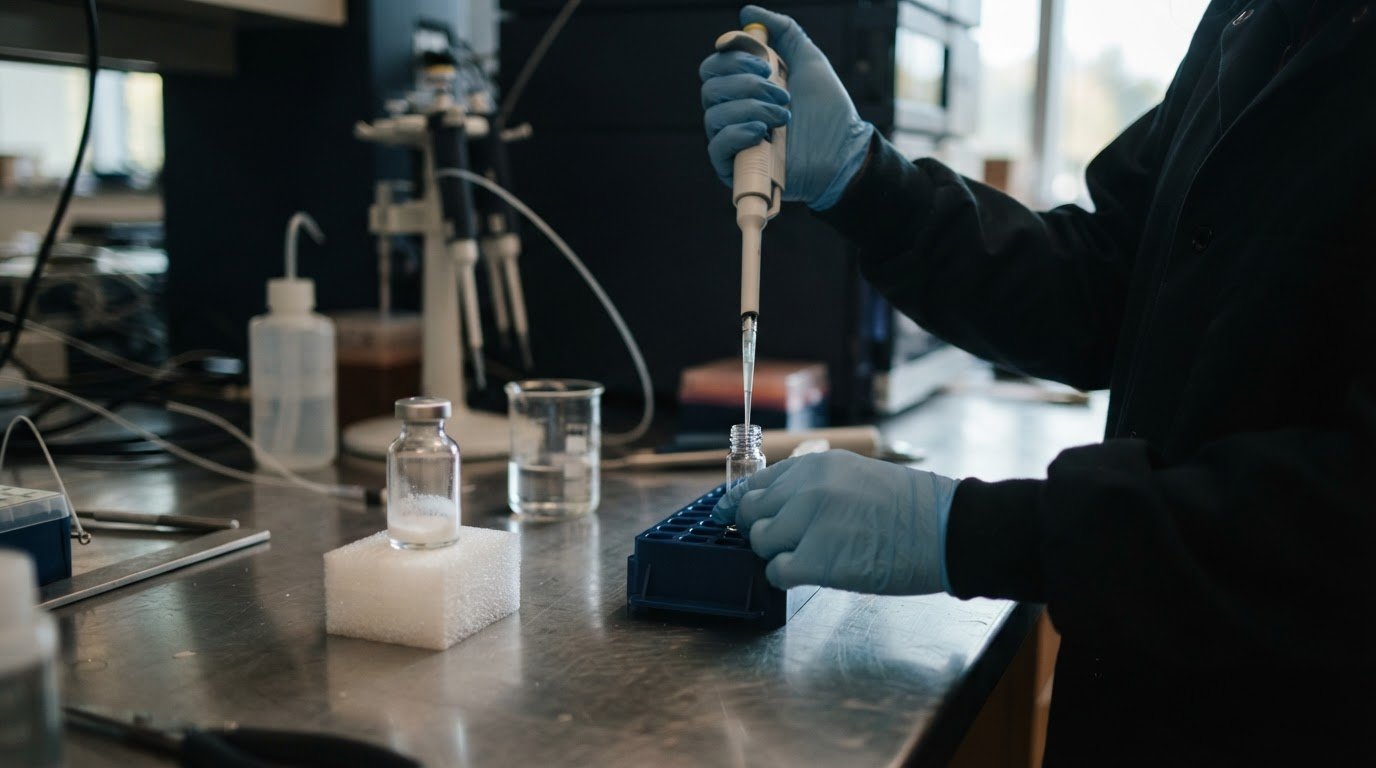
The practical answer to how to publish peptide research is to make the peptide’s identity and analytical quality clear in the manuscript. Report the sequence, relevant modifications, synthesis or sourcing details, and purity evidence in a way that lets readers interpret the work and assess its reproducibility. The appropriate level of detail depends on the peptide and the journal’s requirements.
Sequence length and complexity can affect synthesis, characterization, and the details needed to document the work. A purity value is most useful when readers can see how it was measured and which material the analysis represents. Plan to record these details before submission, not just while writing the methods section.
This guide explains how peptide length and sequence features affect preparation, what purity documentation can show, and how to present analytical information clearly. It also covers aligning the peptide material and supporting records with the study, so the manuscript’s claims stay grounded in evidence.
Key Takeaways
- Organize the manuscript around a reproducible methods description, with the peptide sequence, modifications, and analytical evidence clearly reported.
- Match the journal to the study’s central contribution, then follow its scope, submission format, and author instructions.
- Assess publication and open-access charges as part of journal selection, since the fee structure depends on the journal and publishing model.
- Use reporting guidelines and data-sharing expectations relevant to the study design, and document ethics review where research involves people or animals.
- For laboratory research materials, Bluefin Peptides offers research peptides and blends with HPLC verification, mass-spectrometry confirmation, and batch certificates of analysis.
Steps to Prepare and Submit a Peptide Research Manuscript
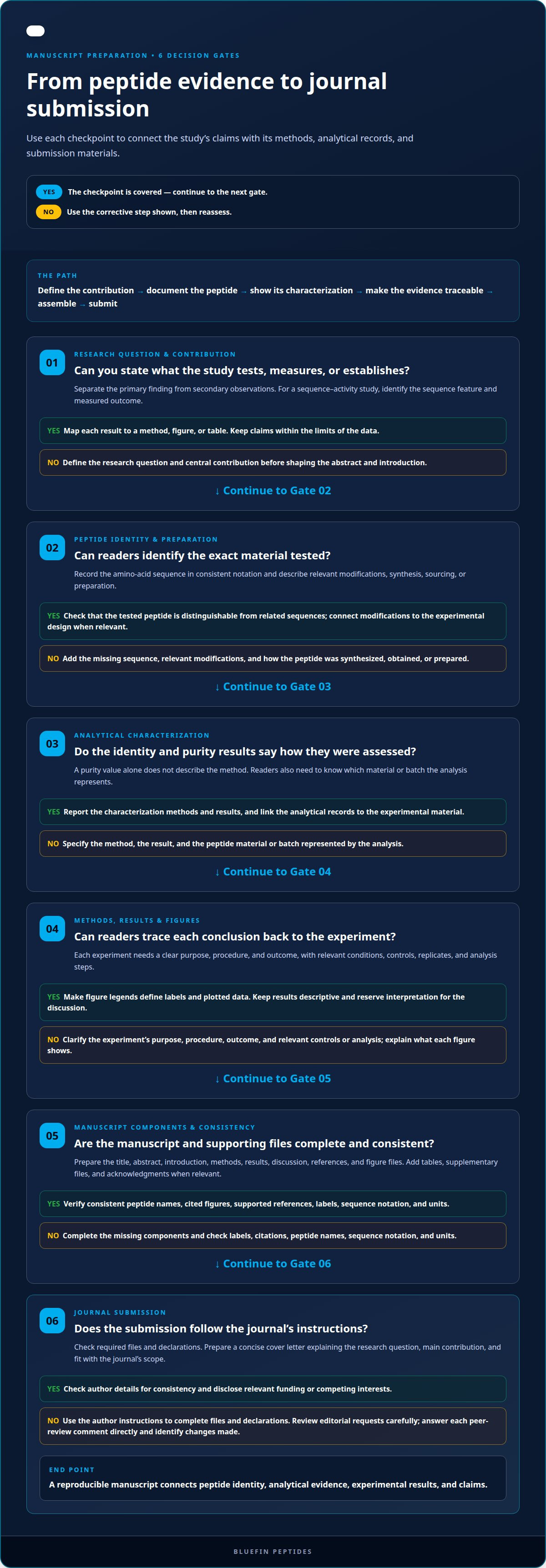
Start with the study’s central claim and supporting evidence. A manuscript about sequence design needs different emphasis from one about biological activity. Map each result to a method, figure, or table, then identify the journal’s article type and submission instructions. This initial alignment connects the research question, evidence, and manuscript structure.
- Define the research question and contribution. State what the study tests, measures, or establishes, and distinguish the primary finding from secondary observations. For a sequence-activity study, identify the sequence feature under investigation and the measured outcome. Build the abstract and introduction around that connection. Keep claims within the limits of the data. A clear scope helps editors assess relevance and guides readers through the evidence.
- Record peptide identity and preparation. Report the amino-acid sequence using consistent notation. Describe relevant modifications, such as terminal changes or nonstandard residues, when present. Explain how the peptide was synthesized, obtained, or prepared for the experiment. Include enough detail to distinguish the tested material from related sequences. For a modified peptide, connect each modification to the experimental design.
- Describe analytical characterization. Identify the methods used to assess identity and purity, report the results, and specify which material or batch they represent. If chromatography or mass spectrometry supports characterization, explain its role. A purity value alone does not describe the method. Link analytical records to the experimental material so readers can interpret the results and reproduce the workflow.
- Organize methods and results together. Give each experiment a clear purpose, procedure, and outcome. Specify relevant conditions, controls, replicates, and analysis steps. In each figure legend, define labels and explain what the plotted data represent. Keep the results section descriptive and reserve interpretation for the discussion. This structure lets readers trace conclusions from the experimental design to the evidence.
- Assemble manuscript components. Prepare the title, abstract, introduction, methods, results, discussion, references, and figure files. Add tables, supplementary files, and acknowledgments when relevant. Use peptide names consistently across the text and figures. Check that every figure is cited and every reference supports the associated statement. In the final edit, look for mismatched labels, sequence notation, and units.
- Submit through the journal’s process. Follow the journal’s author instructions for files and declarations. Write a concise cover letter that explains the research question, main contribution, and fit with the journal’s scope. Enter author details consistently and disclose relevant funding or competing interests. After submission, review editorial requests carefully. For peer-review revisions, answer each comment directly and identify the changes made.
Researchers planning how to publish peptide research can use these steps to connect each claim with its supporting evidence. A practical approach to how to publish peptide research begins with a defined contribution, then carries that clarity through characterization, manuscript preparation, and submission.
Which journals publish peptide research, and how do their scopes and requirements compare?
Choose a journal based on the study’s main contribution. Journal of Peptide Science is a direct fit for peptide chemistry and related biology. Peptides publishes work focused on peptide science, including biological activity. Journal of Medicinal Chemistry may suit studies linking peptide structure with drug discovery. ACS Chemical Biology can fit work connecting chemical tools with biological mechanisms. These journals serve different audiences, so make the match clear in the submission.
First classify the manuscript’s central result. A synthesis or structure study may align with peptide chemistry. A receptor or functional study may suit a biology-focused journal. A design-and-activity paper may interest medicinal chemistry readers. A peptide used to probe a cellular pathway may fit chemical biology. A sequence comparison alone, for example, differs from a study linking sequence changes to a defined biological effect. Choose a journal for the main finding, not simply because “peptide” appears in its scope.
Next, compare the journals’ author instructions. Check accepted article types, manuscript organization, abstract format, figure preparation, reference style, and supplementary-material rules. Requirements can differ even between journals in related fields. See whether the journal expects a structured abstract or specific sections, and review its policies on data availability, author contributions, and competing-interest disclosures. These checks help make the submission ready, but do not determine the scientific strength of the result.
Editorial fit also depends on the depth of evidence. A chemistry journal may expect detailed characterization supporting compound identity. A biological journal may prioritize controls and interpretation of activity. A medicinal chemistry audience may expect a clear rationale linking molecular design with measured outcomes. These are considerations of scope, not universal rules. Read recent articles in the target journal to see how similar work is framed. Use them to assess audience and presentation, not to imitate their claims.
- Peptide chemistry: Consider Journal of Peptide Science for work centered on synthesis, structure, or peptide properties.
- Peptide biology: Consider Peptides when biological function or activity drives the study.
- Medicinal chemistry: Consider Journal of Medicinal Chemistry when peptide design connects to drug discovery.
- Chemical biology: Consider ACS Chemical Biology when peptides support mechanistic or chemical-tool research.
Before submission, compare the journal’s scope statement and current author guidance with the study. Choose the journal whose readers can evaluate the central result, then format the manuscript for its submission process. A technically sound paper can still face an avoidable mismatch if its contribution is framed for another field. Precise positioning gives editors a clear basis for assessing relevance.
What publication fees or open-access charges apply to peptide research journals?
Publication costs depend on the journal and publishing route. A subscription journal may publish an article without an open-access charge to authors. A journal that offers open access may charge an article processing charge, commonly called an APC. Some journals offer both routes. The route determines whether readers can access the published paper freely or through a subscription. Check the journal’s current author information before submission because policies and charges can change.
Distinguish required charges from optional services. An APC is associated with open-access publication. Journal policies may also list fees for items such as excess pages, color figures, or supplementary services, but these are not universal. Do not assume a fee mentioned in an older article applies to a new submission. Check the journal’s official fee schedule and author instructions for the relevant article type.
Compare the available publishing routes before choosing a journal. For a hybrid journal, check whether the article can use the subscription route or an open-access option. For a fully open-access journal, confirm that open publication is its standard model. If the journal provides the details, record the charge, currency, billing conditions, and payment timing. This helps distinguish publication requirements from optional access choices.
Then identify potential funding or institutional support. A university library, research funder, or institutional publishing agreement may cover or reduce an eligible APC. Eligibility can depend on the corresponding author, journal, article type, and agreement terms. Confirm the conditions with the relevant institution before choosing open access. Do not assume an agreement automatically covers the charge. The author’s affiliation and the journal’s participation can affect eligibility.
Read waiver and discount rules just as carefully. Journals set their own eligibility criteria, application steps, and decision timing. If a waiver is available, determine whether authors must apply before submission or acceptance. Keep the decision separate from editorial review. Fee assistance does not change the scientific assessment, and an accepted manuscript must still meet the journal’s publication requirements.
Use this practical comparison before submitting:
- Journal route: Identify subscription, hybrid, or fully open-access publishing.
- Charge type: Separate required charges from optional services.
- Funding: Check institutional agreements and funder conditions.
- Waiver: Review eligibility and application timing.
- Confirmation: Save the current fee policy with submission records.
For example, an author comparing two peptide journals should assess scope first, then compare access routes and fee policies. A lower charge alone does not make a journal a better fit. Match its readership and publication model to the study, and consider the applicable funding conditions. This keeps financial planning connected to the journal decision rather than treating an APC as an isolated figure.
What reporting guidelines and data-sharing requirements apply to peptide studies
There is no single checklist for every peptide study. Choose reporting guidance that matches the design: ARRIVE for animal experiments, CONSORT for clinical trials, STROBE for observational studies, and PRISMA for systematic reviews. These frameworks address study reporting, not peptide chemistry alone. The journal’s instructions determine which items it requires.
Start by identifying the study design: synthesis, analytical characterization, cell experiments, animal work, clinical research, or a review. Then select the relevant reporting framework. A cell-based experiment does not become a clinical trial simply because it studies a biologically active peptide. Do not apply a checklist mechanically. Use relevant items to identify missing methods, outcomes, or study-design details.
Peptide-specific reporting should let readers identify the material and understand its use. Include the sequence, residue notation, and relevant chemical modifications. Describe preparation, storage, and experimental handling where these affect the protocol. Report the analytical methods and results supporting identity or purity. For example, clearly label a tested peptide and its modified analogue in the methods, tables, and figures.
Share data that supports the findings, such as numerical results, analysis scripts, image files, and original analytical outputs. A chromatogram or mass spectrum can document characterization. Define units, sample labels, and experimental groups in tables. Make supplementary files readable and connect each file to a method or result. Remove duplicate files and explain any exclusions from the analysis.
Choose a repository suited to the data. Zenodo, Figshare, and Dryad can host general research datasets. Proteomics datasets may fit repositories associated with ProteomeXchange. Deposit structural coordinates in the Protein Data Bank when the study determines a structure. A journal may instead have its own supplementary-material process. Match the repository to the data and include a persistent record identifier in the manuscript.
FAIR principles provide a useful framework for data management: findable, accessible, interoperable, and reusable. Use descriptive filenames, clear metadata, standard formats, and documented analysis steps. State what data are available, where they are stored, and any access conditions. If data cannot be shared, explain the specific restriction and identify what remains accessible.
Before submission, compare the journal’s policy with the study design and files. Confirm that each figure has underlying data, each repository record is cited, and each checklist corresponds to the manuscript. Keep sequence identifiers consistent across the text and supplements. This final check helps editors assess the evidence and gives other researchers a clearer path to reuse the reported methods.
What ethics approvals are needed for peptide research involving animals or human participants
Ethics review depends on the study design and participants, not the peptide’s name alone. Identify whether the work involves live animals, human participants, identifiable records, or stored specimens. Document the applicable institutional review process. For human research, this process is often called Institutional Review Board review, or IRB review. For animal work, institutions commonly use an Institutional Animal Care and Use Committee, or IACUC.
For studies involving people, describe the review decision accurately. Name the reviewing body, approval status, and protocol identifier when applicable. If the committee determined that review was not required, report that determination and its basis. Do not call a project approved if it received a different determination. For consent-based studies, explain how participants received study information and provided consent, and describe the relevant procedures in the methods.
For peptide administration or exposure, report clear protocol details. Describe the study population, intervention, route, schedule, and monitoring where relevant. Explain how adverse events or participant concerns were recorded. For research using human samples, describe collection, consent conditions, and any limits on sample use. If records or specimens were de-identified, explain their role without implying that de-identification alone determines review status.
Animal studies need the same transparency. Identify the institutional committee and approval details when applicable. Describe the species, experimental procedures, housing conditions, monitoring, and humane endpoints relevant to the work. Explain how the protocol addressed discomfort and how animal welfare was assessed. For a peptide study involving animal dosing, connect the reported procedures to the approved protocol rather than relying on a general ethics statement.
Before submission, compare the ethics statement with the methods and journal instructions. Keep committee names, protocol identifiers, and approval descriptions consistent throughout the manuscript. If the project included human and animal components, report each review pathway separately. For secondary data or previously collected material, state the source and the review determination applicable to that use. Requirements may vary by journal, article type, and study design.
- Classify the work: Identify participants, animals, specimens, and records.
- Record the determination: Name the reviewing body and its decision.
- Describe procedures: Explain consent, intervention, monitoring, or welfare measures.
- Align the manuscript: Match the ethics statement to methods and journal guidance.
For a study combining human samples and animal experiments, document each component separately. One broad statement may obscure different review decisions. Keep supporting records organized with the study files, and describe the work precisely in the manuscript. Clear reporting helps editors understand the ethical oversight for each procedure and population.
Bluefin Peptides
Bluefin Peptides supports laboratory research with peptide materials and batch-level documentation. Its catalog includes Retatrutide Research Peptide, Tirzepatide Research Peptide, BPC-157 / TB-500 Research Blend, and Ipamorelin / CJC-1295 Research Blend. These offerings may suit projects requiring defined research materials; they do not replace study-specific characterization or journal reporting.
All peptides are ≥99% HPLC-verified, with mass-spectrometry confirmation and batch certificates of analysis. Those records can help researchers identify the supplied batch and organize material documentation alongside their experimental methods. Publication decisions still depend on the study design, analytical evidence, and target journal requirements.
For laboratory research materials and supporting batch documentation, contact Bluefin Peptides.
Move From Manuscript Planning to the Next Study
A publication plan can also sharpen the next experiment. Before work begins, define what evidence would support the central claim and how each result will be recorded. Planning ahead helps align research materials, analytical records, and manuscript needs. It also gives collaborators a shared framework for interpreting the work.
For researchers considering how to publish peptide research, the next useful step is to connect publication goals with practical study preparation. Select materials that fit the research question, then maintain clear records of the batch and its use. Bluefin Peptides offers research materials for laboratory use, including Retatrutide Research Peptide, Tirzepatide Research Peptide, and BPC-157 / TB-500 Research Blend.
Clear documentation supports disciplined research, but it does not replace study-specific methods or journal requirements. Keep the next project focused, traceable, and aligned with its intended scientific contribution. For questions about research materials, contact Bluefin Peptides. Take the next step with a defined protocol and a clear record from the beginning.
For laboratory research use only. Not for human or veterinary use. This content is educational and does not constitute medical, dosing, or usage guidance.
Browse the BLUEFIN catalog