How Long Do Reconstituted Peptides Last? A Research Stability Guide
A shelf-life number without its test conditions can create false confidence. If you’re comparing conflicting timelines online, the key question, how long do reconstituted peptides last, has no universal answer. Stability depends on the peptide, formulation, solvent, storage conditions, handling, and the method used to assess degradation.
That variability matters in research. A timeline reported for one compound or set of conditions can’t automatically be applied to another, and changes in peptide integrity may affect experimental reproducibility. Analytical purity and identity data are useful, but they don’t establish how long a reconstituted sample remains stable.
This guide explains why post-reconstitution stability varies and what evidence can support a product-specific conclusion. You’ll learn how to assess whether a reported duration matches the peptide and conditions relevant to your work, and how to document a research-only decision without relying on a universal countdown. Batch COAs and COA lookup help identify and review research material; stability claims still require relevant, validated evidence.
Key Takeaways
- The answer to “how long do reconstituted peptides last” depends on the specific peptide and the conditions being evaluated, not a universal countdown.
- Distinguish possible degradation pathways from confirmed changes in a particular sample.
- Compare evidence for lyophilized material and reconstituted solutions without assuming either state has a fixed shelf life.
- Use a four-step review to match evidence to the material, conditions, measurements, and limits of your research question.
- Use batch documentation and COA lookup to review analytical information, while keeping stability conclusions tied to relevant evidence.
How long do reconstituted peptides last? Why there is no universal answer
There is no single duration that applies to every reconstituted peptide. “Reconstituted” means lyophilized, or freeze-dried, material has been dissolved into a liquid research preparation. Stability depends on the particular peptide and formulation, as well as the conditions and methods used to evaluate it. A duration observed in one study is not automatically a shelf-life limit for another material.
Post-reconstitution stability is specific to the peptide, formulation, and study conditions. That distinction is essential when interpreting online estimates. This guide concerns laboratory research materials only, not human, veterinary, or consumer use.
Why online shelf-life estimates can conflict
Sources may describe different peptide sequences, formulations, solvents, containers, storage conditions, or analytical methods. Even when two pages use the same general label for a peptide, the evidence behind their estimates may not describe identical preparations. Different conditions can produce different observations, so a number detached from its experimental setup has limited value.
Separate an observation from a validated shelf-life limit. An observation reports what was measured in a defined experiment. A validated limit requires evidence relevant to the exact material and conditions, assessed with an appropriate method over the stated period.
Treat numerical durations as claims to verify, not default guidance. A result from one solvent or formulation cannot establish the stability of a different preparation. If a source does not identify the material and test conditions, it cannot support a confident product-specific conclusion.
What a shelf-life statement should actually describe
A useful statement identifies the peptide and formulation under evaluation, rather than relying on a broad category label. It should also describe the storage conditions, observation period, and measurements used to determine whether the material changed. Without those details, readers cannot judge whether the evidence matches their research preparation.
Look for a defined stability-indicating measurement and a clear account of how results were assessed. A general appearance check, for example, is not equivalent to an analytical measurement of chemical integrity. The method must be suitable for detecting the change addressed by the claim. Otherwise, an apparently unchanged sample may not provide enough evidence to establish stability.
Finally, keep three questions separate: chemical stability, sterility, and assay suitability. Evidence that a peptide’s chemical characteristics remained within specified criteria does not, by itself, establish that a preparation is sterile or appropriate for a particular assay. Those conclusions require their own relevant evidence. Read a shelf-life statement only within the scope it supports, not as an all-purpose endorsement of the sample.
What changes after reconstitution: peptide degradation and stability factors
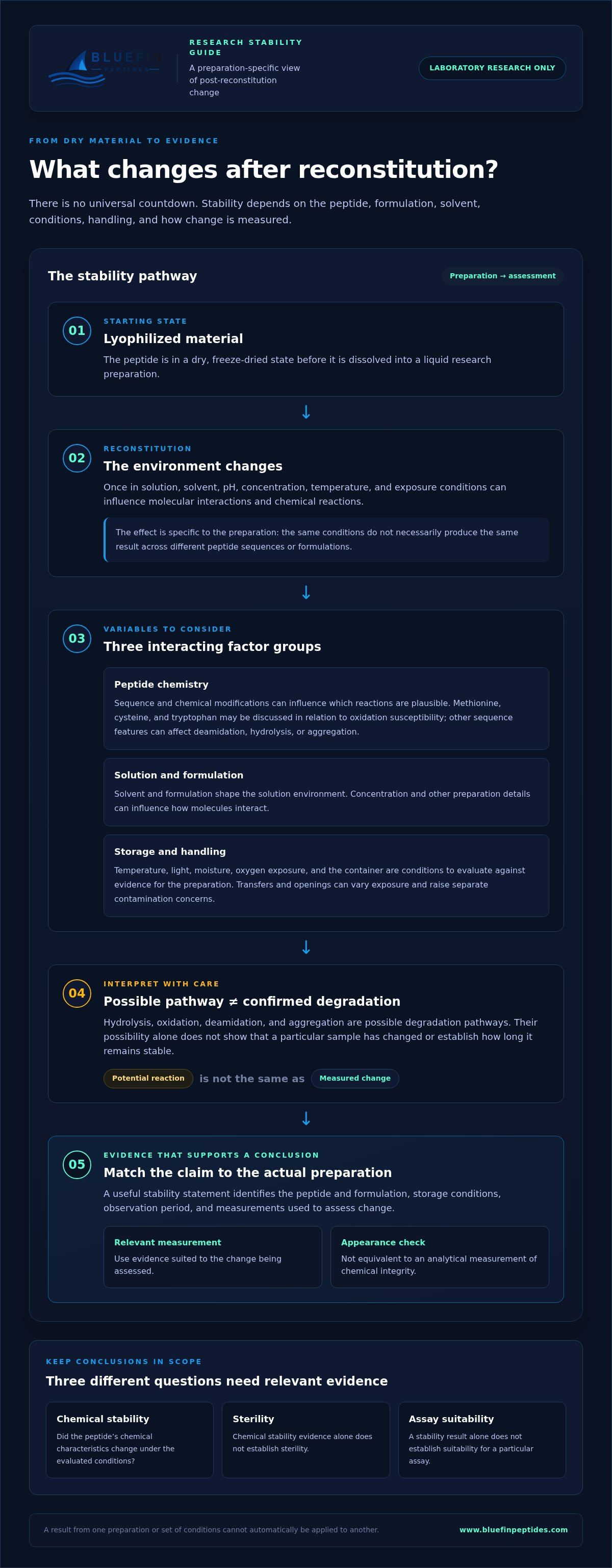
Adding liquid changes a lyophilized peptide’s physical and chemical environment. Molecules that were in a dry state are now in solution, where solvent, pH, concentration, temperature, and exposure conditions can influence molecular interactions and chemical reactions. The effect is preparation-specific. The same conditions do not necessarily produce the same result across different peptide sequences or formulations.
Potential degradation pathways are not the same as a measured loss of stability. Hydrolysis, oxidation, deamidation, and aggregation may occur, but their possibility alone does not prove that a particular sample has degraded or establish a usable duration. Evidence must come from measurements relevant to the material and conditions being assessed.
How peptide chemistry can affect stability
A peptide’s sequence and any chemical modifications can influence which reactions are plausible. For example, residues such as methionine, cysteine, and tryptophan may be discussed in relation to oxidation susceptibility, while other sequence features can affect deamidation, hydrolysis, or interactions that promote aggregation. These are chemical considerations, not predictions of a specific sample’s behavior. Without matching experimental evidence, they cannot establish a degradation rate or shelf-life duration.
Reconstitution also changes the surrounding conditions that shape these reactions. The solvent and formulation may affect the solution’s chemical environment, while concentration and other preparation details may alter how molecules interact. A general statement about a pathway can help guide what to investigate, but it cannot substitute for testing the specific peptide preparation.
Why the storage environment matters
Temperature, light, moisture, and oxygen exposure are variables to evaluate against evidence for the preparation in question. Their effects depend on the peptide, formulation, container, and study setup. A storage recommendation drawn from one set of conditions cannot automatically be transferred to another. Record the actual conditions used in the research workflow so measurements can be interpreted in context.
Handling matters, too. Each transfer or opening can introduce variation in exposure and preparation, and may increase contamination concerns. That is separate from chemical degradation: a chemically altered sample is not necessarily contaminated, and evidence of chemical integrity does not establish sterility. Neither condition proves the other.
Appearance alone is not a stability test. A clear solution or lack of visible particles cannot establish molecular identity, purity, sterility, or performance in an experimental assay. Conversely, a visible change may prompt investigation but does not identify its cause. Use analytical measurements suited to the question, and don’t treat visual inspection as a substitute. When assessing how long do reconstituted peptides last, the answer depends on measured evidence, not appearance or a general list of possible mechanisms.
For qualified laboratory research, research peptide materials can be reviewed alongside the relevant batch documentation. Analytical identity or purity information helps characterize starting material, but does not independently demonstrate stability after reconstitution.
How to judge peptide stability claims across powder and solution conditions
A stability claim only has meaning in the material state and conditions it describes. Lyophilized powder is a dry physical state; reconstitution dissolves that material into a solution and changes its environment. Evidence for powder therefore cannot, by itself, establish how long the same peptide remains stable after reconstitution. The relevant question is not simply how long do reconstituted peptides last, but whether a reported result applies to the specific preparation and conditions under review.
Powder stability versus reconstituted-solution stability
Compare the states directly, then check the evidence behind each claim. A powder-storage result cannot be carried over to solution, and a solution result cannot be assumed to apply to a different formulation. Neither state has a universal duration. Refrigeration or freezing claims also require evidence for the relevant peptide and formulation. Freeze-thaw observations must match the tested conditions, rather than being treated as a rule for every compound.
Lyophilized powder
Evidence needed: Identification of the peptide and formulation, storage conditions, observation period, and analytical endpoint for the dry material.
Limit of generalization: Findings apply to the tested powder conditions; they do not establish stability after dissolution.
Reconstituted solution
Evidence needed: Identification of the peptide, formulation, solvent, storage and handling conditions, observation period, and stability measurement for the solution.
Limit of generalization: Findings do not automatically transfer to another solvent, formulation, storage setup, or peptide.
Freeze-thaw evaluation
Evidence needed: A description of the material state and the specific freeze-thaw conditions assessed, alongside the analytical endpoint.
Limit of generalization: A result under one protocol does not establish the effect of different cycles or conditions.
What a meaningful stability comparison includes
Before relying on a reported result, verify that its evidence identifies the peptide and formulation, describes the conditions, and states what was measured. Confirm that the study evaluated the same material state as the claim: powder data are not solution data. Also distinguish chemical integrity from assay performance and sterility. A result supporting one conclusion does not establish the others.
Purity testing can characterize a sample at the point and under the method tested, but it does not alone prove how the material behaves after reconstitution. A guide to analytical quality standards can help clarify what purity measurements establish and where their scope ends. For a stability comparison, look for evidence that evaluates the relevant material state over stated conditions, not simply a general quality claim.
A research workflow for evaluating post-reconstitution stability evidence
A defensible stability decision begins with a match, not a generic shelf-life estimate. The evidence should describe the same research material and relevant conditions, then support only the conclusions its measurements can sustain. A stability conclusion is only as applicable as the match between its evidence and conditions.
Use this four-step review before adopting a reported duration or setting an internal acceptance threshold:
- Identify the material. Record the peptide identity, batch identifier, formulation, and material state relevant to the planned analysis. Distinguish lyophilized powder from a reconstituted solution, and note formulation details that define the sample under review.
- Match the conditions. Compare the source’s material and study conditions with the research preparation in question. Consider whether formulation, solvent, storage conditions, and observation period align. Mark differences and missing information as evidence gaps instead of filling them with an online estimate.
- Assess the measurements. Determine what the source actually measured and whether that endpoint addresses the claim. A measurement of chemical integrity, for example, does not automatically establish sterility or performance in a particular assay.
- Document limitations. State what the evidence supports, what remains uncertain, and which conditions fall outside its scope. Any proposed acceptance threshold should be justified by the research design and protocol, not borrowed as a universal standard.
Match the evidence to the research material
For each source, capture enough detail to compare its test material with the sample being assessed. If a paper reports stability for a different formulation or material state, record that mismatch plainly. A close match may support a more relevant interpretation, but it still does not justify extending the conclusion beyond the reported conditions. If identity, formulation, or test conditions are missing, preserve that uncertainty in the review.
In laboratory records, document the source, batch identifier, material state, study conditions, and observation date. Add the analytical method and reported time points when available. These fields create a traceable record of how a stability conclusion was reached and help distinguish published evidence from local observations. Keep the record specific enough that another researcher can identify the basis and limits of the decision.
Document analytical endpoints and uncertainty
HPLC purity results and mass-spectrometry identity information can support characterization of research material, but neither alone establishes solution stability over time. Interpret each result within its measurement scope: the method, sample state, reported time points, and conditions. Avoid turning an initial purity or identity result into a claim about later performance without relevant stability evidence.
If the evidence doesn’t answer a key question, record it as unresolved. That is more reproducible than adopting a precise-sounding estimate whose conditions cannot be matched. To review research materials and their batch documentation, access Bluefin Peptides’ research catalog and COA lookup.
Use batch documentation and COA lookup to support peptide research
Batch documentation helps researchers identify and review analytical information associated with research material. A certificate of analysis (COA) can connect a batch identifier to documented test results, supporting traceability in laboratory records. Its scope matters: a batch COA does not, by itself, establish how long a peptide remains stable after reconstitution. That conclusion requires evidence relevant to the peptide, formulation, material state, and study conditions.
What analytical documentation can establish
Bluefin Peptides describes its catalog peptides as at least 99% HPLC-verified, with mass-spectrometry confirmation and batch COAs. HPLC verification provides analytical purity information under the method and conditions reported; mass spectrometry provides confirmation information relevant to identity. These are distinct forms of documentation, and neither statement alone supplies a post-reconstitution shelf-life conclusion.
Use the COA to review the available batch-level analytical record and match its identifier to the material in your research documentation. Keep the interpretation bounded by what the reported methods actually establish. Initial purity or identity information does not demonstrate how a sample changes over time in solution, under different storage conditions, or in a particular assay.
For a separate example of product-specific documentation, the retatrutide analytical specifications guide discusses analytical specifications and laboratory standards. It provides context for documentation, not evidence of post-reconstitution stability unless the relevant stability conditions and measurements are specifically reported.
Access research catalog information
Qualified researchers can use Researcher Access for research catalog access and COA lookup. Access is free to join and requires self-attestation and email verification. Sign-in supports a one-time code or password. The site describes its connection as SSL-encrypted and its data as protected.
As you review a COA, record the batch identifier alongside the source, material state, and conditions relevant to your analysis. This keeps product documentation distinct from stability evidence and makes the basis of a research decision easier to trace. The question of how long do reconstituted peptides last still cannot be answered by purity or identity information alone; use those records to identify the material, then evaluate stability claims against evidence specific to the preparation.
For qualified research, access the Bluefin Peptides research catalog to review catalog information and use COA lookup. Treat batch documentation as one part of a documented evidence review, not a substitute for stability measurements.
Make stability decisions traceable in your next study
Turn uncertainty into a documented research decision. Before applying a shelf-life estimate, define what evidence would support it for the material and conditions under review, and record where that evidence ends. The question of how long do reconstituted peptides last is best answered through a defined, evidence-matched process, not a borrowed countdown.
Use batch records as a traceable starting point. Bluefin Peptides states that catalog peptides are ≥99% HPLC-verified, with mass-spectrometry confirmation and batch COAs. Those records support review of analytical information, but they are not post-reconstitution stability studies. Researcher Access provides catalog access and COA lookup, helping qualified researchers connect documentation with the material they are evaluating.
For your next step, access the Bluefin Peptides research catalog to review catalog information and use COA lookup as part of a careful, research-only evidence review. Clear records make the reasoning easier to examine and strengthen the foundation for reproducible research.
Frequently Asked Questions
How long do reconstituted peptides last in the refrigerator?
There is no single refrigerated duration that applies to every reconstituted peptide. A defensible estimate needs evidence for the specific peptide and formulation under comparable refrigerated conditions. For a research record, note the storage conditions and any known deviations, then compare them with the conditions used in the supporting stability study. If no relevant study is available, a general online estimate cannot establish a reliable use window for that preparation.
Do reconstituted peptides expire immediately?
No, reconstitution alone does not prove that a peptide becomes unusable immediately. It changes the material’s environment, so stability must be assessed for the resulting preparation rather than inferred from the dry material’s record. For a research decision, distinguish the time of preparation from a validated limit: the preparation date is useful documentation, but it is not itself evidence that the peptide has expired or remains stable.
Can reconstituted peptides be frozen?
Freezing may be considered only when evidence supports it for the particular peptide and formulation. A low temperature does not, by itself, establish stability, and results from one freeze-thaw protocol may not apply to another. Researchers evaluating frozen storage should document the tested temperature conditions, handling history, and analytical endpoint. Without comparable data, avoid treating freezing as a universal way to extend a preparation’s stability.
Does a peptide COA show how long it lasts after reconstitution?
Usually, a batch COA documents analytical results for the tested material; it does not automatically establish a post-reconstitution duration. Check what material state the COA describes and which methods and results it reports. If it covers the lyophilized batch, it cannot alone show how the dissolved preparation behaves over time. Use it to identify and review the batch, then assess stability through evidence designed for the relevant solution conditions.
What happens if a reconstituted peptide is left at room temperature?
The effect cannot be determined from room temperature alone. The outcome depends on the peptide, formulation, exposure conditions, and time, so a general prediction would be unreliable. Record the conditions and duration of the exposure as accurately as possible, then assess whether relevant stability evidence covers that scenario. A sample’s appearance after exposure cannot establish that its molecular integrity or performance remains unchanged.
How can researchers tell whether a reconstituted peptide has degraded?
Researchers need an analytical method suited to the suspected change and the sample being evaluated. Compare measurements against an appropriate baseline and interpret results within the method’s sensitivity and defined criteria. Cloudiness, color, or particles can flag a change for investigation, but their absence does not prove stability. Nor does a chemical measurement alone determine sterility or suitability for a specific assay; those require separate evidence.
Is lyophilized peptide more stable than reconstituted peptide?
Lyophilization places material in a dry state, while reconstitution creates a solution with a different chemical environment. That distinction can affect stability, but it does not establish that every lyophilized peptide is more stable under all conditions. Compare evidence for the same peptide and formulation in each state, including storage conditions and measurements. Avoid transferring a powder’s documented storage period to a reconstituted preparation without supporting data.
For laboratory research use only. Not for human or veterinary use. This content is educational and does not constitute medical, dosing, or usage guidance.
Browse the BLUEFIN catalog