High-Performance Liquid Chromatography for Peptides: How HPLC Works
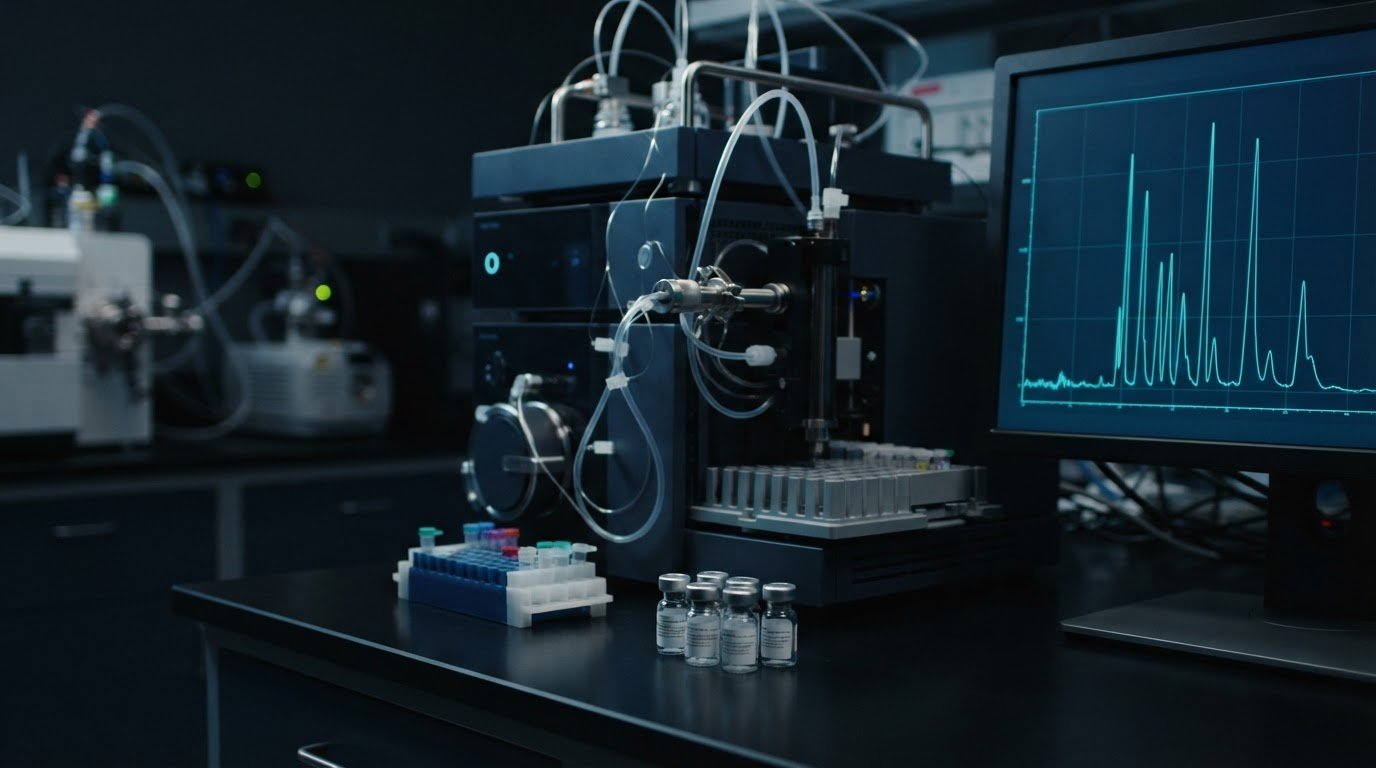
A clean HPLC peak shows separation, not the full identity or quality of a peptide sample. That distinction matters when interpreting high performance liquid chromatography for peptides: a purity percentage describes the detected chromatographic profile under specific conditions, but it cannot establish every property of the material on its own.
It’s reasonable to look to a chromatogram for clear evidence. The key is understanding what that evidence supports and where it stops. This article explains how HPLC separates peptide-related components, how peptide properties and method settings influence the result, and how to review peaks and purity estimates without treating them as complete verification.
We’ll also distinguish chromatographic purity from identity confirmation and explain why complementary analysis, especially mass spectrometry, adds useful evidence. Bluefin Peptides states that its research peptides are at least 99% HPLC-verified, with mass-spectrometry confirmation and batch-specific certificates of analysis. These methods provide different information. Understanding their roles helps qualified researchers assess analytical documentation more precisely.
Key Takeaways
- Understand how high performance liquid chromatography for peptides separates sample components through differences in retention, and consider what the resulting signal can establish.
- Learn how column chemistry, mobile-phase composition, gradient, flow, and temperature can influence peptide separation.
- Interpret peak-area percentages in the context of the method. They are not, by themselves, absolute measures of chemical purity.
- Review a chromatogram systematically by checking the sample and batch, method, detector, displayed data, and reported calculation.
- Assess analytical documentation as layered evidence, distinguishing chromatographic observations from identity confirmation and batch records.
What High-Performance Liquid Chromatography for Peptides Measures
High-performance liquid chromatography (HPLC) separates components in a liquid sample by passing a pressurized mobile phase through a column containing a stationary phase. Compounds move through the column at different rates because their interactions with the two phases differ. A detector records changes in the material leaving the column, producing signals that can be examined as a chromatogram. The method provides evidence about how sample components behave under specified analytical conditions.
In one sentence: HPLC separates components through differential retention, a detector records signals as they elute, and an analyst interprets those signals in the context of the method and other evidence.
The distinction matters in high performance liquid chromatography for peptides: a peak is a detector response at a particular point in the run, not automatic proof of a specific peptide identity. A peak may be consistent with an expected component, but retention time alone cannot establish its sequence or uniquely identify it. Interpretation must stay within what the method and detector can show.
How chromatographic separation works
As the mobile phase carries a sample through the column, each compound repeatedly partitions between the moving liquid and the stationary material. A compound that interacts more strongly with the stationary phase may spend longer in the column; one that favors the mobile phase may elute sooner. Retention time is an observed, method-dependent measurement, not a universal molecular identifier. The High-performance liquid chromatography (HPLC) overview describes this general separation principle and common HPLC modes.
A chromatogram plots detector response against time. Each visible peak marks a response as material exits the column, while its position and shape reflect the separation and detection conditions. Peak presence, size, or timing can guide analysis, but none should be treated in isolation as definitive chemical identification.
Why peptide samples need careful separation
Peptide retention can be influenced by amino-acid sequence, charge, hydrophobicity, and sample conditions such as solvent composition and pH. These properties affect how a peptide interacts with the column and mobile phase. Related peptide components may elute at distinguishable times when the method has sufficient selectivity. The same sample can produce different chromatographic behavior if analytical conditions change.
For example, a sequence variant or another related component may produce a separate peak if its interactions differ enough under the chosen conditions. If two components behave too similarly, they may overlap instead. A single chromatographic method therefore cannot be assumed to resolve every impurity, degradation product, or chemical modification. Separation is conditional: the chromatogram records what the configured method can distinguish, not necessarily every component present.
For qualified researchers, the practical starting point is to read HPLC evidence as a record of separation under defined conditions. The chromatogram can reveal detected signals and their relative elution behavior. Establishing what a particular peak represents requires interpretation supported by suitable complementary evidence, rather than assigning identity from its position alone.
How Peptide HPLC Methods Separate Complex Samples
Reversed-phase HPLC is a commonly used approach for peptide analysis. In this mode, the stationary phase is relatively hydrophobic, and differences in how peptide components interact with it help separate them as the mobile phase passes through the column. General HPLC principles and separation modes are summarized in this overview of high-performance liquid chromatography. The appropriate method depends on the sample and analytical question, not on a universal set of conditions.
Retention behavior depends on both the analyte’s chemical properties and the method conditions used to separate it. A change to the column, solvent composition, gradient, flow, or temperature can alter retention and resolution. Consider these variables together when interpreting a chromatogram or comparing results.
Method variables that influence peptide retention
Column chemistry determines the types and relative strengths of interactions available to sample components. Mobile-phase composition affects how readily peptides remain associated with the stationary phase or move through the column. In gradient elution, the mobile-phase composition changes over time, often increasing its elution strength to move retained components through the column. Flow rate and temperature can also affect retention and peak separation.
These settings are interdependent. A gradient that spreads components apart under one set of conditions may produce different retention or resolution with another column or flow rate. For that reason, high performance liquid chromatography for peptides requires method conditions suited to the target sample and purpose, with appropriate validation before results support analytical conclusions. No single gradient or temperature should be assumed to work for every peptide.
Peptide-specific separation challenges
Some samples contain components with closely related properties. Peptides that differ by sequence, or that include degradation products or chemical modifications, may have similar chromatographic behavior. A method may separate them if its selectivity is sufficient, but similar retention can cause components to overlap, or co-elute, as one apparent peak.
Co-elution limits what can be inferred from the chromatogram: a single signal may represent more than one component, and a visible difference in retention does not by itself identify the compounds. Describe a method in terms of what it separates under the tested conditions, without implying that every impurity or modification has been resolved. The analytical question guides the method, and the method defines the limits of the evidence.
For qualified researchers considering research materials, method context is part of the documentation. Bluefin Peptides supplies research peptides for laboratory use, with HPLC verification and mass-spectrometry confirmation. These are distinct forms of analytical evidence; interpret HPLC results alongside the documented method and complementary data.
HPLC Purity, Mass Spectrometry, and What Each Result Can Show
HPLC and mass spectrometry answer different analytical questions. HPLC separates detected components under defined conditions; mass spectrometry provides mass-based evidence that can support assessment of a molecule’s identity. Batch documentation connects reported analyses to a particular lot. Together, these records provide a more informative picture than a purity percentage alone, but they do not automatically establish every aspect of a sample’s composition or quality.
| Evidence | What it can show | What it does not establish by itself |
|---|---|---|
| HPLC chromatogram | Detected signals and their relative separation under the stated method | Definitive identity of every peak or absence of all impurities |
| Mass spectrometry | Mass-based evidence that can support comparison with an expected molecular mass | Full sequence, complete structure, or biological activity in every case |
| Batch-specific documentation | Reported results associated with an identified lot | Properties that the listed methods did not test |
What an HPLC purity percentage represents
A reported HPLC purity percentage commonly reflects the relative detector signal assigned to a principal peak compared with other integrated signals, using a specified method and calculation. It is an analytical result, not an absolute measure of every chemical species in the sample. Detector response can differ among compounds, and components that co-elute may appear together rather than as distinct peaks. The method’s scope also matters: a signal not detected or resolved under those conditions cannot be interpreted as proof that the corresponding substance is absent.
Read a high percentage alongside the chromatogram, method information, detector details, and calculation. It does not, by itself, establish full peptide sequence, complete structure, or biological activity. The broader context for evaluating such records is covered in this guide to analytical quality standards for research peptides.
Why orthogonal evidence strengthens characterization
Mass spectrometry complements HPLC rather than replacing it. Chromatography separates components, while mass spectrometry measures ions according to their mass-to-charge ratios. The resulting evidence can support a comparison with an expected molecular mass, but a mass match alone should not be treated as complete confirmation of sequence or structure. The methods provide different analytical views.
Batch-specific documentation adds traceability by associating reported results with a particular lot. Bluefin Peptides states that its research peptides are at least 99% HPLC-verified, with mass-spectrometry confirmation and batch-specific certificates of analysis. These are supplier-specific statements, not general guarantees about what every HPLC method establishes. For qualified researchers assessing laboratory materials, the distinction is central: high performance liquid chromatography for peptides contributes separation and purity evidence, while complementary results and lot-linked records help put that evidence in context.
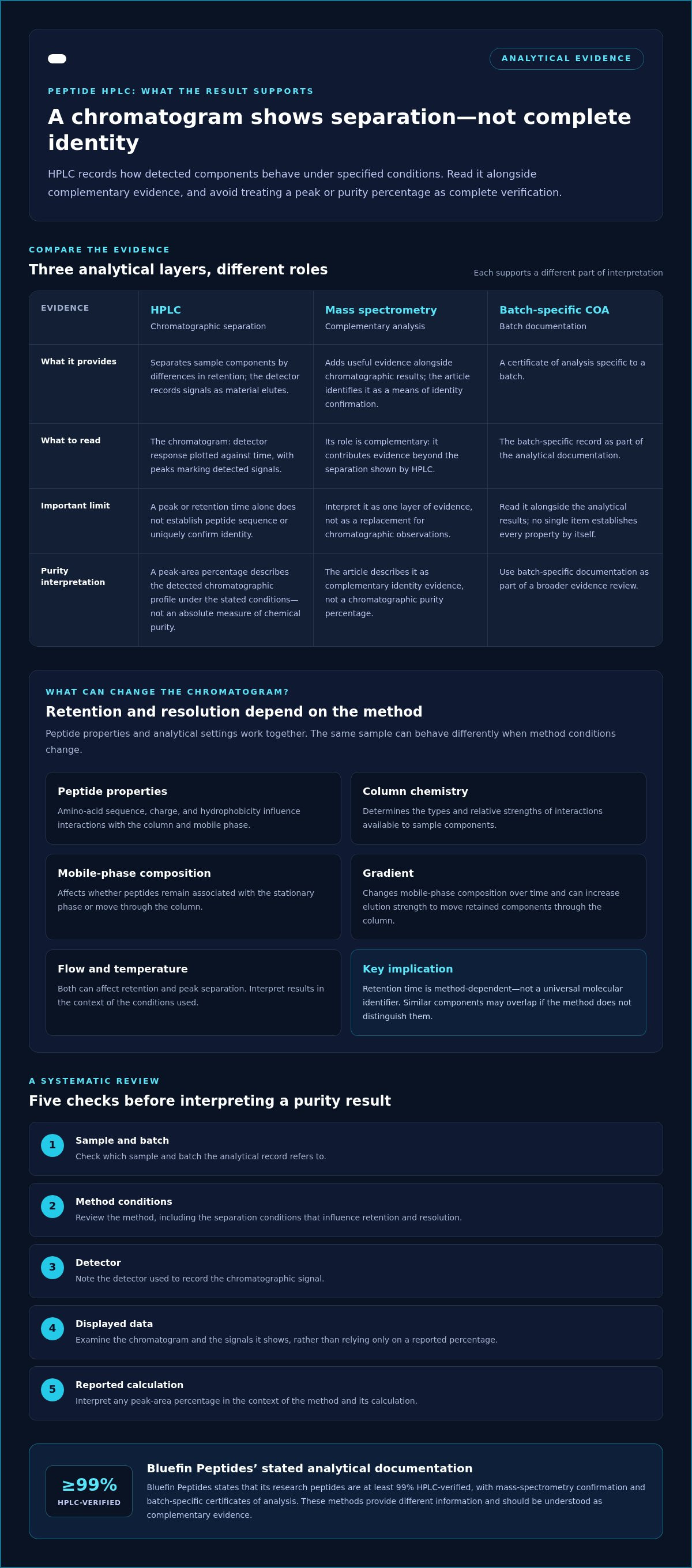
How to Read Peptide HPLC Evidence Without Overinterpreting It
A chromatogram is most useful when read alongside the report that explains how it was produced. For qualified researchers, a disciplined review separates what the document directly records from what someone infers about the sample. Use the sequence below to trace the evidence from the labeled material to the reported conclusion.
Questions to ask when reviewing a chromatogram
Start with the report’s traceability and method details, then examine what the instrument displays. A missing detail is a question to document, not automatic proof that the result is invalid. Keep each observation tied to the sample and conditions named in the report.
- Identify the sample and batch. Check that the report names the material and lot relevant to the sample being assessed. If the connection between the report and batch is unclear, record that gap rather than assuming they match.
- Locate the method information. Review the stated separation conditions, including column and mobile-phase details where provided. This context helps establish what the chromatographic result represents and whether comparisons with other runs are meaningful.
- Check the detector and axes. Note which detector is reported, what the chromatogram’s axes represent, and the units shown. Detector response is an observation under particular conditions, not a direct label for a compound’s identity.
- Examine the peaks and calculations. Look at the displayed peak pattern and how the report calculates any stated percentage. Check whether the value reflects a specified calculation rather than treating it as an unrestricted measure of all sample constituents.
- Compare conclusions with evidence. Ask whether statements in the report stay within what the method and data show. Separate recorded observations, such as a detected peak, from interpretations about what that peak represents.
For a closer guide to report elements and their interpretation, see how to interpret HPLC peptide purity reports. This can help frame questions about a report without turning an absent detail into an automatic verdict.
Limits of a single chromatographic result
One chromatogram reflects its specific method and detection conditions. A different method or detector may reveal a different pattern, while co-eluting components may not appear as separate peaks. The observed trace can support conclusions about detected signals under those conditions; it cannot, by itself, establish every component’s identity or properties.
Chromatographic purity alone is not complete characterization. A peak pattern should not be extended into claims about full sequence, safety, or biological performance unless appropriate evidence supports those conclusions. If the report leaves an unresolved question, state it precisely: for example, “the method details are not shown” or “the peak identity is not established by this chromatogram.” This wording distinguishes missing context from a demonstrated analytical failure.
To explore research materials with analytical documentation in view, review Bluefin Peptides’ research peptides. Bluefin states that its materials are for laboratory research only and provides HPLC verification, mass-spectrometry confirmation, and batch-specific certificates of analysis.
Applying Peptide HPLC Principles to Research-Grade Materials
For laboratory procurement, an HPLC result is one layer of analytical evidence, not a complete verdict on a peptide sample. Interpret it alongside the method description, chromatographic data, complementary analysis, and documentation that connects results to the material’s batch. This approach keeps conclusions proportional to the evidence: a reported chromatographic percentage describes results under stated conditions, while other methods address different analytical questions.
A practical review can follow this sequence:
- Trace the material. Match the product and batch information on the report or certificate to the material under consideration.
- Read the method context. Note which analytical conditions and detector information are provided, since they shape how the chromatogram should be interpreted.
- Compare evidence types. Consider HPLC data alongside mass-spectrometry confirmation and batch-specific documentation, without treating one as a substitute for another.
- Keep conclusions bounded. Distinguish documented findings from properties the listed analyses do not establish.
A layered evidence approach for laboratory procurement
This layered review helps qualified researchers assess what records actually support. Bluefin’s stated documentation practices are not universal analytical requirements, and these methods alone do not establish every material property. For a product-specific example, see the Retatrutide analytical specifications and laboratory standards.
Documentation is most useful when each result can be associated with the relevant batch and read in context. A certificate provides a place to review reported information; it does not extend the scope of an analysis beyond the tests and observations it records. Apply the same careful distinction to any research material, including the stated HPLC verification level.
Research-use boundaries and next steps
Bluefin Peptides’ products are supplied for qualified researchers and laboratory research only. They are not for human, veterinary, or consumer use. This boundary is separate from analytical interpretation: laboratory test results describe specified evidence and should not be converted into guidance about administration, treatment, or consumer use.
In short, high performance liquid chromatography for peptides helps characterize separation and supports purity assessment, while method context, complementary mass-based evidence, and batch records contribute distinct information. The analytical question and research context determine what evidence is appropriate. Qualified researchers can Explore Bluefin Peptides to review its research materials and associated documentation.
Bring Analytical Evidence Into Your Next Research Review
Use the principles of high performance liquid chromatography for peptides as a framework for asking precise questions of analytical records: what was measured, under which method, and how closely does the conclusion match the evidence? That discipline helps keep a reported result useful without asking it to establish properties beyond its scope.
For qualified researchers, the next step is practical: review the batch documentation alongside the research material and consider how each analytical result contributes to the intended laboratory work. These materials are for qualified researchers and laboratory use only, not human, veterinary, or consumer use.
Explore Bluefin Peptides’ research materials and review the available documentation as part of your research planning. Clear questions and careful interpretation make analytical evidence more useful.
Frequently Asked Questions
What is high-performance liquid chromatography for peptides?
High-performance liquid chromatography for peptides is a liquid-phase analytical technique that separates sample components according to their interactions with the column and mobile phase. A detector records signals as components emerge. The method can help compare peptide-containing samples or assess whether a run produced distinct signals, provided the samples and conditions are comparable. The chromatogram describes measured behavior, not complete molecular characterization.
How does HPLC determine peptide purity?
HPLC separates detectable components and records their detector responses; a reported purity value may be calculated from integrated peak areas. For example, a report might express the main peak’s area relative to the total integrated signal. That calculation depends on the method and reporting convention, so it isn’t an absolute inventory of every substance in a sample. Review the calculation and method before comparing percentages across reports.
Does HPLC confirm a peptide’s identity?
No, HPLC retention information alone doesn’t definitively confirm identity. A component eluting at an expected time may be consistent with the target, but another compound could behave similarly under the same conditions. Identity assessment may draw on complementary evidence, such as mass spectrometry, interpreted against the intended analytical question. Treat a purity result and an identity claim as separate findings, and check which data support each statement.
What does an HPLC chromatogram show?
A chromatogram displays detector response over the duration of a run. Its peaks show where detectable signals appeared under the selected conditions; peak position and area can be examined as part of the analysis. For practical reading, first check axis labels and units, then look for the reported integration and any peaks excluded from the calculation. A peak’s appearance alone doesn’t identify its chemical source.
Why is mass spectrometry used alongside peptide HPLC?
Mass spectrometry adds mass-based evidence to the separation information provided by HPLC. If a chromatographic signal is assigned to a target, mass data can be compared with the expected mass as another line of analysis. The strength of that interpretation depends on the method and data available. Batch-linked records also help researchers determine whether analytical results refer to the material under review.
Does 99% HPLC purity mean a peptide is completely pure?
No. A 99% result is a reported value produced under a particular method and calculation, not proof that every possible impurity is absent. Components may overlap, respond differently to a detector, or fall outside the method’s scope. Use the figure as one analytical observation. It doesn’t, on its own, establish the sample’s full identity, structure, or biological activity.
What information should a peptide HPLC report include?
A useful report should identify the sample or batch and provide enough context to interpret the data, such as relevant method conditions, detector information, chromatogram axes, and the stated calculation. Contents vary, so focus on whether the report connects its conclusion to observable results. If a percentage is given without describing its calculation, record that limitation rather than assuming how it was derived.
For laboratory research use only. Not for human or veterinary use. This content is educational and does not constitute medical, dosing, or usage guidance.
Browse the BLUEFIN catalog