Growth hormone secretagogue research: aging, ghrelin, and mechanisms
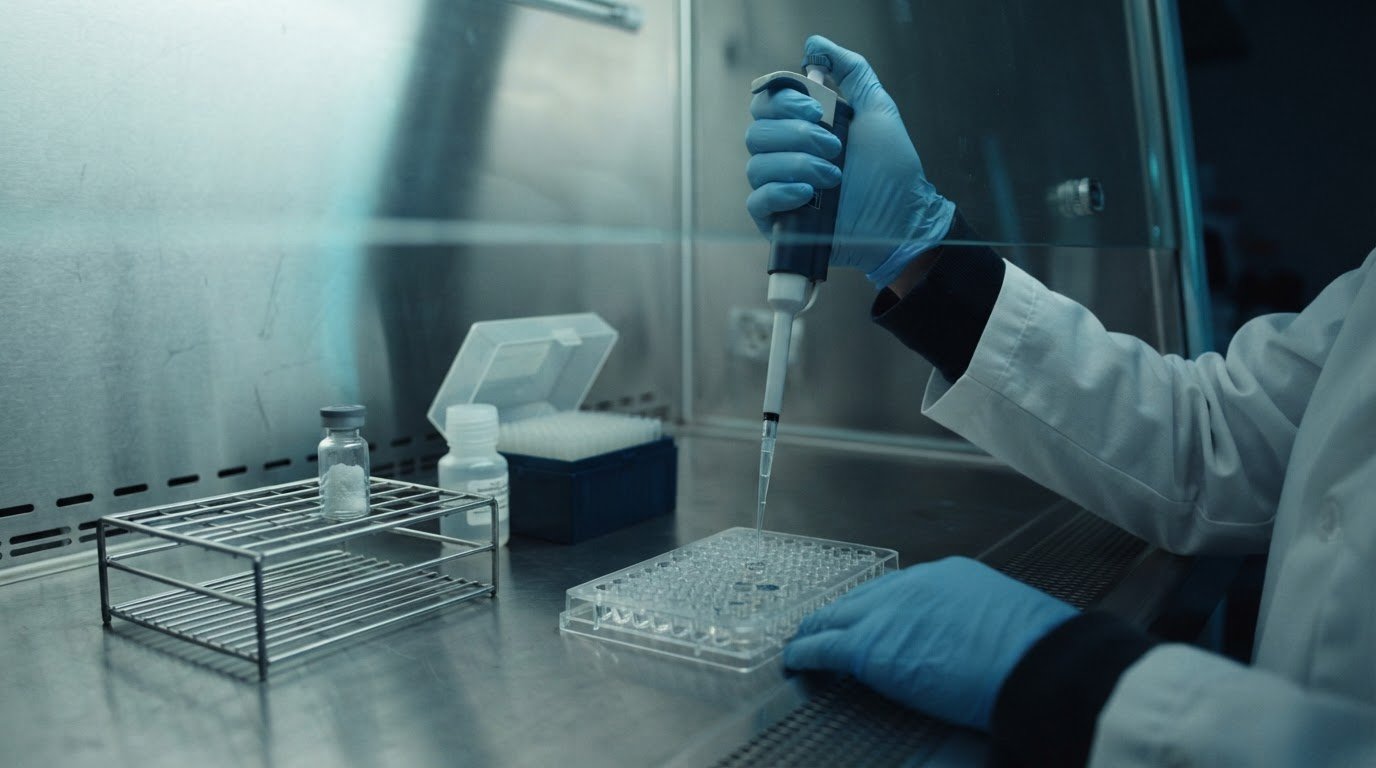
Growth hormone production declines by roughly 14% per decade after age 30. Secretagogues are studied for how they prompt growth hormone release, including through ghrelin-related signaling; this mechanism is distinct from evidence that they improve athletic performance. That distinction sits at the center of growth hormone secretagogue research.
Hormonal changes associated with aging can make secretagogues seem like a direct route to greater strength, faster recovery, or improved body composition. The biology is more specific: a compound may influence hormone signaling, but that alone does not establish a performance effect. Understanding the pathway helps distinguish what laboratory and human studies measure from what athletes may hope to gain.
This article explains how growth hormone and ghrelin relate to aging, how secretagogues act on their signaling pathways, and what human studies report about physical function and athletic performance. It also separates mechanisms from outcomes, helping you interpret the evidence more precisely.
Key Takeaways
- Trace how ghrelin signaling connects to growth hormone release, and why the receptor pathway matters when interpreting secretagogue mechanisms.
- Separate changes in hormone signaling from evidence of improved strength, recovery, or athletic performance.
- Learn what human studies of secretagogues measure, from hormone responses to physical function and body composition.
- Use the study design and measured outcome to assess what a finding can—and cannot—show.
- See where an Ipamorelin / CJC-1295 Research Blend fits in laboratory-focused exploration of secretagogue mechanisms.
Age-related growth hormone decline
Age-related growth hormone decline is the gradual reduction in growth hormone secretion with advancing age, roughly 14% per decade after age 30. This population-level estimate describes a trend, not an individual diagnosis or a direct measure of physical capacity. Growth hormone secretion also varies over time, so a single measurement does not capture the full pattern.
Growth hormone, or GH, is a pituitary hormone that helps regulate processes including tissue growth and metabolism. Its secretion occurs in pulses, and researchers distinguish circulating GH from insulin-like growth factor 1, or IGF-1, which is produced largely in response to GH signaling. Age-related changes in either measure require context: age, timing, and the specific outcome measured all shape what a result means.
A lower GH signal does not, by itself, establish that an older adult has a deficiency or would benefit from a secretagogue. Researchers therefore examine measurable outcomes alongside hormone levels. Body weight and lean body mass, for example, describe different aspects of body composition. Neither measure alone demonstrates improved strength, mobility, or athletic performance.
Capromorelin studies offer a concrete example of how this research has been structured in older adults. One trial randomized 395 men and women aged 65–84 years, and its intended treatment period was 2 years. The study included regimens of 10 mg three times per week, 3 mg twice a day, 10 mg each night, and 10 mg twice a day. These are study regimens, not instructions for personal use.
Trial completion and measured outcomes matter when interpreting those results. A total of 315 participants completed 6 months of treatment, while 284 completed 12 months. At 6 months, body weight increased by 1.4 kg with capromorelin and decreased by 0.2 kg with placebo. Lean body mass increased by 1.4 kg with capromorelin, versus 0.3 kg with placebo. These findings describe specific outcomes at a specific time point; they do not establish an athletic-performance effect.
What doses and treatment durations have been used in research studies? The capromorelin trial used the four regimens above and was intended to provide treatment for 2 years, with reported outcomes at 6 and 12 months. Comparing studies requires attention to compound, dosing schedule, duration, participant age, and endpoint.
What are the known risks, side effects, and long-term safety concerns? Safety questions depend on the compound and exposure. Researchers assess adverse events alongside hormonal and physical outcomes. Longer follow-up matters because short-term changes in body weight or lean mass cannot, on their own, establish long-term safety.
Ghrelin and its receptor
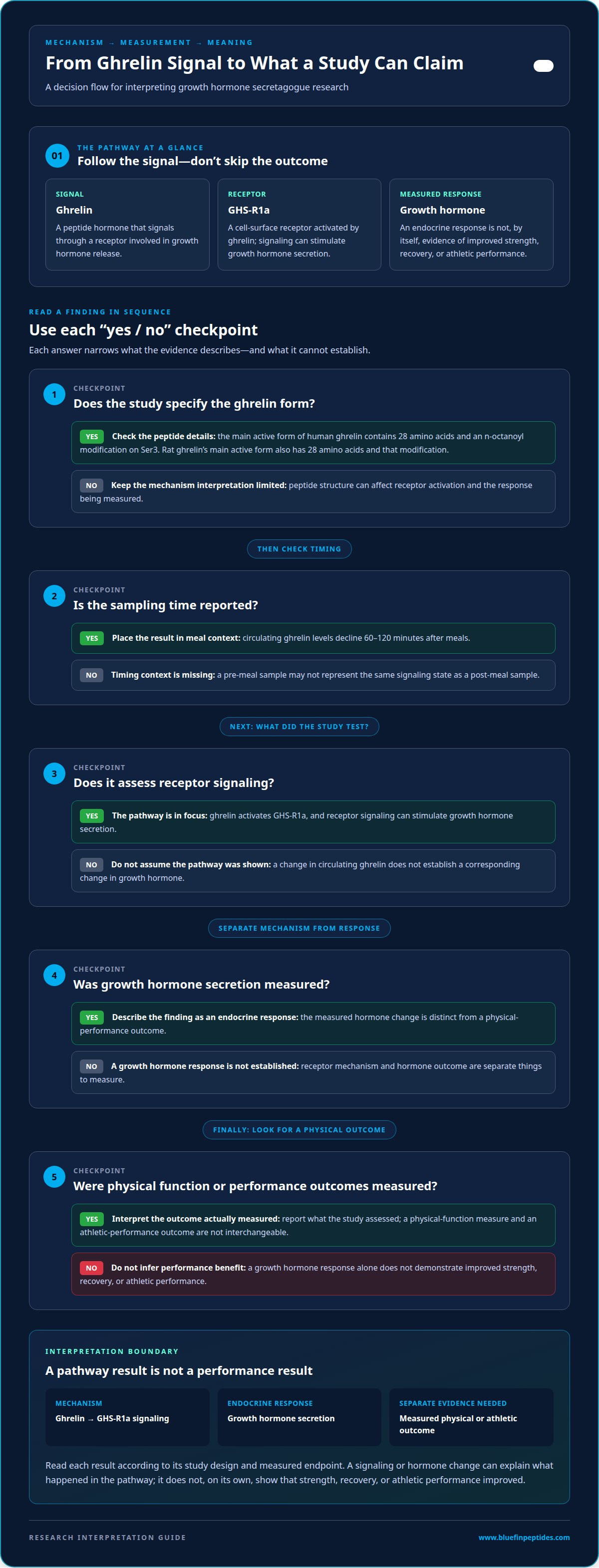
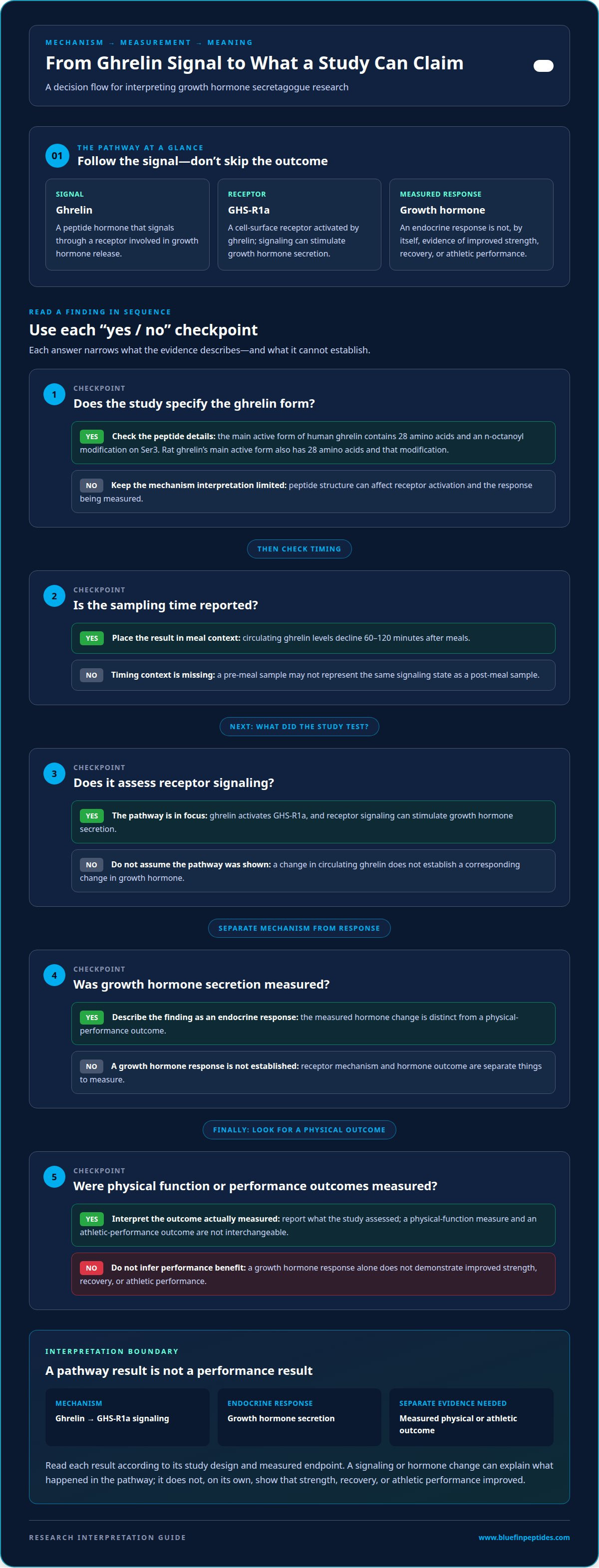
Ghrelin is a peptide hormone that signals through a receptor involved in growth hormone release. The main active form of human ghrelin contains 28 amino acids, with an n-octanoyl modification on Ser3. This structural detail matters because acylation helps ghrelin activate its receptor. Rat ghrelin’s main active form also contains 28 amino acids and an n-octanoyl modification.
The growth hormone secretagogue receptor, often called GHS-R1a, is a cell-surface receptor activated by ghrelin. When ghrelin binds, receptor signaling can stimulate growth hormone secretion. The receptor provides a molecular connection between ghrelin and the pituitary hormone response. A secretagogue that targets this pathway acts through receptor signaling rather than supplying growth hormone itself.
Acylation is the addition of an octanoyl group to ghrelin’s structure. In human ghrelin, the modification is attached to Ser3, the third amino acid. This chemical feature distinguishes the main active form described in research from ghrelin without that modification. For experiments, the molecular form matters: a change in peptide structure can affect receptor activation and the measured response.
Post-meal ghrelin change describes the shift in circulating ghrelin after eating. Circulating ghrelin levels decline 60–120 minutes after meals. This timing gives researchers a defined physiological context for interpreting hormone measurements. A blood sample collected before a meal may not represent the same signaling state as one collected after eating.
Ghrelin connects energy-related signaling with growth hormone release, but those outcomes should be measured separately. A change in circulating ghrelin does not establish a corresponding change in growth hormone. Likewise, a growth hormone response does not demonstrate altered athletic performance. Study design should distinguish the measured signal, the receptor pathway examined, and the downstream outcome.
In practice, researchers can interpret ghrelin-related findings by tracking three connected elements:
- Peptide form: Identify whether the measured ghrelin includes the n-octanoyl modification at Ser3.
- Timing: Record whether sampling occurs before or within 60–120 minutes after a meal.
- Response: Separate receptor activation and growth hormone secretion from physical outcomes.
These distinctions clarify what a result can support. For example, a measured growth hormone change after receptor activation describes an endocrine response; it does not demonstrate improved strength or recovery. In growth hormone secretagogue research, ghrelin’s structure, meal timing, and receptor activity help define the mechanism under investigation.
Growth hormone secretagogue mechanisms
Secretagogues stimulate the body’s signaling pathways for growth hormone release. Their mechanisms differ from those of direct hormone replacement.
Secretagogues Compared With Growth Hormone Therapy
A growth hormone secretagogue prompts the body to release endogenous growth hormone, while growth hormone therapy supplies the hormone itself. This distinction changes which biological step is under study. Secretagogue research examines receptor or releasing-hormone signaling and the resulting pituitary response. Replacement research examines administered growth hormone and its effects. Neither mechanism alone establishes a specific physical or athletic outcome.
Secretagogues Studied in Humans
Human studies have examined compounds that stimulate growth hormone through different pathways. Examples include CJC-1295, sermorelin, GHRP-2, hexarelin, MK-677, capromorelin, and tesamorelin. A single subcutaneous CJC-1295 injection produced a 2- to 10-fold increase in plasma growth hormone in healthy adults. IGF-1 increased 1.5- to 3-fold and remained elevated for 9 to 11 days.
Mechanism depends on the compound’s target. GHRP-6 was identified as a synthetic growth hormone-releasing compound in the early 1980s. Ghrelin-related secretagogues activate the growth hormone secretagogue receptor, while sermorelin acts as a growth hormone-releasing hormone analogue. CJC-1295 without DAC has an approximate half-life of 30 minutes; with DAC, its approximate half-life is 6 to 8 days.
What is the FDA approval status of growth hormone secretagogues in the United States? Approval is compound- and indication-specific, not a class-wide status. Sermorelin was FDA-approved in 1997 to treat growth hormone deficiency in children; tesamorelin was approved in the United States in 2010 under the brand name Egrifta.
Are growth hormone secretagogues legal to prescribe, compound, or sell in the United States? A mechanism or human study does not, by itself, establish permission to prescribe, compound, or sell a substance. The answer depends on the specific compound, product, intended use, and applicable requirements.
Clinical trials test secretagogues against defined endpoints, such as hormone response, body composition, or physical function. In a capromorelin trial, body weight and lean body mass increased relative to placebo at 6 months. A 2026 tesamorelin meta-analysis pooled five randomized controlled trials and found a 1.42 kg increase in lean mass. Such findings describe measured outcomes, not proof of athletic benefit.
How can patients find legitimate clinical trials for growth hormone secretagogues? Search ClinicalTrials.gov by compound name, then review the study sponsor, eligibility criteria, intervention, outcomes, and recruitment status. A trial record helps distinguish formal human studies from general claims about a compound.
Growth hormone secretagogues and athletic performance
Athletic performance is the capacity to complete measurable physical tasks, such as climbing stairs. Growth hormone secretagogue studies have examined body composition and physical function, but these outcomes are not interchangeable. More lean mass does not automatically mean greater strength, faster recovery, or improved competitive results. The measured endpoint determines what a study can support.
Lean body mass is the weight of non-fat tissue, including muscle and other lean tissues. In a capromorelin trial, lean body mass increased by 1.4 kg at 6 months, compared with 0.3 kg with placebo. That result describes a body-composition measure. It does not establish that participants gained equivalent muscle strength or athletic capacity.
Stair-climb performance is a functional measure of the ability to ascend stairs. In pooled capromorelin treatment groups, stair-climb performance improved versus placebo by 12 months. This finding is more directly related to physical function than a change in body weight. However, stair climbing in a study population is not the same outcome as performance in a sport or strength-training program.
The findings summarized here report potential benefits for lean mass and functional stair climbing. They do not establish benefits for bone, sleep, or recovery. These are distinct outcomes that require their own measurements: a change in lean mass cannot substitute for a bone assessment or a sleep measure.
Study design helps explain why performance claims require careful limits. Capromorelin findings came from older adults, so they should not be treated as direct evidence for trained athletes. Age, baseline physical function, training status, and the specific test can affect how well a result applies. Researchers also distinguish measured changes from interpretations of their practical meaning.
To interpret a reported performance result, identify the endpoint and population first:
- Body composition: Determine whether a result measures lean mass, total weight, or another variable.
- Physical function: Identify the task, such as stair climbing, and the comparison group.
- Sport performance: Look for a direct sport-specific measure rather than inferring it from body composition.
- Recovery, sleep, and bone: Treat each as a separate outcome requiring its own assessment.
This framework keeps hormone response, tissue change, and physical performance distinct. For example, increased lean mass and improved stair climbing are separate findings, even when reported in the same research program. A study supports conclusions about the population, treatment period, and endpoints it measured. Those measures alone cannot establish broader athletic effects.
Which growth hormone secretagogues are being studied in humans?
Human secretagogue studies test compounds in people and measure defined biological or functional outcomes. The studies vary by compound, participant group, route, and endpoint, so their findings are not interchangeable. Examples include trials of sermorelin, hexarelin, MK-677, capromorelin, and tesamorelin.
Sermorelin is a growth hormone-releasing hormone analogue examined in human trials. A randomized crossover trial enrolled adults aged 55 to 71 and used nightly administration. A crossover design lets participants receive different study conditions at separate times. The result must be interpreted according to the trial’s population, treatment schedule, and measured outcomes.
Hexarelin is a secretagogue tested for growth hormone responses in several clinical contexts. In an anorexia study, researchers administered it intravenously at 1 μg/kg and reported increased growth hormone secretion. A renal-failure study reported intravenous hexarelin at 2 μg/kg, also with increased secretion. A pituitary Cushing’s study used 2 μg/kg intravenously.
MK-677 is an orally administered secretagogue studied for its effects on growth hormone signaling. A diet-induced catabolism study used 25 mg orally. In a separate study described in the research table, effects differed between treatment days 1 and 7. That time-dependent result illustrates why sampling schedule and treatment duration matter when interpreting hormonal responses.
Tesamorelin is a growth hormone-releasing hormone analogue studied in clinical trials. Its Phase 3 trial randomized 412 patients to tesamorelin or placebo for 26 weeks. The trial reported an 11% reduction in visceral adipose tissue, alongside a 21 cm² decrease measured by CT scan. These are specific body-composition outcomes, not direct measures of athletic performance.
Capromorelin is a secretagogue investigated for changes in body composition and physical function. In its trial, stair-climb performance improved in pooled treatment groups versus placebo by 12 months. That functional measure adds a different kind of evidence from hormone levels or body-composition scans. It still represents the task and participants studied, not every athletic setting.
To compare these human studies, identify the compound, participant group, route, treatment schedule, and primary endpoint. Then distinguish hormone response from body composition, physical function, and sport-specific performance. For example, increased growth hormone secretion after hexarelin does not demonstrate improved stair climbing or athletic output.
For laboratory-focused exploration of related compounds, review research peptide options.
t by itself establish an improvement in body composition, physical function, or sport-specific performance. Other outcomes broaden the range of questions studied without making results interchangeable. The table reports intravenous GHRH at 100 μg in a long-term exogenous-glucocorticoid study. This adds a different treatment context to the examples above; route and participant circumstances remain important when interpreting the response. A tesamorelin trial reported a 37% relative reduction in liver fat. That endpoint complements the reported visceral adipose tissue findings, while remaining a distinct measure of body composition. Across these studies, a result should be read alongside the compound, study group, administration route, duration, and outcome measured. A change in one endpoint should not be treated as proof of a change in another.
Bluefin Peptides
Bluefin Peptides offers research peptides for laboratory use, providing a practical next step when your work moves from understanding secretagogue mechanisms to studying peptide materials. Its catalog includes the Ipamorelin / CJC-1295 Research Blend, alongside other research peptide options. These offerings are intended for laboratory research, not personal use or medical treatment.
For research documentation, products are ≥99% HPLC-verified, with mass-spec confirmation and batch certificates of analysis. These analytical details help characterize the material associated with a batch and support a more traceable laboratory workflow. They do not establish clinical effects or performance outcomes.
If you are planning laboratory work related to peptide signaling, contact Bluefin Peptides to discuss your research needs.
Define the next research question
For growth hormone secretagogue research, the next step is to turn a mechanism into a precise experimental question. Specify the pathway, material, and outcome your study will examine. Keep laboratory investigation distinct from clinical use or assumptions about athletic performance.
Bluefin Peptides offers research materials including Retatrutide Research Peptide, Tirzepatide Research Peptide, and BPC-157 / TB-500 Research Blend. These offerings support laboratory-focused work; they do not establish a clinical effect or answer a performance question on their own. A clearly defined protocol and appropriately interpreted results remain central to sound investigation.
For information about research peptide options, contact Bluefin Peptides. A focused question is a strong starting point for the next stage of your work.
Frequently Asked Questions
What are growth hormone secretagogues and how do they work?
Growth hormone secretagogues are compounds that stimulate the body’s release of growth hormone by acting on signaling pathways. For research, classify each compound by its molecular target before comparing results. Two compounds may both increase growth hormone while engaging different receptors or signaling steps. That distinction helps researchers interpret assay findings without assuming shared mechanisms or identical downstream effects.
What are the known risks, side effects, and long-term safety concerns?
Risks and side effects depend on the compound and exposure, so researchers assess adverse events alongside hormonal and physical outcomes. Longer follow-up matters because short-term changes in body weight or lean mass cannot establish long-term safety.
For laboratory research use only. Not for human or veterinary use. This content is educational and does not constitute medical, dosing, or usage guidance.
Browse the BLUEFIN catalog