GHK-Cu research studies: What results and risks show

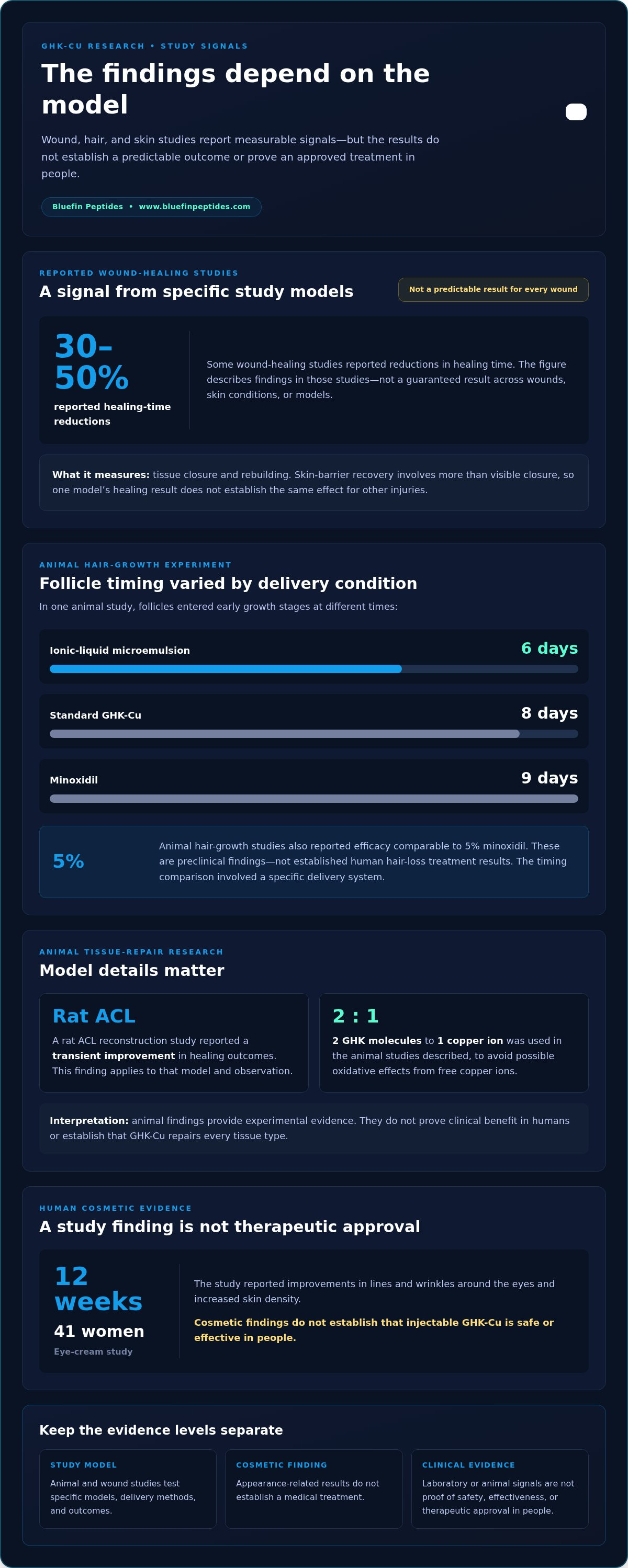
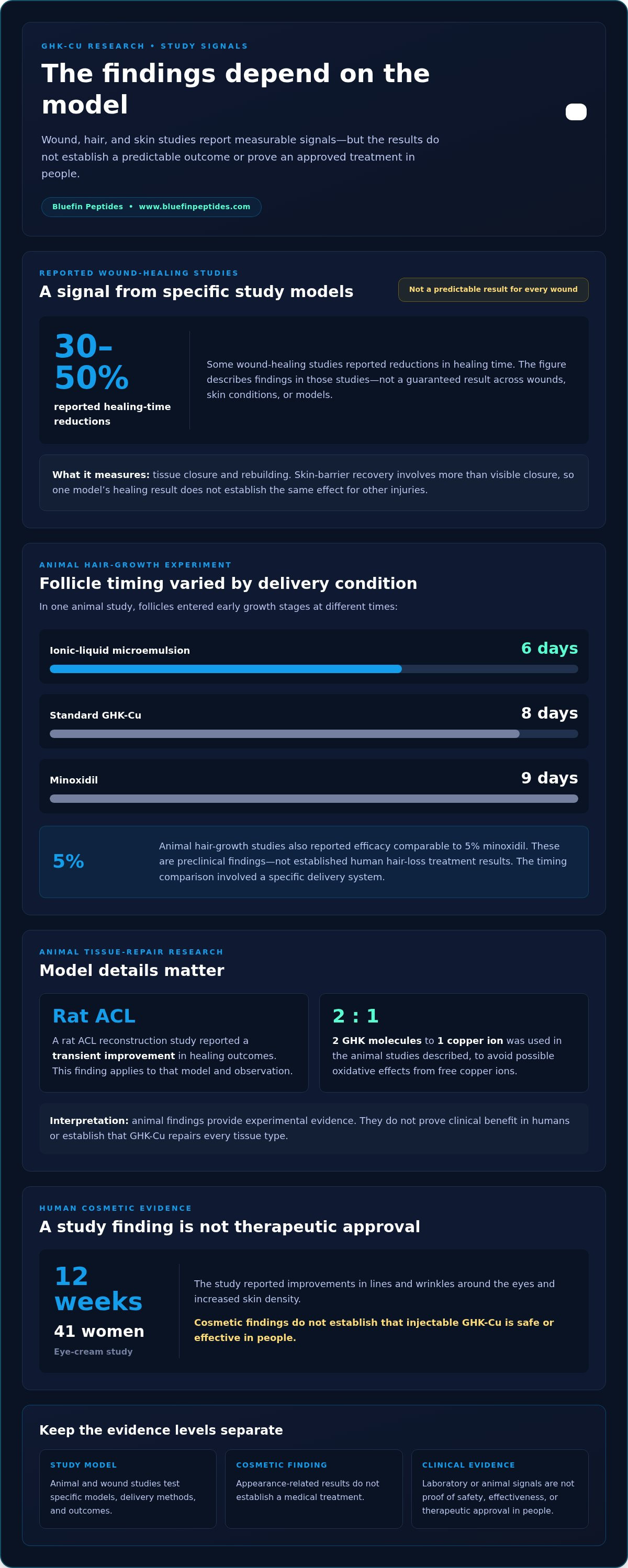
The most important finding in GHK-Cu research studies is also a limit: reported skin and tissue-repair signals do not establish that injectable GHK-Cu is safe or effective in people. A 12-week eye-cream study involving 41 women reported improvements in lines and wrinkles around the eyes and increased skin density. Cosmetic findings and laboratory or animal results are not the same as therapeutic approval.
It’s reasonable to distinguish promising findings from proven treatments, especially when claims about safety can get ahead of the evidence. This article examines what GHK-Cu research studies suggest about skin regeneration, what they reveal about risks and therapeutic approval, and why laboratory use matters. It also puts animal and gene-expression findings in context, so you can understand what they may indicate without mistaking them for evidence of human clinical benefit.
Key Takeaways
- Separate skin and wound-healing findings from proof of an approved treatment; study design and delivery route matter.
- Gene-expression changes can point researchers toward biological pathways, but they do not establish therapeutic benefit.
- Animal findings broaden the research picture, while human safety and effectiveness remain distinct questions.
- According to the National Library of Medicine, one aging-mouse study administered GHK-Cu intranasally at 15 mg/kg daily for two months.
- Laboratory research-use findings are best interpreted within the model, method, and limits of each study.
Can GHK-Cu Really Deliver the Results It Promises?
GHK-Cu research includes wound-healing signals, animal tissue-repair findings, and hair-growth experiments. Their relevance depends on the model, delivery method, and outcome measured.
Wound Healing and Tissue Repair
Wound healing is a coordinated process in which damaged tissue closes and rebuilds its structure. Studies of GHK-Cu examine whether the peptide affects this process, a question relevant to claims about skin recovery and barrier repair.
Some wound-healing studies reported healing-time reductions of 30-50%. That figure describes reported study findings, not a predictable outcome for every wound or skin condition. Skin-barrier recovery also involves more than visible closure: the tissue must restore protective function. A healing result in one model therefore does not establish the same effect across different injuries.
Animal Research on Organ Repair
Animal research uses controlled models to examine GHK-Cu’s effects on tissue repair before drawing conclusions about people. In a rat ACL reconstruction study, GHK-Cu transiently improved healing outcomes. This finding is relevant to tissue-repair research, but applies only to that model and observation.
In the animal studies described, researchers used 2 molecules of GHK to 1 molecule of copper ion to avoid possible oxidative effects from free copper ions. This formulation detail matters because copper availability can influence the conditions being tested. Animal results on wound or organ repair provide experimental evidence, not proof of clinical benefit in humans.
Hair Growth and Hair Loss Research
Research on GHK-Cu and hair growth includes animal experiments comparing follicle development under different delivery conditions. In one study, follicles entered early growth stages in 6 days with an ionic-liquid microemulsion, compared with 8 days for standard GHK-Cu and 9 days for minoxidil.
Animal hair-growth studies also reported efficacy comparable to 5% minoxidil. These findings describe preclinical models, not established human hair-loss treatment results. The delivery system matters: the comparison involved an ionic-liquid microemulsion, so its timing cannot be assigned to every GHK-Cu preparation or method.
Clinical Applications and Evidence
Clinical application means testing whether laboratory or animal findings translate into useful outcomes in people. Wound-healing observations make GHK-Cu relevant to tissue-repair research, but interpretation depends on the study population, delivery route, and measured endpoint.
The rat ACL finding was transient, and reported wound-healing results come from specific studies and models. Neither shows that GHK-Cu treats all wounds, repairs every tissue type, or consistently restores the skin barrier. When assessing GHK-Cu research studies, distinguish a biological signal from a demonstrated clinical result. Study design determines how broadly a finding can be applied.
Is GHK-Cu an approved therapeutic?
No. GHK-Cu appears in cosmetic products, but cosmetic use is not the same as approval as a treatment. Gene-expression findings can justify further investigation, but they do not show that a treatment is approved or effective for a medical condition.
What gene-expression results show
A Connectivity Map analysis screened 1,309 bioactive molecules for their ability to reverse gene-expression patterns associated with metastatic colon cancer. GHK and securinine were identified as agents capable of reversing expression across 54 gene sets overexpressed in that cancer context. This was a gene-profiling result, not a clinical trial showing cancer treatment benefit.
In the reported profiling results, 57 human genes associated with stem-cell function increased by at least 50%, while 46 decreased by at least 50%. Individual changes included USP29 expression increasing by 1,053%, TP73 by 938%, and PARP3 by 253%. These values describe changes in gene expression, not changes in stem-cell number or tissue regeneration in patients.
Cellular pathways and interpretation
Gene expression describes how actively cells use particular genes to produce functional molecules. Changes in expression can help researchers identify cellular pathways for further study, but do not, by themselves, show what cells will do in a living organism.
GHK-Cu is reported to influence the expression of over 4,000 human genes. Another reported finding was an 80% increase in ATM expression after GHK-Cu exposure in breast cancer cells. The cell type and experimental conditions matter: an observed pathway response in cancer cells cannot be treated as evidence of a beneficial effect in other tissues.
Cosmetic use versus therapeutic approval
The distinction matters in practice. A cosmetic product may be used for appearance-related purposes, while therapeutic approval concerns treatment of a medical condition. The presence of copper in GHK-Cu, or a biological signal in laboratory profiling, does not change that distinction.
In GHK-Cu research studies, ask what the method actually measured. Gene-profiling studies measure molecular activity; clinical trials assess outcomes in people. A change in gene expression can guide hypotheses about regeneration or cellular signaling, but does not establish clinical efficacy, safety, or therapeutic approval. Keeping these evidence levels separate prevents laboratory findings from being mistaken for treatment claims.
Is GHK-Cu research only about skin?
No. Animal studies have examined GHK-Cu in lung injury, cognition, aging, and hair growth, while large controlled human trials for musculoskeletal and systemic uses are lacking. Studied formulations include topical preparations and animal dosing through different routes.
Doses vary by model and route, so an animal protocol should not be read as a human regimen. For example, the National Library of Medicine describes an aging-mouse study using intranasal GHK-Cu at 15 mg/kg daily for two months.
Limits of Human Clinical Evidence
Human clinical evidence consists of outcomes measured in people under controlled study conditions. Large controlled human trials of GHK-Cu for musculoskeletal and systemic uses are lacking, limiting conclusions about anti-aging claims beyond skin-related research.
Animal biology can reveal possible mechanisms, but cannot establish that a copper peptide naturally improves human longevity. Wound healing, antioxidant activity, and claims that GHK-Cu stimulates collagen describe distinct effects. Each requires evidence tied to its specific outcome and population.
For example, a change observed in an animal model does not show that people experience the same change or that it affects aging. Keeping the model and endpoint in view helps distinguish a mechanistic signal from a demonstrated clinical result.
Injectable GHK-Cu Evidence
Evidence on injectable use concerns GHK-Cu delivered by injection and the resulting safety and effectiveness in people. No published human studies establish that injectable GHK-Cu is safe and effective, so animal findings cannot fill this gap in clinical evidence.
In the United States, compounding pharmacies are not technically allowed to offer GHK-Cu for injection in humans, according to the available topic findings. Dermatologists quoted in the report advise patients to hold off on injecting GHK-Cu or other substances. These points underline why route matters: topical cosmetic use does not establish injectable safety.
Any safety assessment must distinguish the exposure route, formulation, and study population. A result from a topical preparation or an animal injection cannot prove safety for a different route in people.
Studied Doses and Formulations
Studied formulations include topical serums and creams, microneedling-compatible solutions, and animal preparations administered through different routes. The National Library of Medicine describes one aging-mouse protocol using intranasal GHK-Cu at 15 mg/kg daily for two months.
Another elderly-mouse cognitive study administered GHK-Cu at 10 mg/kg five times per week for three weeks. These are animal protocols, not human dosing instructions. Their differences illustrate why dose interpretation depends on the model, route, and research question.
In described animal studies, researchers also used two molecules of GHK for each copper ion to avoid possible oxidative effects from free copper ions. This formulation detail helps explain the experimental design; it does not demonstrate a human safety profile or therapeutic dose.
Skin regeneration and extracellular-matrix remodeling
GHK-Cu has been studied for its effects on collagen and other components of the extracellular matrix, the structural network that supports skin. Reported findings include changes in collagen production, elastin, and decorin, but each result comes from a specific analysis or study rather than showing a universal skin response.
In a comparative analysis, GHK-Cu improved collagen production in 70% of women. Reported findings also included a 30% increase in elastin production and a 302% increase in decorin at a concentration of 1 nanomolar. These markers describe separate parts of skin structure; their changes should not be combined into a single measure of rejuvenation.
Reported effects of GHK-Cu on gene expression add another layer of evidence. Gene expression concerns cellular activity, while collagen production is a matrix-related outcome. A change in one does not automatically establish a visible skin effect, so study conditions and measured endpoints matter when interpreting claims about regeneration.
One 12-week eye cream study involving 41 women reported that GHK-Cu outperformed placebo and vitamin K cream for reducing lines and wrinkles around the eyes while increasing skin density. This is a specific topical study and outcome. It does not establish identical results for other formulations, body areas, or skin concerns.
Acne and post-inflammatory recovery involve skin changes after inflammation, including visible marks and altered texture. Matrix findings may be relevant to studying tissue remodeling in these contexts, but they do not directly prove that GHK-Cu treats acne or prevents post-inflammatory marks. For example, collagen-related observations cannot establish an acne outcome unless researchers measure it.
GHK was first identified in human plasma, and its concentration declines with age. Reported plasma levels fall from roughly 200 ng/mL at age 20 to about 80 ng/mL by age 60; GHK levels may decrease by more than 50% between early adulthood and later life. This age-related pattern provides biological context, not proof that restoring levels reverses skin aging.
For readers asking about collagen and gene expression, reported evidence points to changes in collagen production and matrix-associated markers, alongside broader effects on cellular gene expression. These findings help explain why GHK-Cu is studied in skin remodeling, while clinical interpretation still depends on the formulation, population, and endpoint measured.
Laboratory research-use context
Laboratory research places GHK-Cu findings within defined models, routes, and measured outcomes. Its research history spans over 40 years of peer-reviewed work, but the evidence includes different experimental settings. A topical skin study, a cell experiment, and an animal model answer different questions. Their findings cannot be treated as interchangeable evidence of human benefit.
One reported analysis found that GHK-Cu exposure stimulated 47 separate DNA repair genes. That observation concerns gene activity, not direct proof of repaired tissue or a clinical outcome. In laboratory interpretation, the distinction between a molecular marker and a functional effect matters. A gene-expression result may guide further study, while a tissue-level result requires its own measurement.
Animal models extend this research beyond topical skin applications. A mouse study reported reduced lipopolysaccharide-induced acute lung injury after GHK-Cu exposure. The model examines an inflammatory injury process in mice; it does not establish the same effect in people. Consider the model, exposure route, and outcome to keep the finding in context.
According to the National Library of Medicine, one aging-mouse study administered GHK-Cu intranasally at 15 mg/kg daily for two months. Another cognitive study in elderly mice used 10 mg/kg five times per week for three weeks. These protocols illustrate how dose and route vary with the question under investigation. Neither animal protocol is a human dosing instruction.
For laboratory use, read each result alongside its model and endpoint. Plasma concentration, topical exposure, and animal administration describe different conditions. Likewise, a change in the extracellular matrix is not the same measurement as a shift in gene expression. To compare effects, note what was exposed, how it was delivered, and which outcome researchers recorded.
Researchers studying GHK-Cu can use a research-use peptide that fits their experimental question and model. Explore GHK-Cu research-use options for laboratory investigations.
Bluefin Peptides: Retatrutide Research Peptide
Bluefin Peptides’ Retatrutide Research Peptide is intended for laboratory research use, not as a substitute for clinical evidence about GHK-Cu. For studies requiring a different peptide research material, the catalog also includes GHK-Cu / BPC-157 / TB-500 Research Blend and KPV / GHK-Cu / BPC-157 / TB-500 Research Blend.
Bluefin Peptides states that its peptides are ≥99% HPLC-verified, with mass-spec confirmation and batch certificates of analysis. Those records support material identity and purity review; they do not establish therapeutic effects. Use the product category that matches the research question and keep laboratory findings distinct from human treatment claims.
For research-use peptide information, visit Bluefin Peptides.
Build Your Next Research Question With Precision
The next step is to define a sharper study question. Before selecting research material, specify the model, comparison, and outcome your protocol is designed to evaluate. This helps distinguish mechanistic signals from therapeutic conclusions and makes results easier to interpret. The same discipline applies when extending GHK-Cu research studies in a new experimental direction.
For laboratory research-use needs beyond this topic, Bluefin Peptides offers Retatrutide Research Peptide, Tirzepatide Research Peptide, and BPC-157 / TB-500 Research Blend. Each is a distinct research material, so selection should follow the study objective rather than assumptions about clinical effects.
Review the available research offerings or contact Bluefin Peptides to take the next step. A clear question and a well-defined model give your research a stronger starting point.
Frequently Asked Questions
Are There Any Dangers or Side Effects?
Safety depends on the formulation and exposure route. Skin irritation or inflammation is a reason to reduce or stop topical copper-peptide use. Injectable GHK-Cu has a different evidence profile: published human studies do not establish its safety and effectiveness. Laboratory and animal findings cannot replace human safety data. Treat claims about a product’s effects as specific to its formulation and study conditions, not as a general safety guarantee.
Are There Better or Complementary Alternatives?
No single alternative is better for every research question; the comparison depends on the outcome being studied. For a skin-focused protocol, define a comparator and measure the same endpoint across treatments instead of assuming that similar mechanisms produce equivalent results. For topical skincare routines, the article’s guidance is to use copper peptides on different nights from retinoids, and not at the same time as strong acids or high-strength vitamin C.
What Benefits Can GHK-Cu Provide?
Reported findings include effects on skin structure, wound-healing models, and gene expression. These point to areas for investigation, not guaranteed individual outcomes or proof of an approved treatment. To assess a claimed benefit, identify the measured endpoint: a change in a laboratory marker, skin density, or wound closure describes a different result in each case. Matching the claim to the actual outcome helps prevent it from exceeding the evidence.
What Exactly Is GHK-Cu?
GHK-Cu is a copper-bound form of GHK, a peptide made from three amino acids. “Cu” indicates copper in the complex. GHK was first identified in human plasma, where its concentration declines with age. When interpreting a study, distinguish the copper-bound complex from GHK alone: the tested material’s composition and experimental conditions shape what the results can show.
What Is GHK-Cu Peptide?
GHK-Cu is a peptide complex in which GHK is bound to copper. Researchers investigate it in different settings, including cell and animal models, while cosmetic products commonly use topical delivery. “Peptide” describes its molecular class; it does not mean a product is a medicine or establish a particular use. In a study, check whether the material was applied topically or tested through another route.
What is GHK-Cu?
GHK-Cu is the copper-bound form of the GHK tripeptide. Its name describes the peptide and its associated copper, not a particular product format or treatment. It may appear in laboratory research or cosmetic formulations, which have different purposes. Read claims alongside the formulation and setting studied: cosmetic use does not establish therapeutic approval or show that another delivery route has the same effects.
Why does GHK need copper?
GHK does not “need” copper in the sense of a demonstrated human treatment requirement. GHK-Cu refers to GHK bound to a copper ion, and researchers study this complex as a distinct experimental material. Copper binding matters because it defines the compound being tested. In described animal studies, researchers used a two-to-one ratio of GHK molecules to copper ions to avoid possible oxidative effects from free copper ions.
What is GHK-Cu and how does it work?
GHK-Cu is a copper-bound tripeptide studied for effects on biological processes, including gene expression and tissue-related pathways. Its observed effects depend on the model and endpoint. A laboratory experiment may measure molecular changes, while a topical study may assess skin outcomes. These measurements answer different questions. “How it works” should therefore refer to a specific experiment, not be treated as one proven mechanism for every use.
For laboratory research use only. Not for human or veterinary use. This content is educational and does not constitute medical, dosing, or usage guidance.
Browse the BLUEFIN catalog