Freeze-Thaw Cycles and Peptide Stability: 2026 Guide
A cycle count is not a stability result. The effects of freeze-thaw cycles and peptide stability depend on the sample’s sequence, formulation, concentration, and handling conditions. A universal cycle limit can create false confidence, while an unexpected temperature excursion does not automatically prove a sample is unusable.
Conflicting guidance can make it difficult to judge whether handling changed a peptide or what evidence supports a recommended limit. This guide explains the main variables that influence stability and offers a practical way to handle and document samples without assuming one cycle threshold fits every peptide. It also distinguishes batch quality documentation from stability data. A COA can report attributes such as purity and mass confirmation, but those results alone do not demonstrate tolerance to repeated freezing and thawing. Bluefin Peptides’ COA lookup lets qualified researchers review batch documentation, with its limits kept clear. The goal is a more precise framework for interpreting evidence and recording relevant conditions.
Key Takeaways
- Define a freeze-thaw cycle consistently, and distinguish a full phase change from a brief temperature fluctuation.
- Freeze-thaw cycles and peptide stability depend on peptide identity, physical state, formulation, exposure conditions, and the property being measured.
- Plan sample handling around the study’s needs, and consider aliquoting to reduce repeated access to a stored sample.
- Record relevant handling conditions so exposure can be interpreted rather than reduced to a cycle count alone.
- Look for stability-specific evidence that identifies the sample, formulation, conditions, time points, and analytical endpoints.
Freeze-Thaw Cycles and Peptide Stability: What the Terms Mean
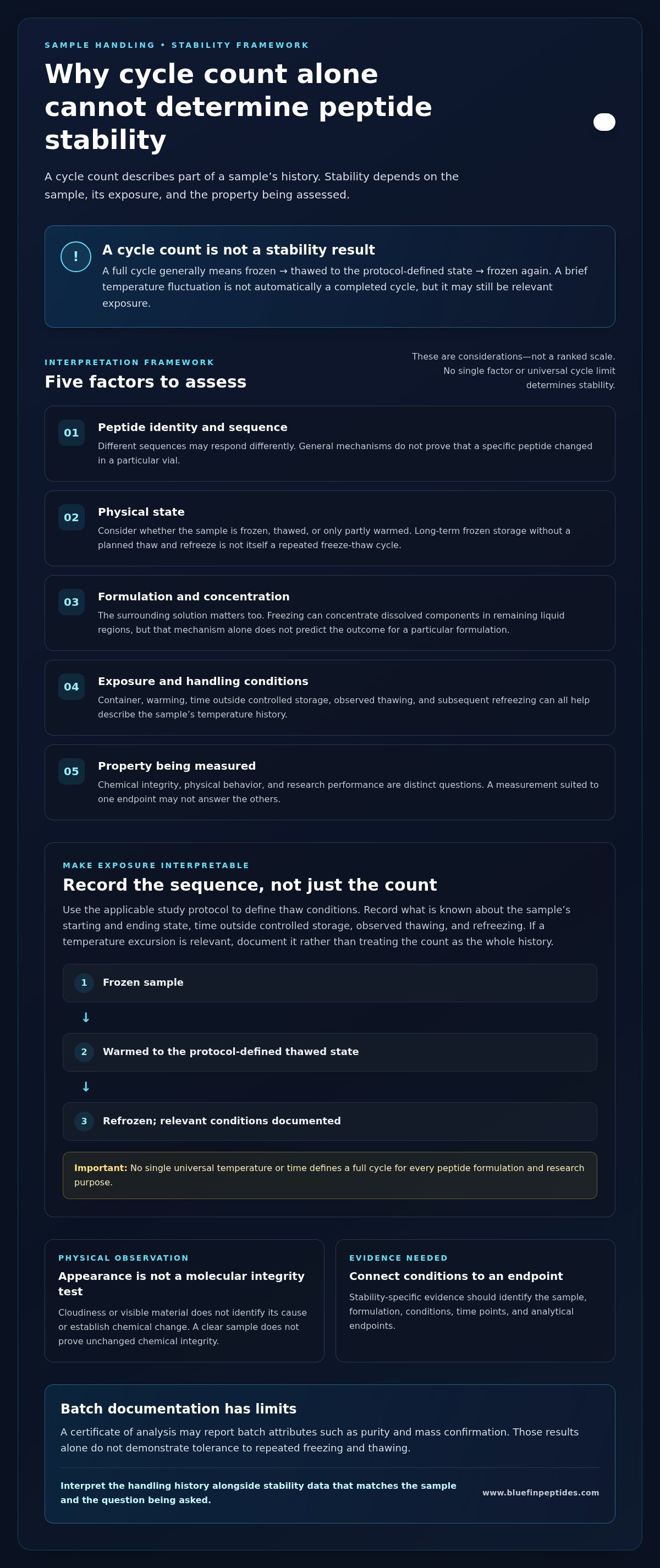
Clear definitions make handling records more useful. In research, a freeze-thaw cycle generally describes a sample moving from frozen storage through thawing and then being frozen again. A short temperature fluctuation during frozen storage is not automatically a completed cycle, but it may still be relevant thermal exposure. The distinction matters: a cycle count summarizes events, while a stability assessment asks whether a defined property changed under specified conditions.
Freeze-thaw exposure: A record of transitions involving frozen and thawed states, including partial warming or other temperature excursions that may affect the sample.
Long-term frozen storage: Continued storage in a frozen state without a planned thaw and refreeze. Duration and temperature still belong in the sample record, but storage alone is not a repeated freeze-thaw cycle.
What counts as a freeze-thaw cycle in a research setting?
For consistent documentation, describe the sequence instead of relying on the label alone: the sample was frozen, warmed until it reached the protocol’s defined thawed state, and later refrozen. A vial removed briefly from storage may warm only in part. Do not silently count that event as a complete thaw, but record it if the sample’s temperature history is relevant.
Record what is known about the exposure, including the starting and ending state, time outside controlled storage, observed thawing, and subsequent refreezing. Use the applicable study protocol to define temperature thresholds and durations. No single universal temperature or time establishes a full cycle for every peptide formulation and research purpose.
What does peptide stability describe?
Peptide stability is the retention of specified chemical and physical properties under defined conditions over time. Chemical integrity may concern whether the molecule retains its expected composition or whether degradation products appear. Physical behavior may include aggregation, precipitation, or altered solubility. These are distinct endpoints, so one measurement cannot automatically answer every stability question.
The relevant endpoint depends on the research question and the method used to assess it. A sample might remain visibly clear while an analytical method detects a molecular change. Visible material, in turn, does not identify its cause or establish the extent of chemical change. Appearance is an observation, not a molecular integrity test.
Physical stress can also affect how molecules associate. The general protein aggregation mechanisms described in biochemistry help explain why changes in physical conditions may matter, but they do not establish how a particular peptide will respond. For freeze-thaw cycles and peptide stability, interpretation depends on connecting recorded exposure to a defined analytical endpoint, not treating a cycle label or visual inspection as a complete result.
How Freeze-Thaw Exposure Can Affect Peptide Samples
Freezing and thawing can change a sample’s physical environment, but the outcome is not identical for every peptide. Sequence, formulation, concentration, container, and the details of warming and refreezing all influence what may occur. A visible change, a measurable chemical alteration, and a change in research performance are different observations. One does not automatically prove the others.
Chemical changes: oxidation, hydrolysis, and other pathways
Oxidation and hydrolysis are possible chemical degradation pathways, not inevitable consequences of every freeze-thaw event. Their likelihood depends on the peptide’s sequence and surrounding conditions, including formulation and exposure to relevant environmental factors. Freezing can also alter a solution’s local conditions: as ice forms, water separates from dissolved components, concentrating solutes in the remaining liquid regions. A review of freeze concentration and peptide stability discusses this physical behavior in frozen protein and peptide solutions. It provides mechanistic context, not a universal prediction for a particular sample.
For example, a formulation’s buffer and other components may respond differently to freezing than the peptide itself. Any proposed link between a specific sequence, a chemical pathway, and a given handling history therefore needs evidence relevant to that peptide and formulation. Do not treat a general mechanism as proof that degradation occurred in an individual vial.
Physical changes: aggregation, precipitation, and interfaces
Physical changes can affect sample behavior without establishing a specific chemical change. During freezing, ice formation creates boundaries between ice and the remaining liquid. Solutes can become concentrated in that liquid, and the altered environment may contribute to association or aggregation in susceptible formulations. The extent of any effect depends on the sample and conditions, so it cannot be inferred from freezing alone.
Aggregation and precipitation are not interchangeable findings. A sample may become cloudy or show visible material, but appearance alone cannot identify the material or determine whether the peptide’s molecular structure has changed. Conversely, a clear sample is not proof that its chemical integrity is unchanged. Use an analytical method suited to the question to distinguish physical behavior from chemical composition.
Cycle count alone cannot establish sample stability. It records one part of the exposure history, not the peptide’s measured condition. Sound interpretation connects that history with formulation details and an appropriate analytical endpoint. Qualified researchers can explore the Bluefin Peptides research catalog while keeping batch documentation distinct from evidence about freeze-thaw tolerance.
Why Peptide Stability Cannot Be Judged by Cycle Count Alone
A cycle count compresses a complex handling history into one number. Two samples recorded as having the same number of freeze-thaw events may differ in peptide identity, physical state, formulation, exposure conditions, and the property measured afterward. Without those details, the count cannot show whether either sample retained the characteristics relevant to its research use.
Which sample and protocol variables change the interpretation?
Compare like with like. A study of a solution cannot automatically establish stability for lyophilized material, and results from one formulation cannot be transferred to another without supporting evidence. Consider concentration, container, and handling history separately, then ask whether the tested conditions match the research question. These details determine how closely published findings apply to the sample under review.
What does a cycle limit actually tell a researcher?
A reported limit describes a tested protocol, peptide, formulation, and analytical endpoint. It is not a universal product specification unless evidence supports that broader claim. Before relying on a published result, check what was tested, how exposure was defined, and what property was measured. The ICH guidelines for stability testing of biological products provide a framework for evaluating stability evidence, but do not make one cycle threshold applicable to every peptide.
Interpretation should follow the evidence. A sample can be described as stable only in relation to a defined endpoint and tested conditions; a cycle count by itself cannot establish that conclusion. Qualified researchers can consult the Bluefin Peptides research catalog for batch attributes, while keeping batch characterization distinct from peptide-specific freeze-thaw data. The practical question is not simply how many cycles occurred, but whether relevant measurements under comparable conditions support the conclusion.
A Practical Framework for Reducing and Recording Freeze-Thaw Exposure
A useful handling plan begins with the research question, not a generic cycle limit. For freeze-thaw cycles and peptide stability, define what the sample must retain, control avoidable temperature transitions, and preserve a record that supports later interpretation. Follow the applicable laboratory protocol and peptide-specific evidence. Do not treat general practice as a validated instruction for every formulation.
- Define the study need. Identify the experimental or analytical endpoint before deciding what exposure matters. A study focused on chemical composition may require different evidence from one examining physical behavior or assay performance. Specify the property being assessed and the conditions the interpretation must cover.
- Plan sample handling. Map when and how the material will be accessed, including its physical state and formulation. Aliquoting may help when repeated access to a shared container would otherwise create additional temperature transitions. Treat it as a planning option, not a universal requirement: suitability depends on sample quantity, container, protocol, and research purpose.
- Track exposure as it occurs. Record the sample identifier, formulation or physical state, dates and times of relevant handling events, and any observed thawing or refreezing. Note departures from the written protocol, including unexpected warming or delays. A precise record is more informative than an unexplained cycle total.
- Assess the relevant evidence. Compare the recorded exposure with data that match the sample and endpoint. State what was measured, under which conditions, and what the evidence cannot establish. If no suitable stability data exist, report the handling history without turning it into a claim that the sample remained stable.
Plan sample handling around the research endpoint
Use the endpoint to guide decisions. If the question concerns a measured physical property, for example, a record limited to chemical composition may not answer it. Minimize unnecessary transitions when that is consistent with the laboratory’s validated procedure, but do not replace the procedure with a blanket rule. Handling choices should remain specific to the peptide, formulation, and study requirements.
Create a traceable freeze-thaw record
Keep factual observations separate from conclusions. Write “visible particles observed” as an appearance note, then document any analytical result in its own field. Include the protocol or study used to support an interpretation, and identify differences between its conditions and the sample’s history. This makes the limits clear to anyone reviewing the record later.
Qualified researchers can use the Bluefin Peptides research catalog to review batch attributes alongside handling records. Batch documentation can help identify reported attributes, while a defensible assessment of freeze-thaw tolerance still depends on relevant stability evidence.
Interpreting Stability Evidence and Research Peptide Documentation
Analytical documentation answers specific questions about a tested batch. It does not automatically show how that sample behaves after repeated freezing and thawing. HPLC results can describe a chromatographic purity profile, while mass spectrometry can provide mass or identity confirmation according to the method used. Neither result alone demonstrates retained stability under a particular handling protocol. Interpret each document in light of its stated methods, sample, and findings.
What HPLC, mass spectrometry, and a batch COA can establish
A batch COA records results for specified attributes and methods. Read the reported values in that context: a purity result is not a freeze-thaw study, and mass confirmation is not proof that no degradation occurred during later storage or handling. Treat a stability claim cautiously if it gives no exposure conditions, time points, or defined analytical endpoint. Without those details, readers cannot determine what was evaluated.
What makes a stability claim interpretable?
A useful stability report identifies the peptide and sample state, describes the formulation and storage conditions, and explains the exposure history. It also names the analytical method, tested time points, and acceptance criteria used to judge the endpoint. Without these details, a reported cycle limit cannot be reliably compared with another study or applied to a different sample.
- Sample: peptide identity, batch or sample identifier, and whether it was lyophilized or in solution.
- Formulation: relevant buffer and sample concentration, where reported.
- Conditions: storage and exposure conditions, including how freezing, thawing, and refreezing were defined.
- Timeline: dates or time points at which measurements were made.
- Endpoint: the property measured, analytical method, and criteria used to interpret the result.
Compare evidence only when these details align closely enough with the question being asked. A report on one formulation and endpoint, for example, cannot establish performance for a different formulation or endpoint without supporting data. If a document reports purity but does not describe freeze-thaw exposure, use it as batch characterization, not as evidence of freeze-thaw tolerance. Clear limits are part of a sound interpretation.
Bluefin Peptides’ research peptides are ≥99% HPLC-verified, mass-spectrometry confirmed, and supplied with batch COAs. These documents support review of reported batch attributes; they should not be read as peptide-specific stability testing. Bluefin Peptides also provides a COA lookup for researchers reviewing batch documentation.
Qualified researchers can explore the research catalog and COA lookup for research-use-only products. Keep batch verification and stability evidence distinct, and base conclusions about freeze-thaw cycles and peptide stability on data that match the sample and conditions under review.
Make Your Next Stability Decision Evidence-Led
Turn handling records into a practical foundation for the next study. Define the property your research needs to preserve, then use evidence that matches the peptide, formulation, and exposure conditions. That approach keeps freeze-thaw cycles and peptide stability in their proper context: a question answered through relevant measurements, not assumptions based on a cycle count.
For qualified researchers, Bluefin Peptides provides Researcher Access, which is free to join. It uses an SSL-encrypted connection, protects data, and does not send spam communications. Access to the research catalog and COA lookup supports review of batch documentation, while stability conclusions should remain tied to stability-specific evidence. Products are exclusively for qualified research use and are not intended for human, veterinary, or consumer use.
Explore the research catalog and COA lookup through Researcher Access. Create access with self-attestation and email verification, then review the documentation relevant to your research workflow.
Frequently Asked Questions
How many freeze-thaw cycles can a peptide tolerate?
There is no universal cycle limit that applies to every peptide. A defensible limit must come from evidence for the relevant peptide, formulation, sample state, and measured endpoint. If a protocol or paper reports a threshold, check how it defined a cycle and whether the test conditions match your own. Without comparable data, record the exposure accurately rather than treating a specific count as a proven safe boundary.
Does freezing permanently damage every peptide?
No. Freezing does not automatically cause permanent damage to every peptide, and the outcome depends on the sample and conditions. A brief excursion, a controlled study exposure, and prolonged or repeated handling are not equivalent situations. If a sample has experienced an unexpected event, document what is known and assess the property relevant to the research. Do not infer damage or retained integrity from the event alone.
Can a peptide remain stable after repeated freeze-thaw cycles?
Yes, a peptide may retain a specified property after repeated cycles, but that conclusion needs measurements under defined conditions. The finding applies to the tested sample and endpoint, not automatically to other sequences or formulations. In research on freeze-thaw cycles and peptide stability, distinguish “no change detected by this method” from proof that every relevant property remained unchanged. The analytical method’s scope matters.
Does an HPLC purity result prove freeze-thaw stability?
No. An HPLC purity result reports what the method found in the analyzed sample at the time of testing; by itself, it does not show how the sample responds to freezing and thawing. A high initial purity result, for example, cannot establish that a later thawed sample has the same profile. Compare results from appropriately handled samples and confirm that the method can detect the change relevant to the study.
Should researchers aliquot peptide samples to limit freeze-thaw exposure?
Aliquoting can be useful when a shared container would otherwise be repeatedly accessed, but it is not automatically the right choice for every experiment. Consider whether portions can be prepared without compromising the protocol, whether the available material supports the planned analysis, and whether each portion can be identified and tracked. Include aliquot preparation in the handling record, since it becomes part of the sample’s history.
What information should a peptide freeze-thaw stability study report?
A useful report identifies the peptide, sample state, formulation, concentration where relevant, container, and exposure protocol. It should also state the tested time points, analytical method, endpoint, and criteria used to interpret change. A result about chromatographic profile, for example, should not be presented as a finding about every physical property. Record departures from the planned protocol so readers can judge how closely the findings apply.
Can visual inspection confirm that a peptide is still stable?
No. Visual inspection can document features such as clarity, color, or visible particles, but it cannot confirm molecular integrity or rule out a change that requires analytical detection. A clear sample may still need testing against the study endpoint; visible material may also have more than one possible explanation. Treat appearance as an observation to record, not as a standalone pass-or-fail stability test.
For laboratory research use only. Not for human or veterinary use. This content is educational and does not constitute medical, dosing, or usage guidance.
Browse the BLUEFIN catalog